
For years, the debate around India's listed companies has run along a simple axis: are rising wages finally catching up with corporate profits, or are companies still keeping the gains for shareholders. The Reserve Bank of India's report on the performance of the private corporate business sector during 2025-26 seems, on first read, to answer in labor's favor. Staff costs rose 10.7 percent for manufacturing companies and 9.0 percent for non-IT services companies in the year ended March 2026. Over the same year, their operating profit margins fell 30 basis points to 13.9 percent for manufacturing and 210 basis points to 20.0 percent for non-IT services. Wages up, margins down: the obvious story is that payrolls finally ate into profit.
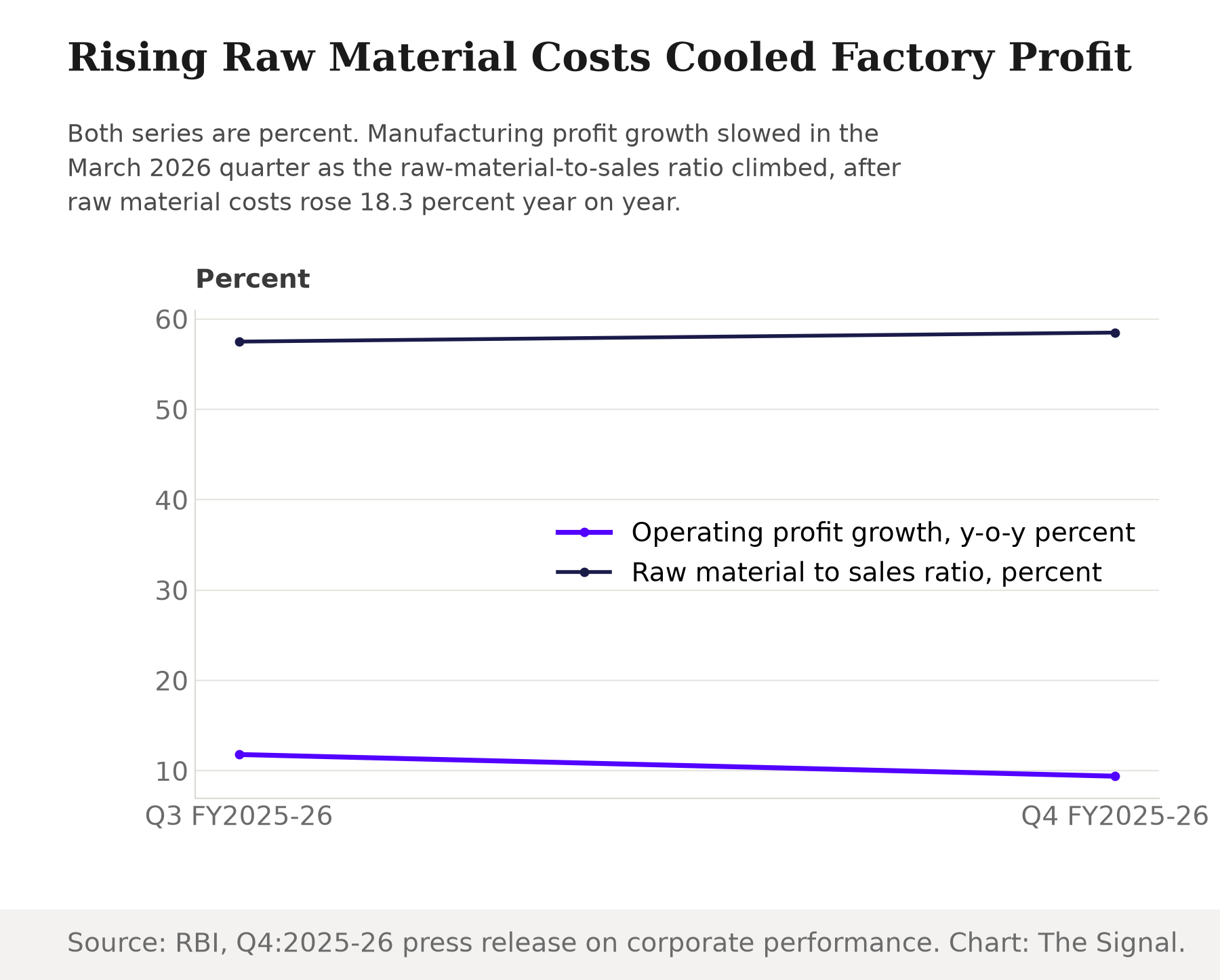
It is worth slowing down on that. RBI's separate press release on the March 2026 quarter names the culprit for manufacturing directly, and it is not the workforce: raw material costs rose 18.3 percent year on year in Q4:2025-26, pushing the raw-material-to-sales ratio up to 58.5 percent from 57.5 percent the previous quarter, and manufacturing's operating profit growth moderated to 9.4 percent from 11.8 percent in Q3:2025-26 as a direct result. The RBI's own language ties the slowdown to input costs, not to the wage bill.
The full-year scorecard
Two of India's three big corporate segments lost margin in FY2025-26 even as all three raised wages; only IT gained.
| Sector | Staff cost growth, FY2025-26 | Margin change, FY2025-26 | Staff cost growth, FY2024-25 | Margin change, FY2024-25 |
|---|---|---|---|---|
| Manufacturing | 10.7% | -30 bps (to 13.9%) | 10.0% | -20 bps (to 14.2%) |
| Non-IT services | 9.0% | -210 bps (to 20.0%) | 12.0% | -30 bps (to 22.1%) |
| IT | 6.1% | +50 bps (to 22.4%) | 4.4% | -80 bps (to 21.9%) |
Source: RBI, Performance of the Private Corporate Business Sector, 2025-26; RBI, Performance of the Private Corporate Business Sector, 2024-25.
The table shows something the simple labor-versus-capital framing misses: wage growth does not track margin loss, even within the group of sectors that lost margin.
The wage bill doesn't line up with the margin loss
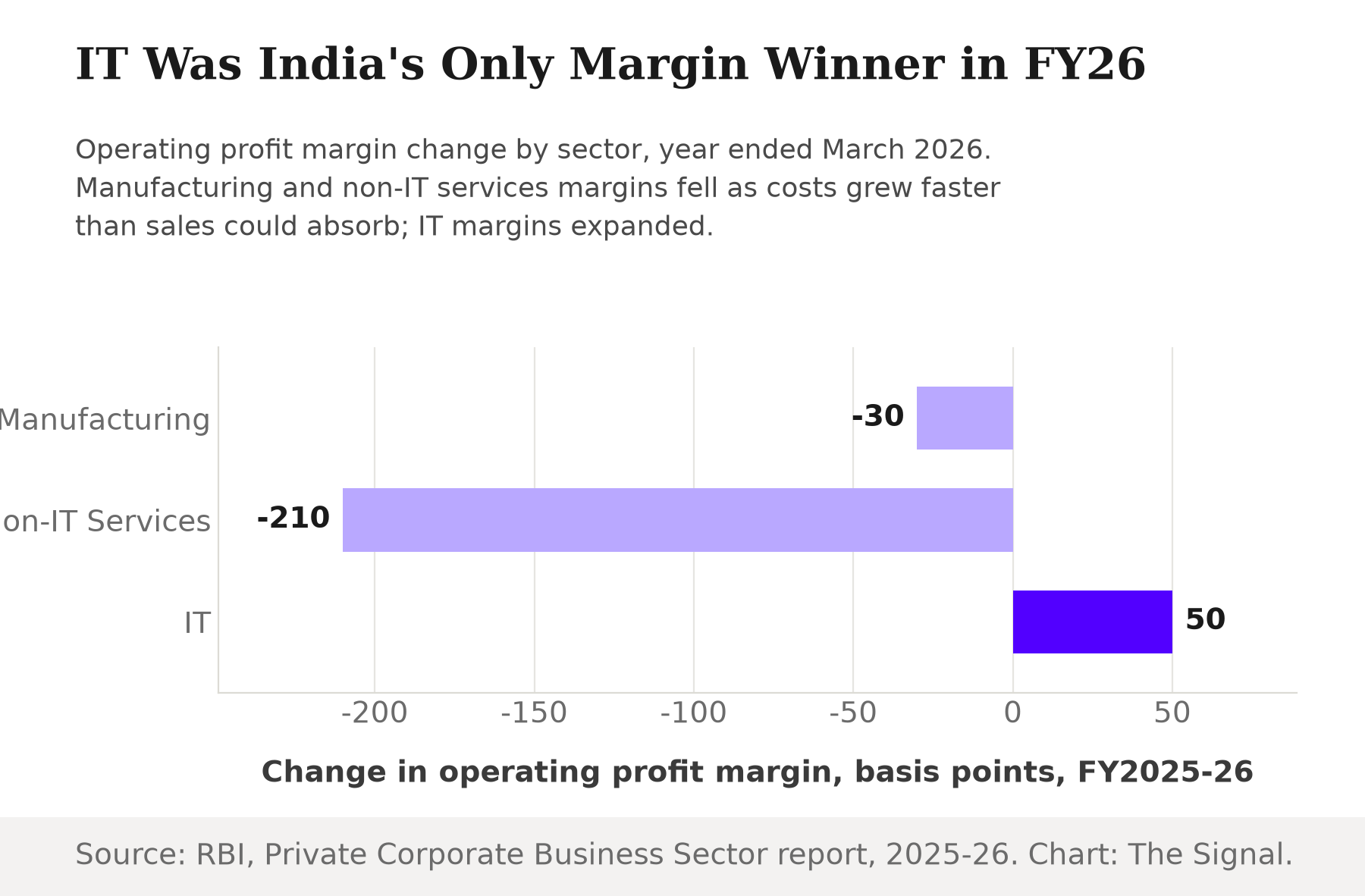
Manufacturing's own staff costs grew faster than non-IT services' in FY2025-26, 10.7 percent against 9.0 percent. Yet manufacturing's margin loss was a fraction of non-IT services', 30 basis points against 210, seven times smaller. If wage growth alone explained margin loss, the sector with the higher wage bill should have lost more margin, not less. It did not. Something else is doing the work, and for manufacturing, RBI has already named it: raw material costs, not payrolls.
IT's real lever was cost discipline, not just low costs
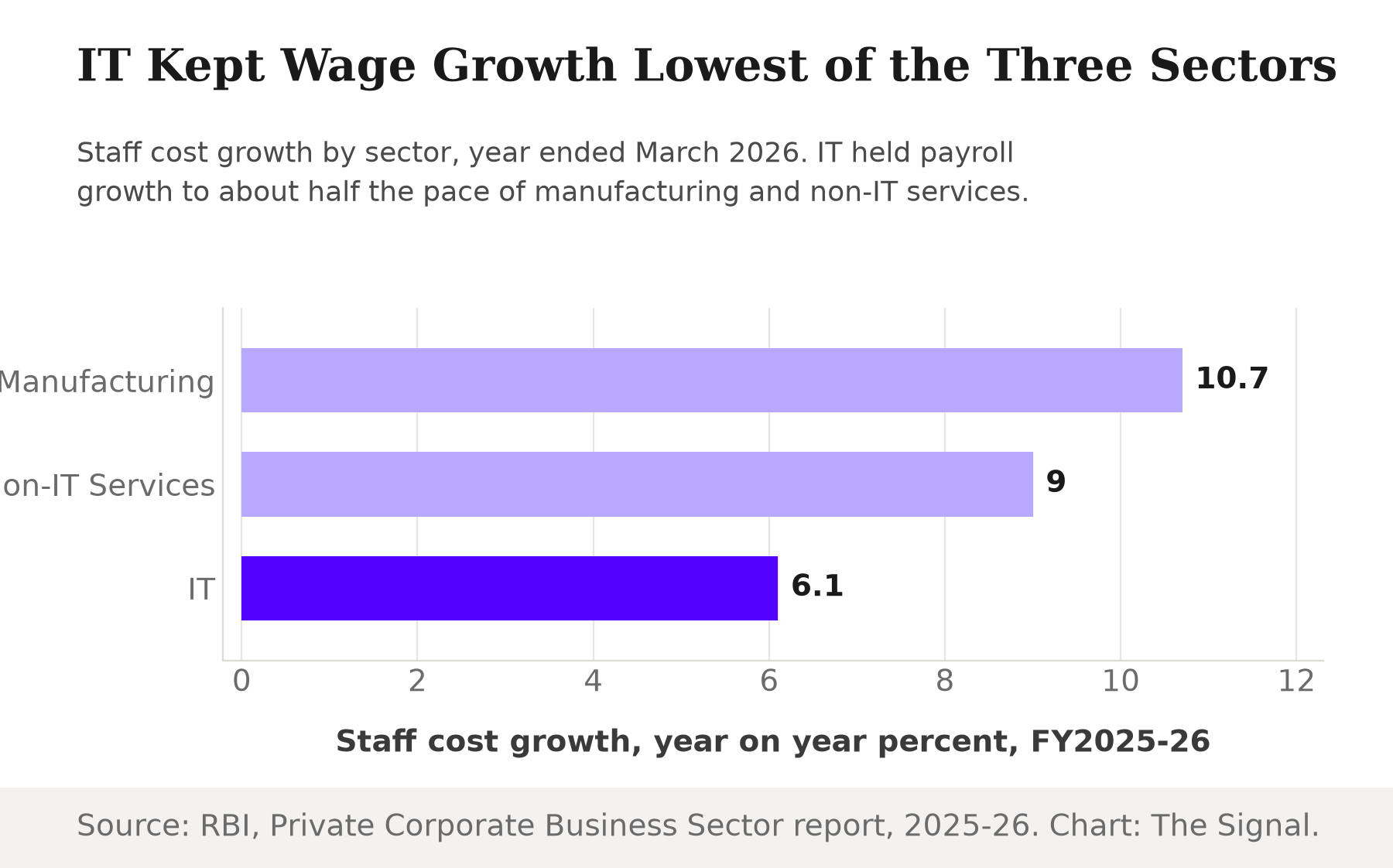
IT is the exception that makes the pattern legible. Its staff costs grew just 6.1 percent in FY2025-26, the slowest of the three segments, and it was the only one of the three to grow its operating margin, up 50 basis points to 22.4 percent. That is not simply a story about IT having cheaper labor to begin with. A year earlier, in FY2024-25, IT's own staff costs grew even more slowly, just 4.4 percent, and its margin still fell 80 basis points, the steepest decline of the three sectors in FY2024-25. Low wage growth on its own did not save IT's margin in FY2024-25. Something changed between the two years for the same kind of wage restraint to start paying off.
Part of the backdrop is how much slower revenue growth has become across the board. Aggregate sales growth for India's listed private corporate sector peaked at 32.5 percent in FY2021-22, during the post-pandemic snapback, before normalising to 7.2 percent by FY2024-25. When sales are growing at double-digit rates, a company can absorb a rising wage bill without touching its margin. When sales growth has settled near single digits, as it has for two years running, the same wage increase has nowhere to hide. It shows up directly in the margin line, in whichever sector cannot also point to a cost shock elsewhere.
The honest objection
The clean story that IT bought its margin with wage discipline runs into a complication in RBI's own more recent data. An early flash read of Q4:2025-26 results, based on 955 listed non-financial companies, found manufacturing's operating profit growth holding broadly stable despite the input-cost spike, while operating profit margins for both IT and non-IT companies softened sequentially during the quarter. If IT's own margin was softening quarter over quarter even as its full-year number improved, the wage-discipline win may already be fading rather than holding.
That tension is real, but it reflects a difference in vintage, not a contradiction. The flash read comes from a narrower, provisional sample and describes only the change within a single quarter. The fuller FY2025-26 report, released afterward, is what shows manufacturing's own profit growth actually decelerating once the complete data came in, from 11.8 percent in Q3:2025-26 to 9.4 percent in Q4:2025-26, a bigger swing than the flash estimate implied. If anything, the final numbers were harder on manufacturing's margin story than the early read suggested, not softer. IT's full-year gain is the number that is now locked in for FY2025-26; whether it holds into FY2026-27 is exactly what the next quarterly report will show.
The Signal
Two different cost lines are doing two different jobs in India's FY2025-26 corporate results, and folding them into a single wages-versus-profits story hides both. Manufacturing's margin is a commodities story: raw material costs, not payrolls, are the line item RBI itself points to for the March 2026 quarter. IT's margin is a discipline story: the one segment that kept its wage bill growing in the low single digits was the only one of the three to grow its margin in FY2025-26. That same restraint had not been enough to save its own margin a year earlier, when faster sales growth was still cushioning everyone else. The number worth watching when RBI's next quarterly report lands is not the aggregate wage bill. It is whether IT can repeat FY2025-26's restraint now that margins across India's corporate sector are being squeezed from more directions than raw materials alone.
Reporting basis: the full-year FY2025-26 staff cost and margin figures are from the Reserve Bank of India's report on the performance of the private corporate business sector, 2025-26, and the FY2024-25 comparison figures are from RBI's equivalent report for 2024-25. The Q4:2025-26 raw material cost and manufacturing profit growth figures are from RBI's separate press release on that quarter. The aggregate sales growth trend from FY2021-22 to FY2024-25 is from an RBI Bulletin research article, "Resilience and Revival: India's Private Corporate Sector". The early flash Q4:2025-26 estimate, based on 955 listed companies, is from the RBI Bulletin's May 2026 "State of the Economy" article. The seven-times comparison of manufacturing's and non-IT services' margin losses is The Signal's calculation from those RBI figures.