India's clean-power story has a clean number behind it. In June 2025, the country's installed electricity capacity from non-fossil sources crossed 50%, more than five years ahead of the target India set for itself under the Paris Agreement. A year on, the Central Electricity Authority's June 2026 report shows non-fossil sources at 54.18% of installed capacity, against coal's 40.84%. Read those two numbers and the direction looks settled: India's grid is turning away from coal, on schedule and ahead of plan.
It is worth slowing down on that reading. Installed capacity is what exists today. It says nothing about what the country is building for tomorrow, and on that count the picture runs the other way. India's proposed coal mine capacity nearly doubled in a single year, from 329 Mtpa in 2024 to 638 Mtpa in 2025, the sharpest rise of any country and the main driver of the world's coal mine pipeline growth, according to Global Energy Monitor's Global Coal Mine Tracker. The global pipeline of proposed coal capacity grew 11% in 2025, to 2,521 Mtpa, and India's jump was the single largest driver of that growth, even though China's own pipeline, at 1,321 Mtpa, is still more than double India's. Capacity tells you what the grid looks like today. What the mine pipeline shows is different: what the people financing coal for the next few decades think the grid will still need.
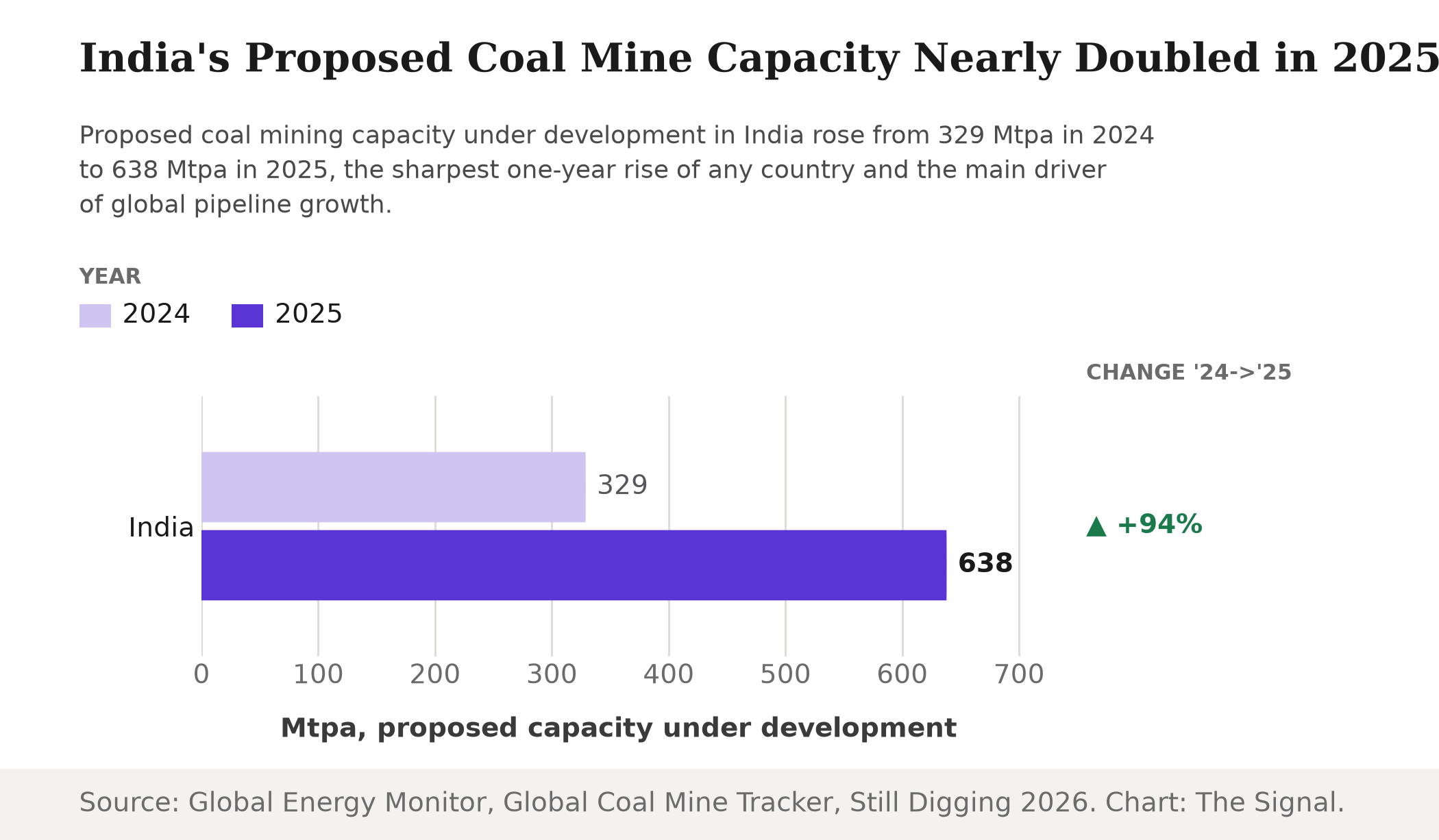
Source: Global Energy Monitor, Still Digging 2026. Chart: The Signal.
Where the new mines are going up
The jump is not spread evenly across the country. Global Energy Monitor's "Still Digging 2026" report attributes the spike to Jharkhand and Odisha, India's leading coal-producing states, where proposed mine projects have doubled. That is not a diversification story. It is the existing coal belt doubling down on itself: the states that already anchor India's coal economy are the ones adding the most new proposed capacity, which is what a planner does when betting on continuity, not a hedge against it.
A pipeline is a forecast, not a guarantee
The honest caveat here is that a "proposed" mine is not a producing one, and the gap between proposal and delivery can be wide. Globally, new coal mine capacity actually commissioned fell nearly 40% in 2025 to 113 Mtpa, a new decade low, driven by declines in China and Australia, even as the pipeline of proposed mines kept expanding, Reuters reported via Business Standard. Worldwide, in other words, proposals and completions are moving in opposite directions in the same year.
That gap is real, but it does not make India's number noise. Proposals are the stage where capital is actually put at risk: permits, land, financing commitments, environmental clearances. Fewer mines are clearing that bar globally, which makes it more notable, not less, that India's own proposal count kept adding to the pipeline against the global current. A pipeline that keeps adding proposals while the world's completion rate shrinks is a statement about where one country's capital is still willing to go, even as it goes rarer everywhere else.
Coal still anchors the grid it is supposedly leaving
| Source | Installed capacity (MW) | Share of total |
|---|---|---|
| Coal | 224,158 | 40.84% |
| Solar | 162,152 | 29.54% |
| Wind | 57,443 | 10.47% |
| Large hydro | 52,065 | 9.49% |
| Gas | 20,122 | 3.67% |
| Nuclear | 8,780 | 1.60% |
| Lignite | 6,620 | 1.21% |
| Biomass, waste, small hydro and diesel | 17,518 | 3.19% |
Source: Central Electricity Authority, installed capacity report, June 2026. "Biomass, waste, small hydro and diesel" combines CEA's four smallest categories; the grouping is The Signal's aggregation.
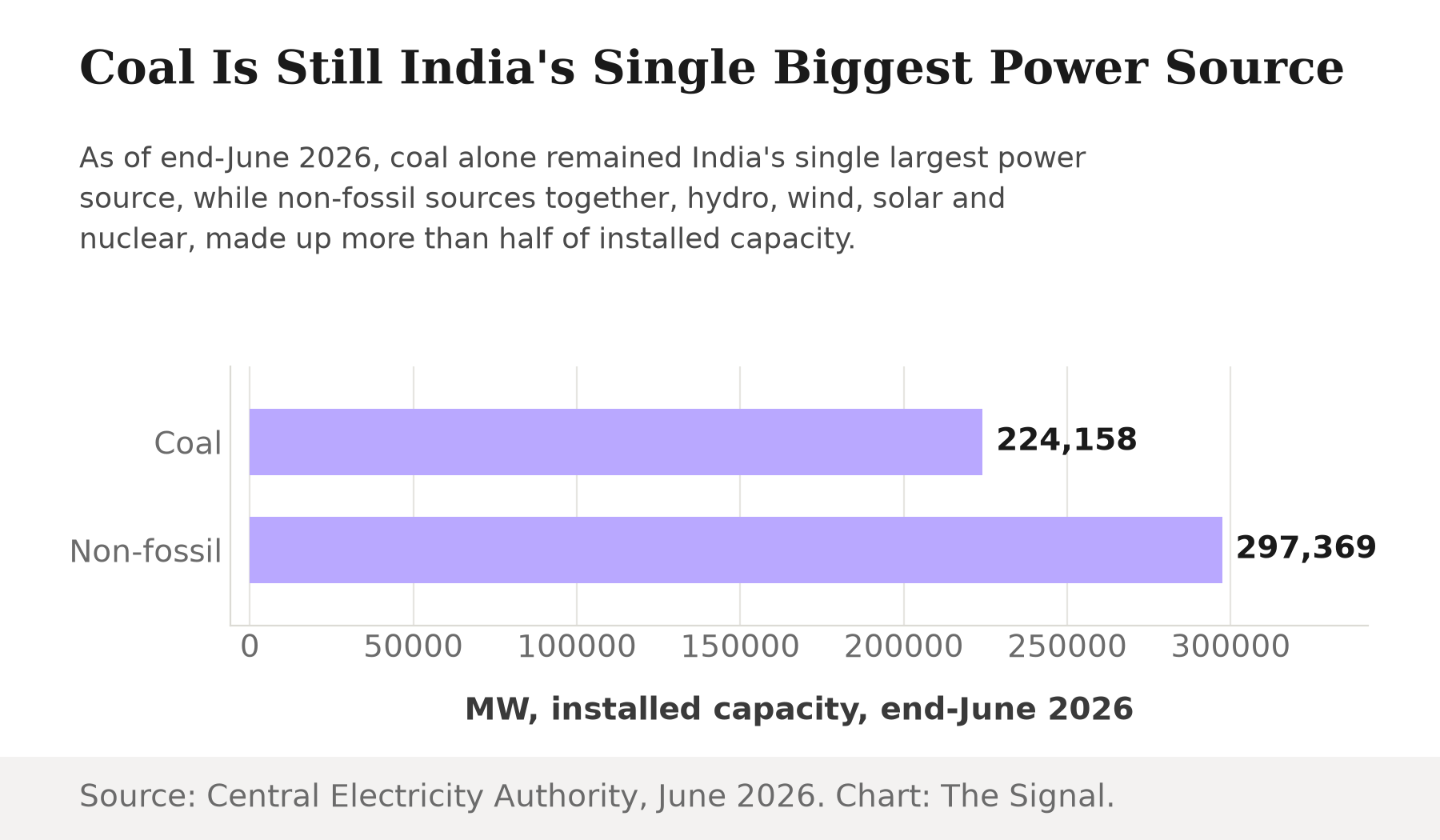
The capacity mix is genuinely ahead of where India promised to be. But the same Central Electricity Authority report that shows non-fossil sources in the majority also shows coal alone still ahead of every other single source, solar included, by a wide margin. A grid operator planning for the 2030s does not retire a plant type that still carries the largest single share of the load on the strength of a capacity-mix headline. It looks at the mines being permitted today, because those are the ones that will be feeding coal plants a decade from now.
Production is rising to meet the mines
The mine pipeline is not an isolated data point against an otherwise flat production picture. India's raw coal production hit a record 1,047.523 million tonnes in FY2024-25, up 4.98% year-on-year, the Ministry of Coal's Year End Review 2025 reports. That record was not treated as a ceiling. The Ministry of Coal's Annual Report 2025-26 sets an annual production target of 1,150.63 million tonnes for FY2025-26, a further step up from the FY2024-25 actual.
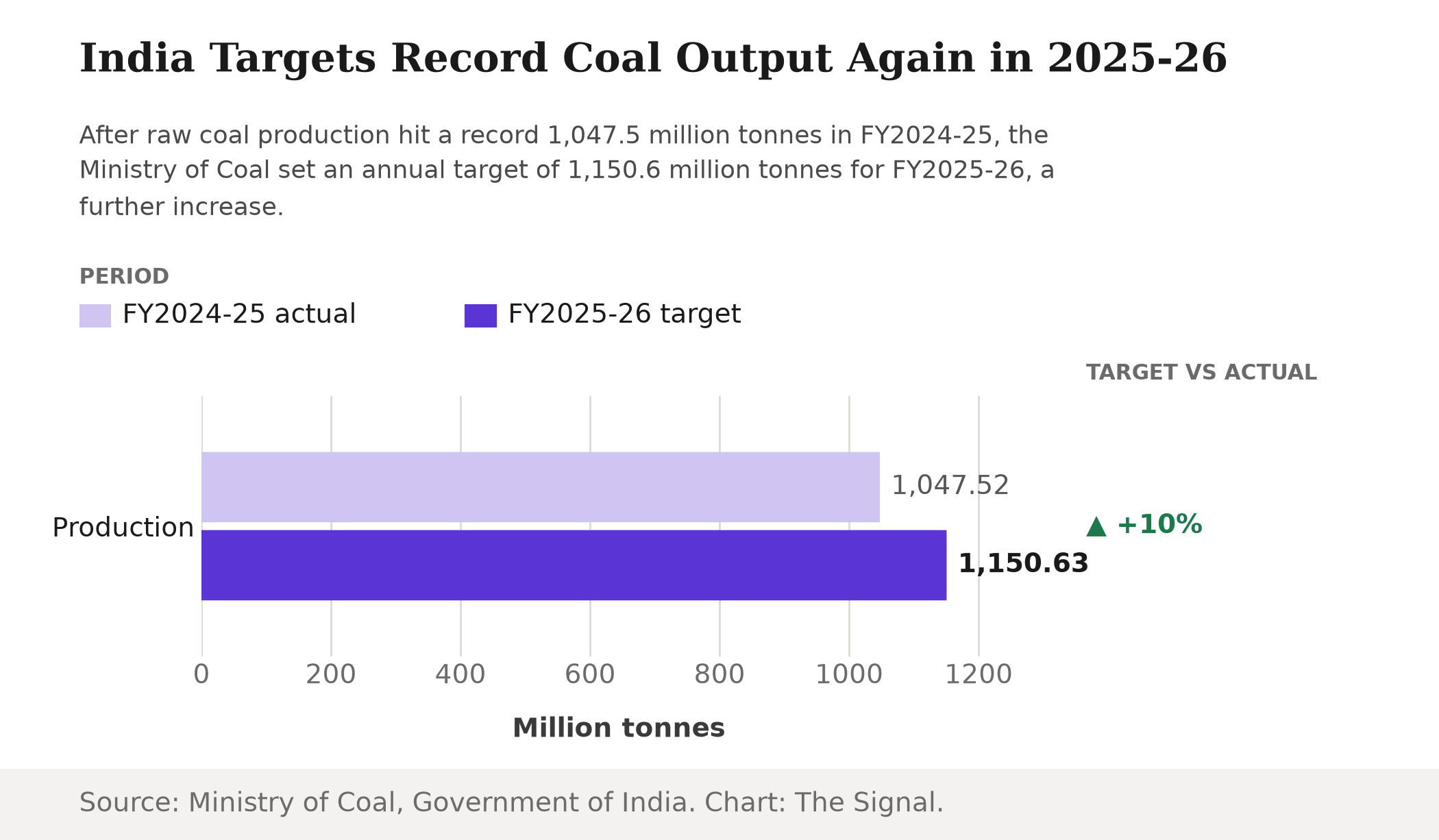
Source: Ministry of Coal, Year End Review 2025; Ministry of Coal, Annual Report 2025-26. Chart: The Signal.
Mines take years to permit and build, so a mine proposed in 2025 is a bet on demand in the early 2030s, not next quarter. The ministry's decision to keep raising its own production target in the same period reads as confirmation, not a hedge: the demand side agreeing with what the supply side is proposing.
The midstream is getting the same signal
The commitment is not confined to digging more coal out of the ground. In May 2026, the Union Cabinet approved a scheme worth Rs 37,500 crore to promote surface coal and lignite gasification, targeting the gasification of about 75 million tonnes of coal and lignite as part of a national goal to gasify 100 million tonnes of coal by 2030, a Press Information Bureau release on the Cabinet's decision states. Gasification is not a transition technology away from coal. It is a bet that coal, converted into syngas and downstream chemicals, has an industrial role that outlasts its role in the power plant. A government spending real money engineering new uses for coal in 2026 is not a government planning to wind the resource down.
The honest objection
The strongest case against reading too much into the mine pipeline is that India's installed-capacity numbers are the ones that are actually true today, not projections. Non-fossil capacity did cross 50% of installed capacity in June 2025, more than five years ahead of India's own Paris Agreement target, and it has kept climbing since. On this view, the coal mine pipeline is a hedge, not a reversal: India is adding generation of every kind to meet demand that is outpacing any single source, and proposing more coal capacity alongside strong non-fossil additions is simply prudent risk management by a country that cannot afford a shortfall.
That case is real, and the non-fossil progress is not in dispute. But it does not explain why the coal mine pipeline is accelerating rather than flattening as the non-fossil share climbs, or why the production target and the gasification investment are moving in the same direction as the mine proposals rather than against them. A genuine hedge would show the coal-side numbers holding steady while the non-fossil side pulls ahead. Instead, both sides are rising together, which looks less like insurance and more like a plan for coal to keep growing in absolute terms even as it shrinks as a share of a larger pie.
The Signal
Two numbers describe the same country in the same year, and they are both true: non-fossil capacity crossed half the grid, and proposed coal mine capacity nearly doubled to 638 Mtpa. The capacity-mix number is what India has already built. The mine pipeline is what the people who allocate capital for a decade at a time think it will still need. Watch the completion rate on this proposal wave, not the next capacity-mix milestone. If a meaningful share of those proposed mines clears permitting and financing into producing ones, the honest read of India's energy transition is not a switch from coal to clean power. It is both expanding at once, and coal is not the one being phased out.
Reporting basis: the proposed coal mine capacity figures for India, and the concentration in Jharkhand and Odisha, are from Global Energy Monitor's Global Coal Mine Tracker, via its "Still Digging 2026" report. The global pipeline's 11% growth to 2,521 Mtpa is from the same Global Energy Monitor report; the China comparison figure is from that report as carried by Down To Earth. The global decline in newly commissioned coal mine capacity is per Reuters, as carried by Business Standard. India's installed capacity by source is from the Central Electricity Authority's monthly report for June 2026; the 50% non-fossil milestone reached in June 2025 is from a Ministry of Power release via the Press Information Bureau. Coal production figures for FY2024-25 and the FY2025-26 target are from the Ministry of Coal's Year End Review 2025 and Annual Report 2025-26, respectively. The coal and lignite gasification scheme is per a Press Information Bureau release on the Union Cabinet's decision. The "biomass, waste, small hydro and diesel" grouping in the capacity table is The Signal's own aggregation of the Central Electricity Authority's smallest reported categories.