N Chandrasekaran told the Tata Sons board on August 12, 2026 that he will not seek reappointment when his current term ends, and asked it to begin a search for his successor. His tenure runs until February 20, 2027, and the board had already tried to extend it: Sir Dorabji Tata Trust and Sir Ratan Tata Trust had unanimously recommended a five-year extension, and the resolution was tabled at the Tata Sons board on February 24, 2026, only to fail when one board member declined to support it. Days before shareholders were due to vote on his reappointment as a director at the group's August 18, 2026 annual general meeting, he chose to step aside instead. Read as a simple story, this is a personality clash: an outgoing chairman and Noel Tata, who chairs the trusts that effectively run the company, failing to agree on terms.
It is worth slowing down on that framing. Reuters reported that Noel Tata had sought several conditions for backing Chandrasekaran's reappointment, including a commitment that Tata Sons would never be listed on a stock exchange, alongside disputes over board representation and the exit terms for minority shareholder Shapoorji Pallonji. Whatever the specific sticking point, look at the mechanism that decided it: nobody who owns shares in a listed Tata company got a vote. Tata Trusts, the group's philanthropic arm, hold 66% of the equity share capital of Tata Sons, the private holding company that actually appoints the group's chairman.
Two thirds of the company that picks the chairman is a set of trusts.
Tata Sons is not listed. Nobody buys or sells its shares on an exchange, and no shareholder register anywhere records a claim on the company's leadership, however big a stake they hold in the operating companies underneath it.
Who actually owns Tata Sons
Tata Trusts hold 66% of Tata Sons, and Shapoorji Pallonji Group, the construction conglomerate that has been a Tata Sons investor for generations, holds 18.4%, a stake estimated at around ₹3 lakh crore. Subtract both from the whole and about 15.6% of Tata Sons is left with other holders, mostly Tata family and employee trusts (our calculation, from the two disclosed stakes). Whoever they are, none of them are the shareholders of TCS, Tata Motors or Titan.
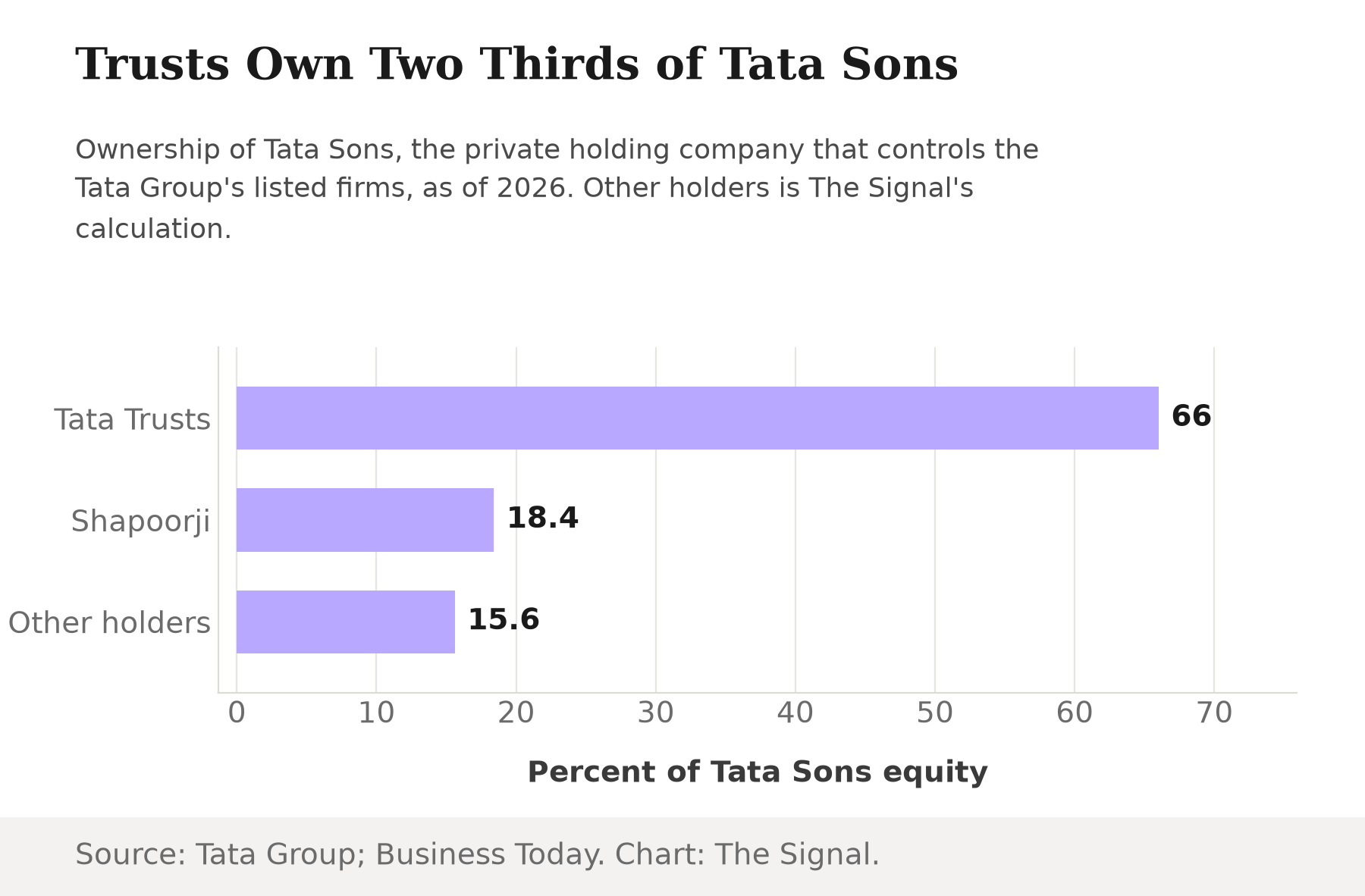
Source: Tata Group's corporate site; Business Today. Other holders' 15.6% is The Signal's calculation. Chart: The Signal.
The value with no vote
The companies that answer to this arrangement are not small. Tata Sons owns 2,59,54,99,419 shares of Tata Consultancy Services, a 71.74% stake, in the group's most valuable listed company. TCS alone commanded a market capitalisation of ₹7,67,613.45 crore in July 2026; pair that with Tata Sons' 71.74% stake and the single holding is worth roughly ₹5.51 lakh crore (our calculation, from the two disclosed figures), before counting anything else the group owns. Zoom out further: the Tata Group's 26 publicly listed companies carried an aggregate market capitalisation of more than $328 billion as of March 31, 2025, a figure that predates the current succession fight by more than a year but still frames the scale of what the trustees oversee. Not one shareholder in those 26 companies, however large their holding, gets a vote on who chairs Tata Sons.
The arrangement is unusual enough that regulators treat Tata Sons differently from an ordinary private holding company. The Reserve Bank of India classified Tata Sons as an Upper Layer Non-Banking Financial Company for 2026-27, a category reserved for the largest and most systemically important non-bank lenders, without prejudice to Tata Sons' pending application to de-register from that category. Tata Sons is private in ownership and governance, yet big enough that its own financial regulator will not simply take its word that it should be treated like any other holding company.
The same mechanism, twice
The same removal mechanism has now played out twice in a decade.
| Date | Event |
|---|---|
| October 2016 | Cyrus Mistry removed as Tata Sons chairman |
| March 26, 2021 | Supreme Court sets aside the NCLAT order reinstating Mistry, rules the board acted within its rights |
| October 9, 2024 | Ratan Tata dies |
| October 11, 2024 | Noel Tata unanimously appointed chairman of Tata Trusts |
| February 24, 2026 | Board resolution to extend Chandrasekaran's term five years fails to pass |
| August 12, 2026 | Chandrasekaran tells the board he will not seek reappointment |
Source: Bar and Bench; News on Air; Business Today.
Cyrus Mistry was removed as chairman of Tata Sons in October 2016, reinstated by the National Company Law Appellate Tribunal, and then had that reinstatement overturned when the Supreme Court ruled in March 2021 that the Tata Sons board had acted within its rights. That ruling is the load-bearing precedent behind everything since: the country's highest court held that the board, which the trusts control through their 66% stake, can remove a chairman and have the decision stand. Chandrasekaran was not voted out in 2026, but the same asymmetry shaped the outcome. One board member's objection was enough to sink a resolution that two of the largest Tata Trusts had already unanimously recommended, and rather than contest that arithmetic through a shareholder vote he has no access to, he chose to step down.
Noel Tata's two years
Noel Tata was unanimously appointed chairman of Tata Trusts on October 11, 2024, two days after Ratan Tata's death on October 9, 2024. He has now held that role for under two years, and with it the largest single say over Tata Sons. The current succession is the first time his authority over the chairmanship has been tested in public. The company he now effectively controls is also managing an unrelated exit: Shapoorji Pallonji Group is planning to monetise around 7 percentage points of its 18.4% Tata Sons stake through a share-swap arrangement, receiving shares in 16 listed Tata Group companies instead. That swap does not touch the mechanism that picks the chairman. Even after the deal, whatever Tata Sons shares Shapoorji Pallonji keeps will carry no more say over succession than they do today. Tata Sons shares pay dividends and appreciate in value, but they do not carry a vote on the chairmanship that a public market could exercise.
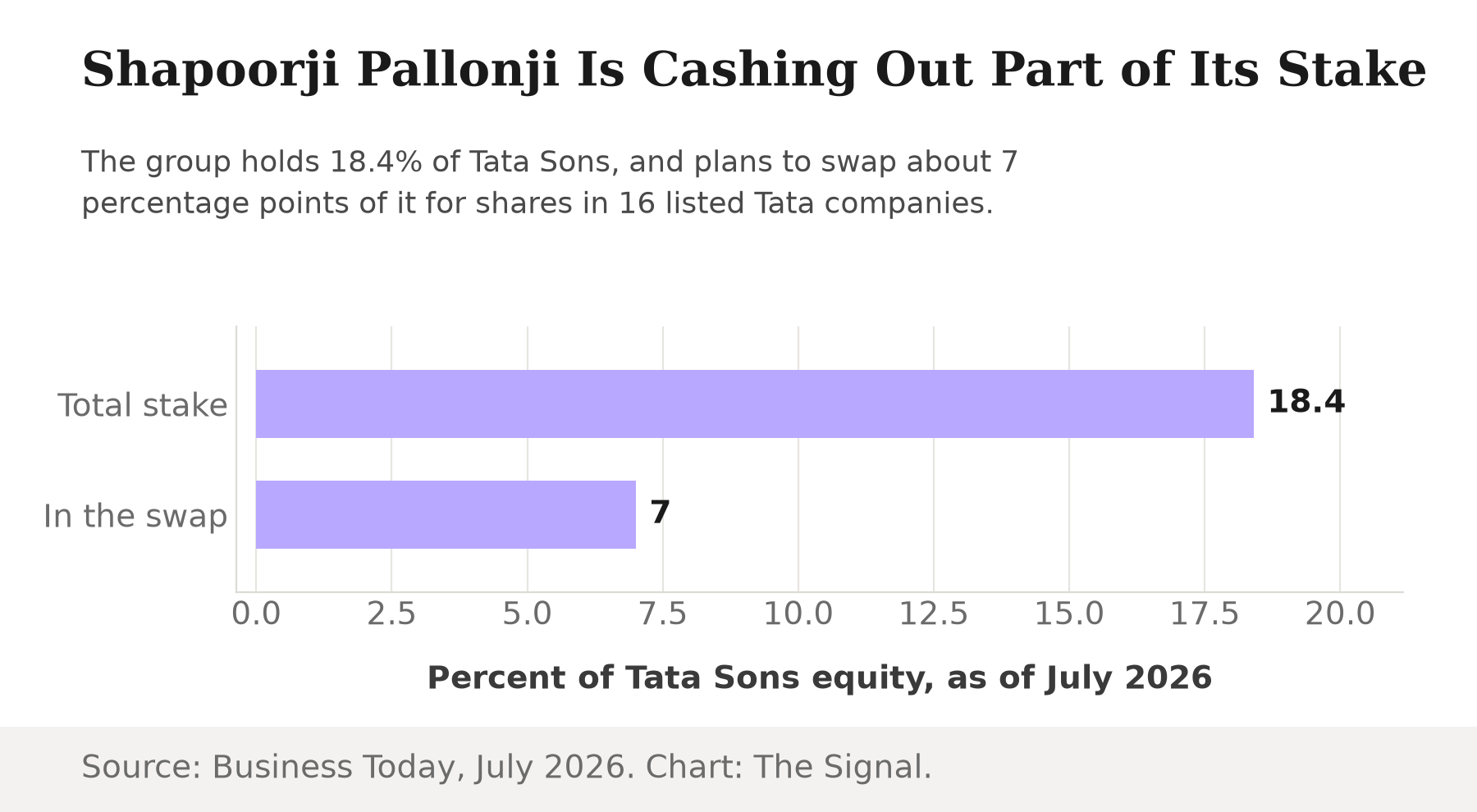
Source: Business Today. Chart: The Signal.
The honest objection
The strongest case for trustee control is that it is precisely what has kept the Tata Group intact for more than a century: insulated from a hostile bid, an activist raid, or the short-term pressure an earnings-driven market puts on ordinary listed conglomerates, with profits recycled into the trusts' education, health and livelihood work rather than extracted by a controlling family. Tata's own account of the arrangement frames it that way, describing the trusts' 66% stake as underwriting philanthropic programs rather than private wealth. That output has been shrinking, not growing: Tata Trusts' combined grant disbursals fell to about $106 million in the 2024-25 fiscal year, down 39% from more than $173 million in FY20, even as the operating companies underneath grew. On that view, Chandrasekaran's exit is not evidence of a broken system. It is the system working as designed, replacing a leader over an internal disagreement without the disruption a public proxy fight would force onto the group's listed companies.
That case is real, and the Tata Group's record under trust governance is hard to dismiss. But it strains against a group of the size and public importance the operating companies have reached today. The RBI itself now polices Tata Sons as an Upper Layer NBFC precisely because its scale makes it systemically significant, even though ownership sits with two private groups. An arrangement built to protect a family firm from outside pressure looks different once the firm underneath it carries more than $328 billion in public shareholders' money, run day to day by a chairman those shareholders do not elect and cannot remove.
The Signal
Tata Sons will name a new chairman before Chandrasekaran's term ends on February 20, 2027, and the trustees, not the market, will make that choice, the same as they did in 2016 and again in 2026. The question worth watching is not who gets picked. It is whether the next chairman inherits the same unstated condition Reuters reported this one lost over: that Tata Sons itself never lists. If that stays the price of the job, every professional executive who runs the group's public companies profitably will keep answering, on the one decision that matters most, to trustees who never had to win a single vote from the shareholders paying for the results.
Reporting basis: the ownership structure of Tata Sons, 66% held by Tata Trusts, comes from Tata Group's own corporate site, as does the $328 billion aggregate market capitalisation of the group's 26 listed companies, from Tata's investor relations page. Tata Sons' 71.74% stake in TCS and the Shapoorji Pallonji Group's 18.4% stake and planned share-swap are per Business Today's reporting. TCS's own July 2026 market capitalisation is also per Business Today; the ₹5.51 lakh crore value of Tata Sons' TCS stake is The Signal's calculation from the two disclosed figures. The Reserve Bank of India's Upper Layer NBFC classification is from the RBI's own press release. Chandrasekaran's tenure timeline, the failed February 2026 board resolution and his August 2026 statement are per Business Today's report of his statement to the board. The reported listing condition and the board and Shapoorji Pallonji disputes are per Reuters, as carried by Autocar India. The Cyrus Mistry removal and the Supreme Court's March 2021 ruling are per Bar and Bench. Noel Tata's October 2024 appointment as Tata Trusts chairman is per Prasar Bharati's News on Air. Tata Trusts' declining grant disbursals are per Forbes India's analysis of Tata Trusts' annual reports. The 15.6% residual stake in Tata Sons is The Signal's calculation from the two disclosed stakes.