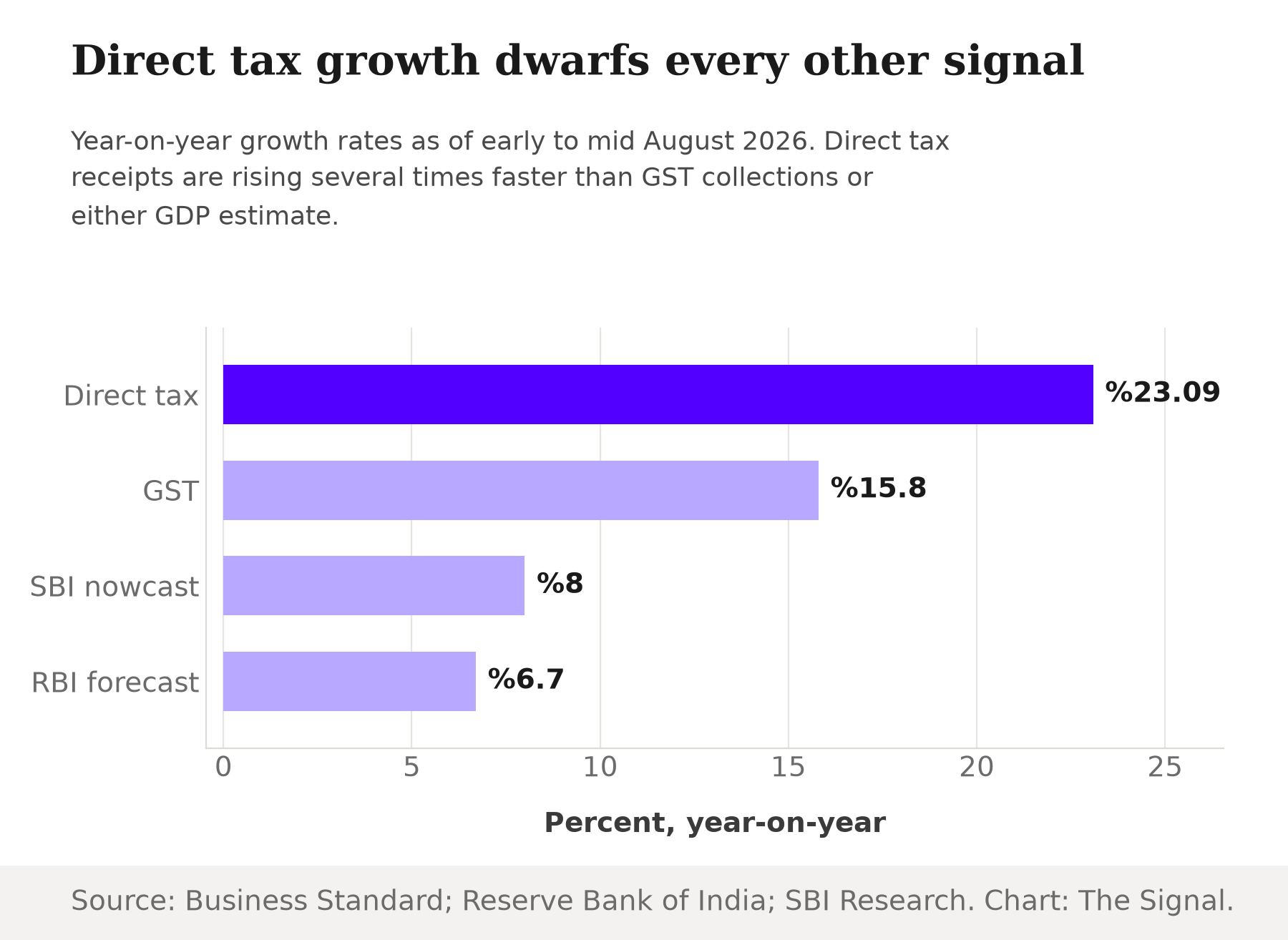
India's income tax department posted its latest running total on August 10: net direct tax collections for the financial year had reached ₹8.11 lakh crore, up 23.09 percent from the same point a year earlier. Four and a half months into FY27, that is the kind of print a finance ministry frames as unambiguous good news: more revenue arriving faster than planned, without touching a single rate.
It is worth slowing down on that framing. The RBI's Monetary Policy Committee, meeting five days earlier on August 5, projected real GDP growth of just 6.7 percent for the full FY27 year, with the April to June quarter itself coming in at 7.0 percent. Even the government's own Budget assumed nominal GDP, before adjusting for inflation, would grow only 10.0 percent over the prior year's estimate. Tax collections are not tracking either number. They are running at more than double the Budget's own growth assumption, and more than three times the RBI's real-growth estimate.
For every point of nominal growth the Budget assumed, direct tax collections are running at 2.3 points instead.
Here is the arithmetic behind it. The Union Budget's own Medium-term Fiscal Policy Statement states that nominal GDP for FY27 was projected to grow 10.0 percent over the First Advance Estimates of FY26, the base every other budget number is built on. Divide the 23.09 percent tax number by that 10.0 percent assumption and the buoyancy works out to 2.3, well above the roughly 1-to-1 relationship a stable, broad-based expansion would produce. A buoyancy that high is what shows up when collections are front-loaded, not when the whole economy is quietly running hot.
A ratio of 2.3 is unusual, but it is not unheard of. Direct tax buoyancy hit 2.52 in FY22, the highest in the preceding 15 years, per CBDT's own time-series data. But that spike fell straight back to 1.1 the very next year, and across the prior 23 years buoyancy had cleared 2 in only six of them. A buoyancy this high has a track record of being a one-year event, not a new normal.
Where the growth is actually coming from
Non-corporate tax collections, which are mostly personal income tax, are growing faster than the corporate side: net non-corporate collections rose 23.43 percent to ₹5.07 lakh crore, against a slower 19.83 percent rise in net corporate tax to ₹2.70 lakh crore. One plausible mechanical reason sits inside that split: personal tax collections lean heavily on tax deducted at source, withheld automatically from salaries, dividends and market-linked payouts the moment they are paid, regardless of whether output in the wider economy is accelerating. A pickup in withheld tax on capital gains, or a widening compliance and formalization net, can lift the collection number well before broader activity data catches up, if it ever does.
That mechanism shows up directly in one line item. Securities Transaction Tax collections, levied on trades in the capital markets, grew 51 percent year-on-year to ₹33,824 crore in the same window, more than double the pace of net direct tax collections overall. That is not a broad-based signal from wages or corporate output; it is a market-activity tax outrunning everything else in the mix.
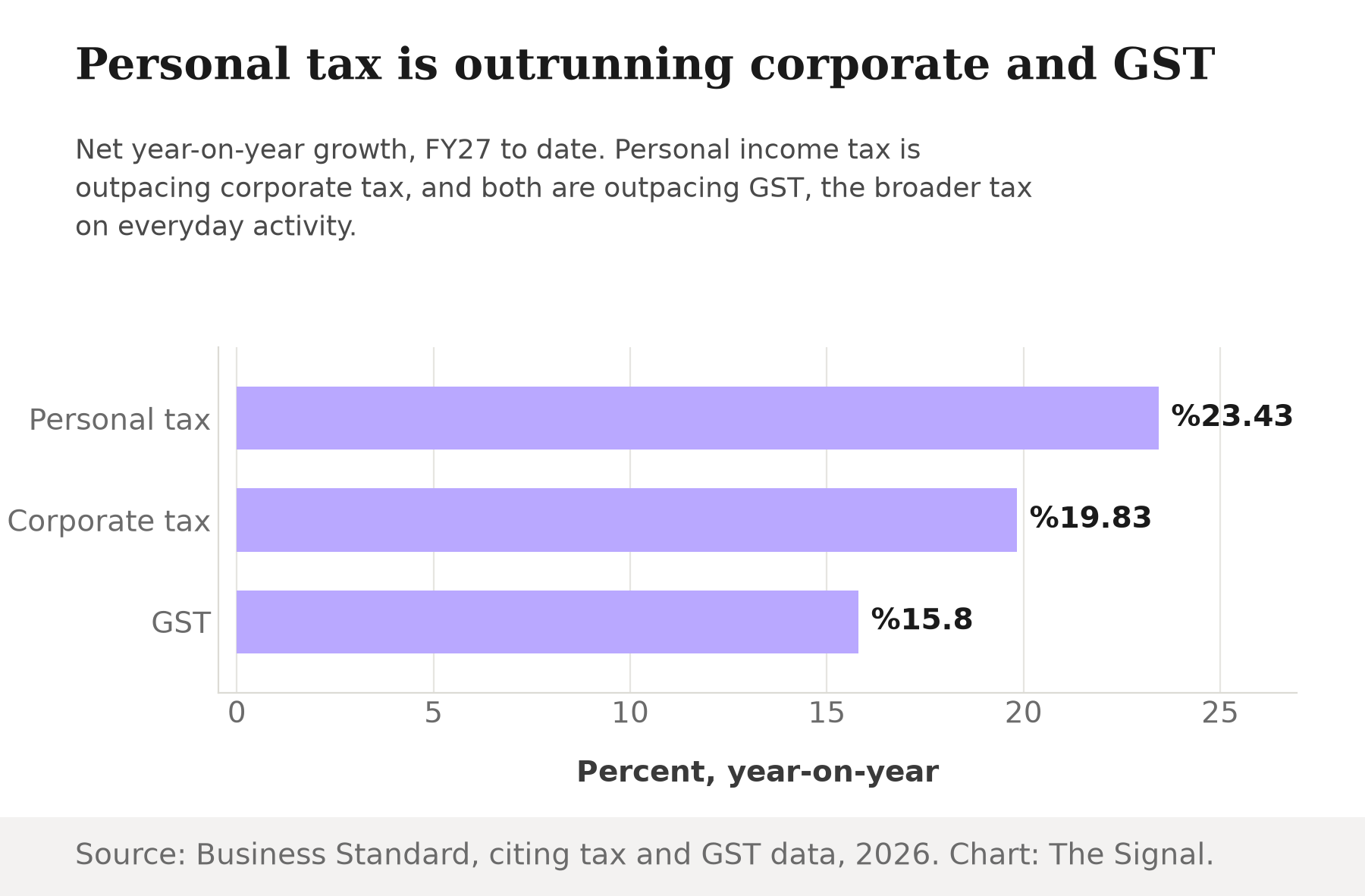
The pattern holds outside direct tax too. Gross GST collections, which track nationwide consumption and business turnover in near real time, rose 15.4 percent year-on-year to ₹2.11 lakh crore in July 2026, with net GST collections up 15.8 percent to ₹1.81 lakh crore. GST is the broader, more contemporaneous gauge of activity, less prone to the timing quirks of advance-tax payment dates. And even GST, the faster-moving read, is growing at little more than two-thirds the pace of net direct tax. The growth cascades: fastest in personal income tax, slower in corporate tax, slower still in the tax that tracks what people and businesses actually spend.
RBI and SBI disagree on how hot the quarter ran
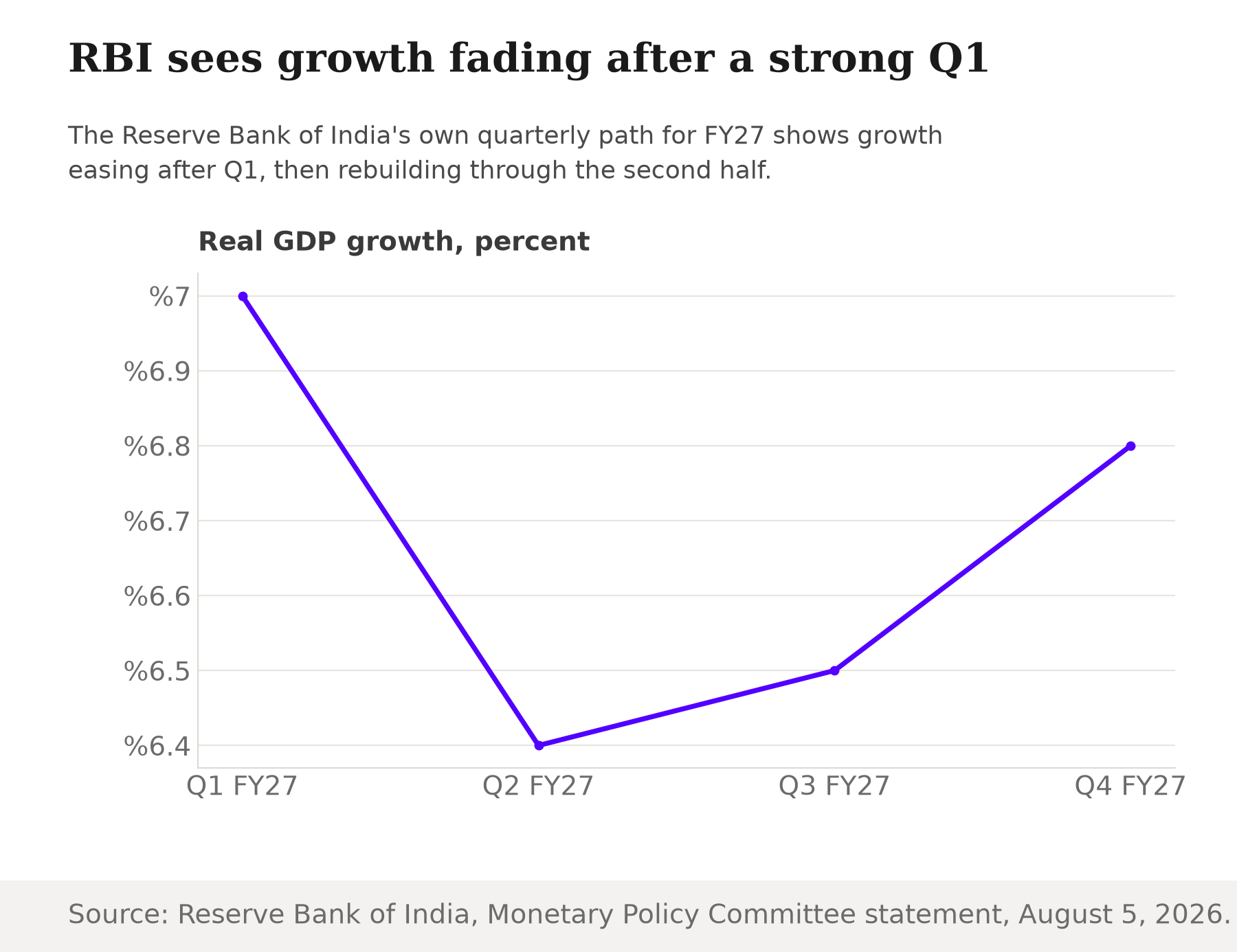
RBI's Monetary Policy Committee projected FY27 real GDP growth at 6.7 percent, with Q1 FY27 (April to June) at 7.0 percent, easing to 6.4 percent in Q2, before rebuilding to 6.5 percent in Q3 and 6.8 percent in Q4. SBI Research's nowcasting model, published a day after the tax print on August 11, puts Q1 FY27 real growth closer to 8.0 percent, a full percentage point above the RBI's own Q1 estimate, citing 86 percent of its 50 tracked leading indicators showing acceleration, against 69 percent in the same quarter a year earlier.
That gap between the central bank and the country's largest lender is the strongest case for taking the tax number at face value. If SBI's nowcast of roughly 8.0 percent Q1 growth is right, direct tax growth of 23.09 percent is about 2.9 times real GDP growth rather than well over three times against the RBI's 6.7 percent FY27 estimate. That narrows the puzzle. It does not close it.
What the Budget itself is banking on
The stakes attach directly to the government's own arithmetic for the rest of the year.
The Budget's own math leaves little room to treat a tax windfall as free money.
| Metric | FY26 | FY27 |
|---|---|---|
| Corporation tax collections | ₹11.09 lakh crore (Revised Estimate) | ₹12.31 lakh crore (Budget Estimate) |
| Fiscal deficit, percent of GDP | 4.4% (Revised Estimate) | 4.3% (Budget Estimate) |
| Fiscal deficit, in rupees | not stated | ₹16.96 lakh crore (Budget Estimate) |
| Direct tax, share of gross tax revenue | not stated | 61.2%, or ₹26.97 lakh crore (Budget Estimate) |
Source: Union Budget 2026-27, Medium-term Fiscal Policy Statement; Receipt Budget.
The Budget targets ₹26.97 lakh crore in direct tax collections for FY27, which would make up 61.2 percent of gross tax revenue, so direct tax is not a side item in the government's books; it is the largest single piece. The Budget also targets a fiscal deficit of 4.3 percent of GDP for FY27, down from 4.4 percent in the FY26 revised estimate, a tighter path, not a looser one, which leaves the government little appetite to treat an early tax surge as spare room to borrow more. And the Budget Estimate for FY27 put Corporation Tax collections at ₹12.31 lakh crore, up from a Revised Estimate of ₹11.09 lakh crore for FY26. That works out, by our calculation, to just 11 percent full-year growth, against the 19.83 percent net corporate tax growth already booked year-on-year through August 10. The two are not a like-for-like comparison: one is a year-to-date run rate, the other a full-year budget assumption. But the direction is the same: the government's own document did not price in a year this strong.
The honest objection
The strongest case against calling this an artefact is that SBI's nowcast could simply be right: 86 percent of the 50 leading indicators SBI Research tracks were showing acceleration in Q1 FY27, against 69 percent a year earlier, so the economy may be genuinely running hotter than the RBI's committee is willing to say out loud, and tax collections would be a leading indicator rather than an illusion. Formalization drives have lifted India's tax base durably before, and a buoyancy above 1 during such a drive is not unprecedented.
That case survives contact with the GST data less well. If broader activity were truly accelerating this fast, the tax that tracks day-to-day consumption should be accelerating with it. Instead net GST collections grew 15.8 percent against net direct tax's 23.09 percent, a gap that points toward something concentrated in withheld income-tax and advance-tax payments rather than a broad-based pickup in activity.
The Signal
Two things can be true at once. The economy could be running hotter than the RBI's own committee admits, in which case SBI's nowcast and its accelerating indicators are the number to trust. Or a chunk of this year's 23 percent tax print is doing what advance-tax schedules, deducted-at-source payments on market gains, and a widening compliance net do every few years: front-loading collections without front-loading output. What happens next tells you which is true. If growth data over the coming quarters converges toward SBI's estimate, the buoyancy was a leading signal. If it does not, and the tax print decelerates as one-off items roll off, the FY27 deficit target was built on a collection number the government may not get to keep.
Reporting basis: the direct tax collection figures, including the corporate and non-corporate split, are per Business Standard's reporting of provisional Income Tax Department data as of August 10, 2026, as also reported by The Tribune, which carried the Securities Transaction Tax figure; the GST figures are per Business Standard's reporting of GST Network data for July 2026. The FY22 buoyancy figure of 2.52 is from CBDT's own time-series data, released via PIB; the buoyancy history across the following year and the prior 23 years is per an earlier Business Standard story, published in 2023. The FY27 and quarterly real GDP growth projections are from the Reserve Bank of India's Monetary Policy Committee statement of August 5, 2026. The Q1 FY27 nowcast and leading-indicator figures are from SBI Research's Ecowrap note of August 11, 2026. The Budget's nominal GDP assumption, the direct tax and corporation tax targets, and the fiscal deficit figures are from the Union Budget's Medium-term Fiscal Policy Statement and Receipt Budget documents, both published by the Ministry of Finance. The tax buoyancy ratio, the GST-to-direct-tax growth comparison, and the corporation tax run-rate comparison are The Signal's calculations from those figures.