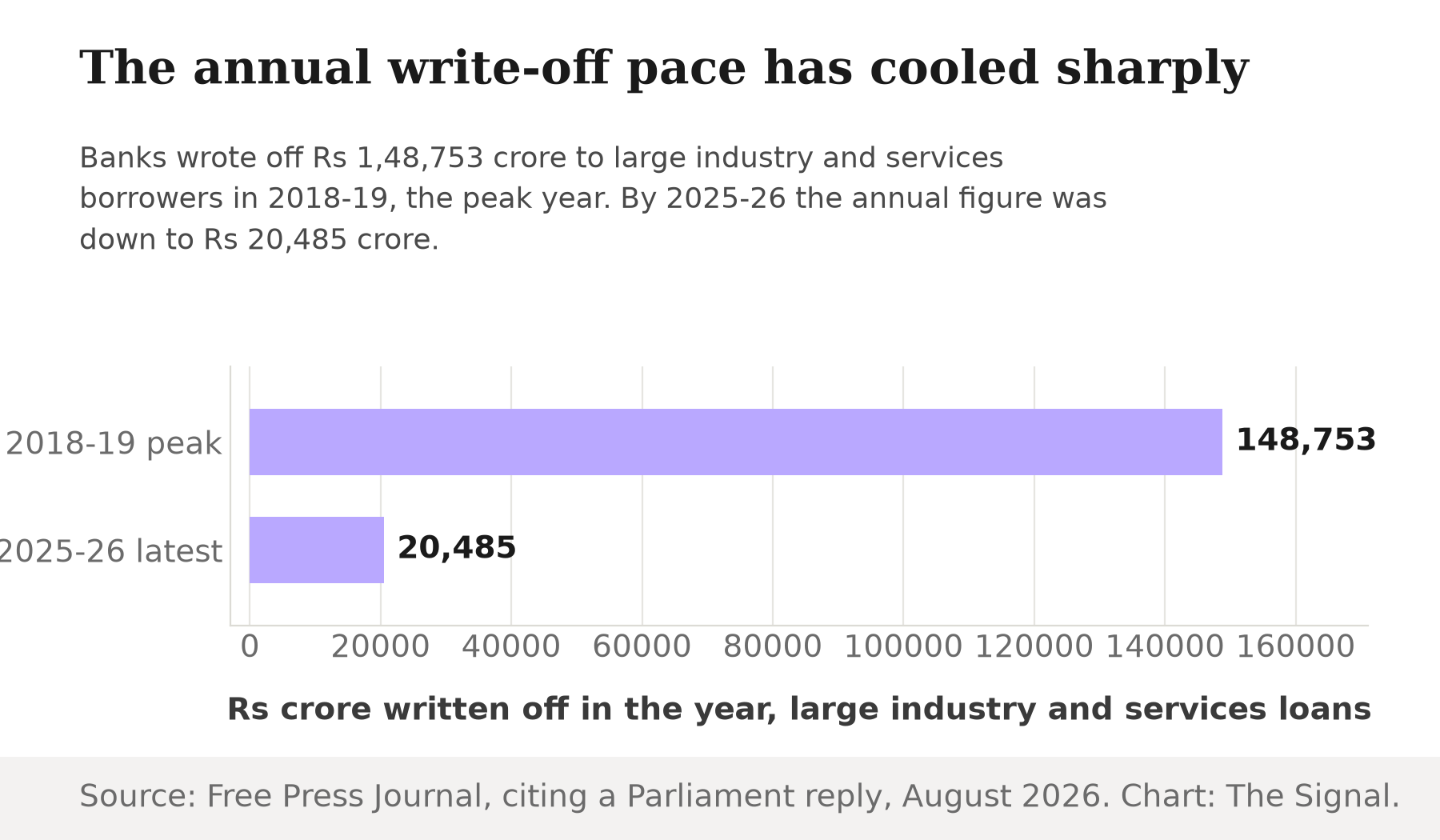
On August 10, 2026, the Finance Ministry told Parliament that banks have written off close to Rs 9.95 lakh crore in loans to large industries and services companies over the twelve financial years to 2025-26. Minister of State for Finance Pankaj Chaudhary's written reply came with the usual defense attached: a write-off is an accounting entry. It moves a bad loan off the balance sheet so a bank's books look cleaner and its provisioning burden eases. It does not cancel the borrower's debt, and the bank keeps the legal right to chase it. Read that way, Rs 9.95 lakh crore is bookkeeping, not forgiveness, and the pace looks like it is cooling anyway: annual write-offs peaked at Rs 1,48,753 crore in 2018-19 and had fallen to Rs 20,485 crore by 2025-26.
It is worth slowing down on that defense, because it rests entirely on what happens after the write-off: whether the debt that leaves the books is actually chased down and clawed back. On that question, the government's own numbers are far less comfortable.
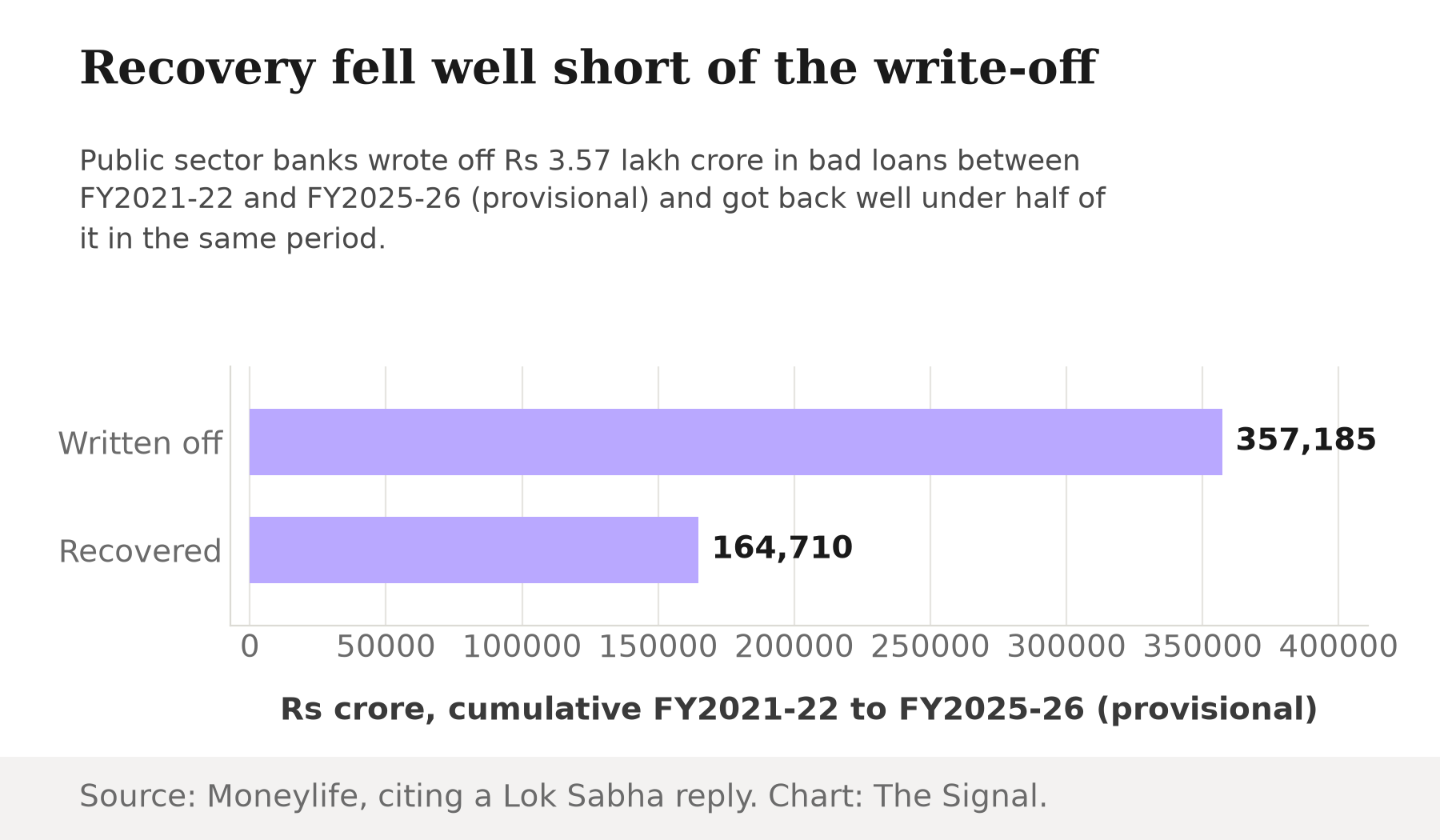
Public sector banks recovered well under half of what they wrote off in the past five years.
Start with the group for which Parliament has the cleanest before-and-after figures. Between FY2021-22 and FY2025-26 (provisional), public sector banks wrote off Rs 3,57,185 crore in bad loans and recovered just Rs 1,64,710 crore of it over the same five years, a recovery rate of about 46 percent. More than half of what public banks erased from their books in the past five years has simply not come back in cash.
What a write-off is supposed to be
A technical write-off is routine banking practice, and by one measure the system does look disciplined: the underlying loan book to large industry and services kept growing even as banks wrote off bad debt against it, from Rs 63.19 lakh crore in FY2024-25 to Rs 69.22 lakh crore in FY2025-26, per RBI data cited in the same Parliament reply. Measured against that book, the Rs 20,485 crore banks wrote off in 2025-26 came to a little under 0.3 percent of what large industry and services owed that same year, our calculation. A rounding error against the outstanding book is exactly what routine provisioning should look like. The problem is not the size of any single year's write-off. It is what happens to the stock of debt already wiped off the books over twelve years, and there the government has been asked a different question with a much less flattering answer.
The recovery rate depends on which window you ask about
Widen the lens past public sector banks alone and the number moves, but not toward reassurance. A separate Finance Ministry reply to the Rajya Sabha, covering the five years to FY2023-24 and the whole banking system rather than public banks by themselves, put recovery at only 18.5 percent of what had been written off in that window. That is a different set of banks and a different five-year clock than the public-sector figure above, so the two are not directly comparable, but neither reading is close to "most of it comes back."
No single number captures the recovery rate: it depends on which banks, which window, and which recovery channel is being measured.
| Recovery measure | Scope | Window | Share recovered |
|---|---|---|---|
| System-wide bank write-offs | All scheduled commercial banks | Five years to FY2023-24 | 18.5% |
| Public sector bank write-offs | PSBs only | FY2021-22 to FY2025-26 (provisional) | About 46% |
| IBC resolution plans | All CIRP cases since December 2016 | To September 2025 | 32.44% |
| Largest insolvency cases (claims over Rs 1,000 crore) | 172 companies | To March 2025 | 33.89% |
Sources: ThePrint, citing a Finance Ministry reply to the Rajya Sabha; Moneylife, citing a reply to the Lok Sabha (the public sector bank share recovered is The Signal's calculation from the two rupee figures given); and the IBBI's quarterly newsletters.
Bankruptcy court gets a third, no more
When write-offs alone do not work and a bank pushes a company into formal insolvency instead, the outcome looks structurally similar. Since the Insolvency and Bankruptcy Code took effect in December 2016, creditors have recovered Rs 3.99 lakh crore against Rs 12.31 lakh crore in admitted claims through approved resolution plans, as of September 2025, a haircut of about 67 percent. For the very largest cases, the shortfall starts before any recovery process even begins. Among 172 companies with admitted claims over Rs 1,000 crore each, the assets actually available when they entered resolution were worth just Rs 1.95 lakh crore against Rs 10.24 lakh crore owed to creditors, as of March 2025: the businesses were already hollowed out before the courtroom process started.
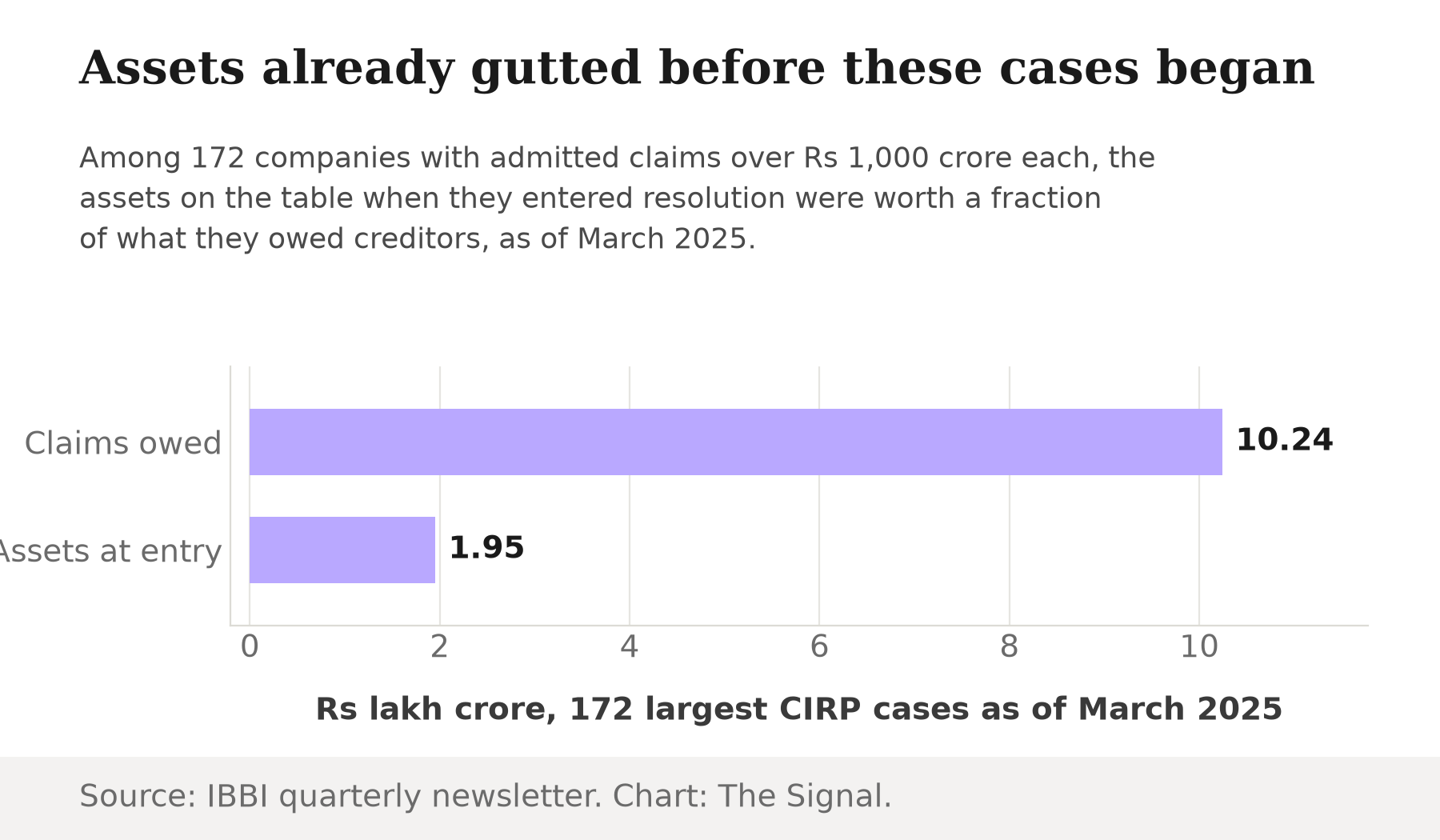
Yet on that measure the resolution process actually outperformed what the entry-point numbers implied. Creditors ultimately recovered 33.89 percent of admitted claims for those 172 cases, which works out to roughly Rs 3.47 lakh crore, our calculation, nearly 1.8 times the Rs 1.95 lakh crore the assets were deemed worth when these companies first entered resolution. The court process found more value in these companies than a snapshot of their assets at the door suggested it would. It still returned only a third of what creditors were owed.
The honest objection
The strongest case for patience is that the trend lines are pointing the right way. The annual write-off pace has fallen by about 86 percent from its 2018-19 peak of Rs 1,48,753 crore to Rs 20,485 crore in 2025-26, which reads less like a bank hiding fresh bad lending and more like credit discipline improving. And a bankruptcy code that pays out even a third of admitted claims, slowly, is still a working legal channel compared with the near-total losses banks absorbed on defaulted corporate debt before the IBC existed in 2016.
That case is real, but it answers a different question than the one the Rs 9.95 lakh crore figure raises. A falling annual write-off pace says banks are lending more carefully now. It says nothing about what happens to debt already erased from the books over the past twelve years, and on that stock, every published recovery measure lands under half: 18.5 percent system-wide, 32.44 percent through the IBC, 33.89 percent for the largest insolvency cases, or the most favorable public-sector bank reading of about 46 percent. "Not forgiveness" is technically correct. In practice, most of what gets written off behaves like money the bank has stopped expecting back.
The Signal
Parliament keeps getting handed the write-off total, and only occasionally the recovery total, and the two rarely sit in the same reply. That is not a conspiracy. It is a reporting gap, and it explains why the "corporate loan waiver" framing keeps resurfacing whenever a fresh write-off figure is tabled: without the recovery number beside it, a technical accounting move and an actual bailout look identical from the outside. The figure worth watching next is not the write-off total, which will keep climbing with each fresh tally. It is whether a future Parliament reply is forced to publish the recovered sum alongside the written-off one. Until that becomes routine, "just an accounting entry" is a claim banks make on paper, while the cash tells a slower story.
Reporting basis: the 12-year write-off figure and the annual write-off pace are from Minister of State for Finance Pankaj Chaudhary's written reply to Parliament, as reported by Free Press Journal; the outstanding large-industry loan book is from the same reply, as reported by Telangana Today. The public sector bank write-off and recovery figures for FY2021-22 to FY2025-26 are from a separate reply to the Lok Sabha, as reported by Moneylife. The system-wide five-year recovery rate to FY2023-24 is from a Finance Ministry reply to the Rajya Sabha, as reported by ThePrint, and rests on that single reported source. The IBC-wide and largest-case insolvency recovery figures are from the Insolvency and Bankruptcy Board of India's own quarterly newsletters. The write-off-to-book share, the public sector bank recovery share, and the realised-value figure for the 172 largest cases are The Signal's calculations from those reported numbers.