By the government's own count, its flagship skilling scheme looks like it is finally reaching scale. PMKVY 4.0 has trained 27.24 lakh candidates across 38 sectors, covering 36 states and 737 districts, as of 31 March 2026, the Press Information Bureau reported, describing a scheme reaching deep into the country's districts. Read only that line, and Skill India looks like it is doing what it was built to do: turning a large, young workforce into a certified one, just as that workforce is coming of age.
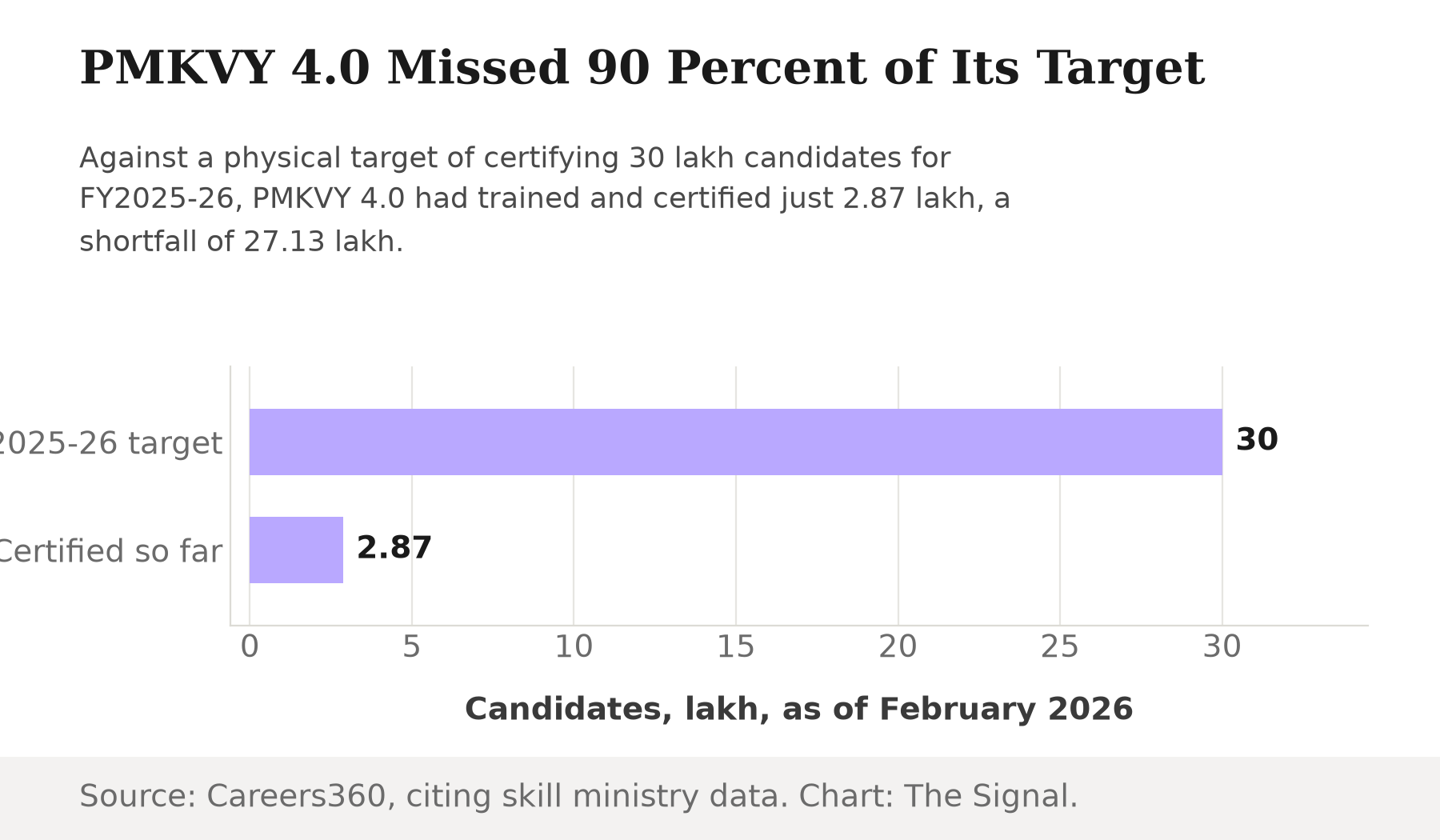
It is worth slowing down on that framing. Set against the scheme's own target for FY2025-26, the fiscal year that ended this past March, the number that matters is not 27.24 lakh. It is 2.87 lakh. PMKVY 4.0 had a physical target of certifying 30 lakh candidates for FY2025-26, but by February 2026, with the year almost over, it had trained and certified just 2.87 lakh, a shortfall of 27.13 lakh, Careers360 reported, citing skill ministry data placed before Parliament. Divide one figure into the other and the scheme certified roughly a tenth of the people it had set out to certify for FY2025-26, a shortfall of about 90 percent against its own plan.
The stakes of that miss are set by the demographic math PMKVY exists to serve. Each year, around 7-8 million people are added to India's labour force, per the International Labour Organization and Institute for Human Development's India Employment Report 2024. Against that scale, a target of certifying 30 lakh candidates in a year was already a modest ask; certifying 2.87 lakh reaches under 4 percent of just one year's addition to the workforce.
The easy explanation is the one usually reached for with a government training scheme: nobody wants to enrol. It is only half true, and it obscures a more specific problem sitting upstream of enrolment.
Zero enrolment, not zero demand
The enrolment numbers are genuinely stark. In the first seven months of FY2025-26, from April to October 31, 2025, Prime Minister Kaushal Kendras trained only 17,328 candidates nationally, and many states reported zero enrolment in that window, per a Lok Sabha reply from the skill ministry, reported by Careers360. A training centre with zero enrolled candidates for seven straight months is not a demand problem in the ordinary sense: it is a centre that is not functioning as a place anyone can walk into and start a course.
That distinction matters, because the money to run those centres was not moving either.
The money that did not move
PMKVY 4.0 had utilised just 14% of its allocated budget, the Parliamentary Standing Committee on Labour, Textiles and Skill Development found in its examination of the ministry's Demand for Grants, as reported by Careers360. Eighty-six percent of the money Parliament had already approved for the scheme was sitting unspent when that committee looked. Separately, the Ministry of Skill Development and Entrepreneurship's own year-end review states that ₹1,652.89 crore was utilised under PMKVY between April 2024 and September 2025, a slow eighteen-month drawdown by the ministry's own account.
Then the allocation itself was cut. The Union Budget's Revised Estimate cut FY2025-26 funding for the composite Skill India Programme, which bundles PMKVY 4.0 with PM-NAPS and the Jan Shikshan Sansthan scheme, from a budgeted ₹2,700 crore to ₹2,000 crore, Union Budget documents show. That revised figure sits below even the ₹2,800 crore allocated for FY2026-27, the fiscal year now underway.
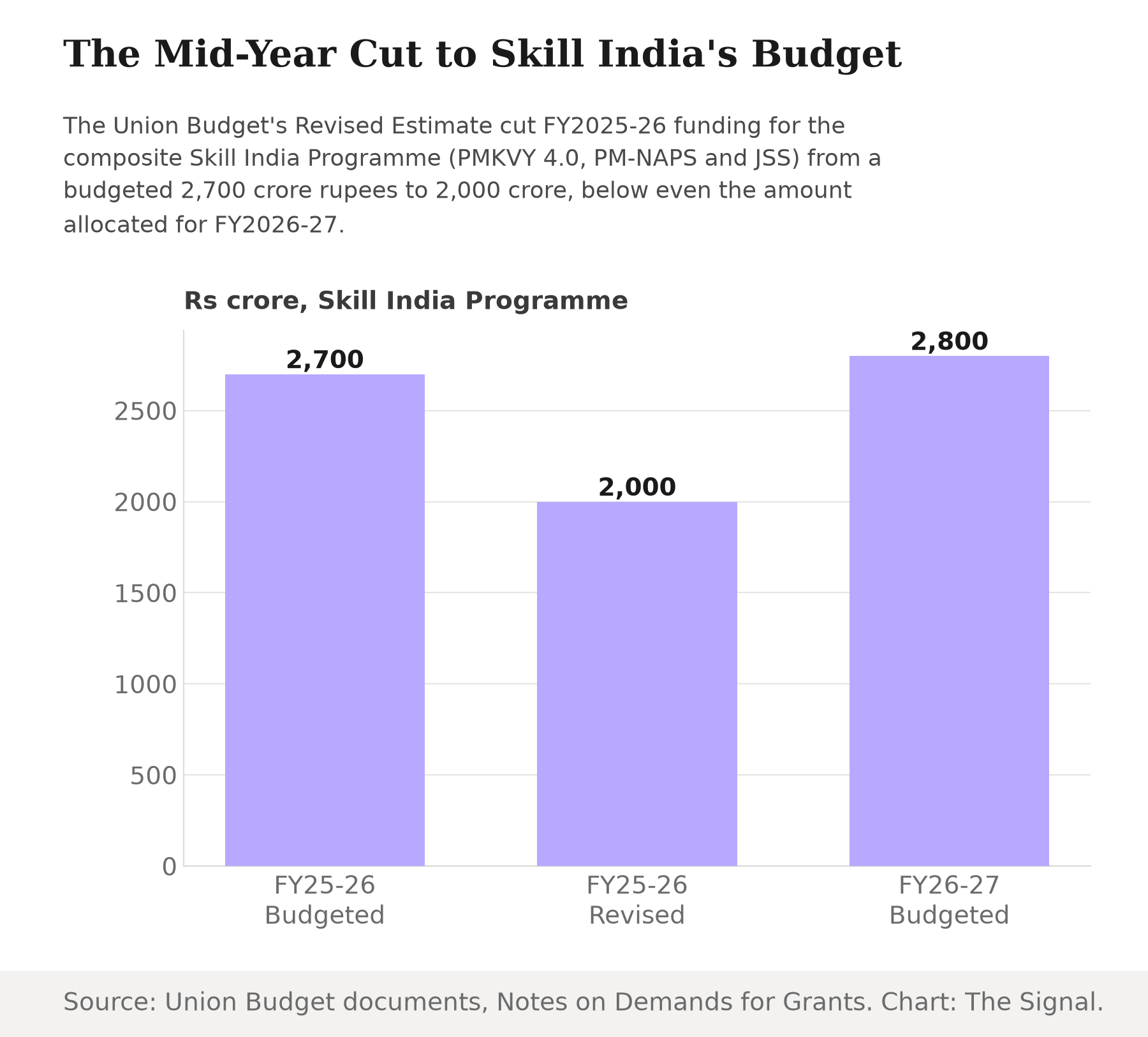
A scheme that had used just 14 percent of its money got less of it, mid-year. A ministry sitting on unspent funds is an easy target for a Finance Ministry revision; whether the cut caused the shortfall or simply confirmed it, both facts point the same way: the constraint sat on the funding side, not the enrolment side.
A program running well below its own earlier pace
PMKVY is not a new scheme groping toward its first results. It has three completed phases behind it. Between 2015 and 2022, the ministry released ₹10,194 crore to implementing agencies and certified 1.10 crore beneficiaries across those first three phases, the Comptroller and Auditor General of India found in a performance audit. Against that base, PMKVY 4.0's cumulative total of 27.24 lakh candidates as of March 2026 is a small fraction of what the scheme once certified: about a quarter of the earlier phases' total, even though 4.0 has had years to build toward it. PMKVY 4.0 was itself launched as part of the Skill India Mission in January 2023, the skill ministry announced that month, so that 27.24 lakh total was built up over roughly three years: about 8.6 lakh candidates a year, against close to 15.7 lakh a year in the first three phases. Even measured fairly, per year rather than as raw cumulative totals of unequal length, PMKVY 4.0 is certifying at a little over half its predecessors' pace, by our calculation.
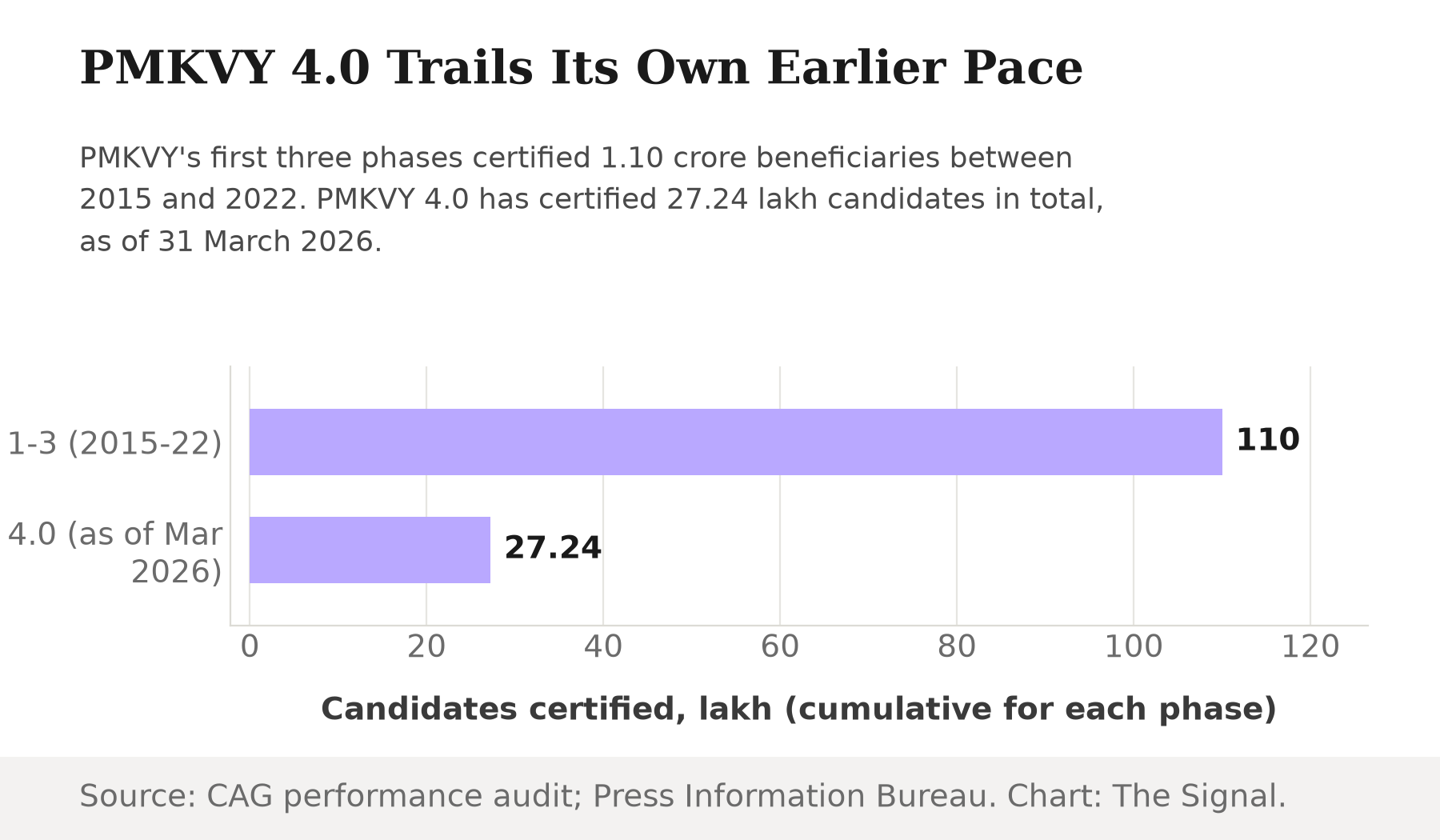
That is not proof that appetite for vocational training has collapsed. It is consistent with a delivery machine, the network of training partners and Kaushal Kendras that PMKVY runs on, that has been running on a fraction of the funding and cadence the earlier phases had.
The honest objection
The strongest case against calling this a funding squeeze is that the causality could run the other way: a ministry that had spent only 14 percent of an allocation had already shown it could not absorb the money, so a Finance Ministry trimming that allocation mid-year is ordinary fiscal housekeeping, not sabotage. On this reading, PMKVY's problem is administrative capacity to disburse and enrol, and the budget cut is a symptom of that failure, not its cause.
The ministry's own account to Parliament complicates that reading, though. MSDE has told a parliamentary standing committee that staggered approvals for releasing funds, pending Cabinet approval for the Skill India Programme, produced "intermittent momentum" across FY2022-23, FY2023-24 and FY2024-25, Careers360 reported. By the ministry's own telling, the bottleneck was money moving out of Delhi in the first place, years running, not demand failing to show up at the centres.
That case has real force, and the public record here cannot settle which came first. But it does not explain the scale of the shortfall. Even crediting the ministry with the reduced ₹2,000 crore Revised Estimate in full, a scheme running at 14 percent utilisation was never going to reach its 30 lakh candidate target on that spending pace, cut or no cut. Whichever direction the causality runs, the binding constraint on PMKVY 4.0 in FY2025-26 was money moving through the system, not people wanting to walk into a Kaushal Kendra.
The Signal
PMKVY's usual defense against a bad year is the enrolment chart: are people signing up. That chart is real, and it is bad. But it sits downstream of a simpler one: is the money reaching the centres that would enrol them. On the numbers the ministry has itself put before Parliament, the answer in FY2025-26 was no, not much of it. Watch the FY2026-27 utilisation figures when the Standing Committee next examines them. If the ₹2,800 crore budgeted for FY2026-27, the fiscal year now underway, gets spent at a rate closer to 100 percent than the 14 percent PMKVY 4.0 managed in FY2025-26, its defenders will have a real recovery story. If it does not, whatever training target the ministry sets next will matter less than the money it actually lets the scheme spend.
Reporting basis: the FY2025-26 target and actual certification figures, and the Prime Minister Kaushal Kendra enrolment figures, are per Careers360's reporting of skill ministry data placed before Parliament in Lok Sabha replies. The 14 percent budget utilisation figure and the ministry's "staggered fund releases" explanation are per Careers360's reporting of the Parliamentary Standing Committee on Labour, Textiles and Skill Development's examination of the ministry's Demand for Grants, a separate parliamentary body from the Lok Sabha replies above. The 2015-22 phase totals are from the Comptroller and Auditor General of India's performance audit (Report No. 20 of 2025). The FY2025-26 Revised Estimate and FY2026-27 Budget Estimate are from Union Budget documents. The 31 March 2026 cumulative training count and the April 2024-September 2025 utilisation figure are both from the Ministry of Skill Development and Entrepreneurship, via two separate Press Information Bureau releases. The January 2023 launch date for PMKVY 4.0 is from a separate Press Information Bureau release. The 7-8 million annual labour-force addition figure is from the ILO and Institute for Human Development's India Employment Report 2024. The roughly 90 percent target shortfall, the share of one year's labour-force addition PMKVY reached, and the comparison of PMKVY 4.0's per-year and cumulative pace against the 2015-22 phases are The Signal's calculations from those figures.