India's labour market looked steady heading into the middle of 2026. The overall unemployment rate for people aged 15 and above held at 5.5% in June, unchanged from May and broadly stable against June 2025's 5.6%. Urban labour force participation improved to 50.1% in June from 49.8% in May. Over the year to June 2026, rural participation rose half a percentage point while urban participation slipped 0.3 points. Read only the headline numbers and June 2026 looks like a labour market holding its ground, maybe even leaning toward more people, especially rural people, being drawn in.
It is worth slowing down on that rural participation gain. Split the labour force by sex and the number doing the improving is not the one that ends up mattering by June.
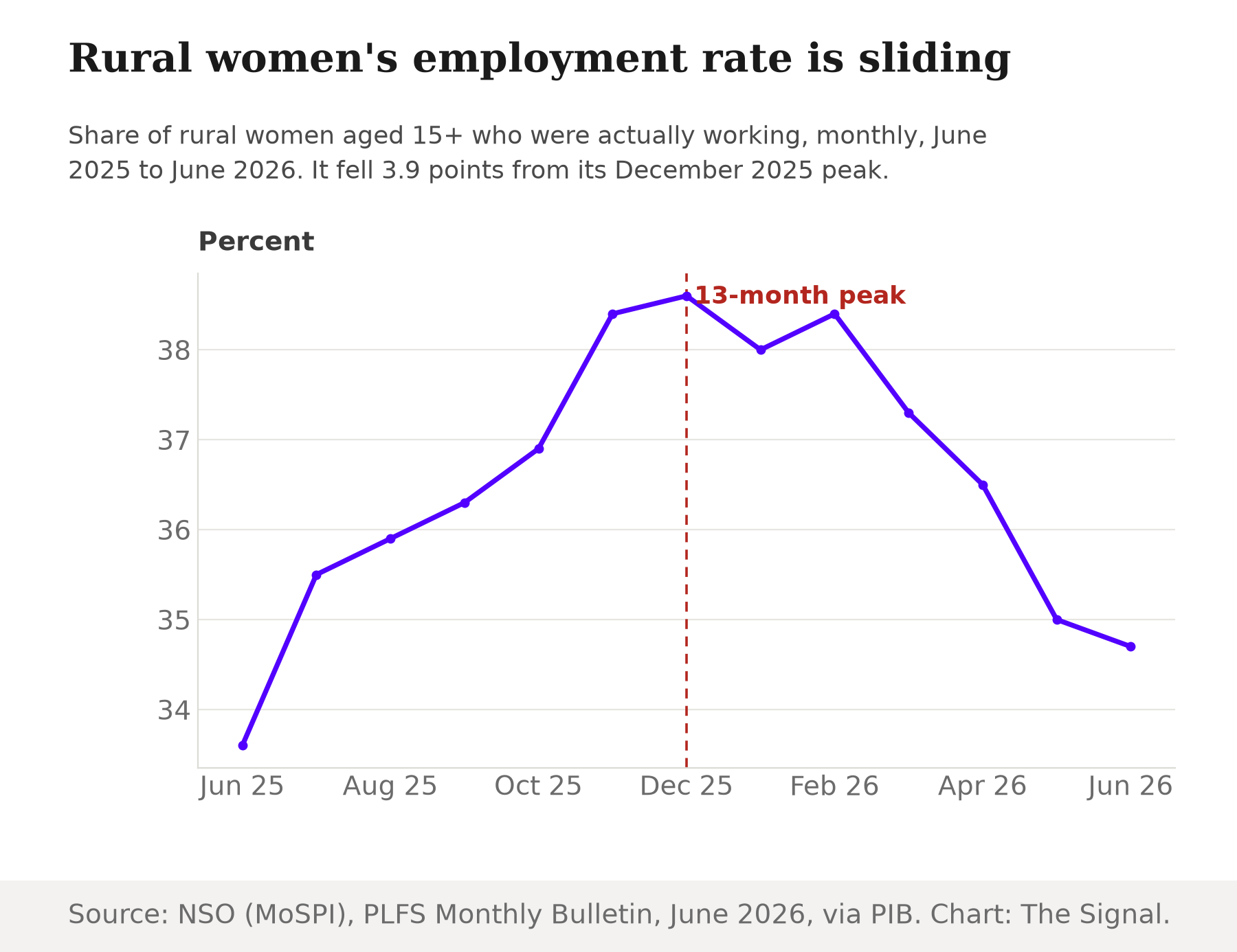
Rural women's employment rate fell 3.9 points in six months while their participation barely moved.
The number underneath: the share of rural women aged 15 and above who were actually working fell from a 13-month peak of 38.6% in December 2025 to 34.7% in June 2026, a decline of 3.9 percentage points, even as rural female labour force participation held roughly steady over the same stretch. Participation did not fall. Employment did. That combination has a name: rising unemployment.
The participation gain that looked like progress
On its own, the monthly participation data reads as a genuine inclusion story. Female labour force participation nationally rose to 32.7% in June 2026, up 0.7 percentage points from 32.0% a year earlier. Rural female participation did most of that work, climbing 1.4 points year on year to 36.6%, while urban female participation slipped 0.4 points to 24.8%. By that measure alone, rural India is where more women are entering the labour force, and urban India is where fewer are.
The monthly snapshot below lays out where June 2026 sits against the closest comparison point for each measure.
Rural unemployment eased in June even as urban unemployment rose.
| Measure | Comparison period | Earlier value | June 2026 |
|---|---|---|---|
| Urban labour force participation | May 2026 to June 2026 | 49.8% | 50.1% |
| Rural unemployment rate | May 2026 to June 2026 | 5.1% | 5.0% |
| Urban unemployment rate | May 2026 to June 2026 | 6.4% | 6.6% |
| Female labour force participation (national) | June 2025 to June 2026 | 32.0% | 32.7% |
| Rural female labour force participation | June 2025 to June 2026 | 35.2% | 36.6% |
| Urban female labour force participation | June 2025 to June 2026 | 25.2% | 24.8% |
Source: NSO (MoSPI), PLFS Monthly Bulletin, June 2026, via PIB.
Where the gains went missing
Pair the participation numbers with the employment and unemployment numbers, and the rural female participation gain stops looking like unambiguous progress. Both the overall and rural female unemployment rates climbed to the top of the published 13-month series in June 2026: overall female unemployment reached 5.9%, up from a series low of 4.8% in November 2025, and rural female unemployment reached 5.0%, up from a series low of 3.4% in November 2025. Women stayed in the rural labour force. They simply failed to find work inside it, at a rate the series had not recorded before.
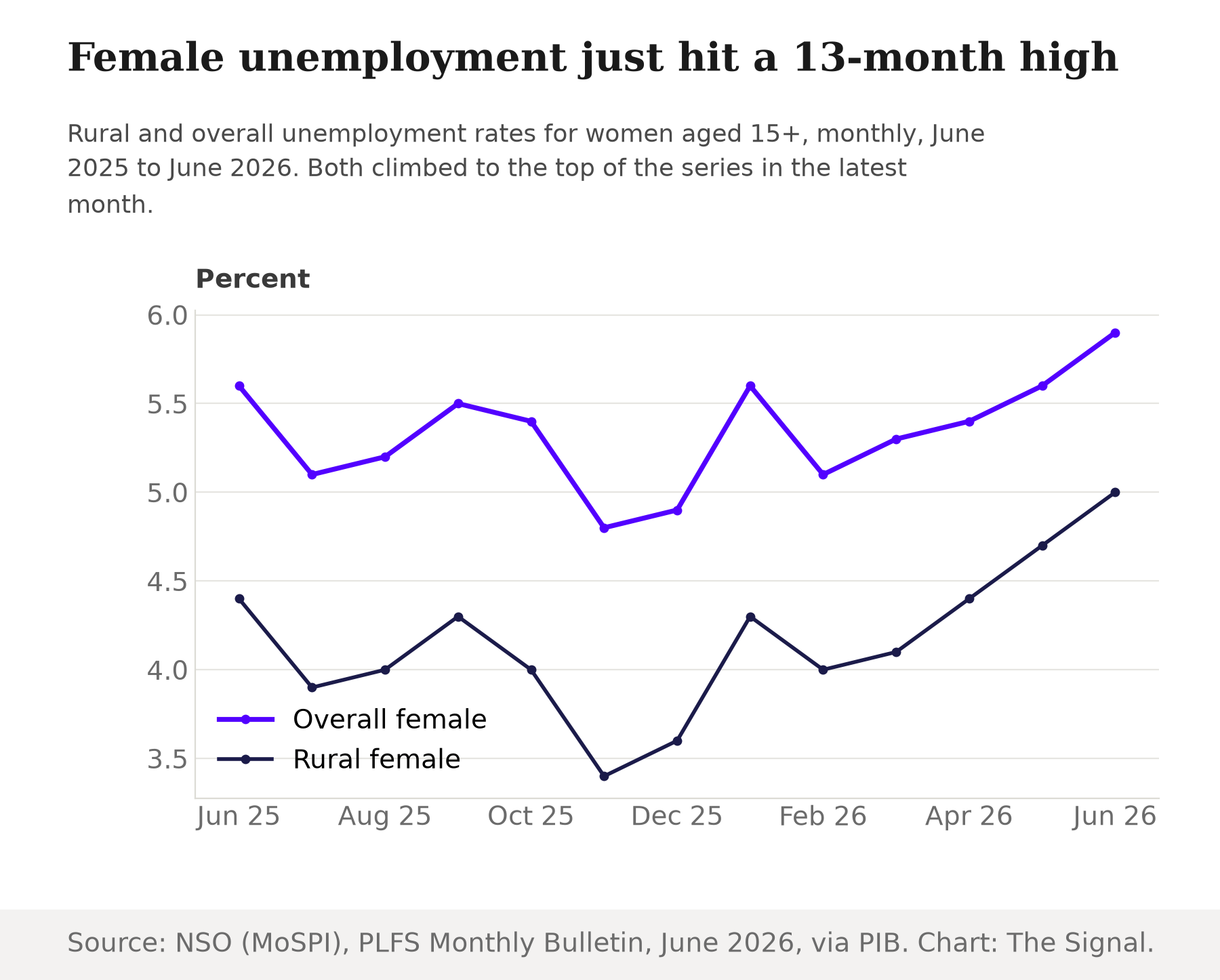
The split shows up most clearly against the gender-blind rural number. The overall rural unemployment rate, covering both sexes, eased marginally from 5.1% in May to 5.0% in June, the same month that the rural unemployment rate specific to women rose from 4.7% to 5.0%. The all-rural figure that gets quoted in a headline improved; the one that isolates women moved the other way.
A second, independent read points the same way
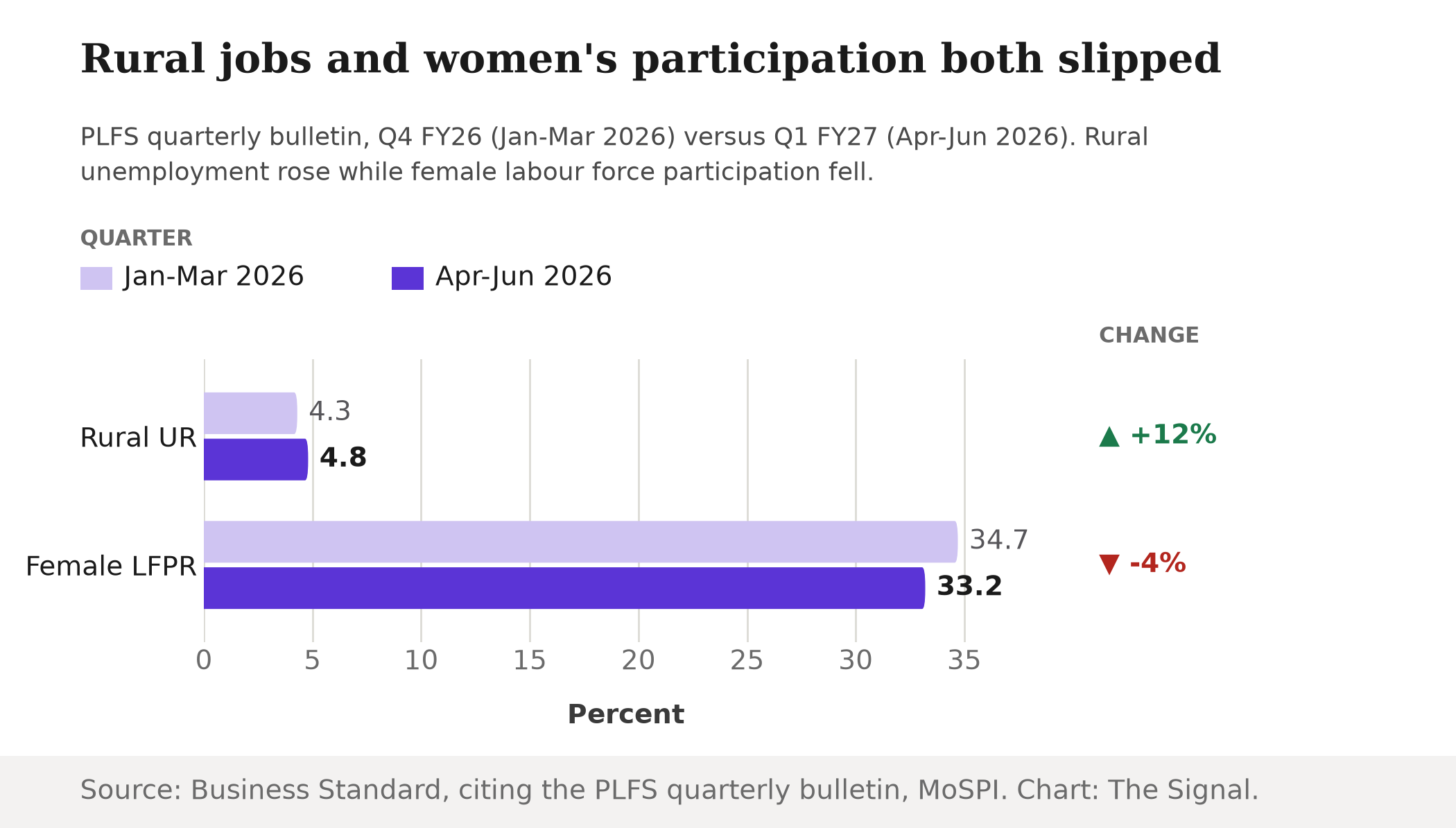
None of this comes from a single bulletin. NSO also publishes a separate quarterly PLFS release, built on a different sample window than the monthly one above, so its levels are not directly comparable month to month. But its direction for April-June 2026 agrees. Rural unemployment climbed to 4.8% in the April-June quarter (Q1 FY27) from 4.3% in January-March, overall labour force participation fell to a five-quarter low of 54.6% from 55.5%, and female labour force participation fell more sharply still, to 33.2% from 34.7%. The same quarterly release also shows rural employment continuing to shift away from agriculture, down to 52.9% of rural workers from 55.8% the previous quarter, and toward regular wage and salaried jobs, up to 16.1% from 15.5%, a broader compositional shift in what rural work looks like, not one confined to either sex.
The honest objection
The strongest case against reading this as deterioration is timing. Rural women's farm work follows the sowing and harvest calendar, so a slide from a December peak to a June trough could be the ordinary rhythm of the agricultural year reasserting itself rather than a new loss of jobs. On that view, the headline unemployment rate held at 5.5% in June 2026, unchanged from a year earlier, precisely because nothing structural changed; the swings inside the female-specific numbers are the kind of seasonal noise the calendar produces every year. It also is not every woman everywhere: in the same quarterly release, the urban unemployment rate for women actually eased to 8.7% in April-June 2026 from 9.1% the previous quarter.
That case would be more comfortable if it rested on one number from one survey. It does not. The quarterly PLFS bulletin, a separate NSO release built precisely to average out single-month noise, reports the same direction for the entire April-June quarter: rural unemployment up and national female labour force participation down sharply, to 33.2% from 34.7%. Two independently timed, independently published NSO surveys landing on the same conclusion for the same window is not a seasonal artifact. It is a signal.
The Signal
India's aggregate unemployment rate says the labour market held its shape in June 2026. Split by sex, and especially in rural India, it did not. Rural women kept showing up in the labour force in roughly the numbers they always have. The jobs did not show up for them at the same rate, and the unemployment measure that isolates women posted new highs in June 2026 that the aggregate figure did not. This is not uniform: urban female unemployment actually improved over the same window. It is concentrated in the rural workforce that had been powering the country's recent female-participation gains. Watch the next PLFS prints for whether rural female employment claws back toward its December 2025 level, or keeps drifting lower while participation holds firm. That gap, between women showing up and women being counted as employed, is where India's female labour market is actually being decided this year, not in the headline rate.
Reporting basis: the June 2026 headline unemployment and participation rates, the female-specific labour force participation splits, and the monthly chart series for the rural female worker-population ratio and for female unemployment rates are all read from the National Statistics Office's (NSO, MoSPI) PLFS Monthly Bulletin for June 2026, published via the Press Information Bureau, a single origin. The April-June 2026 (Q1 FY27) quarterly figures, including the rural unemployment rate, the overall and female labour force participation rates, the rural employment composition shift, and the urban female unemployment rate, are as reported by Business Standard, citing the PLFS quarterly bulletin released by the Ministry of Statistics and Programme Implementation, a second and independent origin. The 3.9-percentage-point fall in the rural female worker-population ratio between December 2025 and June 2026, and the identification of the 13-month high and low points in the female unemployment series, are The Signal's readings of the bulletin's own published monthly chart values, not new reporting.