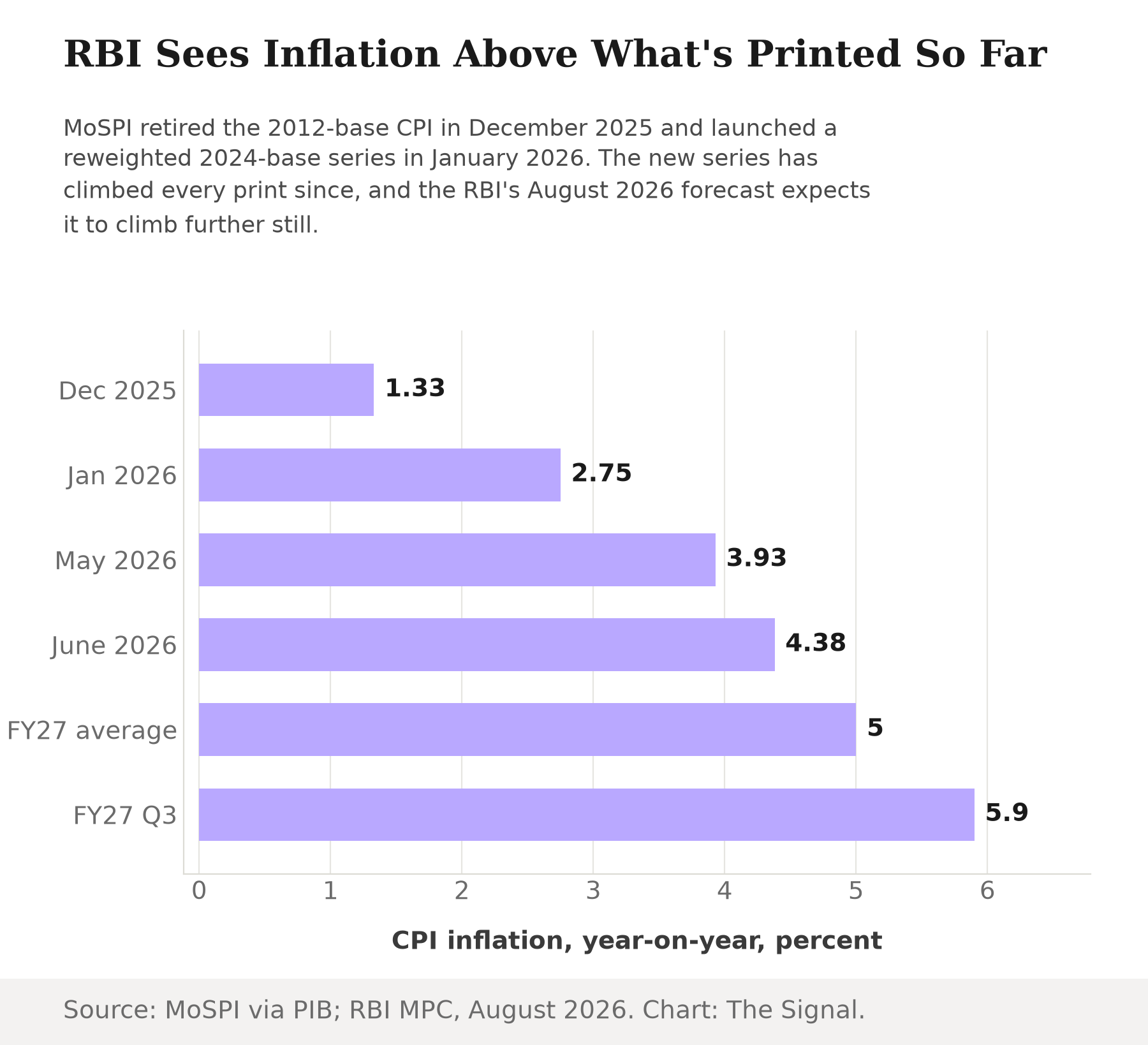
For most of the second half of 2025, India's retail inflation numbers looked like a rare bright spot. By December 2025, headline inflation had fallen to just 1.33 percent year-on-year, running below the RBI's lower tolerance limit for a fourth consecutive month. Read at face value, it looked like an unambiguous win for policy.
It is worth slowing down on that reading. That December print was the outgoing series' last month in the spotlight. Weeks later, MoSPI retired the 2012-base CPI and launched a new series rebuilt on a 2024 base year, and the number the new series produced did not tell the same story.
The relaunched series opened at 2.75 percent year-on-year in January 2026, already 1.42 percentage points above the retired series' final reading of 1.33 percent, and it kept climbing from there. By May 2026 the print had risen to 3.93 percent, and by June 2026, the most recent month available, it stood at 4.38 percent. The RBI is not betting on that climb stopping. At its August 2026 meeting, its Monetary Policy Committee held the repo rate at 5.25 percent while projecting inflation for the 2026-27 financial year to average 5.0 percent, rising to 5.9 percent in the third quarter: a Q3 forecast that sits roughly 1.52 percentage points above the 4.38 percent the new index has actually printed so far.
A basket rebuilt for 2024, not 2012
The new series is not a cosmetic update. MoSPI reweighted the consumption basket using the Household Consumption Expenditure Survey of 2023-24, the first major update to the spending patterns behind the CPI in over a decade. Food and beverages, the category most prone to swings from vegetable and pulse prices, saw its combined weight fall from 42.617 percent under the old 2012 base to 36.753 percent under the new 2024 base. The number of priced items also grew, from 299 to 358.
Food's weight in the CPI basket fell by nearly six percentage points at the same moment the headline print jumped.
| Metric | 2012 base (outgoing) | 2024 base (new) |
|---|---|---|
| Food and beverages weight | 42.617% | 36.753% |
| Priced items in basket | 299 | 358 |
| Underlying survey | Not stated in this release | Household Consumption Expenditure Survey 2023-24 |
Source: MoSPI's National Statistical Office, via PIB, January 2026.
A basket with less food weight does not move like the one it replaced. Food prices had been pulling the old series toward its late-2025 lows, so trimming food's share dampens some of that pull before actual prices even move. That alone is a plausible driver of part of the gap between the two series.
The food numbers themselves make the case sharper. The Consumer Food Price Index was still in deflation, -2.71 percent year-on-year, in December 2025 under the old base; by January 2026 under the new base it had swung to +2.13 percent, a food-only move of 4.84 percentage points, more than triple the 1.42-point jump in the headline number over the same two prints. And MoSPI's own numbers show the weight cut is not just a reclassification artifact of the new international COICOP categories. Keeping the old 2012 classification, updated consumption weights alone would still have pulled food's share from 45.86 percent to 40.10 percent, close to the 42.62-to-36.75 percent drop actually published under the new structure.
What the RBI is actually pricing in
The RBI operates under a flexible inflation-targeting mandate: hold CPI inflation at 4 percent with a tolerance band of 2 to 6 percent, and the Central Government renewed that exact target and band, unchanged, for the five-year period from April 1, 2026 to March 31, 2031. Judged against that band, both the outgoing series' 1.33 percent and the new series' early prints sat comfortably inside it, even below the target's midpoint.
The RBI's own projections describe a different trajectory. Its Q3 FY2026-27 forecast of 5.9 percent, and its full-year average of 5.0 percent, both sit well above the 2.75 to 4.38 percent range the new CPI series has printed so far. A central bank does not publish a forecast that far above its own latest data point by accident: it is a signal that the low prints of the past year, old base or new, are not being treated as the new normal.
Rural inflation is pulling away from urban
The new series' first three prints show a widening split the outgoing series did not surface in the same way. In January 2026, rural inflation stood at 2.73 percent against urban's 2.77 percent, essentially level. By May 2026, rural had risen to 4.25 percent against urban's 3.53 percent, and by June 2026, rural reached 4.74 percent against urban's 3.92 percent, a gap of more than eight-tenths of a percentage point that did not exist five months earlier.
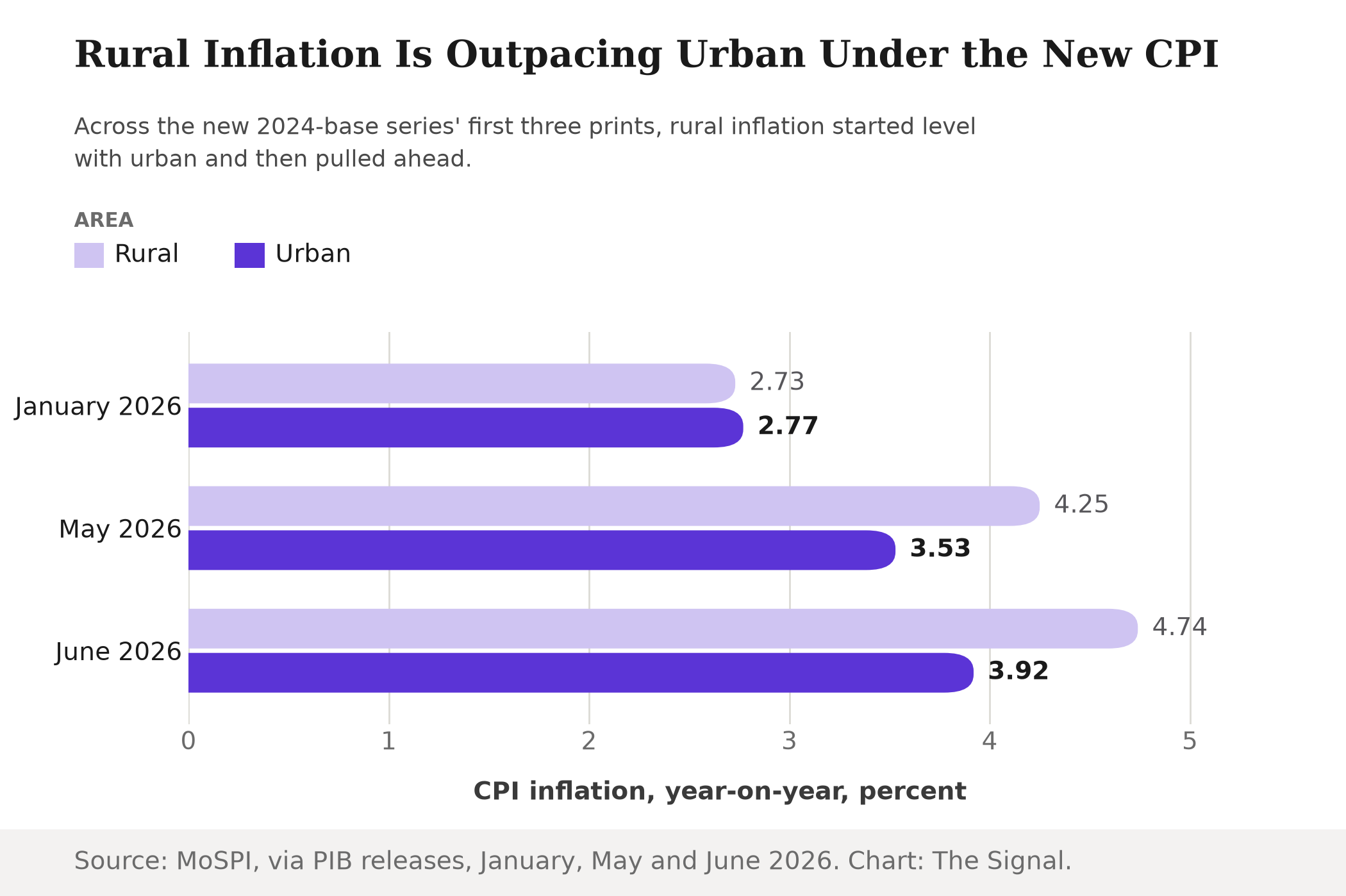
A widening rural-urban gap, in a basket that just cut food's weight, is worth watching in the prints still to come. This pairing alone does not explain it.
What does not move
One thing the rebasing does not touch is the calculation behind government pay. Dearness allowance for central government employees and pensioners is indexed to a separate index, the Labour Bureau's Consumer Price Index for Industrial Workers, carrying its own 2016 base year that the Labour Bureau introduced in 2020, not MoSPI's general CPI. That CPI-IW series is administered specifically to regulate dearness allowance and industrial-worker pay. Because the two indices are separate, the general CPI's move from a 2012 to a 2024 base has no mechanical effect on DA or pension payments; only one of the two just changed.
The honest objection
The strongest case against reading much into the base-year switch is that December and January are not a clean comparison to begin with. India's CPI carries a seasonal pattern, tied partly to vegetable prices that swing with the winter harvest, so some of the jump from 1.33 percent in December 2025 to 2.75 percent in January 2026 could simply be ordinary month-to-month movement that would have shown up under the old basket too. MoSPI never published a January 2026 reading on the old 2012-base methodology, and the agency's own fix for base-year comparability, a linking factor built from the two series' calendar-year 2025 overlap, only produces a back series running from January 2013 to December 2024, short of the new series' own January 2026 launch. There is no official way to isolate exactly how much of that jump came from the new weights versus the normal seasonal cycle.
That objection is real, and it should stop anyone from pinning a precise number on the rebasing's contribution. But it does not touch the more important part of the pattern: the climb did not stop at the changeover. The new series has printed higher at every reading since its launch, and the RBI's own forecast expects that climb to continue well past where it has printed so far.
The Signal
The debate over whether 2025's low inflation prints were "real" or partly a function of an aging basket comes down to which number to trust when planning around it: a rate-setter, a pensioner, a household budgeting for the months ahead. The RBI has already answered for itself. Its own August 2026 forecast puts inflation at 5.0 percent on average for the year and 5.9 percent at its third-quarter peak, levels the new CPI has not come close to printing yet. Whatever mix of an outdated basket and genuine price pressure produced the sub-target readings that made headlines in late 2025, the number worth watching from here is not how low the print can go. It is whether the RBI's own forecast turns out to be right about how high it still has to climb.
Reporting basis: the December 2025, January 2026, May 2026 and June 2026 CPI prints, the basket reweighting details, the food (CFPI) figures and the linking-factor back series scope are all from the Ministry of Statistics and Programme Implementation's National Statistical Office, released via the Press Information Bureau. The RBI's inflation target, tolerance band and current five-year mandate period are from the Reserve Bank of India's own published overview. The August 2026 repo rate decision and the FY2026-27 inflation forecast are from the Reserve Bank of India's Monetary Policy Committee statement. The CPI-IW's separate base year and its role in dearness allowance calculations are from the Labour Bureau, Ministry of Labour and Employment, via a Press Information Bureau release. The percentage-point comparisons between individual prints, and between the new series' prints and the RBI's forecast, are The Signal's calculations from those figures.