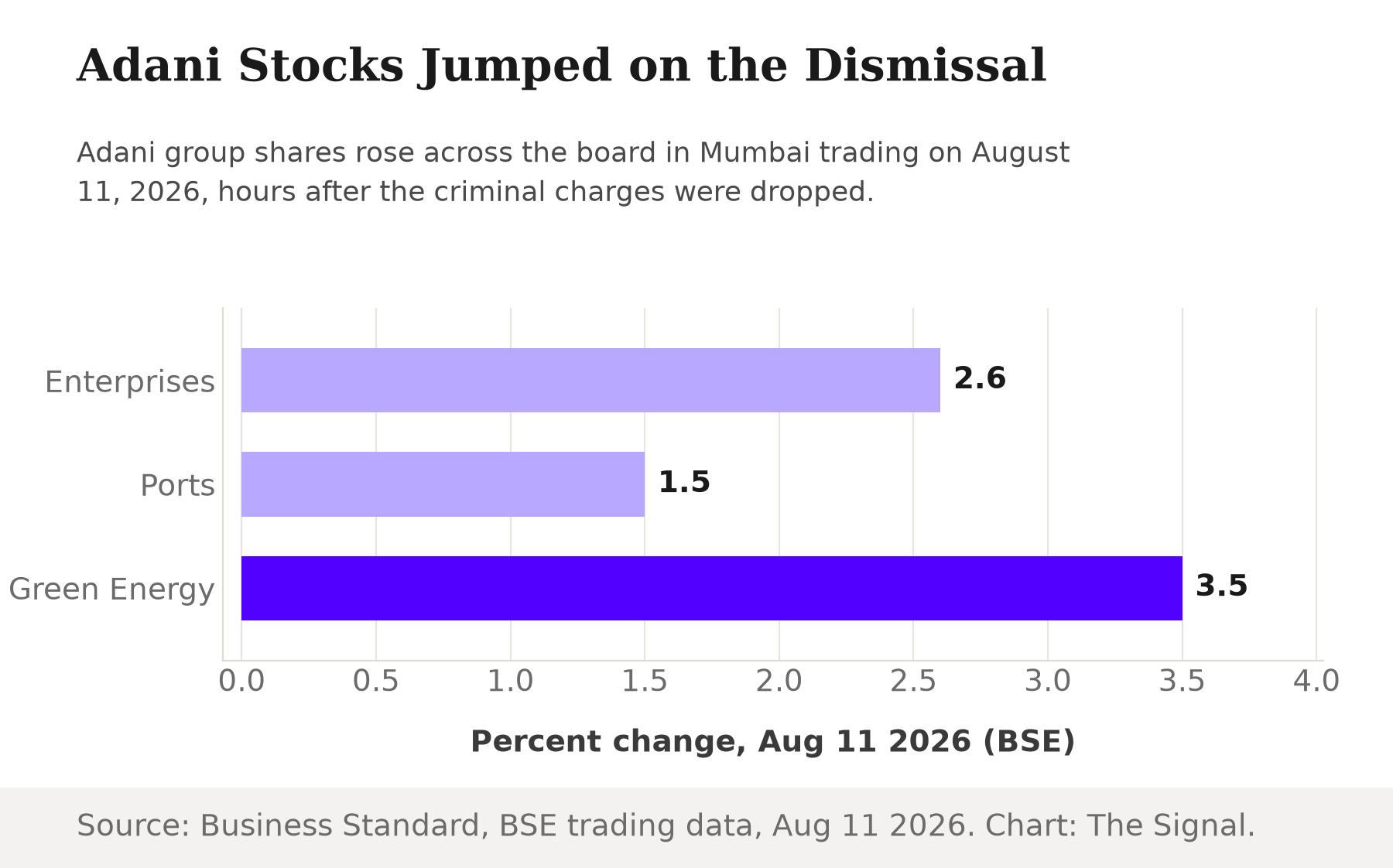
On August 10, 2026, US District Judge Nicholas Garaufis dismissed all criminal charges against Gautam Adani, his nephew Sagar Adani, and Adani Green Energy executive Vneet Jaain, granting the government's own motion to end a case it had spent two years building. Judge Garaufis, while granting the dismissal, wrote that the irregularities in the decision to dismiss the indictment were concerning, and criticized a senior Justice Department official for coordinating with Adani's defense lawyers on the decision. Hours later in Mumbai, Adani group stocks rose as much as 3.5 percent, with Adani Enterprises up 2.6 percent and Adani Green Energy the day's top gainer. Read that sequence quickly and the story writes itself: a two-year-old prosecution has collapsed, and the market has treated it as exoneration.
It is worth pausing on that sequence. Dismissed by request is not disproven at trial. There was no verdict on the merits, because the Justice Department itself moved to end the case before it ever reached one, and the judge who granted that motion signed off with visible reservations about how the request came together.
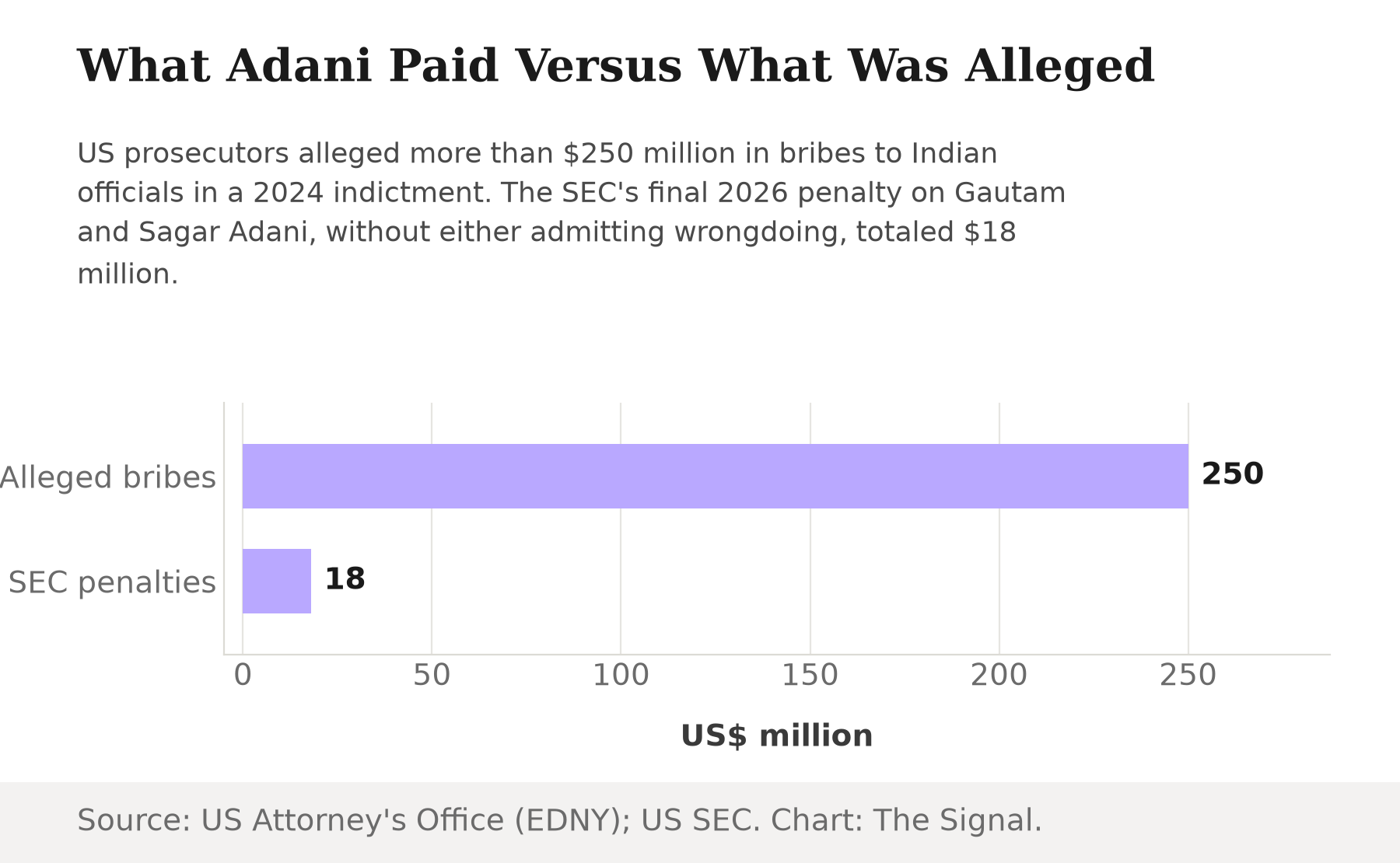
Start with the scale of what prosecutors originally alleged. The November 2024 indictment charged that Gautam Adani, Sagar Adani and Vneet Jaain agreed to pay more than $250 million in bribes to Indian government officials to secure solar energy supply contracts projected to generate more than $2 billion in after-tax profit over roughly 20 years. Two years, a change of US administration, and one dismissal motion later, none of that figure has been tested at trial or contradicted by one. It has simply stopped being prosecuted.
What Adani actually paid
The criminal case is gone, but a parallel civil case is not, and it produced an actual number. In May 2026, the SEC's final judgments required Gautam Adani and Sagar Adani to pay civil penalties of $6 million and $12 million respectively, which together total $18 million, without either admitting or denying the SEC's fraud allegations. That penalty traces to a specific transaction: Adani Green Energy's September 2021 bond offering raised $750 million, including about $175 million from US investors, while the bribery scheme was allegedly still ongoing. The bonds were sold on anti-bribery statements that the SEC says were materially false. The criminal case and the civil case describe the same underlying conduct. Only one of them ended in a payment.
The FCPA matter was not the only US bill Adani Group settled that same month. In a separate case with nothing to do with the bribery allegations, the US Treasury's Office of Foreign Assets Control reached a $275 million settlement with Adani Enterprises Limited over 32 apparent violations of Iran sanctions, after the company purchased liquefied petroleum gas shipments, which OFAC says had actually originated in Iran, between November 2023 and June 2025 from a Dubai-based trader. That penalty alone is more than fifteen times the combined SEC fraud settlement, on a claim the dismissed criminal case never touched at all.
The dismissal closed the criminal case. It did not touch the timeline below.
| Date | Event | Source |
|---|---|---|
| Sept 2021 | Adani Green Energy raises $750M bond, including $175M from US investors, while the scheme was allegedly ongoing | SEC |
| Nov 2024 | DOJ indicts Gautam Adani, Sagar Adani and Vneet Jaain over $250M+ in alleged bribes | DOJ, EDNY |
| Nov 2024 | Moody's and Fitch cut outlook on 7 and 4 Adani entities to negative | Business Standard |
| Feb 2025 | Trump executive order pauses new FCPA enforcement for 180 days | Federal Register |
| June 2025 | DOJ guidelines require senior sign-off on all FCPA cases | DOJ, Office of the DAG |
| May 2026 | SEC final judgments: $6M and $12M penalties, no admission | SEC |
| Aug 10, 2026 | Judge dismisses criminal charges on DOJ's own motion | CBS News |
| Aug 11, 2026 | Adani stocks jump as much as 3.5% in Mumbai trading | Business Standard |
A policy retreat wearing a legal ruling
The dismissal did not happen in a vacuum. In February 2025, President Trump's executive order directed the Justice Department to cease initiating any new FCPA investigations or enforcement actions for a 180-day review period, the first pause in FCPA enforcement since the statute's 1977 passage. Four months later, DOJ's June 2025 guidelines, issued to implement that pause, required that every new FCPA investigation or enforcement action be personally authorized by senior Department leadership rather than career prosecutors alone. Neither document named Adani. They didn't need to. They reset the bar for every FCPA matter still in the pipeline, and the Adani prosecution, built by career prosecutors under a different administration, was still in that pipeline.
DOJ's own account of why it dropped the case fits that reset more than it fits a discovery that the underlying facts were wrong. The department told the court its decision rested on jurisdictional and evidentiary challenges, the predominantly Indian nature of the alleged conduct, and the absence of identified investor losses, not a finding that the underlying allegations were false. Jurisdiction and evidence are objections a defense team typically raises at the start of a case, not two years into one. That they carried the day now, under guidelines that require senior political sign-off before a case like this can even proceed, is the simpler explanation.
What the market priced, twice
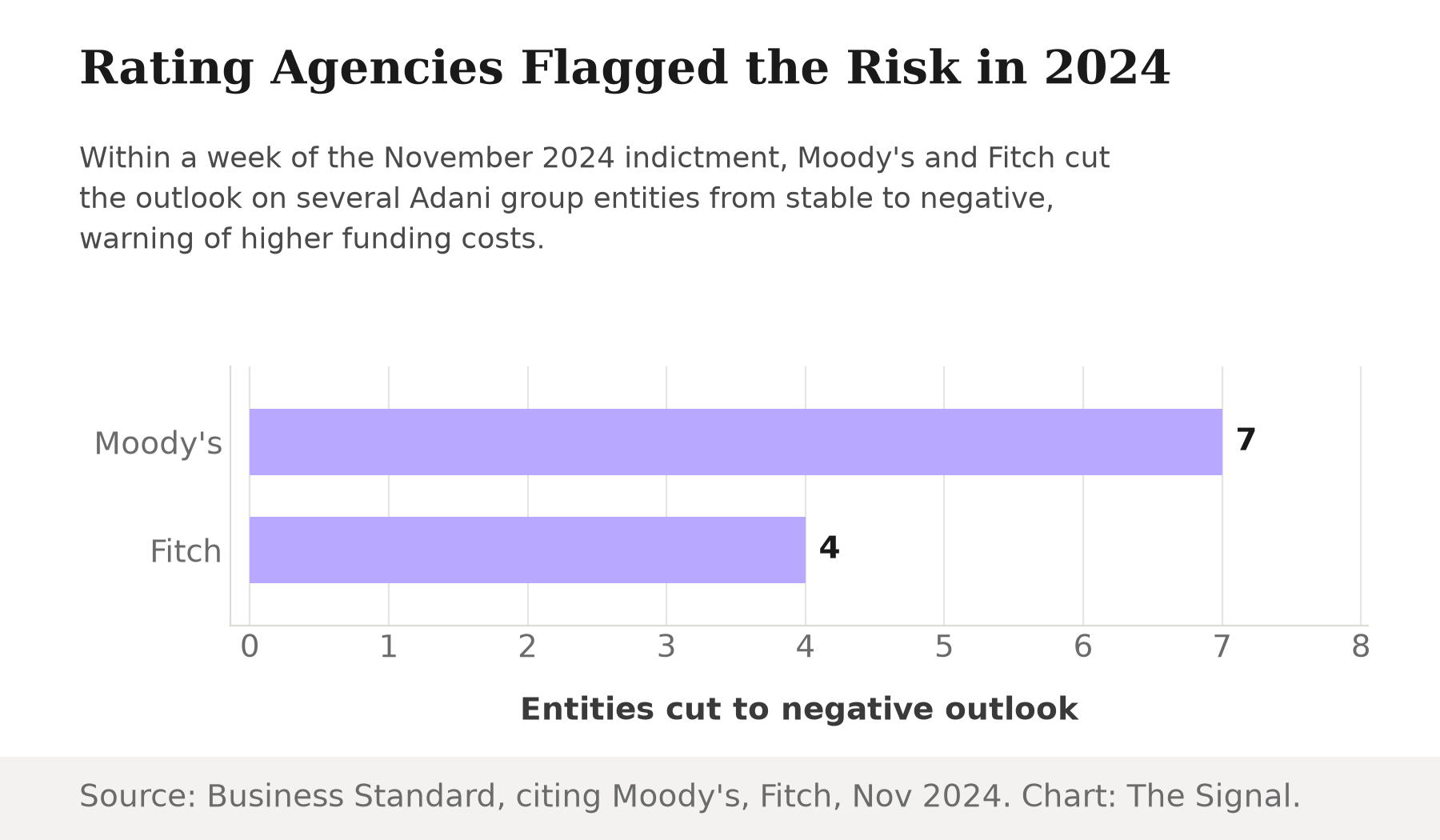
The market has now priced this case in both directions, and neither move was a ruling on guilt. Within a week of the November 2024 indictment, Moody's and Fitch cut their outlook on seven and four Adani group entities respectively from stable to negative, warning that the group's funding costs and access to capital would suffer. That was a bet on legal and governance risk while the federal charges were active.
The August 11, 2026 rally is the mirror image of that downgrade. Adani Enterprises rose 2.6 percent, Adani Ports 1.5 percent, and Adani Green Energy 3.5 percent, a bet that removing the criminal exposure removes the risk the rating agencies flagged.
Both bets can be individually rational. Neither answers the question the case itself never resolved, and a rating agency's outlook, once cut, is not automatically restored just because the indictment that triggered it is gone.
The honest objection
The strongest case against reading this as a political favor is that DOJ's stated grounds are genuinely substantive. Indian authorities had already examined the matter, no investor had come forward with identified losses, and the underlying conduct was overwhelmingly Indian in location and effect: legitimate reasons a federal prosecutor might conclude a case is better pursued, if at all, somewhere else. On this reading, the dismissal is a sober legal retreat from an overreaching prosecution, not a favor to a politically connected businessman.
That case is real, but it does not explain the timing. This exact case survived scrutiny by career prosecutors for two years under a different administration, then ended within eighteen months of an executive order pausing FCPA enforcement across the board and a department memo requiring senior political sign-off on every case like it. A dismissal for genuine evidentiary weakness and a dismissal shaped by a blanket policy pullback look identical from the outside. Judge Garaufis's own words are the reason to doubt it was purely the former: he called the irregularities in the decision to dismiss the indictment concerning, and faulted a senior DOJ official for coordinating with the defense on that decision.
The Signal
Adani's charges are gone. The allegations that produced them are not disproven, because a dismissal on the government's own motion was never built to test them. What survives is the part that came with a number attached: an SEC penalty of $18 million, paid without admission, and the 2024 rating downgrades that priced legal risk into the group's borrowing costs before any court had ruled on anything. Watch three things from here: whether the SEC's civil penalty remains the only figure regulators ever attach to this conduct, whether the FCPA pause DOJ built in 2025 survives past this administration, and whether lenders price Adani's paper as though the legal risk actually left, rather than merely moving from the courtroom to the balance sheet. A case can end at the courthouse steps and still walk out unsettled at the bank.
Reporting basis: the indictment's allegations are per the US Attorney's Office for the Eastern District of New York. The bond-offering and civil-penalty figures are per two separate US Securities and Exchange Commission litigation releases. The Iran-sanctions settlement figure is per the US Treasury's Office of Foreign Assets Control's own settlement announcement. The FCPA enforcement pause is per the executive order as published in the Federal Register, and the implementing guidelines are per the Deputy Attorney General's memorandum. The rating downgrades and the stock reaction are per Business Standard, citing Moody's, Fitch and BSE trading data respectively. The dismissal ruling and the judge's comments are per CBS News; DOJ's stated reasoning for the dismissal is per The Tribune's coverage of DOJ's court filings. The combined SEC penalty figure is The Signal's own calculation from the two individual penalty amounts.