
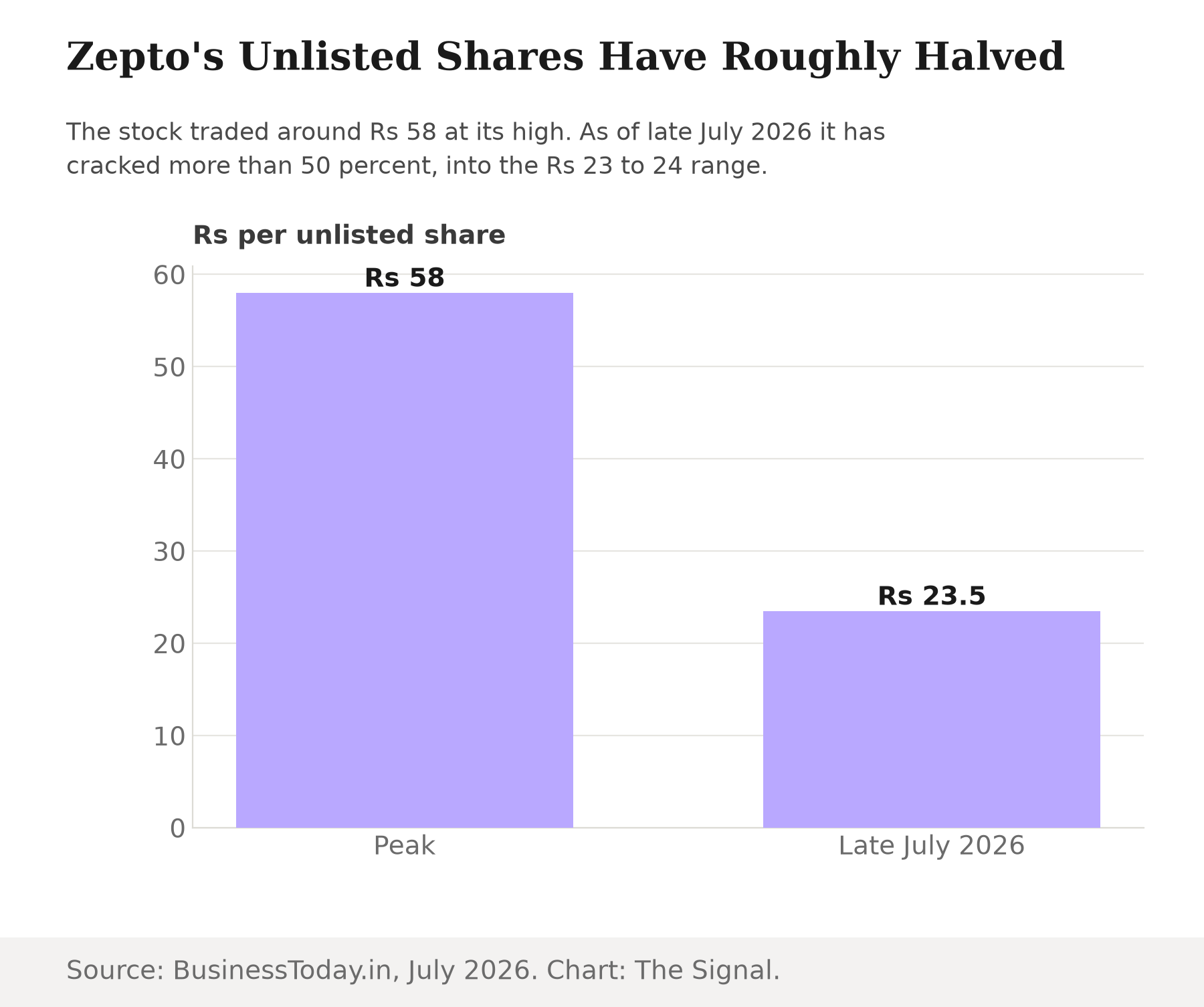
Zepto's unlisted shares have cracked more than 50 percent from their peak of around Rs 58, trading in the Rs 23 to 24 range as of late July 2026. The obvious read is that India's most aggressive quick commerce spender is running out of road: an IPO that keeps slipping, competitors closing in, and investors who have simply stopped believing the story.
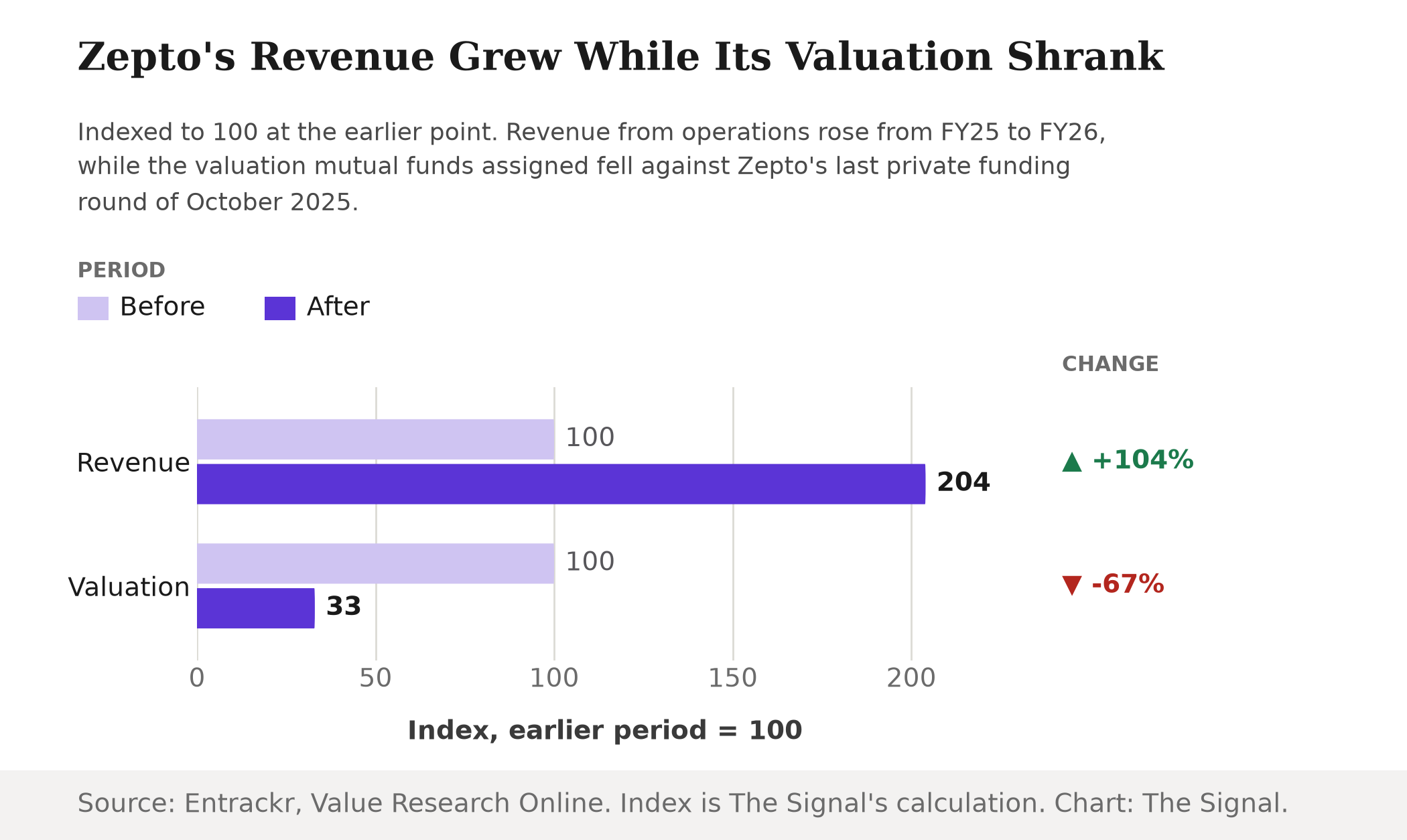
It is worth slowing down on that story. Zepto's revenue from operations more than doubled to Rs 22,624 crore in FY26, up from Rs 11,110 crore in FY25. Its net loss widened too, to Rs 5,905 crore in FY26 from Rs 4,695 crore in FY25, a roughly 26 percent increase, well short of the doubling on the revenue line. That is a company still burning cash to grow, not one whose fundamentals just went bad. Something other than the operating numbers is driving the price down, and it is worth naming precisely what.
The number that carries the story
India's largest mutual funds were asked what Zepto is worth. They said about a third of what its last private investors had paid. That earlier round is a fixed point: Zepto was valued at $7 billion in a $450 million funding round closed in October 2025. A third of that is roughly $2.3 billion, our calculation from the two figures. Put the revenue line and the valuation line next to each other, indexed to the same starting point, and the mismatch is the whole story.
A rule, not a verdict on the business
The mechanism behind that second bar is regulatory, not analytical. India's mutual fund industry manages Rs 82.22 lakh crore in assets as of June 30, 2026, nearly all of it money that ordinary savers can redeem on any business day. To protect that redeemability, AMFI, acting under a SEBI mandate, issues periodic, binding valuation circulars that mutual funds must follow for every security they hold, listed or not. A fund cannot simply carry an unlisted startup stake at whatever the last funding round said it was worth. It has to mark that stake using the circulars' prescribed methodology, which pulls in fresher evidence, including how the same shares are trading in the unlisted market.
That is a mechanical process applied on a schedule, not a fresh judgment about whether Zepto's quick commerce business is sound. The stock crashing on unlisted desks and the mutual fund industry's mark-to-market obligation are two views of the same underlying discipline. They are not two independent verdicts that happen to agree.
It is not just Zepto
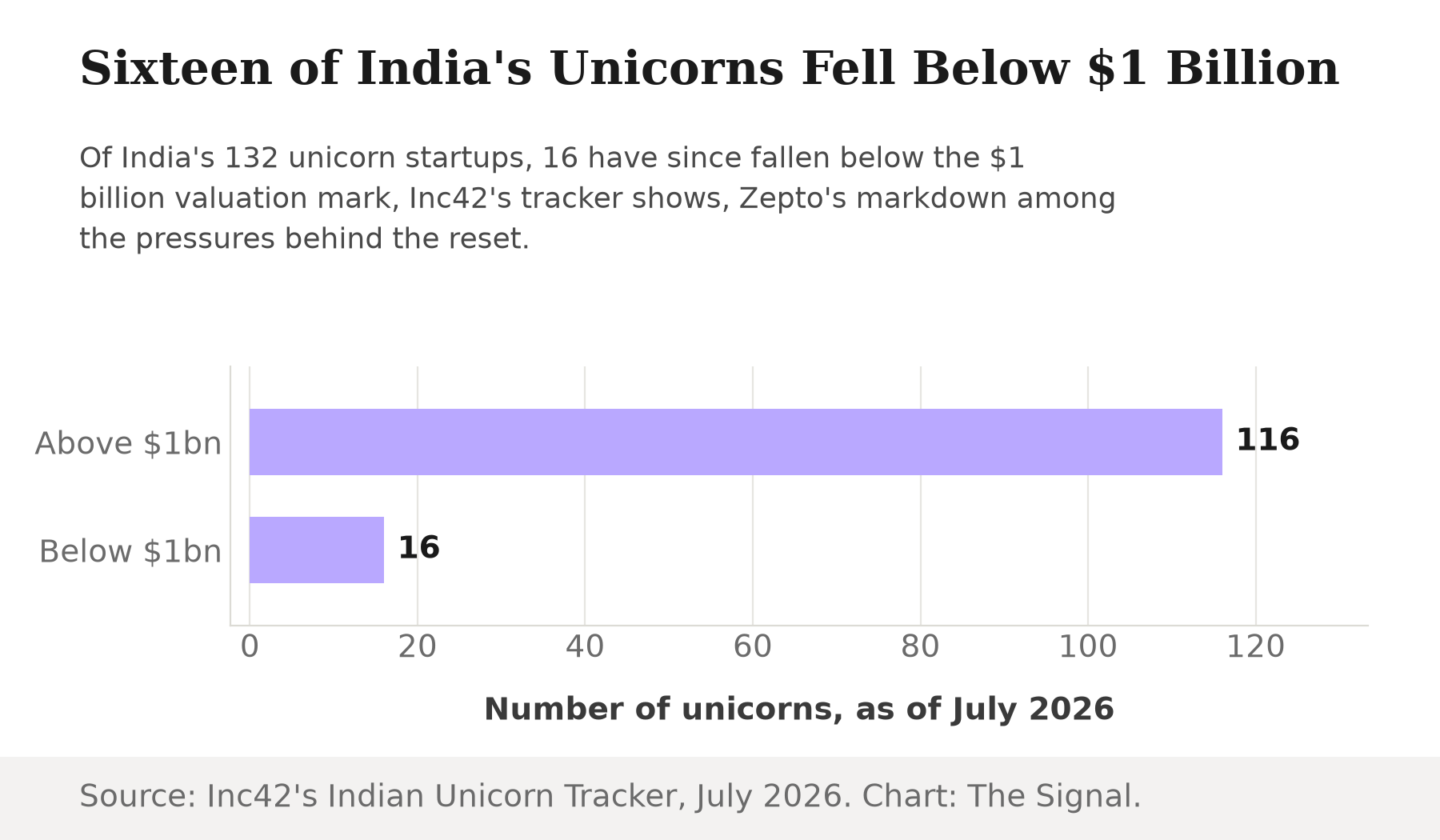
Sixteen of India's 132 unicorn startups have slipped below the $1 billion valuation mark since being named unicorns, Inc42's tracker shows. Zepto is the highest-profile name going through the reset in public view this year, but it is one of sixteen, not an isolated case of a single company's business unravelling.
Nor is the sector itself shrinking under Zepto's feet. India's quick commerce GMV grew roughly 100 percent year on year in January 2026. A category growing that fast looks nothing like a demand collapse. The repricing is happening in the accounting of what these companies are worth, not in the market they are selling into.
Not every markdown in this story carries the same reasoning, though, and the difference is worth stating plainly.
Two different discounts, two different logics are sitting on Zepto at once.
| Marker | What it valued Zepto at | Measured against |
|---|---|---|
| Domestic mutual funds' book mark | About a third of the last private round | The $7 billion round of October 2025 |
| Top mutual funds' and insurers' IPO ask | 30 to 40 percent below the already-cut IPO price | The reduced IPO valuation itself |
Source: Value Research Online; Outlook Money.
The first row is the mechanical mark this piece has been describing. The second is different in kind: top mutual funds and large domestic insurers are seeking valuations as much as 30 to 40 percent below Zepto's already-reduced IPO valuation, citing the business it does not have, a food delivery arm of the kind Swiggy and Zomato both operate and monetise. That "already-reduced IPO valuation" is not an abstraction: Zepto's own IPO ask, before that institutional pushback, sat in the $4 billion to $5 billion range, itself already a cut from the $7 billion private round. That is not a valuation rule. Instead, investors are pricing a specific gap in Zepto's product portfolio against peers that have one more revenue line than it does.
The honest objection
The strongest case against the "it's just the rule" framing is that institutional ask citing Zepto's missing food delivery business. If large buyers are demanding a discount for a specific, named product gap, part of this repricing is a genuine reassessment of the business, not a mechanical mark-to-market exercise. A rule does not usually cite a missing product line as its reason.
That case is real, but it does not explain the scale of what has actually happened. The IPO-specific ask tops out at 30 to 40 percent below the reduced IPO valuation. The book mark mutual funds have already applied cuts the last funding round's value by roughly two-thirds, about twice as steep. A missing food delivery business can plausibly justify the smaller number. It does not obviously justify the larger one, and it says nothing about why fifteen other Indian unicorns, with no missing vertical in common with Zepto, have separately fallen below the same billion-dollar line. A portfolio gap is specific to one company. A rule applied on a schedule, across a market where GMV was still growing at roughly 100 percent year on year as recently as January 2026, is a market-wide one, and the market-wide one is the bigger number here.
The Signal
Zepto's business and Zepto's price are answering two different questions right now, and the coverage has been treating them as one. The revenue line answers whether quick commerce still works as a business; on the numbers available, it does. The valuation line answers what a fund legally obligated to mark its book has to write down when the freshest evidence of price is a crashing unlisted stock; on the numbers available, that obligation, not a fresh read on the app, is the one moving the price. Watch what happens when Zepto or a peer actually lists: if the listed price lands near the mutual fund mark rather than near the last private round, the rule was reading the market correctly, and every unlisted unicorn still holding a stale funding-round valuation has been given fair warning. If it lands closer to the private round instead, the mark-to-market discipline overshot on the way down, the same way private valuations overshot on the way up.
Reporting basis: the unlisted share price and IPO-related reporting on Zepto is per BusinessToday.in. The mutual fund valuation mark, the thesis-carrying figure behind the headline, is per Value Research Online alone; no other source in this piece's reporting independently corroborates the "about a third" figure. The separate institutional IPO valuation ask, and the $4-5 billion range it was measured against, is per Outlook Money and its separate reporting on the IPO's valuation talks. Zepto's FY26 and FY25 revenue figures are per Entrackr's reporting of the company's regulatory filings, and its FY26 and FY25 net loss figures are per Outlook Business's reporting of the same filings. The Indian unicorn count and the tally of unicorns that have fallen below $1 billion are from Inc42's Indian Unicorn Tracker. Quick commerce sector GMV growth is from Redseer Strategy Consultants. India's mutual fund industry AUM is from AMFI's own published data, and the existence of its binding valuation circular regime is from AMFI's circular registry. The $2.3 billion implied mutual fund valuation, the 26 percent loss-growth figure, and the indexed revenue-versus-valuation comparison are The Signal's calculations from those figures.