India's roads have killed more people nearly every year since the pandemic. So when the road transport ministry's own real-time accident-reporting portal showed deaths on national highways easing from 53,372 in 2023 to 52,609 in 2024, the figures read as the first genuine sign of a turn: two straight years without a rise on the country's most dangerous class of road. After a run of increases stretching back to the Covid-disrupted low of 2020, that would be real news.
It is worth slowing down on that. The ministry keeps a second, older count of the same thing, for the same year, and it says the opposite. In its annual Road Accidents in India report, the ministry recorded 64,772 fatalities on National Highways, including Expressways, in 2024, or 36.6 percent of the country's total road deaths. That is not a decline from the portal's 52,609. It is a gap of 12,163 deaths, our calculation from the two government figures, for the same roads in the same year.
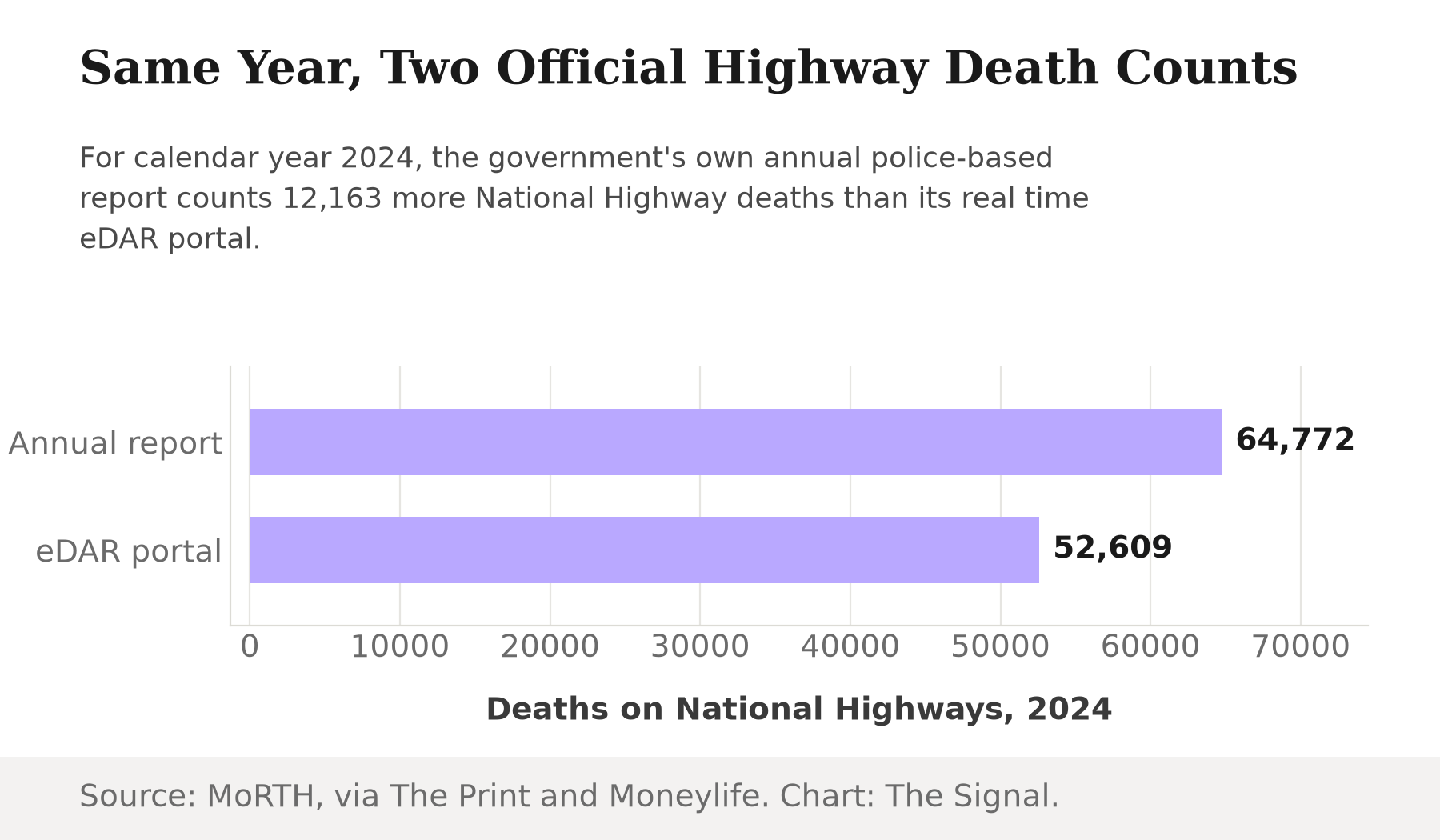
Source: The Print, citing the ministry's Road Accidents in India 2024 report; Moneylife, citing the ministry's eDAR portal figures. Chart: The Signal.
Two tallies, one ministry
The lower number comes from the government's electronic Detailed Accident Report system, known as eDAR, a portal that logs accidents as police and hospitals file them. It is the source for the 53,372-to-52,609 figures, and for a further 26,770 deaths on national highways in just the first half of 2025, all disclosed in a Rajya Sabha reply from road transport minister Nitin Gadkari.
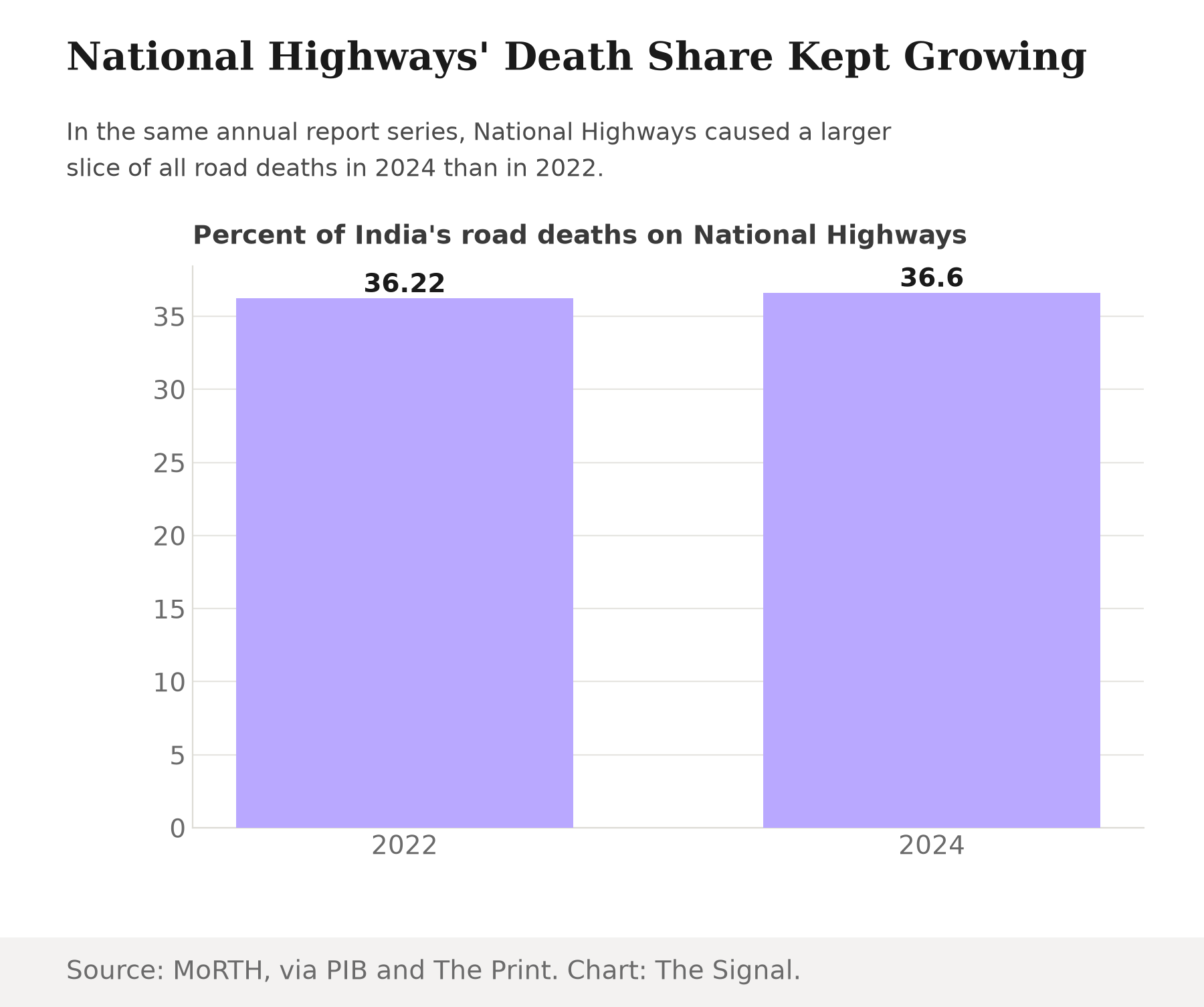
The higher number comes from a different, older exercise: the ministry's annual Road Accidents in India report, compiled from state police returns and published roughly seven months after each calendar year ends. That is the series that put National Highways, including Expressways, at 36.22 percent of India's road accident deaths in 2022, with 61,038 fatalities out of 1,68,491 nationally, and it is the same series that recorded 64,772 highway deaths, a larger share of a larger total, two years later. The two counts are not measuring different things. They are two separate government efforts to measure the same national highway network in the same year, and for 2024 they land more than 12,000 deaths apart.
The two government counts of National Highway deaths only overlap in one year, 2024, and disagree by 12,163.
| Period | Road Accidents in India report | eDAR portal tally |
|---|---|---|
| 2022 | 61,038 deaths (36.22% of total) | not published for this year |
| 2023 | not published for this year | 53,372 deaths |
| 2024 | 64,772 deaths (36.6% of total) | 52,609 deaths |
| H1 2025 | not published for this year | 26,770 deaths |
Source: Ministry of Road Transport and Highways, via PIB; The Print; Moneylife.
The national trend never bent
Whichever highway count a reader prefers, it sits inside a national trend that kept climbing. India's road accident fatalities fell to 138,383 in the Covid-disrupted year of 2020, then rose every year through 2022 to 168,491. They kept rising to 177,175 in 2024, and further still to 183,382 in 2025, as accidents nationally rose 5.3 percent to over 5.13 lakh. The line has one dip in six years, and it is the pandemic year.
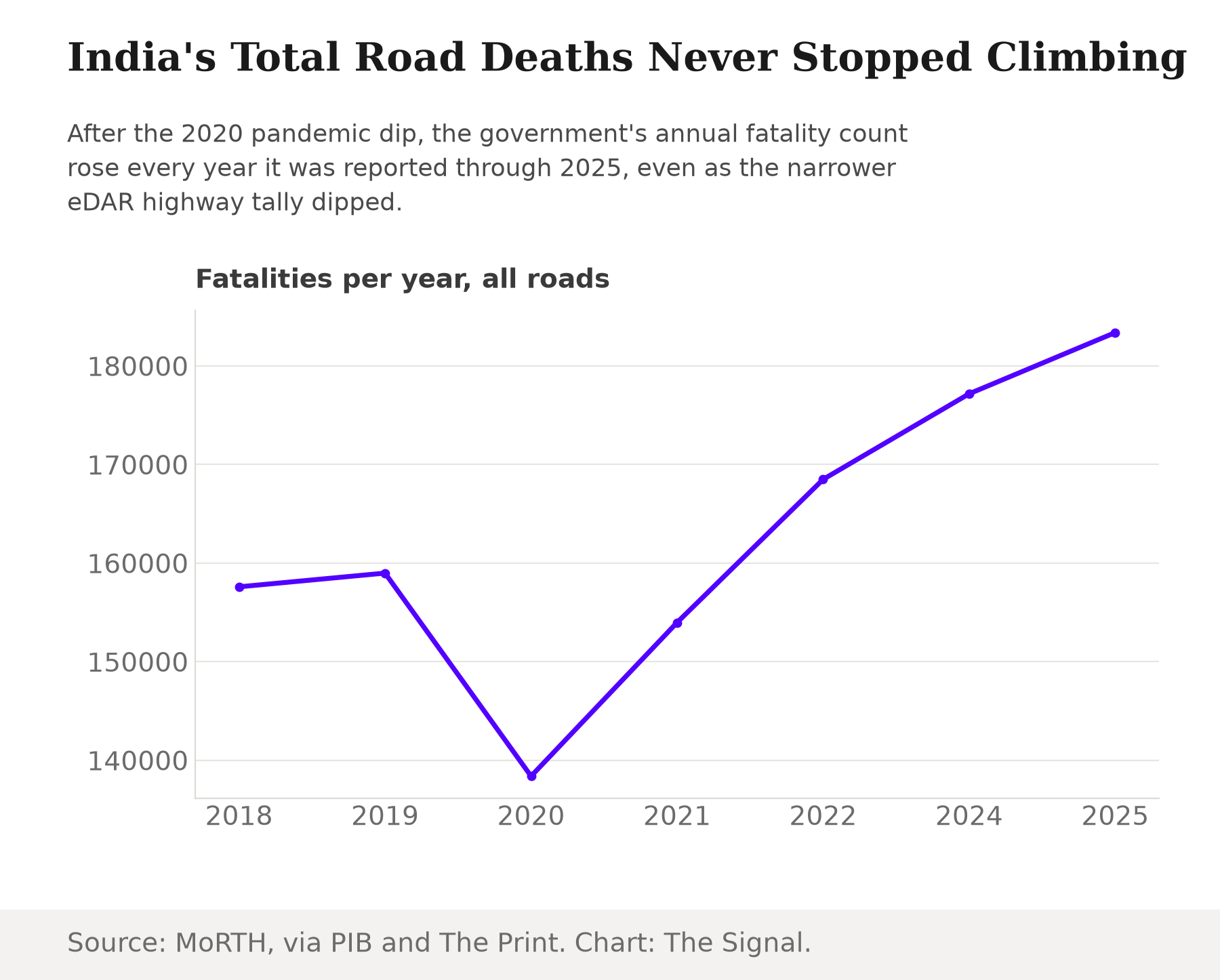
Source: Ministry of Road Transport and Highways, via PIB (2018 to 2022); The Print (2024); Telangana Today (2025). Chart: The Signal.
National Highways have not been shrinking as a share of that toll either. Their share of all road deaths moved from 36.22 percent in 2022 to 36.6 percent in 2024, a small move but the wrong direction for a network supposedly getting safer. That share is already lopsided against the size of the network carrying it: National Highways make up just 2.1 percent of India's total road length, yet accounted for 36.6 percent of the country's road deaths in 2024, a share of deaths roughly 17 times the network's share of the roads.
Source: Ministry of Road Transport and Highways, via PIB (2022); The Print (2024). Chart: The Signal.
What is still killing people on the highways
The mechanisms behind the toll have not gone away. Over-speeding caused 82,124 road accidents in India in 2025, about 16 percent of the national total, the single largest identified cause the ministry reported. And the danger is concentrated in known locations: 6,358 accident-prone stretches the ministry calls "black corridors" on India's national highways claimed 37,164 lives between 2023 and 2025. Those corridors are identified, mapped and, on paper, prioritized for fixes. They are still killing at a rate that would fill a mid-sized town every three years.
The honest objection
The strongest case for the eDAR decline being real is that eDAR is arguably the more precise instrument, geo-tagging incidents close to real time, rather than waiting for state police departments to compile and forward the annual returns the ministry aggregates into its yearly Road Accidents in India report many months later. On that reading, the older exercise's higher count may partly reflect classification lag or broader attribution rules for what counts as a national highway accident, and the portal's smaller number is the one worth trusting as the leading indicator.
The ministry's own account cuts against that reading. In the methodology chapter of its Road Accidents in India 2024 report, the ministry states plainly that the report "has not been prepared on the basis of eDAR data," because the eDAR platform is still under phased national rollout, with gaps in state-level data completeness, timeliness and, in its own words, no "nationally audited, reconciled and time-series-consistent dataset" yet fit for official statistics. By the compiler's own admission, the lower eDAR figure is the less complete one, not the more precise one.
That case does not survive contact with the portal's own newer data. The eDAR portal itself recorded 26,770 deaths on national highways in just the first half of 2025, which annualizes to roughly 53,540, our calculation from doubling that figure. That is not a continuation of the fall from 53,372 in 2023 to 52,609 in 2024. It is a return to essentially the same level. Even by the more favorable of the ministry's two counts, the one-year dip did not become a trend.
The Signal
A ministry cannot claim its safest year on one count while its own broader count, and its own national totals, say otherwise. The honest reading of 2024 is not that highways got safer or that they got more dangerous. It is that India's road-safety data currently support both claims at once, depending on which government office's spreadsheet is doing the counting. The ministry's own methodology notes concede the newer, lower count is the less complete instrument, not the more precise one: the older, police-reported count is still the one the ministry trusts enough to publish as its official statistic. The number everyone should be watching, the national total, has not stopped climbing since the pandemic. Whether the eDAR portal's dip was real progress or a rounding blip will only be settled by what it shows for 2026, measured against itself and not against the headline someone chose to read off it first.
Reporting basis: the 2022 National Highway death share and the 2018 to 2022 national fatality series are from Press Information Bureau releases by the Ministry of Road Transport and Highways. The 2024 national and National Highway figures are as reported by The Print, drawing on the ministry's own Road Accidents in India 2024 report. The 2023, 2024 and first-half-2025 eDAR portal figures are as reported by Moneylife, from a Rajya Sabha reply by road transport minister Nitin Gadkari. The 2025 national accident and fatality totals and the over-speeding share are as reported by Telangana Today and Assam Tribune, both drawing on the same written reply by the minister to the Lok Sabha. The black-corridor fatality count is as reported by Outlook India, from a separate Rajya Sabha reply by the ministry. The National Highway road-network share, the fatality distribution by road category, and the ministry's own account of why the Road Accidents in India 2024 report was not built on eDAR data are all from the report's methodology and analysis chapters, published directly by the Ministry of Road Transport and Highways. The 12,163-death gap between the two 2024 counts, the concentration-of-risk multiple for National Highways, and the annualized first-half-2025 eDAR figure are The Signal's calculations from those government figures.