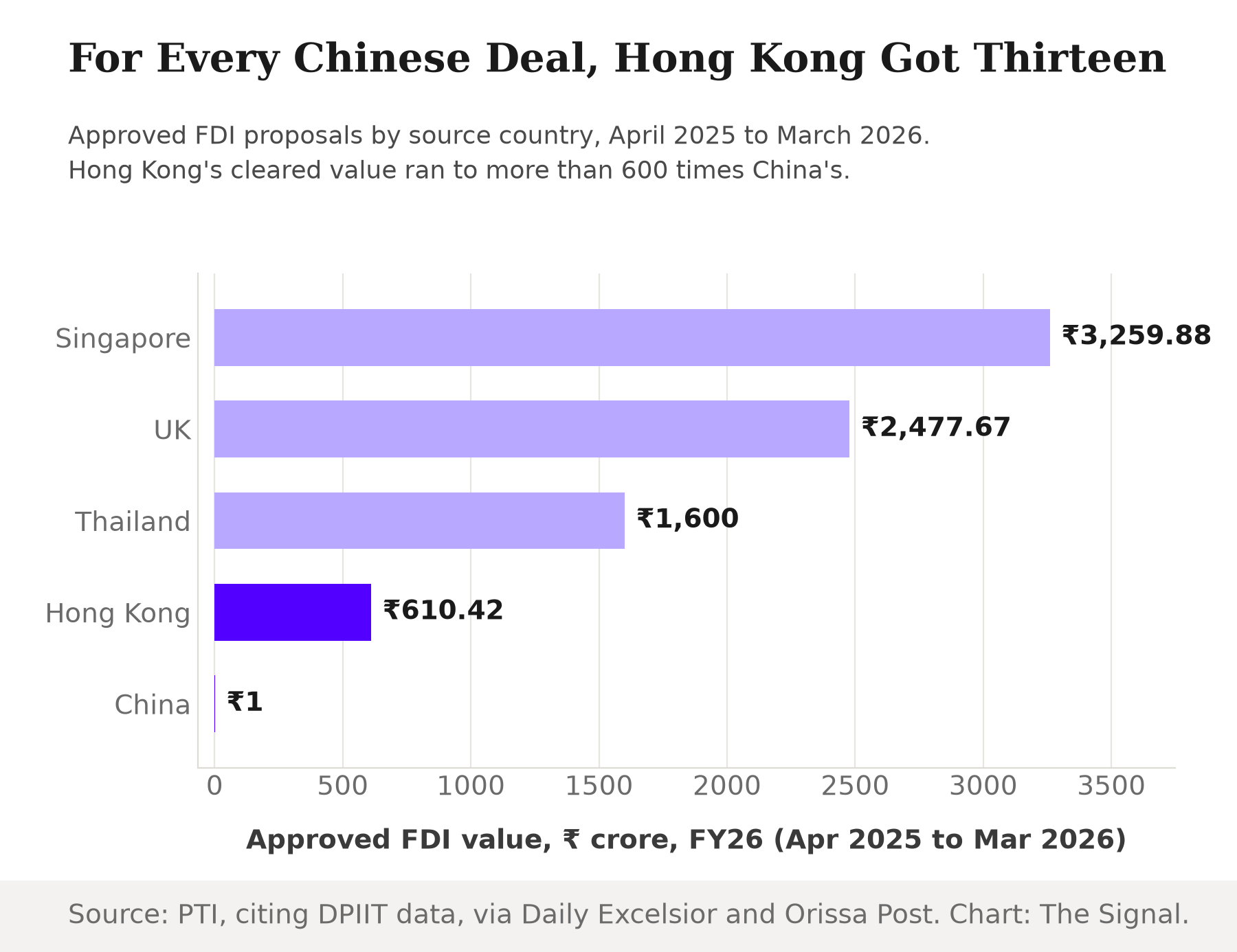
In the fiscal year that ended in March 2026, India's government cleared 63 foreign direct investment proposals worth a combined Rs 10,292.67 crore, or $1.18 billion. Singapore led the pack with five proposals worth Rs 3,259.88 crore, followed by the UK's five proposals worth Rs 2,477.67 crore and Thailand's two worth Rs 1,600 crore. Buried in that same release is a single line about China: one approved proposal, worth Rs 1 crore. The read-across is obvious and, on its own, unremarkable: five years after Press Note 3 forced Chinese investors onto the slow, discretionary government-approval route, Chinese capital has all but stopped clearing it.
It is worth slowing down on that. The same release that reported China's single approval also reported Hong Kong's: 13 proposals, worth Rs 610.42 crore. By count, Hong Kong outpaced China 13 to 1, and by value the gap is too large to state as a simple ratio: Rs 610.42 crore against Rs 1 crore, a difference of more than 600 times.
| Source country | Proposals approved, FY26 | Value approved, ₹ crore |
|---|---|---|
| Singapore | 5 | 3,259.88 |
| UK | 5 | 2,477.67 |
| Thailand | 2 | 1,600.00 |
| Hong Kong | 13 | 610.42 |
| China | 1 | 1.00 |
Source: PTI, citing DPIIT data, via Orissa Post and Daily Excelsior. Chart: The Signal.
That gap is the reason to look past the obvious read. The rule built to keep Chinese capital out is on the books and working exactly as designed against direct Chinese filings. But the rule meant to screen China does not treat Hong Kong as China.
The rule was built around a land border
Press Note 3, issued on 17 April 2020 to curb opportunistic pandemic-era takeovers of Indian companies, requires "an entity of a country sharing land border with India, or where the beneficial owner of an investment into India is situated in or is a citizen of any such country" to invest only through the government route rather than the faster automatic route. China shares a land border with India. Hong Kong, a special administrative region on the South China coast, does not. An investor of record in Hong Kong is not automatically pulled into the government-route queue the way a mainland Chinese entity is; it only lands there if Indian screening traces its beneficial ownership back to a land-border country.
That beneficial-ownership language is not incidental; it is the mechanism the government itself has been actively tightening. In March 2026, DPIIT's Press Note No. 2 amended the FDI policy to define "beneficial owner" specifically for an investment routed through an entity incorporated in a country other than a land-border country, using the same ownership criteria set out in India's anti-money-laundering rules. In plain terms, the amendment is written to reach through exactly the kind of structure at issue here: an investment that shows up on paper as Hong Kong, Singapore or any third jurisdiction, tracing back to whoever actually controls it.
The government's own March 2026 amendment targets the routing structure this data shows.
The same Cabinet decision also eased the rule at its edges: land-border-country investors holding a non-controlling beneficial stake of up to 10% can now use the automatic route, and proposals in specified manufacturing sectors, including capital goods and polysilicon and ingot-wafer production, get a firm 60-day decision. The direction of the March 2026 changes is not a blanket crackdown; it tightens the ownership test in one place while loosening the route in another, narrower one.
This is not new, and the approval pipeline is thinner too
The FY26 pattern repeats FY25 almost exactly: India approved just one Chinese proposal in 2024-25 too, worth Rs 28.71 crore, out of 82 total government-route approvals in 2024-25. Two fiscal years running, China's approved count has been exactly one. What moved is the denominator: total approvals fell from 82 in FY25 to 63 in FY26. China's count held flat at one in both years even as the overall pipeline narrowed, so Hong Kong's 13 proposals took a visibly larger slice of a smaller pool.
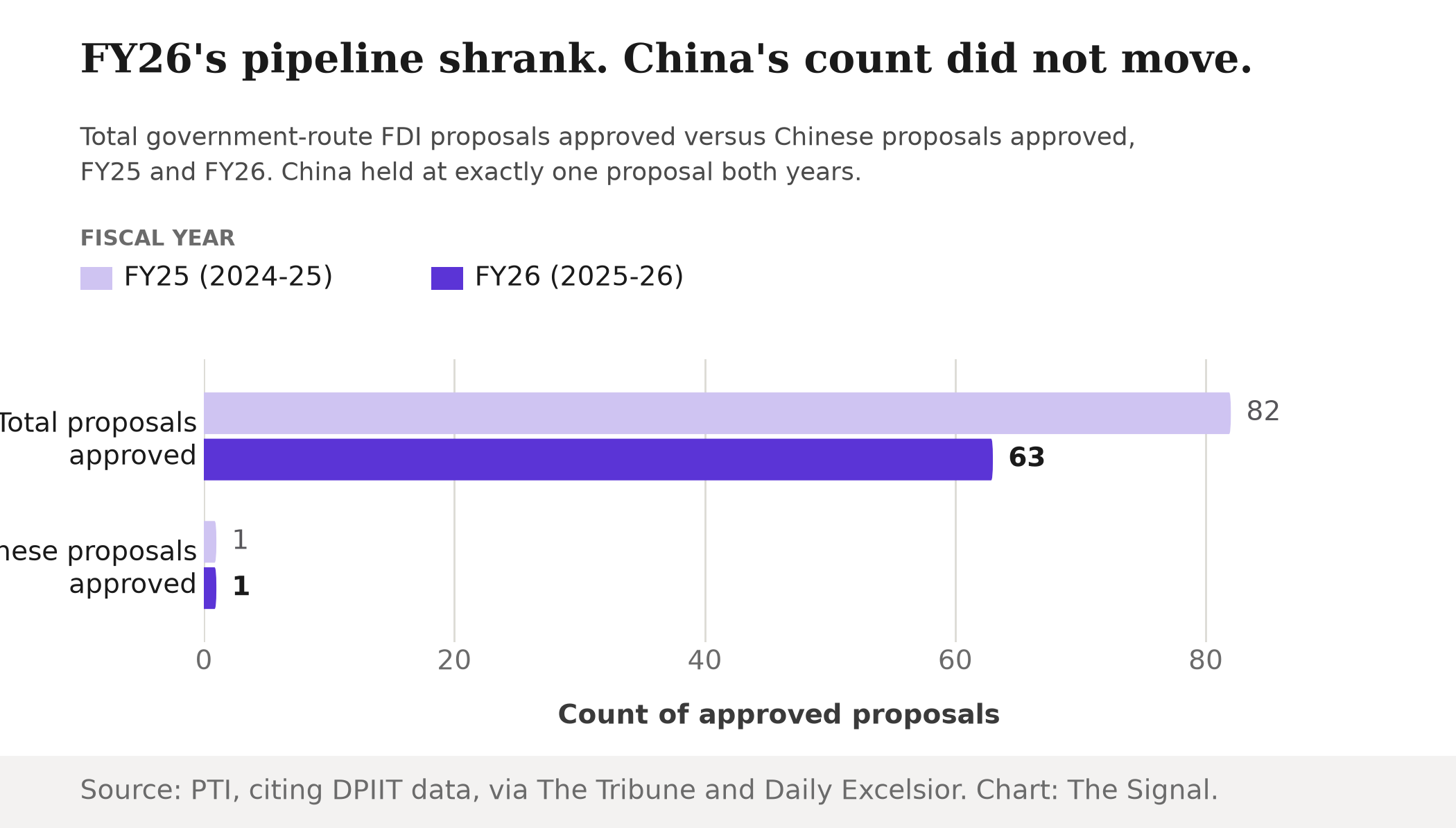
Source: The Tribune, for FY25; Orissa Post, for FY26. Chart: The Signal.
The historical gap was never this wide
If Hong Kong were simply a bigger natural conduit for capital into India than China, a wide gap would be unremarkable on its own. The 26-year record says otherwise. On DPIIT's cumulative table of country-wise FDI equity inflow from January 2000 to March 2026, Hong Kong ranks 15th among source countries with $4,912.57 million, and China ranks 23rd with $2,512.60 million, out of a grand total of $788,529.07 million. Over more than two and a half decades, Hong Kong's lead over China is under two to one, and both sit well below the top-ranked source, Singapore, at $194,689.14 million.
Twenty-six years of cumulative data show a 2-to-1 gap. One fiscal year shows a 13-to-1 gap in count and a 600-to-1 gap in value.
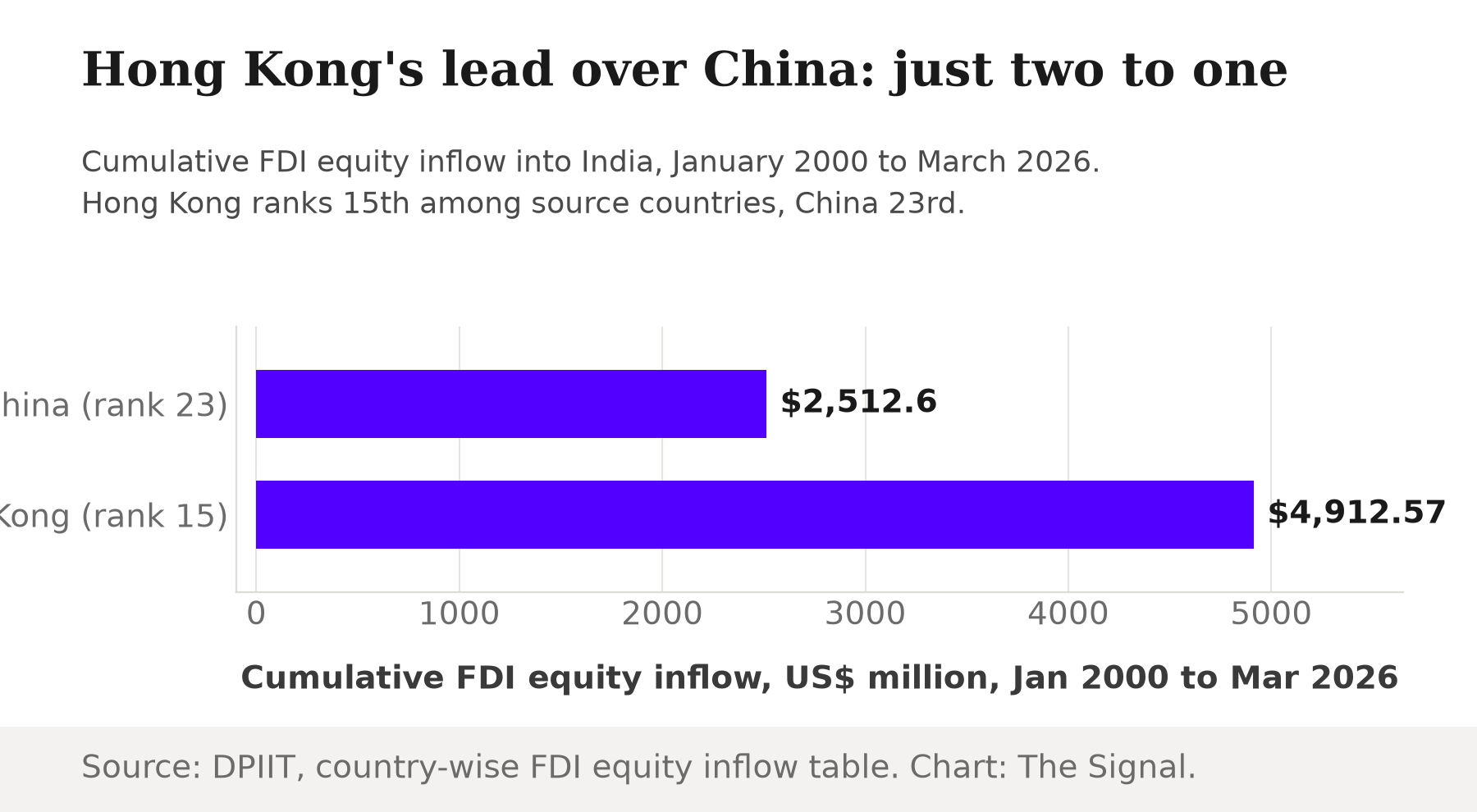
Source: DPIIT's country-wise/year-wise FDI equity inflow table. Chart: The Signal.
A conduit that was twice China's size across 26 cumulative years does not organically become 600 times China's size in a single year of approvals. Something changed the shape of the flow, in the same year Press Note 3's government-route bottleneck has had the longest to bind on direct Chinese filings.
The honest objection
The strongest case against reading this as evasion is that Hong Kong is a major, independent financial centre in its own right, home to global banks, holding companies and funds with no Chinese beneficial owner at all. A 13-to-1 approval gap could simply reflect that a lot of non-Chinese capital, and legitimately Hong-Kong-domiciled capital, routes through the territory for reasons that have nothing to do with China's land-border restriction. On this reading, the amended beneficial-ownership rule is doing its job correctly by letting genuinely non-Chinese Hong Kong capital through, and the small number of Chinese-flagged approvals just reflects that direct mainland filings have dried up post-2020.
That case holds for some, perhaps most, of Hong Kong's 13 approved proposals. It does not explain why the gap moved so sharply against the 26-year base rate in the very fiscal year Press Note 3 scrutiny of China has had the longest to bind. Nor does it explain why the government judged it necessary, in the same March 2026 order, to write a beneficial-ownership definition aimed specifically at investment "routed through an entity incorporated in a country other than" a land-border country. A rule does not usually get sharpened against a pattern that is not occurring at all.
The Signal
None of the matrix of public data here can say how many of Hong Kong's 13 approved FY26 proposals trace back to a Chinese beneficial owner; that determination sits inside DPIIT's case files, not in any published table. What the public numbers do show is a rule that screens by the investor's registered jurisdiction first, and a government that just rewrote the beneficial-ownership definition to reach through exactly that kind of third-jurisdiction structure. Against that backdrop, an approval pattern where the jurisdiction next door to China outperformed China 13 to 1 in count and roughly 600 to 1 in value emerged, in a year when the historical base rate said the gap should be closer to 2 to 1. Watch whether FY27's Hong Kong numbers move once the amended beneficial-ownership test has a full year to run. If the gap narrows, the March 2026 amendment closed what the data suggests was open. If it does not, the rule has a jurisdiction-shaped hole that a definition change alone has not filled.
Reporting basis: the FY26 and FY25 approval counts and values, including the China and Hong Kong figures and the FY26 country breakdown, are Press Trust of India reports citing DPIIT data, as carried by Daily Excelsior, Orissa Post and The Tribune; those three outlets recarry the same PTI wire copy and are counted as one origin. The cumulative country-wise FDI equity inflow rankings and totals are from DPIIT's own published table. The Press Note 3 (2020) rule and the March 2026 Cabinet amendment, including the beneficial-ownership definition and the eased automatic-route and fast-track provisions, are from Press Information Bureau releases and DPIIT's Press Note No. 2 (2026 Series). The value multiple between China's and Hong Kong's FY26 approvals and the comparison between the FY26 gap and the 26-year cumulative gap are The Signal's calculations from those figures.