
On 30 July 2026, the Reserve Bank of India issued a stack of amendment directions covering commercial banks, small finance banks, regional rural banks, urban co-operative banks and payments banks. The headline change is narrow and technical: a bank now has the freedom to offer a differential interest rate on bulk deposits, effective 1 October 2026. That freedom is tied to the differential run-off rate applicable to that funding under the Liquidity Coverage Ratio framework. Read as banking-desk housekeeping, it sounds like nothing much: banks may price large deposits differently from small ones. In practice, most banks already did something close to that quietly, negotiating with their biggest corporate and treasury clients while retail depositors took whatever the published card rate said. The new rule does not invent that two-tier system. It gives half of it a formula, a start date, and a legal basis to point to.
It is worth slowing down on the word "half." Small finance banks got the identical LCR-linked pricing freedom in their own Second Amendment Directions, 2026, also effective 1 October 2026. Regional rural banks, urban co-operative banks and payments banks did not. Their versions of the same amendment round move the other way, tightening the rule that a smaller institution's deposit rate cannot be a matter of discretion at all. The freedom to price bulk money differently is not a system-wide upgrade. It runs along a line between which banks the RBI now treats as sophisticated enough to run a liquidity-risk model, and which it does not.
That line has a precise number on it. A "bulk deposit," for the banks that get the new freedom, is legally defined as a single Rupee term deposit of 3 crore rupees or more. Below that line, a saver at a commercial bank or small finance bank still gets one published card rate, same as everyone else. At or above it, from 1 October 2026, the bank can price the money however its liquidity model says it is worth, and that model just became a lot friendlier to the depositor with the bigger cheque.
The math behind the freedom
The math changed before the pricing rule did. Under RBI's Basel III Liquidity Coverage Ratio framework, unsecured wholesale funding from non-financial corporates was re-rated to a 40 percent stressed cash run-off rate from 1 April 2026, down from the 100 percent run-off previously assumed for that funding. A run-off rate is a stress-test assumption: the share of a given funding source regulators assume would flee a bank within 30 days if trouble hit. A 100 percent run-off treated every rupee of that corporate money as likely to walk out the door inside a month. Under the new 40 percent figure, less than half of that money counts as flight risk.
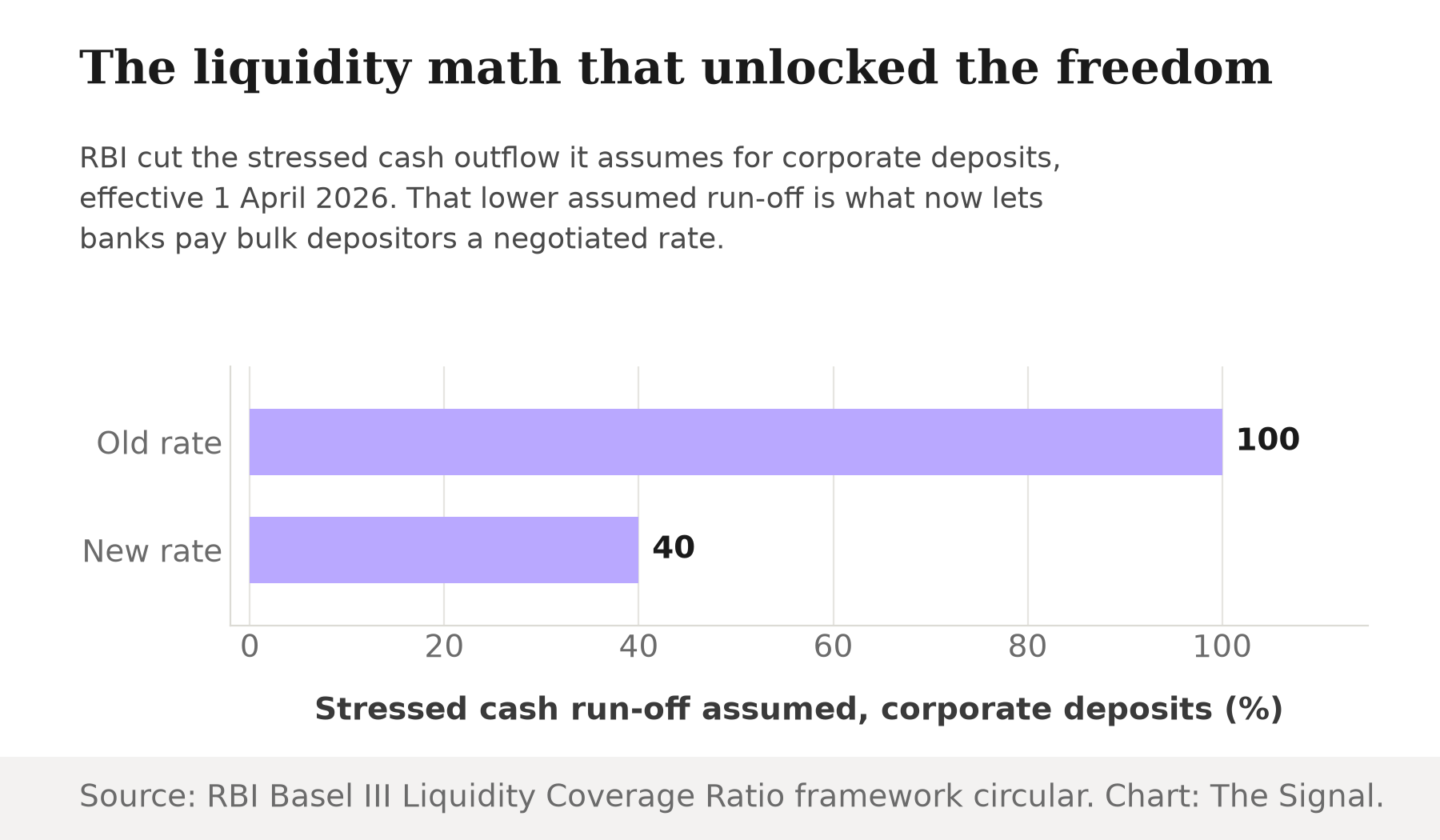
Source: RBI's Basel III Liquidity Coverage Ratio framework circular. Chart: The Signal.
Less assumed flight risk means a bank needs to set aside fewer high-quality liquid assets against that funding, which makes it cheaper to hold. The new bulk deposit rule turns that regulatory arithmetic directly into pricing permission: the Commercial Banks Second Amendment Directions tie the rate a bank may offer explicitly to "the differential run-off rate applicable to deposits or unsecured wholesale funding under the LCR framework", the same language used almost word for word in the Small Finance Banks version. Money that got cheaper to hold, in other words, is now formally allowed to earn its depositor a better rate. A retail depositor's fixed deposit at the same bank is still priced off the published card rate, in full, regardless of what the LCR framework assumes about how stable that particular rupee is.
Who gets to price this way, and who does not
The amendment round did not touch every kind of deposit-taking institution the same way. Regional rural banks get no LCR-linked freedom at all; their directions instead reaffirm that deposit rates, including on bulk deposits, must be uniform across all branches and customers, for deposits of similar amount accepted on the same date. Urban co-operative banks are excluded from the pricing freedom too, and instead must publish their bulk deposit rates on their websites by 10:00 am, with only a 10-minute grace period, by 10:10 am, on every business day from 1 October 2026. Payments banks, which cannot lend and run the simplest deposit books of the five categories, get an amendment that only tightens the existing requirement that rates actually paid must strictly match the bank's pre-disclosed schedule.
Two of five bank categories can price bulk deposits off the new liquidity formula. Three cannot.
| Bank type | Bulk deposit pricing freedom from 1 Oct 2026 | What its amendment actually does |
|---|---|---|
| Commercial banks | Yes | Prices bulk deposits off the LCR run-off rate |
| Small finance banks | Yes | Same LCR-linked freedom as commercial banks |
| Regional rural banks | No | Uniform rate reaffirmed across branches and customers |
| Urban co-operative banks | No | Must publish bulk deposit rates by 10:00 am daily |
| Payments banks | No | Rates paid must strictly match the disclosed schedule |
Source: RBI's Second Amendment Directions, 2026 for commercial banks, small finance banks, regional rural banks, urban co-operative banks, and payments banks. Table: The Signal.
A depositor with 3 crore rupees to place has, from October, a real choice between banks that can compete for that money on price and banks that legally cannot. Nobody putting in 30,000 rupees gets that same choice, anywhere.
RBI asked first
The rules did not arrive without notice. RBI released draft amendment directions on 5 June 2026, invited comments until 20 June 2026, and the final directions issued on 30 July 2026 incorporated the feedback it received. A roughly seven-week gap between draft and final text, spanning a full public comment window, is a genuine consultation rather than a rule dropped overnight. It is the reason the final package reads as more deliberate than reactive: five separate bank categories, each treated according to what the RBI's own liquidity framework already assumes about their funding.
The honest objection
The strongest case for the split is not that large depositors deserve a better deal. It is that RBI's own liquidity framework says their money genuinely behaves differently, and that uniform pricing exists precisely to protect depositors at the institutions where a saver has little power to negotiate. A rural bank customer or a co-operative bank depositor is generally less able to shop a rate across several competing banks than a treasury desk placing a multi-crore deposit is. Under that reading, RBI is letting the banks with the risk models use them, while holding a floor under the banks and the depositors that do not have one, rather than handing commercial banks a favour.
That case explains why the freedom exists where it exists. It does not explain why it is closed off entirely rather than made conditional. Nothing in the amendment directions lets a regional rural bank or urban co-operative bank earn the same LCR-linked freedom for a genuinely low-risk bulk deposit, even one from the same corporate treasury a commercial bank down the street can now price competitively. The line is drawn by institution type, not by how risky the specific deposit actually is, so three categories of Indian bank are shut out of competing on bulk deposit pricing altogether, by rule, from 1 October 2026.
The Signal
RBI has not created the gap between what a big depositor earns and what a small saver earns. Banks have run that gap informally for years. What changed on 30 July 2026 is that the gap now has a formula, a start date, and a rule restricting which banks may use it. Commercial banks and small finance banks can now chase bulk money on price. Regional rural banks, urban co-operative banks and payments banks cannot, by rule, regardless of how their own books look. Watch what happens to bulk deposits at those three categories once October arrives: if they start losing large corporate and treasury accounts to banks that can finally price for them, the RBI's liquidity math will have quietly redrawn which parts of Indian banking get to hold India's bulk deposits.
Reporting basis: every figure and rule in this piece is drawn directly from the Reserve Bank of India's own Second Amendment Directions, 2026 for commercial banks, small finance banks, regional rural banks, urban co-operative banks and payments banks, its Master Direction on Interest Rate on Deposits, 2025, its Basel III Liquidity Coverage Ratio framework circular, and its press release announcing the final directions. All are primary regulatory text from a single origin, the RBI, issued or last amended between 21 April 2025 and 30 July 2026. The count of bank categories with and without the new pricing freedom is The Signal's tally from those directions.