On August 1, 2026, the entire 270-kilometre Gurugram-Jaipur stretch of NH-48 stopped using toll booths, as the Shahjahanpur plaza switched on a Multi Lane Free Flow system, completing the rollout across all three plazas on the corridor. No gate drops, no queue, no cash window. The natural next line, in a lot of coverage this week, is that Indian highways have gone satellite: cars read from orbit, tolls charged by the metre. That would be a real story, a shift from a flat FASTag scan to precise, continuous location tracking.
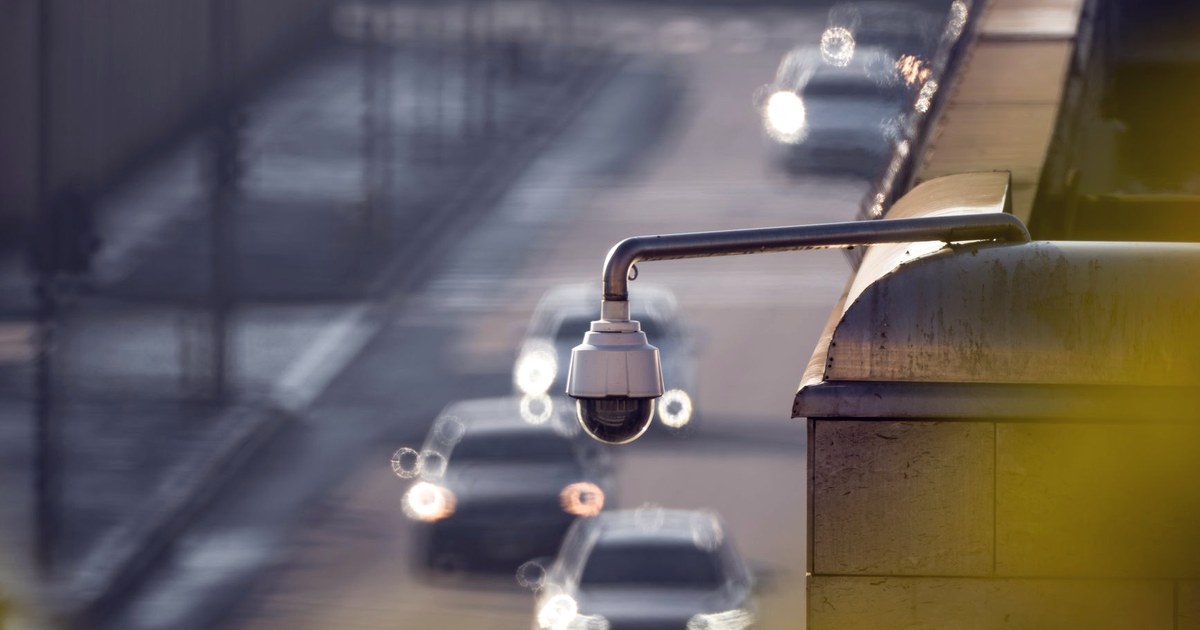
It is worth checking that word before repeating it. Satellite-based tolling in India is not a finished rollout. It is a pilot that has been running on exactly two highway stretches, Bengaluru-Mysuru on NH-275 and Panipat-Hisar on NH-709, introduced only as an add-on alongside FASTag, not a replacement for it, according to a 2024 statement from the Ministry of Road Transport and Highways. NH-48 is not one of those two corridors. And as recently as April 2025, NHAI publicly stated that no decision had been taken on nationwide satellite-based tolling, and that it would instead deploy an ANPR-FASTag-based Barrier-Less Tolling System at selected plazas first. That is almost certainly the technology behind the cameras now watching Gurugram-Jaipur: number-plate recognition matched to a FASTag account. No satellite receiver sits in the car.
The reason satellite tolling has stalled is not technical. In a written reply to the Rajya Sabha, Union Minister Nitin Gadkari said a government Apex Committee and a High-Level Empowered Committee of industry and academic experts recommended further deliberation on the satellite-based system specifically on security, privacy and operational-control grounds, as of July 2025. India's own experts flagged the exact feature that would make satellite tolling different from what just launched: a continuous, exact record of where a car has been, not just where it crossed.
Five months later, the government's own timeline pointed the same way. In a Rajya Sabha reply on December 17, 2025, Gadkari told Parliament it is the Automatic Number Plate Recognition system, not GNSS, that will be implemented nationwide by the end of 2026 to replace traditional toll collection. Several outlets covering that same reply called it "satellite-based toll collection," but the minister's own words to Parliament name ANPR, the camera-and-FASTag technology already running on NH-48, not the satellite system the committees are still reviewing. The conflation in this week's coverage of the NH-48 launch isn't new. The government's own December briefing produced the same mislabelling seven months earlier.
The efficiency case doesn't need a satellite
None of this makes the barrier-free rollout a non-event. The gains are real, and they come from cameras and a tag India has already adopted almost universally. FASTag had reached roughly 98% penetration of National Highway toll transactions, with more than 8 crore users, per a Ministry backgrounder as of November 2025. Building a camera-and-FASTag free-flow system on top of that base is an upgrade to existing plumbing, not new hardware in every car.
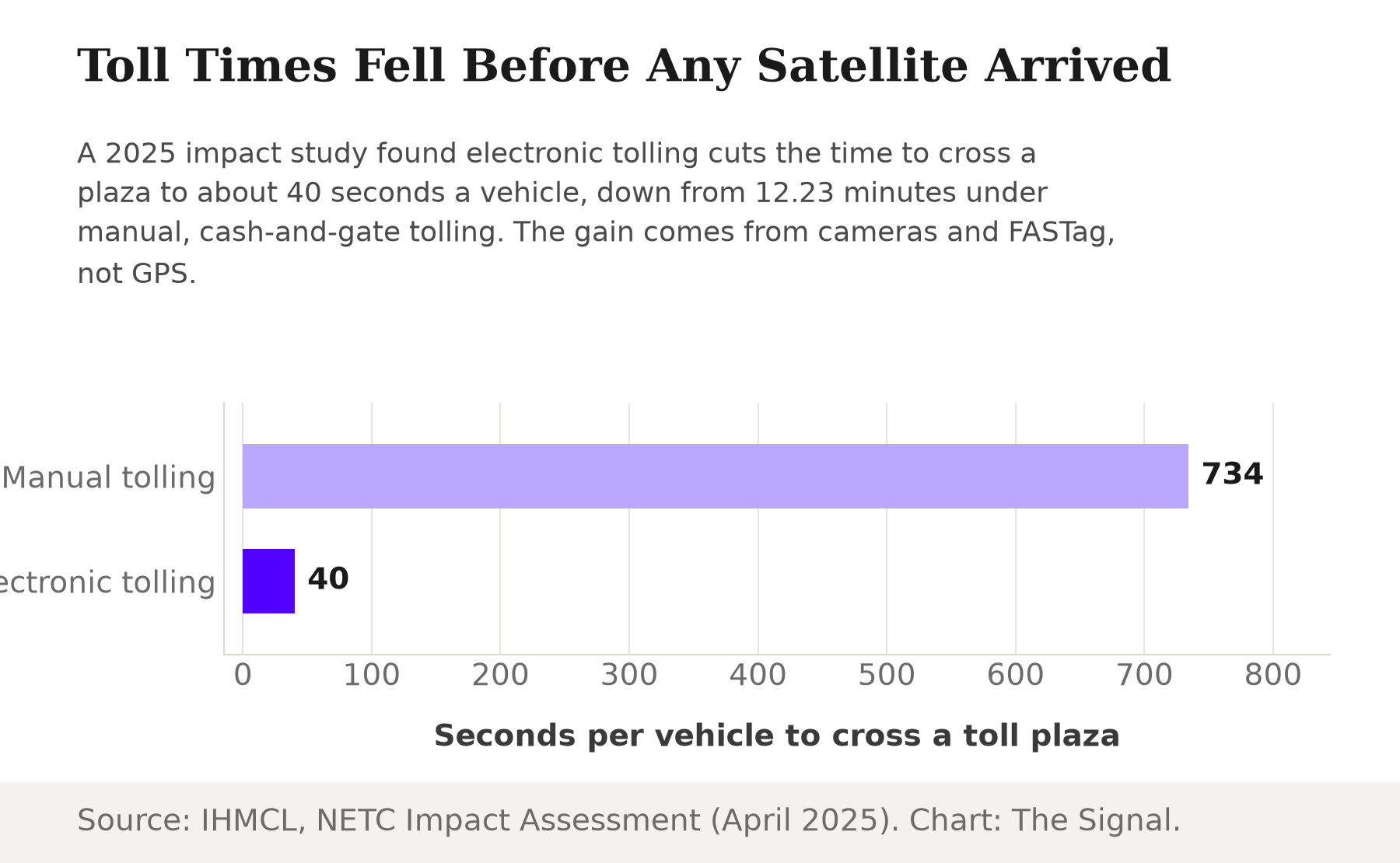
The speed difference makes the case plainest. An IHMCL impact assessment from April 2025 found electronic tolling cuts the average time to cross a plaza to about 40 seconds a vehicle, down from 12.23 minutes under the older manual, cash-based system. That gap, not a satellite feed, is what a driver on NH-48 actually feels this month.
The scale problem this is meant to solve is also getting bigger every year. India's National Highway network had grown to 1,46,560 km by the government's Year End Review 2025, an increase of about 61% from 91,287 km in 2014.
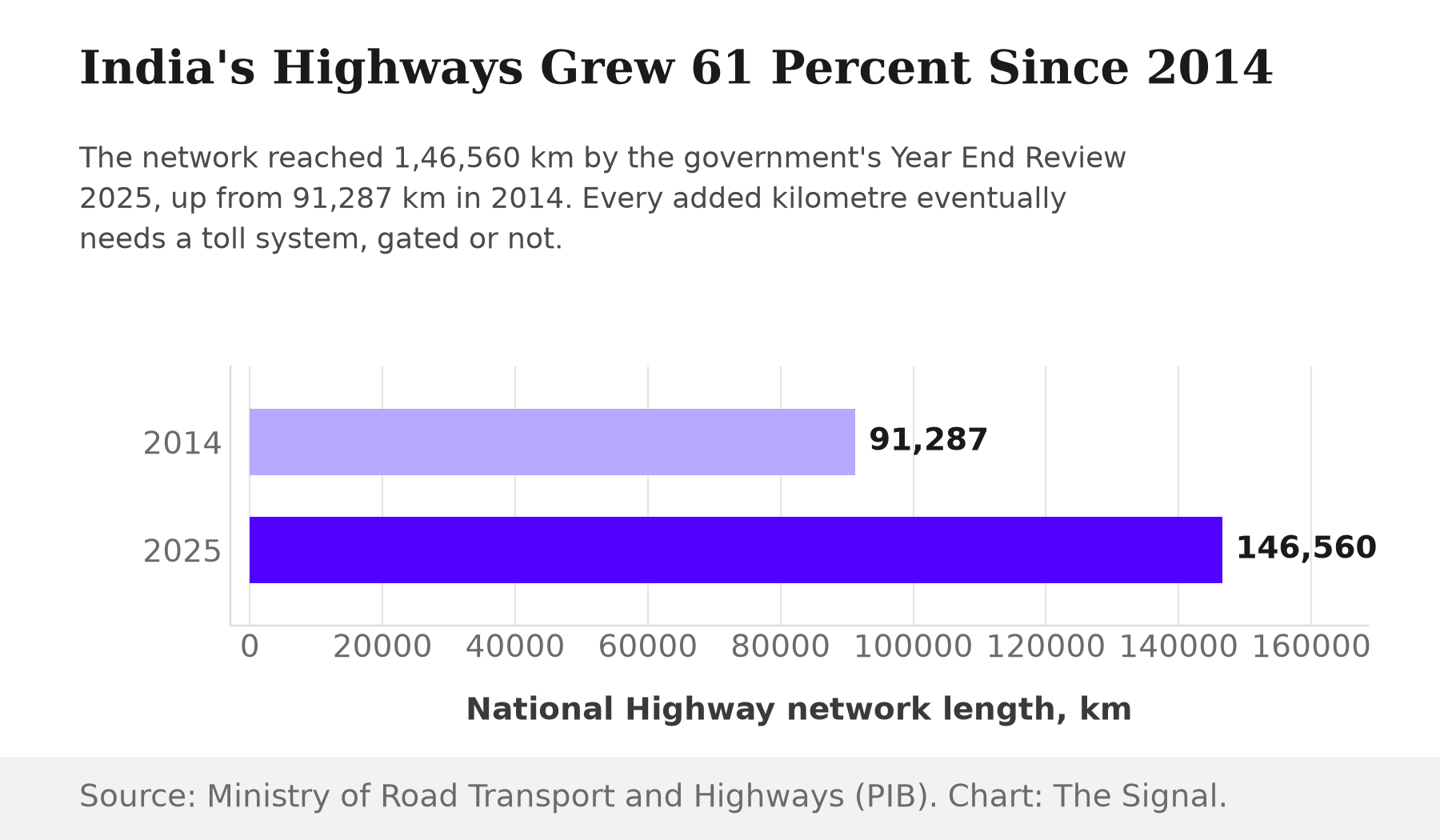
More highway means more plazas that eventually need this kind of upgrade, gate or no gate.
What a satellite would still add, and why it's parked
Distance-based pricing is the one thing ANPR-FASTag cannot do that GNSS was built for. Under the September 2024 amendment to the National Highways Fee Rules, a private vehicle fitted with a valid GNSS On-Board Unit pays no toll for up to 20 km of travel each direction per day, is charged only for the distance actually driven beyond that, and pays double the normal fee if it enters a GNSS lane without a valid unit. That rule already exists on paper. It has simply not left the two pilot corridors named above, and the committees reviewing it have not signed off on taking it further.
NHAI's live pricing tool is flat. Its precision-pricing tool is still a two-corridor pilot.
| Scheme | Price | How it's calculated |
|---|---|---|
| FASTag Annual Pass (national, live from August 15, 2025) | ₹3,000 | Flat fee, valid for one year or 200 fee-plaza crossings, whichever comes first, for non-commercial cars, jeeps and vans |
| GNSS On-Board Unit (pilot corridors only) | Free up to 20 km/direction/day, then per km beyond that | Distance actually travelled, tracked by satellite positioning; double fee if the unit is missing or invalid in a GNSS lane |
Source: Ministry of Road Transport and Highways, FASTag Annual Pass notification; All India Radio, GNSS fee rules.
NHAI activated a ₹3,000 FASTag Annual Pass for non-commercial cars, jeeps and vans, valid for one year or 200 fee-plaza crossings, from August 15, 2025. That is the opposite design choice from exact distance billing: it caps what a frequent driver pays rather than metering every kilometre. It is a strange product to launch a year into a satellite-tolling pilot if that pilot were about to go national and replace flat pricing altogether.
The financial case for going barrier-free at all is large regardless of which technology reads the plate. NHAI expects the free-flow model to cut toll-collection operating costs from about 15% of revenue to around 3-4%, an estimated ₹5,000-6,000 crore in annual savings, alongside roughly 250 crore litres of fuel saved and about 81,000 tonnes of carbon emissions avoided each year, per a Ministry statement from May 2026. A satellite adds nothing to that math. Removing the gate and reading the plate faster, which cameras and FASTag already do, gets there on its own.
The honest objection
The strongest case against calling this a modest upgrade is that camera-based free flow is still a real expansion of automated tracking and enforcement, satellite or not. Under the new system, a vehicle whose FASTag payment fails is issued an e-Notice with 72 hours to pay the normal toll rate; after that the fee doubles, and continued non-payment can get the FASTag blacklisted through the VAHAN platform, according to a June 2026 Ministry notice. A missed manual toll booth payment used to mean an argument with an attendant. Now it means an automated notice, a penalty rate, and a linked vehicle registration record. That is a meaningfully harder system than the one it replaced.
That case holds, but it describes point-based recognition, not the continuous positioning GNSS was reviewed for. The camera and FASTag combination logs a vehicle at each gantry, the way a toll booth already did, just without the stop. It still cannot reconstruct the exact route between two gantries or bill for the precise distance covered, which is exactly the extra capability the government's own committees flagged for further scrutiny rather than approval.
The Signal
The gate disappearing on NH-48 is not the decision that will decide how Indian tolling actually changes. The decision that matters is still sitting with the Apex Committee and the High-Level Empowered Committee, and the government's own December 2025 timeline already leans one way: a national rollout of ANPR by the end of 2026, with no mention of satellite tolling expanding past Bengaluru-Mysuru and Panipat-Hisar. Watch whether that timeline holds, and whether the committees ever clear GNSS for a wider rollout instead. The flat ₹3,000 Annual Pass sitting alongside a national camera-based system, rather than a satellite one, is what will eventually decide whether a toll bill reflects a flat fee or an exact route.
Reporting basis: the NH-48 barrier-free rollout is as covered by Business Today for the August 1, 2026 switch-on. The GNSS pilot corridors and their status as an added facility, and the September 2024 GNSS fee rules, are per Ministry of Road Transport and Highways statements carried by PIB and All India Radio respectively. NHAI's April 2025 clarification that no nationwide satellite-tolling decision had been taken, and the resulting ANPR-FASTag Barrier-Less approach, are per a PIB release. The committees' recommendation for further deliberation on security and privacy grounds is per Free Press Journal's account of Nitin Gadkari's written Rajya Sabha reply, sourced from that outlet alone. The December 2025 update naming ANPR, not GNSS, as the technology going nationwide by end of 2026 is per All India Radio's coverage of Gadkari's Rajya Sabha reply. Toll-crossing times are from IHMCL's NETC Impact Assessment of April 2025. FASTag penetration, the National Highway network's growth since 2014, the MLFF cost and savings figures, the payment-enforcement rules, and the FASTag Annual Pass terms are each from separate Ministry of Road Transport and Highways releases via PIB, as cited inline.