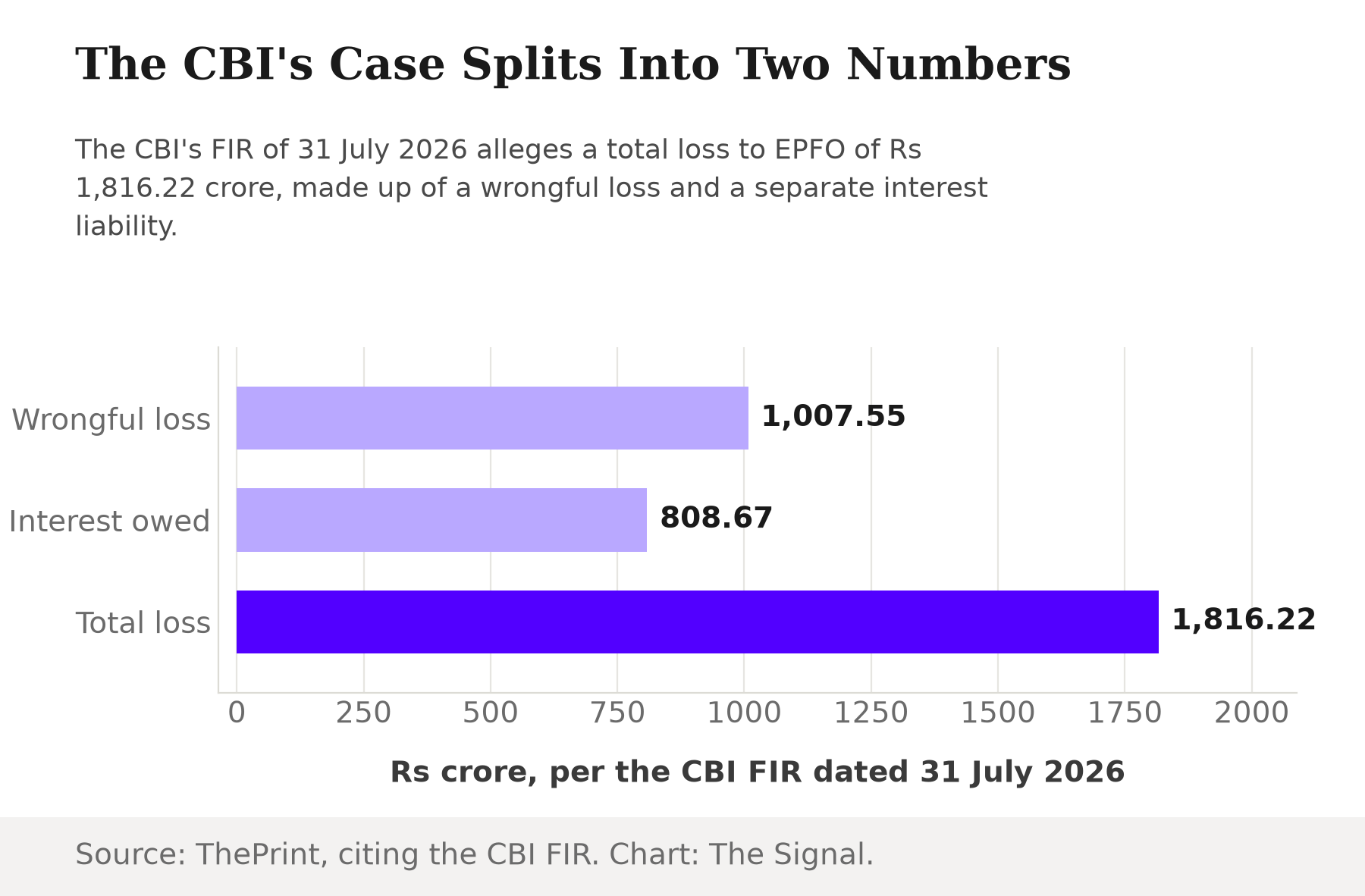
On 31 July 2026, the CBI registered an FIR against Reliance Capital Limited, its former chairman Anil Ambani and others, alleging that fraudulent transactions and diversion of funds caused the Employees' Provident Fund Organisation, India's retirement-savings body for salaried workers, a total loss of Rs 1,816.22 crore. The agency's own breakdown, reported the same day by Daily Excelsior, splits that into a wrongful loss of Rs 1,007.55 crore and a separate interest liability of Rs 808.67 crore. Read as a headline, it is a clean story: a marquee businessman, a public pension fund, a nine-figure hole. The CBI is finally coming for it.
It is worth slowing down on that framing. The investment behind this case was not a rogue bet. EPFO's own investment mandate permits corporate bonds rated at least 'AA' for public-sector issuers and 'AA+' for private-sector ones, a Parliamentary Standing Committee report summarised by PRS Legislative Research found. Between 2013 and 2014, acting through its portfolio managers, EPFO put Rs 2,500 crore into secured Non-Convertible Debentures issued by Reliance Capital, debt set to mature in 2023 and 2024. That 2013-14 position was a policy-compliant allocation to a rated private issuer, the exact kind of instrument the mandate exists to permit.
The default was public knowledge for years
Reliance Capital did not quietly slip into trouble. The company stopped paying interest on EPFO's secured NCDs from October 2019, and the Minister of State for Finance told the Rajya Sabha that the interest in default had reached Rs 534.64 crore as of 30 November 2021, a figure Moneylife reported directly from that government reply. The Reserve Bank of India moved next: it superseded Reliance Capital's board on 29 November 2021, citing defaults in meeting payment obligations to creditors and governance concerns the board had failed to address. A week later, the National Company Law Tribunal admitted an insolvency petition against the company on 6 December 2021, filed on the RBI's own application, with the central bank's advisory committee staying on to assist the court-appointed administrator.
None of that sequence was hidden. A regulator-triggered board supersession and an RBI-initiated insolvency filing are about as public as a corporate default gets in India.
The resolution was already finished
The insolvency process ran its course, and it closed well before the CBI acted. In March 2024, the NCLT approved IndusInd International Holdings' Rs 9,661 crore resolution plan for Reliance Capital. Of the total claims filed against the company, Rs 38,526.42 crore, the tribunal admitted just Rs 26,086.75 crore. The approved plan paid out only Rs 9,661 crore against that admitted amount, a haircut LiveLaw Business put at 63 percent.
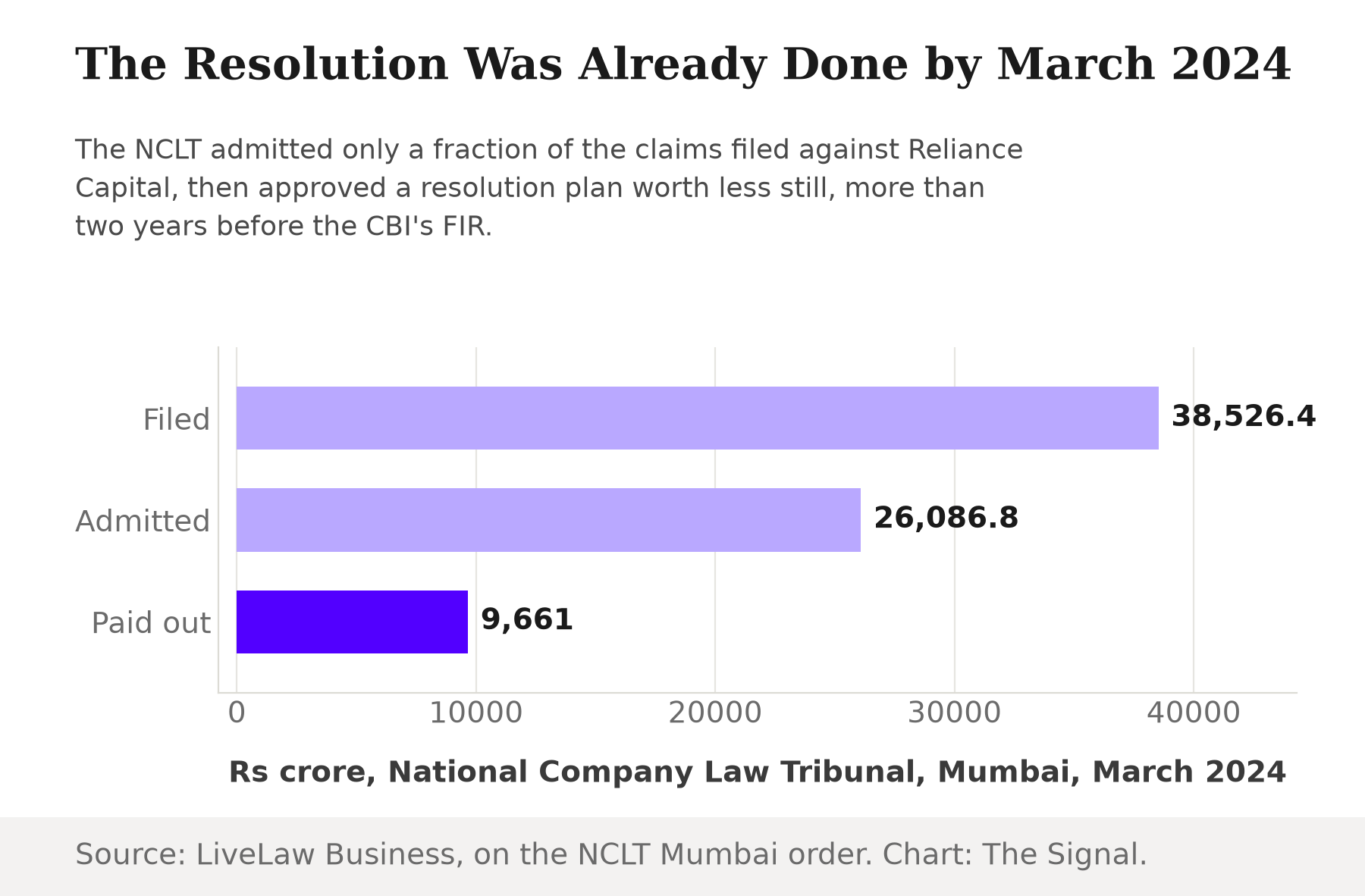
That is the part the CBI's FIR arrives after. Reliance Capital's creditors, EPFO included, went through a full tribunal-supervised claims and recovery process that concluded in March 2024. The CBI's case, filed 31 July 2026, follows that closure by more than two years. Whatever recovery the insolvency process could deliver, it had already delivered, or failed to deliver, long before this FIR existed.
Where the loss actually landed
There is a further piece the headline number skips: what a Rs 1,816.22 crore loss means for the EPFO subscriber whose salary funds the scheme. Under the EPF Scheme, losses on investments are made good from EPFO's own reserves, not charged directly to individual subscriber accounts, per the same Standing Committee report. A loss like this one is absorbed into a shared pool built from decades of contributions across every subscriber in the scheme, not a smaller number in any one worker's passbook.
That pool is large. EPFO's total investible corpus stood at Rs 24.75 lakh crore as of 31 March 2024, more than double its size five years earlier, the Union Minister of State for Labour and Employment told the Lok Sabha. The original Rs 2,500 crore Reliance Capital position, our calculation from those two figures, worked out to roughly a tenth of one percent of that corpus by the time it was resolved. That is not a defense of the investment. It is a reminder that a loss this size, however serious as an allegation of fraud, was never large enough relative to EPFO's total book to have been the systemic threat a Rs 1,800 crore figure implies in isolation.
The honest objection
The strongest case for the CBI acting now is that an insolvency resolution and a criminal case are different instruments answering different questions. The NCLT process exists to recover the maximum value a distressed company's remaining assets can support, split fairly among creditors. It does not, and cannot, determine whether the money was lost through ordinary business failure or through fraudulent diversion, nor can it punish individuals. A criminal investigation can pursue proceeds that moved outside the company's books entirely, and it can hold named individuals accountable in a way a civil recovery process never does. On this view, the CBI's timing reflects the years an investigation into fraud, as opposed to a straightforward corporate default, actually takes.
That case is real, and it is why a criminal filing years after a civil resolution is not automatically suspect. But it does not change what the insolvency process already settled: however this case concludes, EPFO's creditors have already received what the tribunal decided they would receive, and that recovery is not going to move because a criminal case opened in 2026 over an investment made in 2013.
The Signal
The surface story is a fraud case protecting pensioners' money. The more accurate one is a criminal case arriving after every financial question the loss raised had already been answered: the investment was within EPFO's own mandate, the default was handled through public regulatory action starting in 2021, and the insolvency process closed in March 2024, well before the CBI's FIR. What the CBI's case can still deliver is accountability for named individuals, which the insolvency process was never built to provide. It cannot, however, deliver a bigger recovery than the tribunal's 2024 plan already paid out. Watch what the CBI's investigation actually recovers, not the headline figure it opened with. A loss that has already been fully absorbed does not get smaller because a chargesheet calls it fraud.
Reporting basis: the CBI FIR details and the alleged loss breakdown are per ThePrint and Daily Excelsior, both reporting the same 31 July 2026 filing; the Rs 2,500 crore NCD investment and its 2013-14 timing are per Daily Excelsior's report of the FIR. The interest-default figures are from the Minister of State for Finance's Rajya Sabha reply, as reported by Moneylife. The board supersession and the NCLT insolvency admission are from two separate Reserve Bank of India press releases. The March 2024 resolution plan, the claims and admission figures, and the 63 percent haircut are per LiveLaw Business's report of the NCLT Mumbai order. EPFO's investment mandate and the reserve-based loss treatment are from a Parliamentary Standing Committee on Labour report, as summarised by PRS Legislative Research. EPFO's total corpus figure is from the Union Minister of State for Labour and Employment's reply in the Lok Sabha, as reported by The Hans India. The share of the corpus the original investment represented is The Signal's calculation from those two figures.