
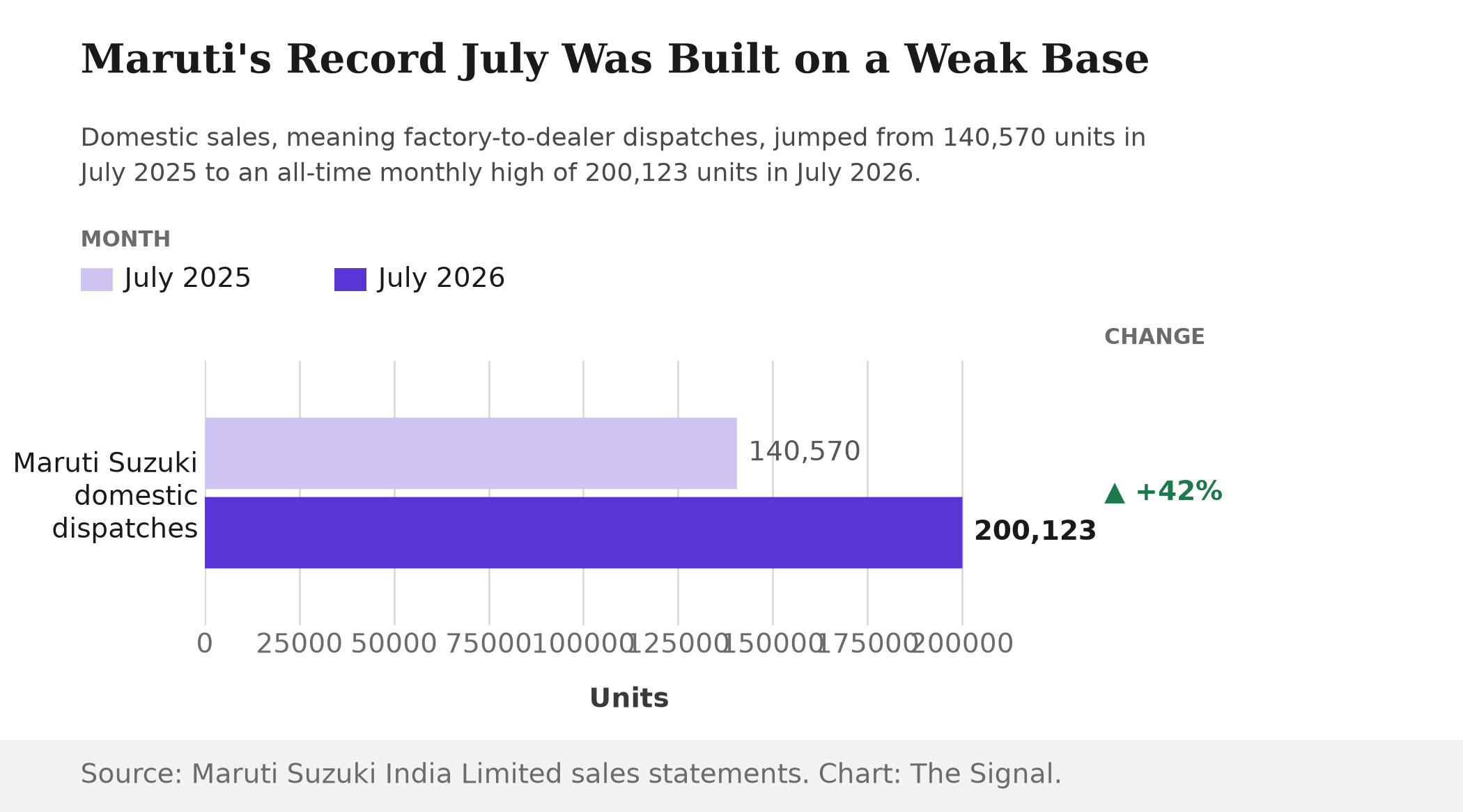
July 2026 handed India's carmakers a stack of records. Maruti Suzuki's domestic sales touched an all-time monthly high of 200,123 units, up from 140,570 units in July 2025, a jump of 42 percent in a year. Hyundai Motor India posted its highest-ever monthly total sales of 75,360 units, up 25.4 percent year-on-year, with domestic sales up 23.3 percent to 54,210 units. Read only the press releases and the story writes itself: Indian car buyers are spending like never before.
Maruti's domestic dispatches rose 42 percent in a year.
It is worth slowing down on the word "sales." What Maruti and Hyundai report each month, and what every automaker in India reports, is the count of vehicles the factory sent out to dealers, not the count of vehicles a customer drove home. That gap already shows up at the wholesale level itself. Tata Motors and Mahindra, India's No. 2 and No. 3 carmakers by volume, were both essentially flat month-on-month in July 2026 even as their headline year-on-year growth read 58 percent and 20 percent, measured off a weak July 2025. Tata's tally of company-reported dispatch data shows Tata sold 62,611 passenger vehicles domestically in July, barely above the 62,076 it sold in June; Mahindra sold 60,048 SUVs, almost unchanged from June's 60,393. Two of India's three largest carmakers, in other words, dispatched roughly the same number of vehicles to dealers in July as they did in June. The record headlines belong to Maruti and Hyundai alone.
The number that actually tracks a sale
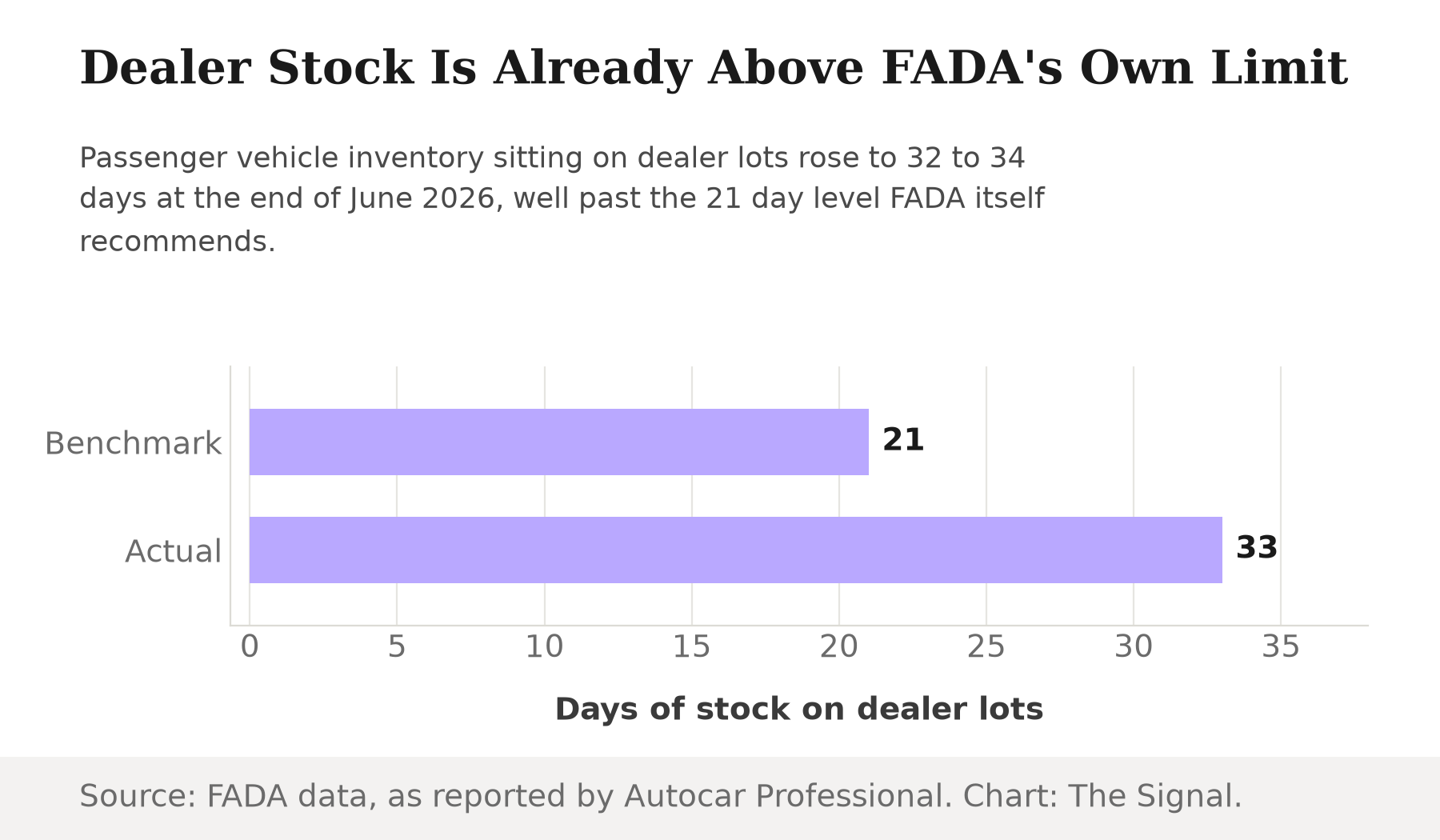
A factory dispatch count cannot tell you whether a car found a buyer. The number that can is how long a vehicle sits on a dealer's lot before someone drives it away. FADA data, as reported by Autocar Professional, show that passenger vehicle inventory rose to approximately 32 to 34 days at the end of June 2026, well above the association's own recommended benchmark of 21 days. FADA, the dealers' own trade body, used that same release to urge manufacturers to calibrate wholesale dispatches more closely with retail demand. A trade association does not publicly ask its members' suppliers to slow down shipments when the goods are moving briskly off the shelf.
Wholesale and retail, measured the same month
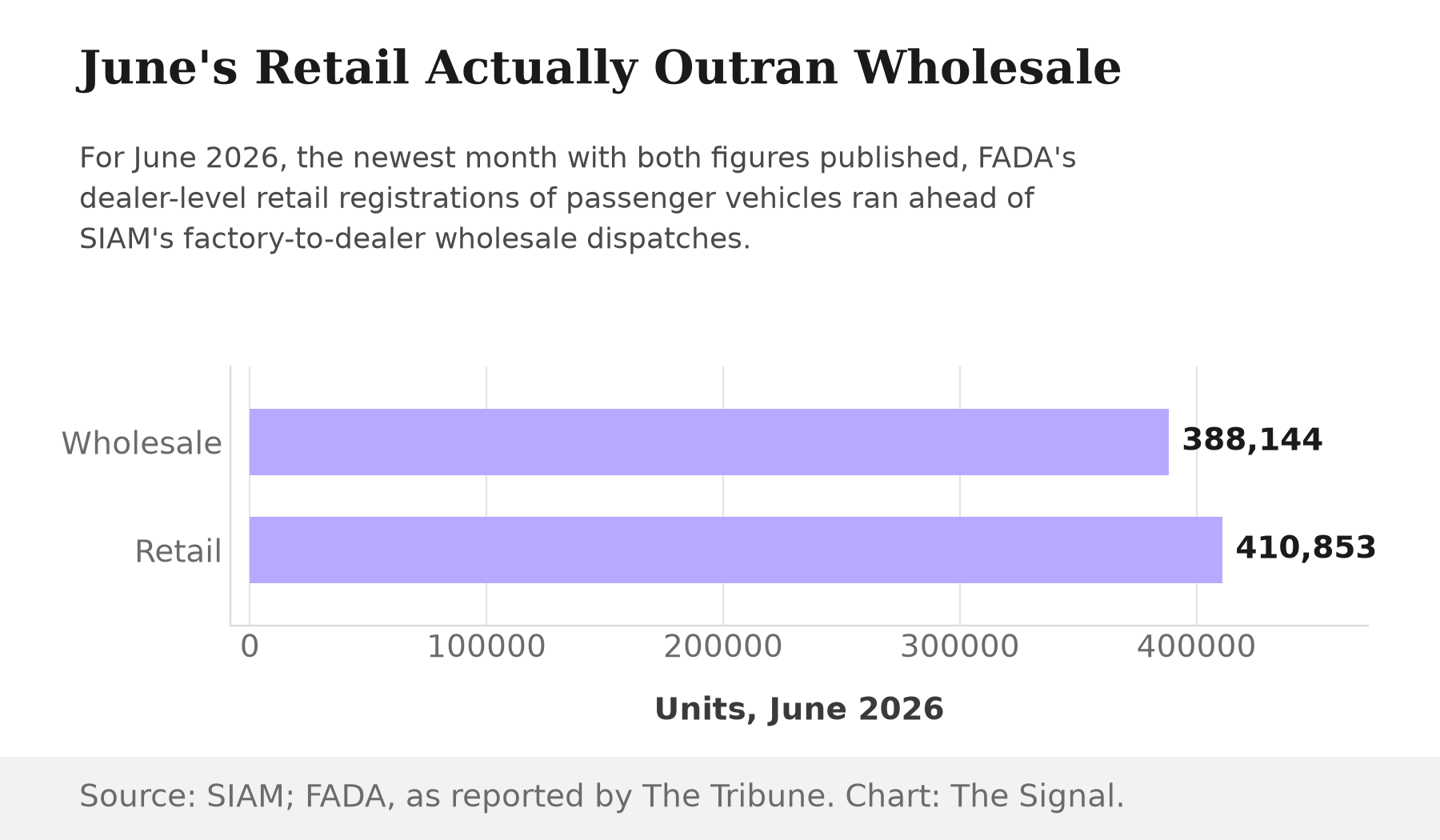
SIAM, the manufacturers' body, and FADA, the dealers' body, both publish monthly, but their newest aggregate figures are for June 2026, since neither has published its July count yet. SIAM's own data show domestic passenger vehicle wholesale dispatches were 3,88,144 units in June 2026, capping the industry's highest-ever first quarter, April to June of FY27, at 1.27 million units, up 25.9 percent year-on-year. FADA's retail data show passenger vehicle registrations hit a best-ever June of 4,10,853 units in 2026, up 28.63 percent year-on-year, as overall industry retail across all vehicle categories crossed 25.57 lakh units, up 21.83 percent year-on-year.
Line those two June figures up and retail, 4,10,853 units, actually ran ahead of wholesale, 3,88,144 units, in the one month both series can be compared directly.
That is not the picture a simple "dealers are being stuffed" story would predict. But it does not contradict the inventory number either. Inventory is a stock, built up across many months of prior dispatches minus retail sales, not a single month's flow. One month in which retail edges past wholesale trims the pile; it does not clear it, and FADA's own count still showed that pile growing, not shrinking, through the end of June. July's factory dispatches, the same record-setting Maruti and Hyundai numbers this piece opened with, are newer stock landing at dealerships before a single one of those cars has had the chance to show up in a retail count.
The honest objection
The strongest case against reading this as a stockpiling problem is that the growth is broad and, on paper, matches on both sides of the ledger. SIAM's own Q1 FY27 wholesale count was up 25.9 percent year-on-year, and FADA's June retail count was up 28.63 percent for passenger vehicles and 21.83 percent for the industry overall. Retail is not lagging wholesale in the aggregate data. Tata and Mahindra's large year-on-year prints, even off a soft base, point to a recovery that reaches beyond Maruti and Hyundai's two standout months. On this reading, dealers are simply carrying more stock because they are selling more cars, and a slightly elevated inventory number is the ordinary friction of a market growing this fast.
That case is real, and the aggregate growth numbers back it. But it does not explain why the inventory figure was already above FADA's benchmark before July's wholesale wave arrived, or why FADA felt the need to say so publicly rather than let the retail numbers speak for themselves. A market absorbing its stock cleanly does not need its own dealer body to ask manufacturers to slow down.
The Signal
Two different things are true in the same month. Retail demand for cars in India is genuinely strong, by SIAM's and FADA's own numbers. And the stock sitting on dealer lots is already running above the level the dealers' own trade body considers healthy, before July's record factory dispatches have even been counted against it. The two facts do not cancel out. They describe an industry where manufacturers are still shipping to a headline growth number while the people actually holding the unsold cars are the ones sounding the alarm. Watch what SIAM and FADA report for July once both series are out: if dealer inventory keeps climbing even as retail keeps growing, the record month was never about the customer at all.
Reporting basis: Maruti Suzuki's July 2026 and July 2025 domestic sales figures are from the company's own press releases. Hyundai Motor India's July 2026 sales figures are per Business Today's report of the company's sales statement. Tata Motors' and Mahindra's July and June 2026 dispatch figures are per Autocar India's tally of both companies' reported numbers. Passenger vehicle wholesale dispatch and Q1 FY27 figures are from SIAM's own press release. Passenger vehicle and overall retail registration figures for June 2026 are per The Tribune's report of FADA's data. The dealer inventory range and FADA's call for manufacturers to calibrate dispatches are per Autocar Professional's report of FADA's data, and that inventory figure, the piece's central number, rests on that single source. The 42 percent year-on-year change in Maruti's domestic dispatches is The Signal's calculation from the company's own reported figures.