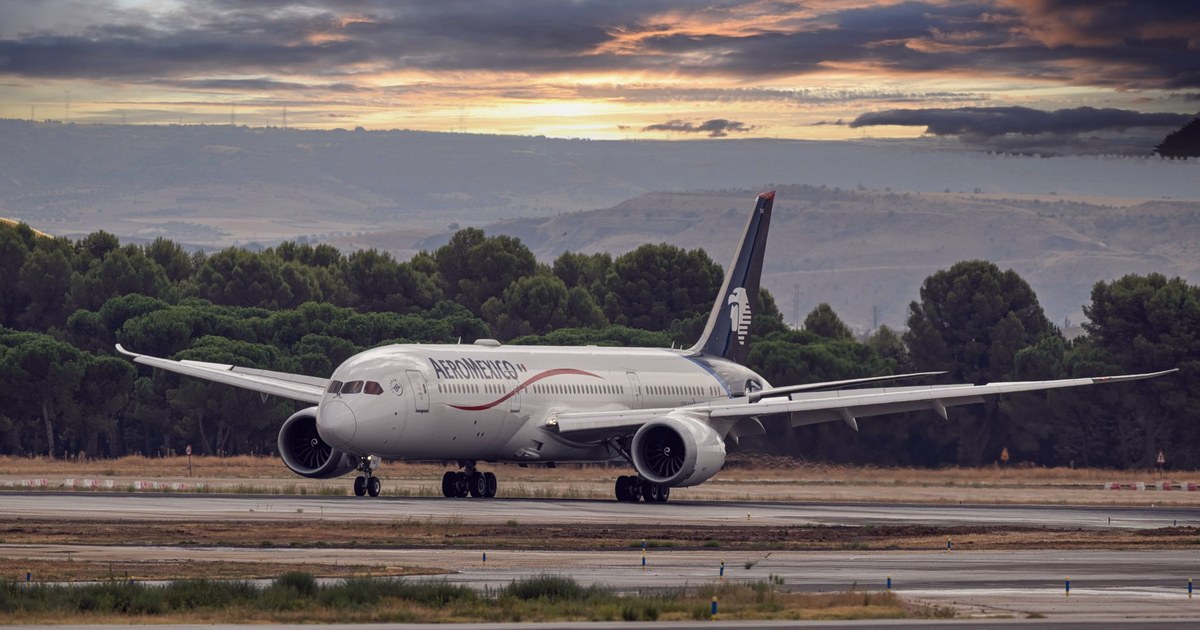
IndiGo said on July 31, 2026 that it is walking away from wide-body flying altogether. Mumbai-Amsterdam moves to the narrow-body Airbus A321XLR from October 25, 2026, and London Heathrow service stops until IndiGo's own Airbus A350-900s arrive, with its damp-lease of Boeing 787-9s from Norse Atlantic Airways concluding by October 31, 2026. Read on the surface, this looks like sensible discipline: a budget carrier trims an experiment that was not paying off, in a market too big to need the distraction. The World Bank counted 180.4 million air passengers carried in India in 2023, and by 2024 India had become the world's fifth-biggest aviation market, at 211 million passengers, up 11.1 percent year over year, a scale where two European routes barely register.
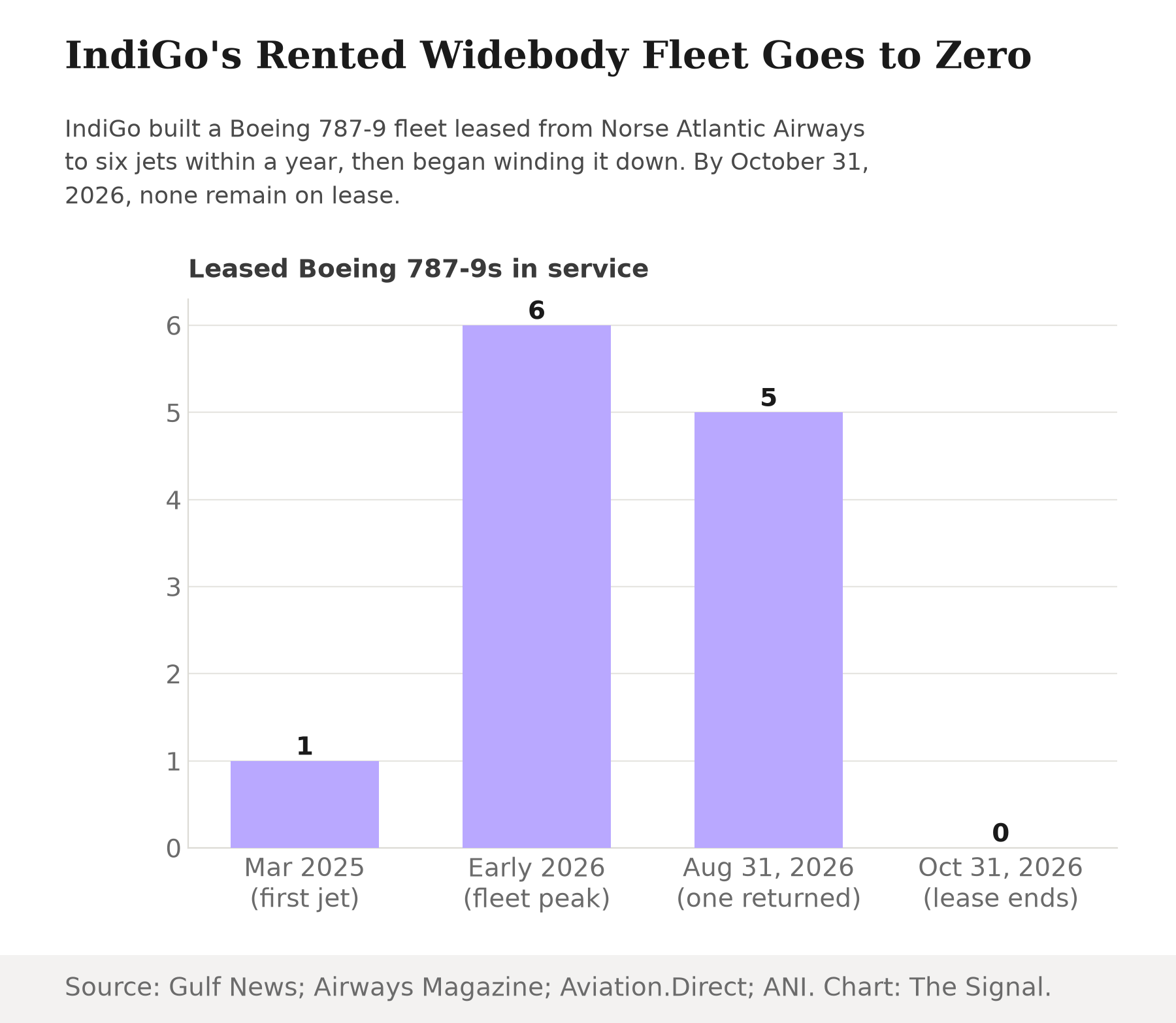
It is worth slowing down on that reading. IndiGo is ending wide-body flying entirely, not trimming it, and it never owned a single one of the jets it flew. Every wide-body IndiGo has put in the air since 2025 was rented, and by October 31, 2026 the number of wide-bodies in its fleet goes from six, at peak, to zero. Scaled against the airline itself, that bet was always tiny: IndiGo's total fleet stood at 432 aircraft as of June 30, 2026, so the six leased Dreamliners were never more than about 1 percent of the operation, a rounding error the airline can walk away from without touching its core narrow-body business.
Source: Gulf News; Airways Magazine; Aviation.Direct; ANI. Chart: The Signal.
How the fleet was built, and unwound
IndiGo's wide-body flying began as a single aircraft. Its damp-lease with Norse Atlantic Airways covered one Boeing 787-9, on an initial six-month term extendable to 18 months, with long-haul flights expected to begin in March 2025. That single jet quickly became a small fleet. By May 2025, Norse Atlantic had committed to leasing six Boeing 787-9s to IndiGo in total, with the last two due to enter service by early 2026. For a little over a year, IndiGo operated a rented long-haul fleet that let it reach European cities it could not otherwise serve.
Then it started coming apart. IndiGo returned one of the six 787-9s to Norse Atlantic, effective August 31, 2026, after airspace detours on the Manchester route drastically raised fuel and personnel costs and made the flights uneconomical to continue. The remaining five jets were reported as staying in service under the existing contract. Two months later, IndiGo went further and ended the arrangement altogether: the Norse Atlantic damp-lease concludes by October 31, 2026, with Heathrow going dark and Amsterdam downgraded to a narrow-body jet, a decision IndiGo has attributed to a challenging operating environment.
The order that does not match the exit
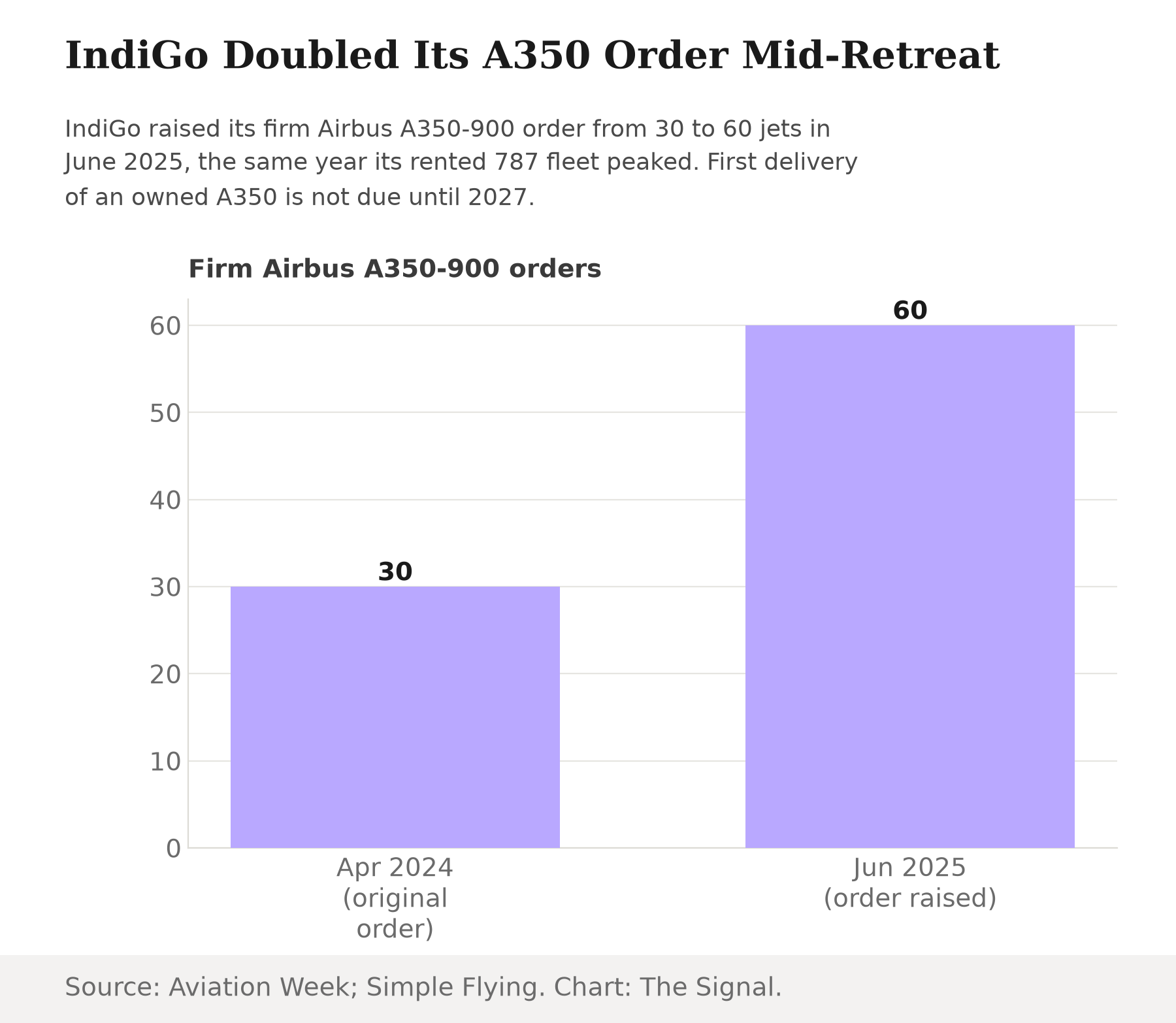
What makes the timing strange is what IndiGo was doing with its own order book at the same moment its rented fleet was near its peak. IndiGo's original firm order, signed in April 2024, was for 30 Airbus A350-900s, with the first delivery due to start in 2027. Rather than scale that back, IndiGo signed an MoU at the IATA AGM in Delhi on June 1, 2025 to add 30 more A350-900s, doubling its firm order to 60 aircraft.
Source: Aviation Week; Simple Flying. Chart: The Signal.
That sequence only makes sense if the rented 787s were always meant as a bridge, not a business. IndiGo was never planning to compete long-haul on leased metal indefinitely; it was buying time and route experience until its own A350s showed up. The trouble is the bridge is now being dismantled before the far bank is in sight: deliveries on the 60-jet order begin in 2027 at the earliest, which means IndiGo goes from six wide-bodies to zero for at least a year, on the same routes it spent the last eighteen months building a case for.
The full build-up and wind-down, in one timeline.
| Milestone | Date | What happened |
|---|---|---|
| Damp-lease signed | Reported Feb 2025 | One Boeing 787-9 from Norse Atlantic, six-month term extendable to 18 |
| First wide-body flight | March 2025 | Long-haul service begins on the leased jet |
| Fleet reaches six | Early 2026 | Two more 787-9s enter service, completing the leased fleet |
| A350 order doubled | June 1, 2025 | MoU adds 30 more A350-900s to the original 30, for 60 total |
| First jet returned | Aug 31, 2026 | One 787-9 goes back to Norse Atlantic after Manchester route costs rose |
| Wide-body exit | Oct 25-31, 2026 | Heathrow paused, Amsterdam moves to A321XLR, lease concluded |
| First owned A350 | From 2027 | Earliest delivery date on the original 2024 order |
Source: Gulf News; Airways Magazine; Simple Flying; Aviation.Direct; ANI; Aviation Week.
The honest objection
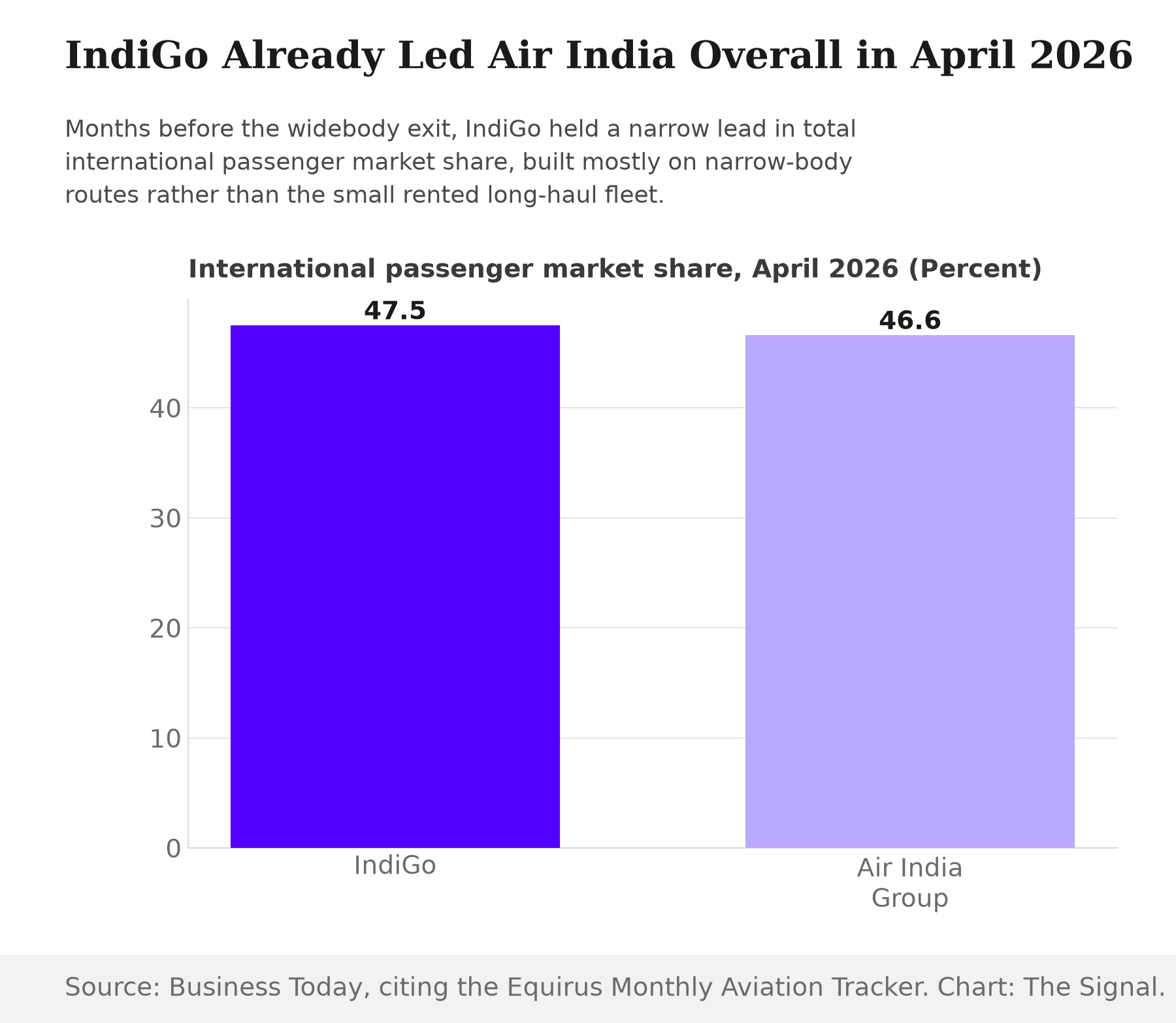
The obvious pushback: none of this means IndiGo is losing the international fight. In April 2026, IndiGo's international passenger market share stood at 47.5 percent against Air India Group's 46.6 percent, a reversal that put IndiGo back ahead. If IndiGo was already winning the international battle before it gave up its wide-bodies, the retreat looks less like weakness and more like a carrier cutting a loss-making sideline from a position of strength.
Source: Business Today, citing the Equirus Monthly Aviation Tracker. Chart: The Signal.
That case is real, but it answers a different question than the one the wide-body exit raises. IndiGo's overall international share is built overwhelmingly on narrow-body, point-to-point routes across the Gulf, Southeast Asia and South Asia, the market it was built to dominate from the start. The rented Boeing 787-9 fleet was never more than six aircraft, carrying traffic on a handful of European routes, next to a narrow-body network that generates the bulk of that 47.5 percent figure. Winning the broad international market-share number is not the same contest as losing the long-haul, wide-body one. They are two different competitions, and IndiGo is now sitting out the second one entirely while Air India, the one Indian carrier that owns its wide-body fleet outright, keeps flying it. Air India's own fleet count put 59 wide-bodies in service as of February 13, 2026, roughly ten times what IndiGo is giving up, and every one of them owned rather than rented.
The Signal
IndiGo's international ambitions were never as far along as the route map suggested. Every wide-body flight it operated ran on aircraft it did not own, and now even that borrowed capacity is going back to its lessor, more than a year before IndiGo's own A350s are due. That gap, from zero wide-bodies at the end of October 2026 to first delivery sometime in 2027, is the window in which Air India owns the wide-body long-haul contest by default, not because it won it. Watch what IndiGo does with its A321XLRs on routes like Amsterdam: if narrow-body long-range jets keep substituting for wide-bodies past 2027, the 60-jet A350 order was never just a bridge. It was a hedge IndiGo is in no hurry to call.
Reporting basis: the wide-body exit and its October 2026 dates are from IndiGo's own statement, reported by ANI. The build-up of the Norse Atlantic damp-lease is from Gulf News (the initial single-aircraft deal) and Airways Magazine (the six-aircraft commitment), with the partial drawdown from Aviation.Direct. The A350 order history is from Aviation Week (the original 2024 order) and Simple Flying (the 2025 MoU doubling it). The international market-share comparison is from Business Today, citing the Equirus Monthly Aviation Tracker. India's aviation market size is from News on Air, citing IATA's World Air Transport Statistics. IndiGo's total fleet count is from its Q1 FY27 results, via Kotak Neo. Air India's wide-body fleet count is from Air India's own official fleet press kit. The one percent share the leased Dreamliners held of IndiGo's total fleet, and the roughly tenfold gap between Air India's and IndiGo's wide-body counts, are the Signal's calculations from those figures; every other figure in this piece is reported as cited.