India's July 2026 GST print reads like an unambiguous win. The official monthly report published on the GST portal shows gross GST revenue rose 15.4% year-on-year to Rs 2.11 lakh crore in July 2026, the fastest monthly growth rate in over a year. Net revenue did even better: Free Press Journal reports, citing the GST portal's monthly data, that net GST revenue after refunds rose 15.8% to Rs 1.81 lakh crore, marking the fastest growth pace in 14 months. Read as a single line, that looks like straightforward evidence that Indian demand is accelerating.
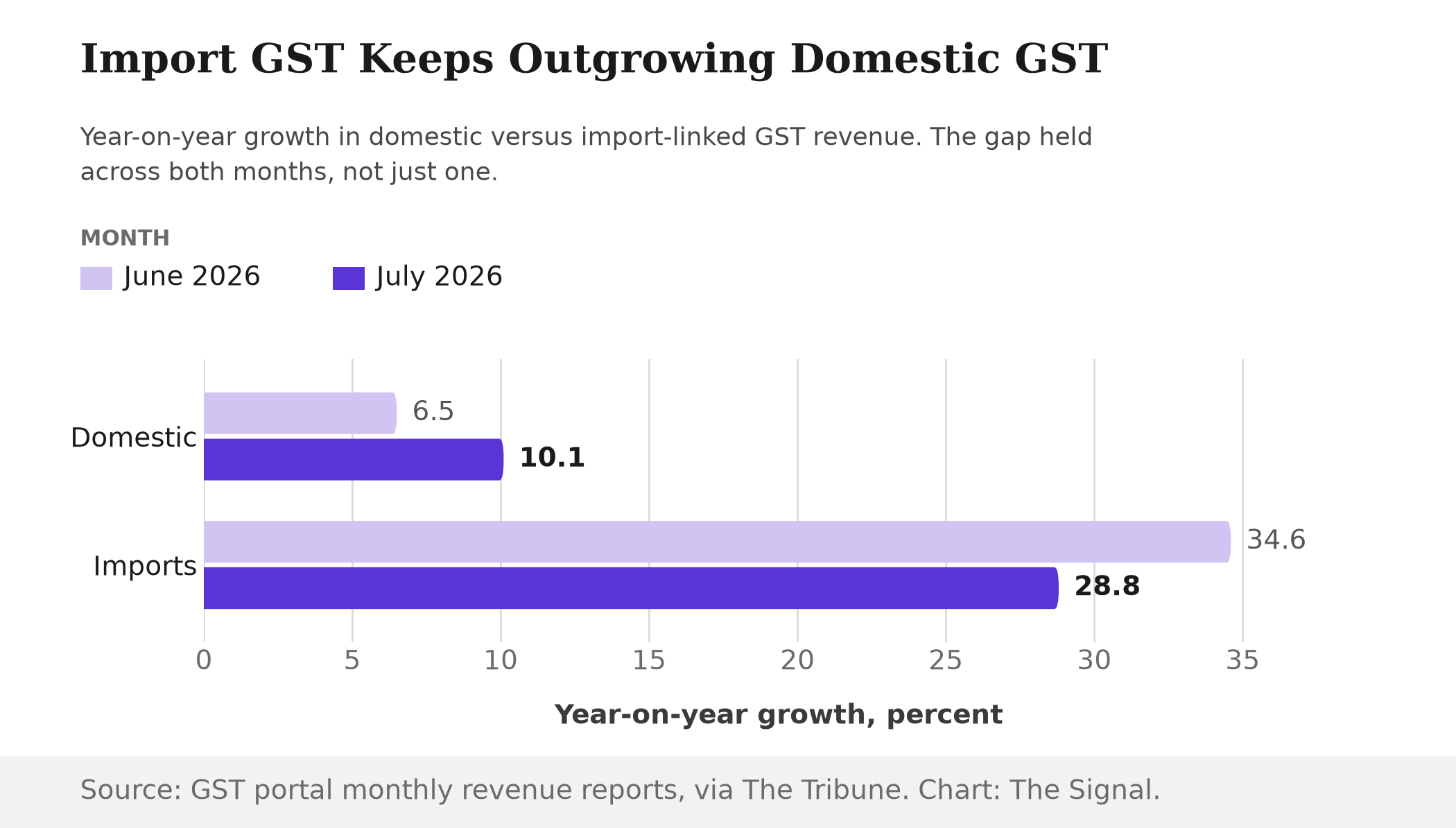
Domestic GST grew at barely a third the pace of import-linked GST.
It is worth slowing down on that reading. GST is not a gauge of how much India is buying. It is a tax on the nominal rupee value of what changes hands, price multiplied by quantity, at every stage of the supply chain. When prices rise, GST collections rise with them even if not one extra unit is sold. A headline growth number is, by construction, part price and part volume, and the growth rate alone cannot say which one did the work.
The number splits in two
Break the July total into its component lines and the picture shifts. The Tribune reports, citing the GST portal's monthly revenue data, that domestic GST revenue grew just 10.1% year-on-year in July 2026, to Rs 1.45 lakh crore from Rs 1.31 lakh crore, while import-linked GST collections surged 28.8%, to Rs 66,511 crore from Rs 51,626 crore. Domestic collections, the line that most directly tracks Indian consumers and businesses buying and selling inside the country, grew at barely a third the pace of the line that tracks what crosses the border.
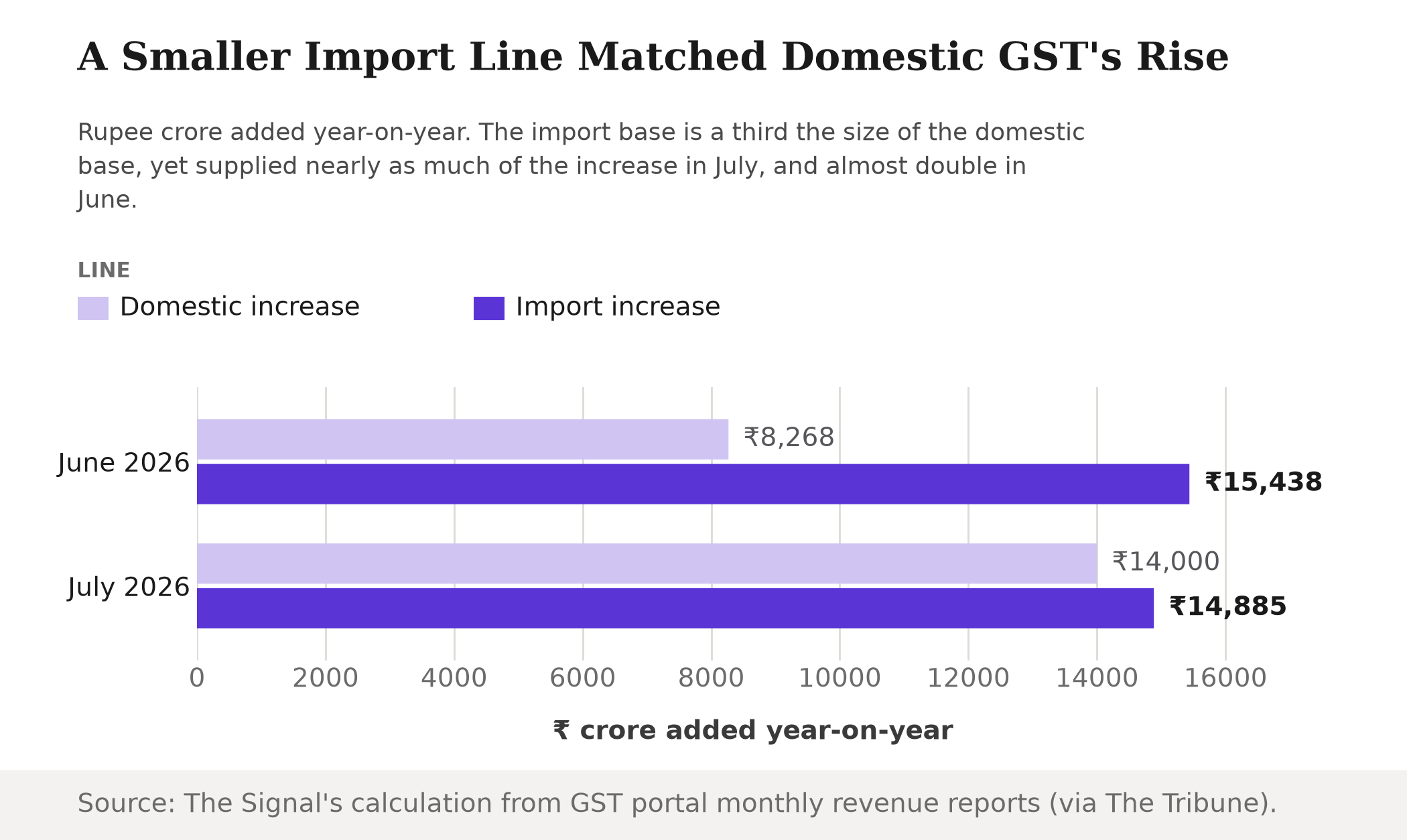
The gap looks sharper once both lines are converted from growth rates into rupees. The domestic base going into July was more than two and a half times the size of the import base, so the percentages alone understate how lopsided the actual increase is. Our calculation from those same figures: domestic GST added roughly Rs 14,000 crore year-on-year in July, and import GST added Rs 14,885 crore. A revenue line worth barely two-fifths of the domestic base supplied a slightly larger absolute increase.
Source: GST portal's June 2026 monthly revenue report; The Tribune, reporting the GST portal's July 2026 data. Rupee increases are The Signal's calculation. Chart: The Signal.
This was not a one-month anomaly. One month earlier, the GST portal's official report for June 2026 shows gross GST collections grew 13.9% to Rs 1.95 lakh crore, with domestic revenue up just 6.5% to Rs 1,34,774 crore from Rs 1,26,506 crore, while import-linked GST revenue jumped 34.6% to Rs 60,038 crore from Rs 44,600 crore. The same arithmetic on June's figures puts the domestic increase at about Rs 8,268 crore against an import increase of Rs 15,438 crore, almost double. In back-to-back months, the smaller, currency- and customs-driven import line supplied as much or more of the GST increase as the much larger domestic base that is supposed to carry the real demand signal.
Source: GST portal's June 2026 monthly revenue report; The Tribune, reporting the GST portal's July 2026 data. Chart: The Signal.
Even the domestic line is not what it looks like
None of this yet explains why domestic collections are growing at all, or whether that growth is more goods sold or the same goods priced higher. Companies reporting results for the same quarter are unusually candid on that question. Republic World reports, citing HUL's Q1 FY27 results release, that Hindustan Unilever's revenue grew 10% in the April-June 2026 quarter, split evenly between 5 percentage points of volume growth and 5 percentage points of price and mix, with the company citing persistent palm oil inflation forcing price hikes in its skin-cleansing segment. Half of Hindustan Unilever's growth, in the same quarter GST accelerated, came from charging more, not selling more.
Havells shows the same pattern at industrial scale. InvestyWise reports, citing the company's Q1 FY27 earnings call transcript, that Havells disclosed price hikes ranging from 5% to 20% across product categories, with cables and wires seeing the steepest increases because of copper and aluminium costs. A length of cable sold in July at a 20% higher price generates 20% more GST on that transaction alone, with the buyer taking home the identical length of wire.
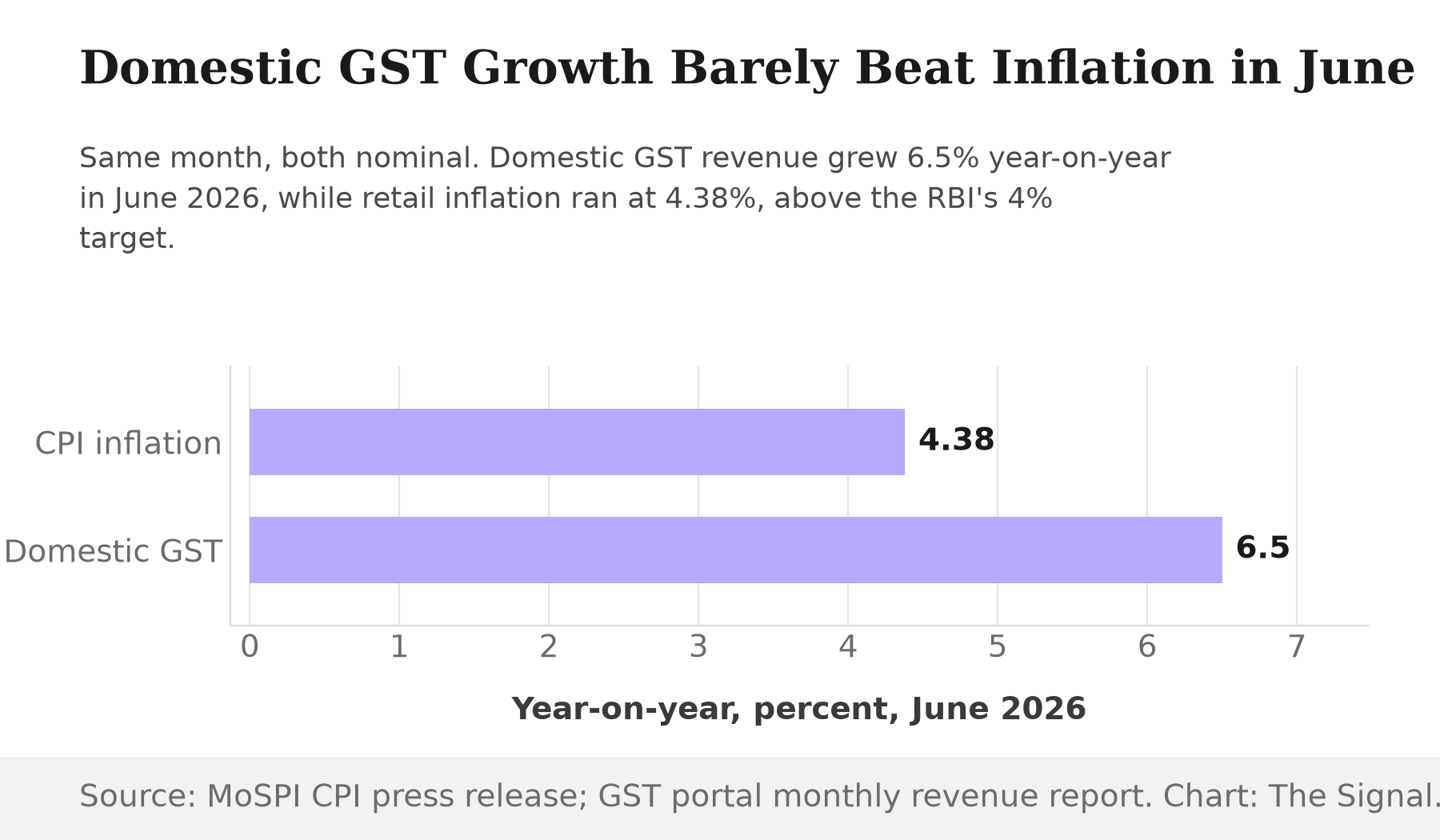
Retail inflation gives a third, independent check on how much of the domestic number is arithmetic rather than appetite. The National Statistics Office (MoSPI) reports that headline retail inflation was 4.38% year-on-year in June 2026, above the RBI's 4% target. Domestic GST revenue grew 6.5% that same month. Retail inflation is not a precise deflator for GST's tax base, which spans wholesale trade and capital goods as well as the retail basket CPI tracks, but the two nominal figures sitting that close together, in the same month, leave only a couple of points of headline growth unexplained by prices.
Source: MoSPI, CPI press release, June 2026; GST portal's June 2026 monthly revenue report. Chart: The Signal.
Retail CPI still understates the case, because GST taxes wholesale trade and capital goods that never enter a household shopping basket. A closer-fitting gauge exists: the Office of the Economic Adviser reports that India's Wholesale Price Index (WPI) inflation was 9.87% year-on-year in June 2026, up from 9.68% in May, well above domestic GST's own 6.5% growth that same month. Deflate domestic GST revenue by WPI instead of CPI and the sign flips. Our calculation: at a 6.5% nominal increase against 9.87% wholesale price inflation, domestic GST revenue contracted by roughly 3% in real, wholesale-price-adjusted terms in June, not merely grew slower than the headline.
The honest objection
The strongest case against reading too much into the composition is that the RBI is not confused by it. The Reserve Bank's Monetary Policy Committee resolution from its June 2026 review states that the MPC held the policy repo rate at 5.25% while assessing that private consumption had been resilient, even as it separately flagged elevated inflation risk. On this reading, the central bank already treats consumption strength and price pressure as two distinct lines in its own analysis rather than one conflated headline number, so a GST print doing that conflation for a general audience does not mislead the people who actually set policy.
That case holds for the MPC's own internal reading. It says less about how the same GST print gets used downstream, in commentary, in policy debate, wherever the headline growth figure gets repeated as shorthand for demand strength without the domestic-import split attached. The MPC's own pairing of resilient consumption with elevated inflation risk is close to conceding that the two cannot be cleanly separated from the aggregate numbers it also watches. A headline growth rate built on a tax base that cannot distinguish price from volume will keep outrunning the more careful read underneath it, however carefully the central bank itself hedges its own language.
The Signal
The GST print's real story is not the size of the headline number. It is that a smaller, price-and-currency-sensitive import line supplied nearly as much rupee growth as the much larger domestic base did, in back-to-back months, while major consumer and industrial companies were openly raising prices on the same goods GST is taxing. None of that makes India's economy weak, only that the headline number is a worse guide to how much India is actually buying than its size suggests. Watch the domestic-versus-import split each month, not the gross figure: if domestic revenue alone starts running well ahead of retail inflation, real demand is genuinely back. Until then, the rupee crore is doing more explaining than the goods.
Reporting basis: gross and net GST revenue figures for July 2026, and the domestic-versus-import split, are from the GST portal's official monthly revenue report and from The Tribune's and Free Press Journal's reporting of that same portal data. The June 2026 GST figures are from the GST portal's own monthly report for that month. Retail inflation is from the National Statistics Office's (MoSPI) press release. Wholesale price inflation is from the Office of the Economic Adviser's WPI/PPI press release, and the WPI-deflated real domestic GST figure is The Signal's own calculation from that release and the June 2026 GST portal data. The RBI Monetary Policy Committee's June 2026 resolution is from the Reserve Bank's own published statement. HUL's Q1 FY27 results are as reported by Republic World, citing the company's results release; Havells' Q1 FY27 price-hike disclosure is as reported by InvestyWise, citing the company's earnings call transcript. The rupee increases in each GST revenue line, and the comparison between them, are The Signal's calculations from the GST portal's reported figures.