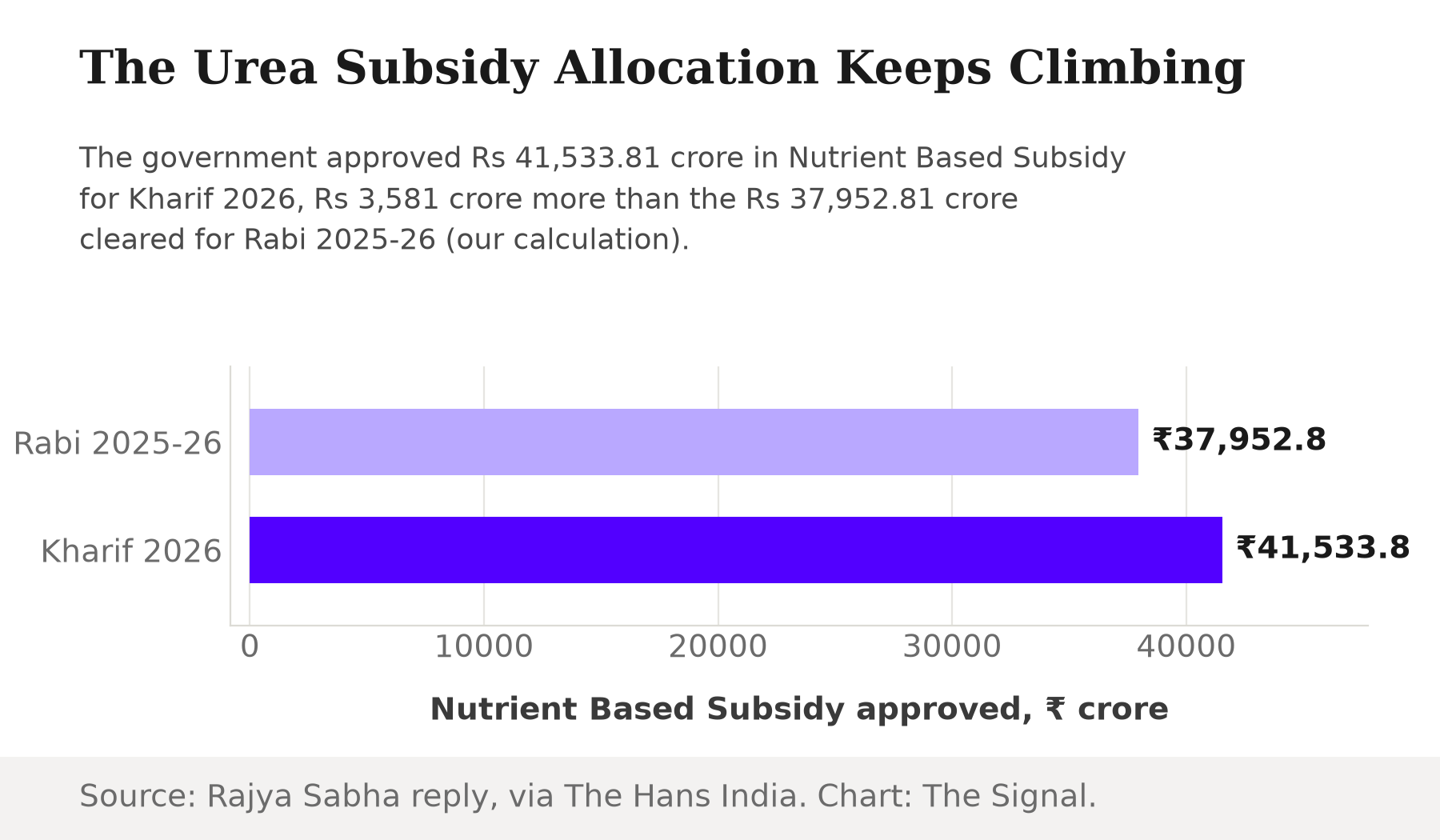
On July 13, 2026, the government told the Rajya Sabha that it had already spent Rs 70,709 crore of its Rs 1.77 lakh crore fertiliser subsidy budget for 2026-27, a healthy 39.9 percent, with two full growing seasons still to run. Alongside it came a second figure: the Nutrient Based Subsidy approved for Kharif 2026 came to Rs 41,533.81 crore, Rs 3,581 crore more than what was cleared for the previous Rabi 2025-26 season. Read as a routine funding update, and that is exactly what it looks like: the money is there, the season is covered, nothing to see.
It is worth slowing down on why that number keeps climbing every season regardless of the weather, the harvest, or how many times ministers and scientists ask farmers to cut back. Strip out the budget arithmetic and what is left is not a story about farmer habit. It is a story about a price.
The number that explains it is Rs 242: the government-fixed retail price of a 45kg bag of urea. That price is not incidental. Parliament's own Standing Committee on Chemicals and Fertilizers cites it directly as the reason urea cannot be folded into the market-linked Nutrient Based Subsidy scheme that covers every other major fertiliser: bringing urea under that scheme, the Committee warned, would let manufacturers set higher prices and "prove detrimental to the interest of the farmers".
Urea and every other major fertiliser sit in two different pricing regimes.
| Urea | DAP and MOP (complex fertilisers) | |
|---|---|---|
| Subsidy treatment | Kept outside the Nutrient Based Subsidy, under statutory price control | Inside the Nutrient Based Subsidy, price decontrolled |
| Retail price | Fixed at Rs 242 per 45kg bag | Set by the market, and has risen since decontrol |
| Committee's own finding | Farmers are using more of it because it is the cheap, controlled option | Rising prices have pushed farmers back toward urea |
In rupee terms the gap is not subtle. For the same Rabi 2025-26 season, DAP sells for Rs 1,350 per 50kg bag and MOP for Rs 1,710.54 per 50kg bag, against urea's Rs 242 per 45kg bag: roughly 5.6 times and 7 times urea's price per bag. A farmer choosing which fertiliser to reach for faces more than a mild preference: a five-to-sevenfold price difference, before any thought is given to which nutrient the soil actually needs.
Source: Lok Sabha Standing Committee on Chemicals and Fertilizers, 52nd Report.
Farmers are following the incentive, not ignoring the advice
This is the part that gets lost in the annual appeals for "balanced fertiliser use." The Committee's own words are unambiguous: the fertilisers that were decontrolled have gone up in price, "and that has led farmers to use more Urea than before," further worsening the nutrient imbalance. That is Parliament's own committee describing rational behaviour, not a diagnosis of farmer inertia: when one input is cheap and fixed and the substitutes are not, demand shifts toward the cheap one, exactly as the subsidy design predicts.
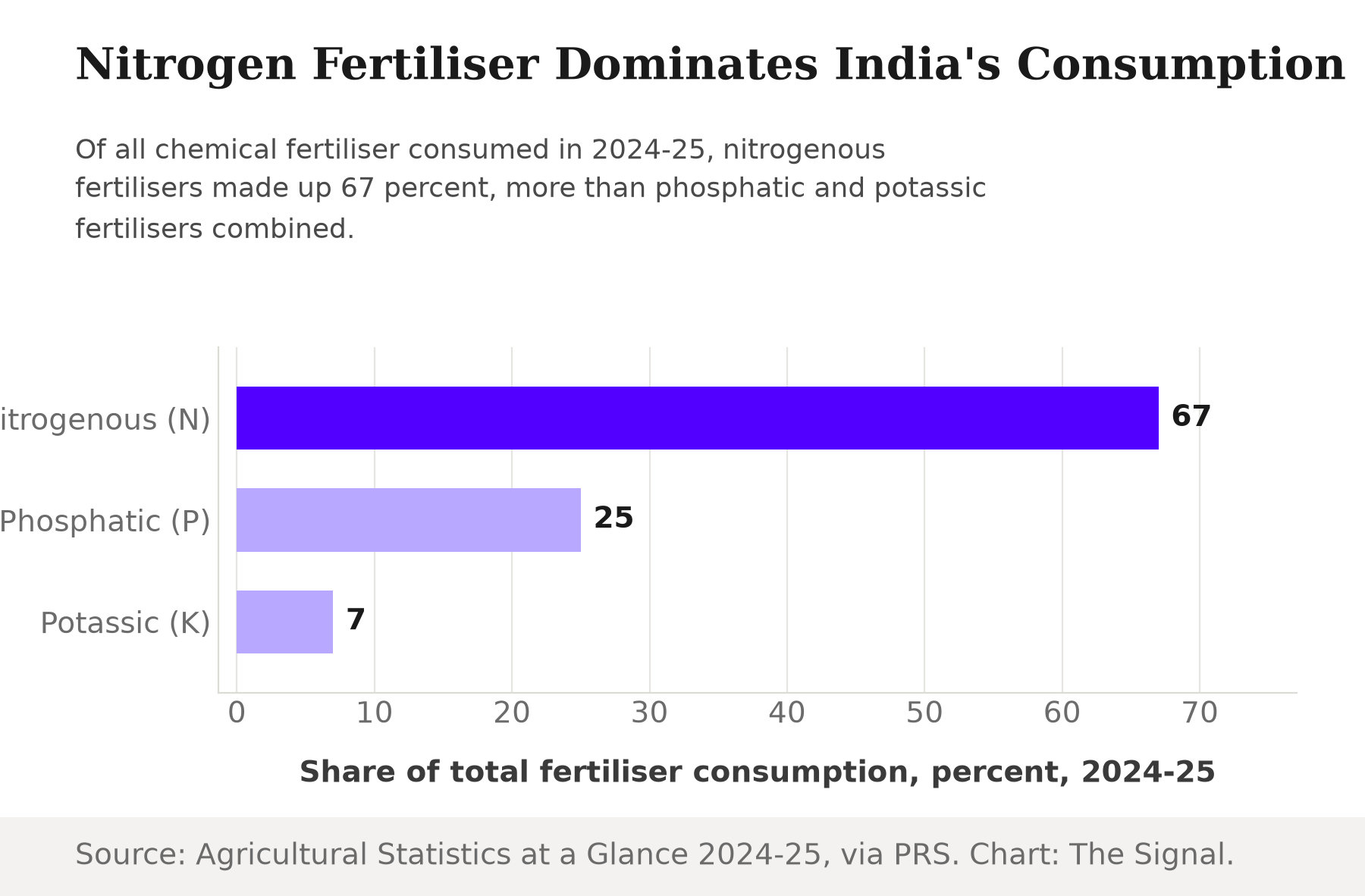
The scale of that shift shows up in the national numbers. Chemical fertiliser use intensity climbed from 92 kg per hectare in 2001-02 to 150 kg per hectare in 2024-25, and the composition of that growth is lopsided: nitrogenous fertilisers, chiefly urea, made up 67 percent of total consumption in 2024-25, against 25 percent phosphatic and just 7 percent potassic.
Reporting from July 2026 puts the concentration even higher at the crop-nutrient level: urea alone now accounts for more than 55 percent of the country's total fertiliser consumption, and the excess application has pushed nitrogen use efficiency down to just 30 to 45 percent, meaning more than half the nitrogen applied is not taken up by the crop it was meant for.
The ratio the government keeps citing against itself
The clearest way to see the imbalance is the ratio agronomists actually use. The recommended application ratio of nitrogen, phosphorus and potassium is 4:2:1. India's actual all-India ratio in 2023-24 was 10.9:4.4:1: 10.9 against an ideal of 4, nearly three times over. The Commission for Agricultural Costs and Prices, in the analysis PRS Legislative Research draws on, links that gap directly to the higher subsidy on urea compared with phosphatic and potassic fertilisers: the same mechanism the parliamentary committee described, confirmed from a different government body.
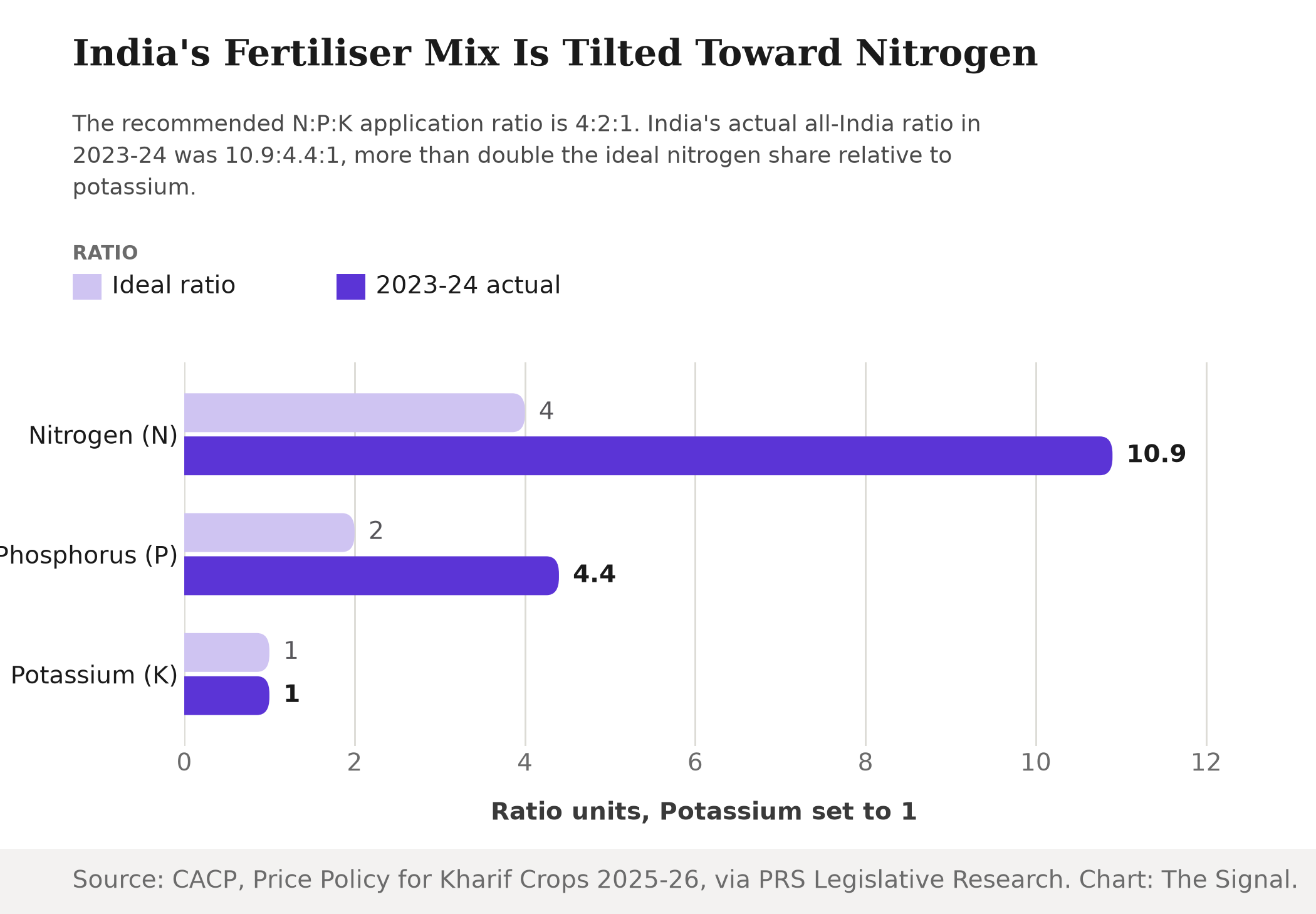
That is the thesis in one image: a ratio is not a moral failing on the farmer's part but what a subsidy schedule produces when it fixes one input's price for years while letting its substitutes float.
This is a trend that has moved in one direction for a decade and a half, not a one-off snapshot. The Economic Survey 2025-26 traces the same all-India N:P:K ratio from 4:3.2:1 in 2009-10, close to the agronomic norm, to 7:2.8:1 by 2019-20, to about 10.9:4.1:1 by 2023-24. Each successive survey found the imbalance worse than the one before it, over the same years the urea price stayed fixed at Rs 242.
The honest objection
The strongest defence of keeping urea's price frozen is the one the Standing Committee itself makes: food security and farmer income come first, and decontrolling urea would let manufacturers set higher prices, directly hurting the same farmers the scheme exists to protect. For a country where fertiliser cost is a real constraint on smallholder margins, that is not a small concern. A government that lifted the price control tomorrow would be accused, correctly, of raising input costs on the same farmers it subsidises.
That case explains why the policy has stayed put. It does not explain why lawmakers have left the imbalance to widen for so long without trying a different fix. One is already on the table: the Economic Survey 2025-26, tabled in Parliament on January 29, 2026, proposes modestly raising urea's retail price while transferring an equivalent amount directly to farmers on a per-acre basis, so the relative price of nitrogen moves closer to its agronomic cost without cutting farmers' overall purchasing power. Protecting affordability and protecting the exact price gap behind the overuse are being treated as one policy, when the government's own economists have already sketched a way to separate them.
What keeps growing every season
The subsidy bill is the visible cost of that choice. The government approved Rs 41,533.81 crore in Nutrient Based Subsidy for Kharif 2026, Rs 3,581 crore more than the prior Rabi 2025-26 season, continuing a rise that predates this year and will likely outlast it as long as the underlying price gap holds.
The Signal
Every season the government asks farmers to use fertiliser in better balance, and every season the ratio gets a little worse, because the incentive underneath the advice has not moved: one nutrient is fixed and cheap, the rest are not. Parliament's own committee has already said this plainly, in writing, and the subsidy math for 2026-27 shows the same pattern continuing. The number to watch is not next year's budget allocation, which will almost certainly rise again. It is whether any future Nutrient Based Subsidy revision touches urea's Rs 242 floor at all. Until it does, asking farmers to rebalance their fertiliser is asking them to act against the price in front of them.
Reporting basis: the urea price-control rationale and its tie to the nutrient imbalance sit in the Lok Sabha's Standing Committee on Chemicals and Fertilizers' 52nd Report, tabled in February 2024. The all-India N:P:K ratio and the fertiliser consumption-intensity figures come from the Commission for Agricultural Costs and Prices and Agricultural Statistics at a Glance 2024-25 respectively, both as compiled in PRS Legislative Research's Demand for Grants 2026-27 analysis for the agriculture ministry. The 2026-27 subsidy budget, the spending to date, and the Kharif 2026 and Rabi 2025-26 Nutrient Based Subsidy figures are Minister of State Anupriya Patel's written answer to the Rajya Sabha on July 13, 2026, carried by The Hans India. The urea share of consumption and the nitrogen use efficiency figure are Down To Earth's. The Rabi 2025-26 absolute figure shown in the subsidy chart is The Signal's calculation, worked back from the stated increase over the Kharif 2026 figure. The DAP and MOP retail prices are Minister Patel's written answer to the Rajya Sabha, carried by DD News. The multi-year N:P:K ratio trend and the per-acre direct-transfer proposal are from the Economic Survey 2025-26, tabled in Parliament on January 29, 2026, the ratio trend as also reported by Down To Earth.