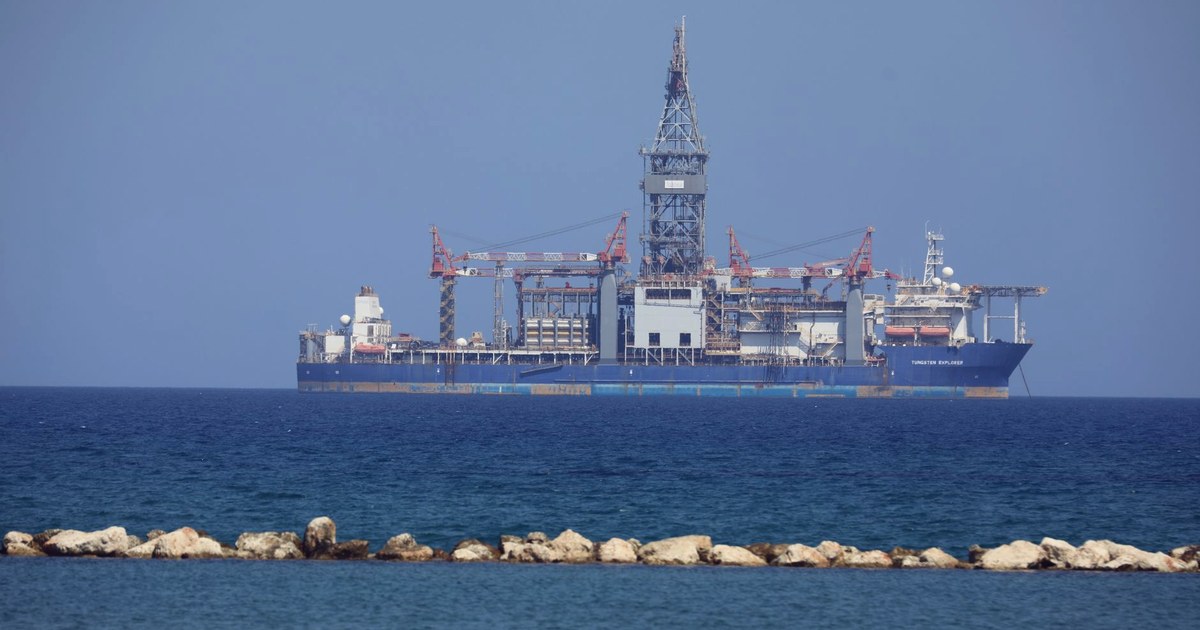
The Union Cabinet on July 31, 2026 approved Samudra Manthan, the National Offshore Exploration Scheme, with an outlay the Prime Minister's Office states is Rs 84,084 crore for implementation through FY2030-31, expected to catalyse reserve accretion of more than 600 million metric tonnes of oil equivalent. The pitch writes itself: India imports most of the crude it burns, the seabed around it is still mostly unexplored, so the government is putting real money behind finding more of it at home.
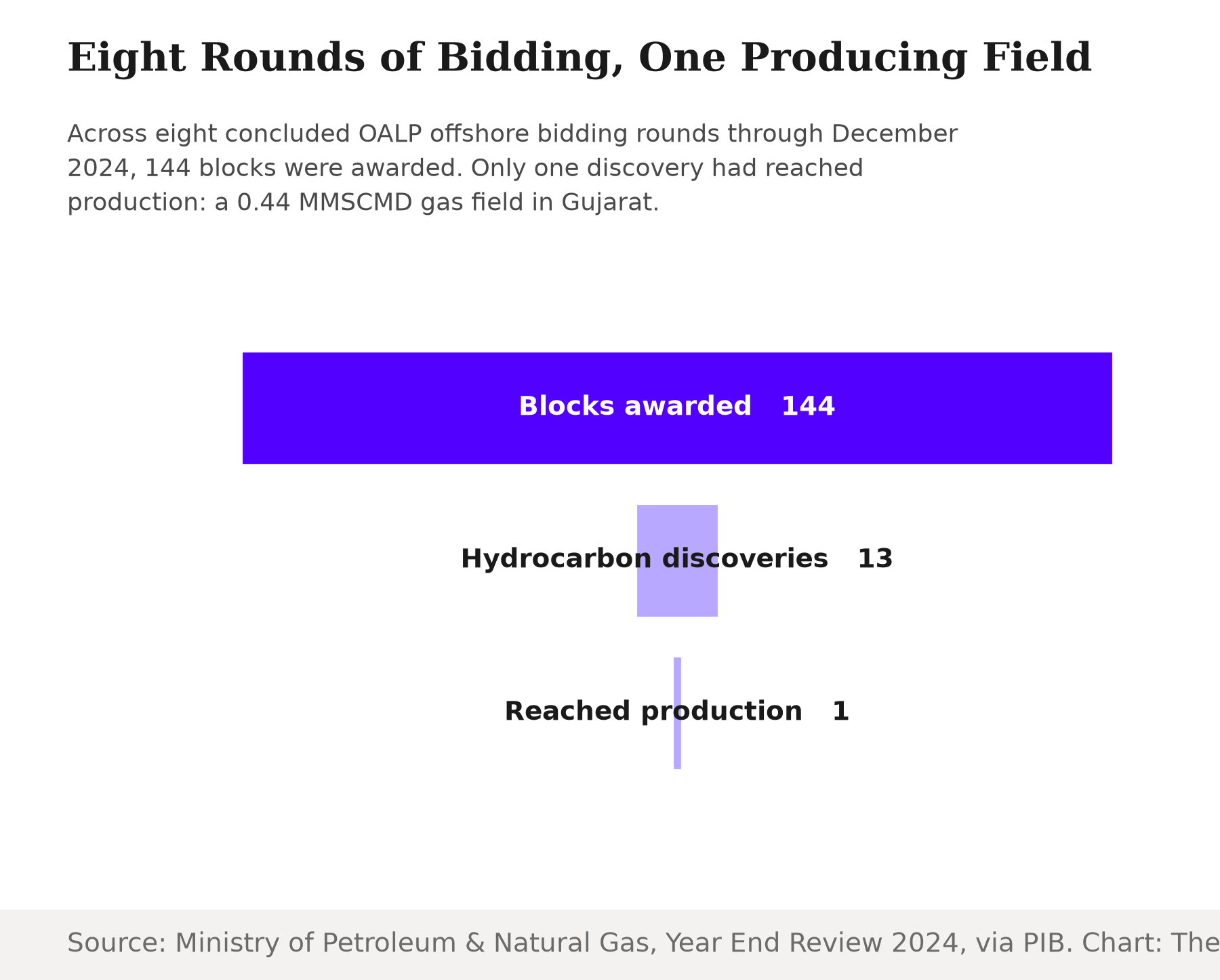
It is worth slowing down on that pitch. Samudra Manthan does not start from nothing. It extends the incentive structure of the Open Acreage Licensing Policy, the bidding program that has run India's offshore auctions across eight concluded rounds, and that program already has a track record. The Ministry of Petroleum & Natural Gas' Year End Review 2024 states that across eight concluded OALP bidding rounds, 144 blocks covering more than 2,42,056 sq km were awarded with committed investment of about $3.137 billion. Just 13 hydrocarbon discoveries resulted, and as of December 2024, only one of those had begun producing: 0.44 MMSCMD of gas in Gujarat. The rest were still under appraisal.
Thirteen of the 144 awarded blocks, about 9 percent, ever yielded a discovery. Fewer than 1 percent of the blocks awarded across eight rounds have reached production. A scheme built to accelerate exploration is being layered onto a program whose bottleneck, on its own numbers, was never a shortage of acreage under bid.
The number Samudra Manthan says it will fix
The case for more offshore money rests on import dependence, and that number has moved in the wrong direction while OALP's rounds were running. The government told the Rajya Sabha, per ThePrint's report of the written reply, that import dependence rose from 85.5 percent in 2021-22 to a record 88.7 percent, provisional, in 2025-26, a climb of 3.2 percentage points in five years. Domestic crude oil production fell too, over the same five years, from 29.7 million metric tonnes to 28.0 million metric tonnes, down 1.7 million tonnes.
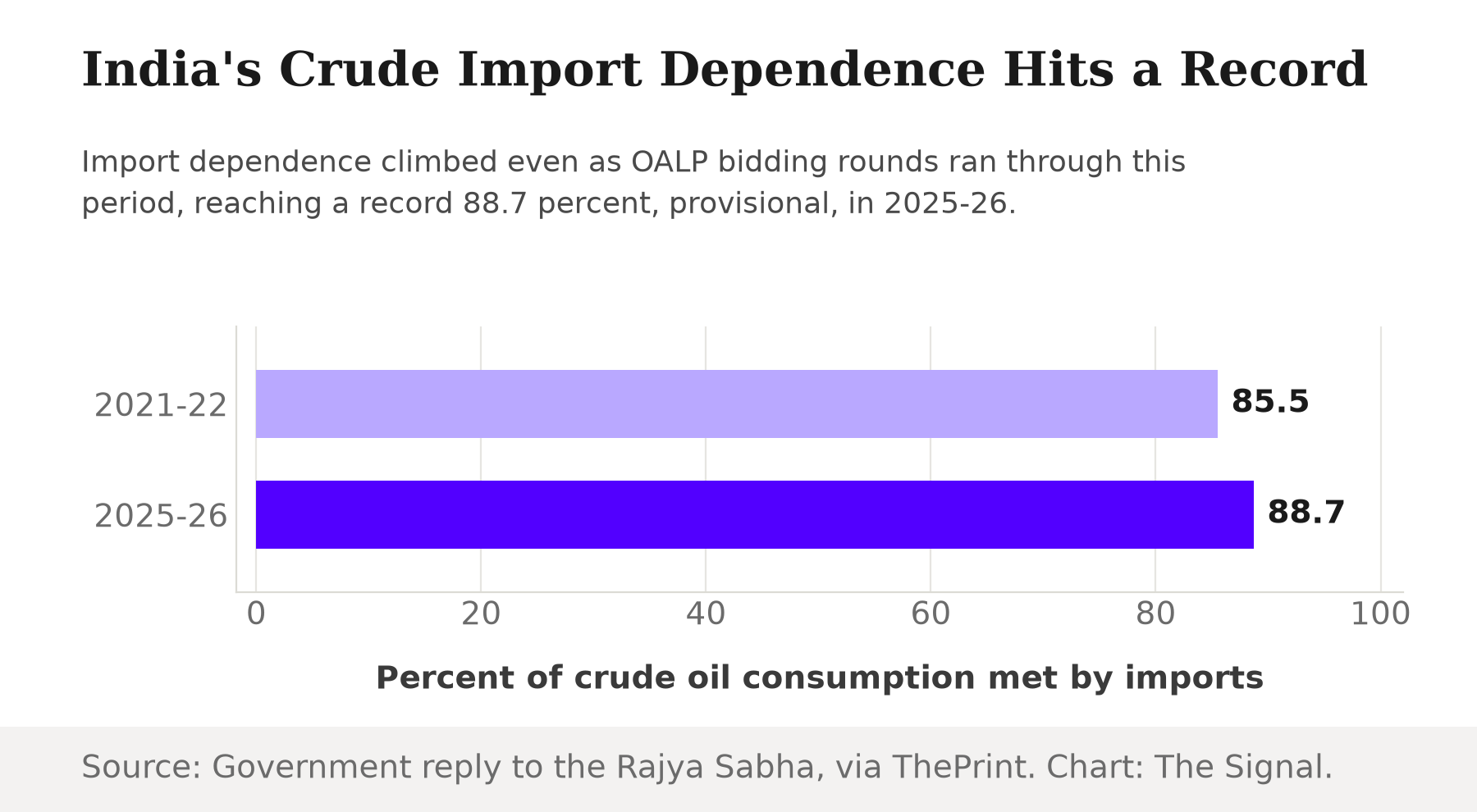
Eight rounds of bidding, 144 blocks awarded, and the dependence ratio still climbed. That does not prove OALP failed on its own terms: discoveries can sit in appraisal for years before a field is developed, and appraisal is exactly where the Ministry's own account leaves most of the 13 discoveries. But it does mean the scheme cannot lean on "more bidding rounds" as a story that has already worked. It hasn't, at least not yet, on the metric the government itself uses to justify doing more of it.
Where the new money goes
Samudra Manthan is explicitly aimed at the harder end of the map. The Directorate General of Hydrocarbons' National Data Repository states that India's 26 sedimentary basins span an estimated 3.36 million sq km, as of February 2024, of which 1.32 million sq km, 39 percent, lies in deep water beyond the 400m isobath, the frontier zone the scheme targets for accelerated drilling.
That frontier is already opening faster than the auction record built up across the eight prior OALP rounds. The Ministry of Petroleum & Natural Gas states that OALP Round-IX, awarded in April 2025, covered 28 blocks across eight basins and 1.36 lakh sq km, 38 percent of it in areas previously designated "No-Go." Round-X, launched the same year, went further still: 25 blocks across 13 basins, offering 1.92 lakh sq km, the largest acreage offered in any single round to date. Add Round-IX's awarded acreage to Round-X's offered acreage and the total, 3.28 lakh sq km, is larger than the entire 2,42,056 sq km awarded across all eight prior rounds combined, our calculation from those two filings.
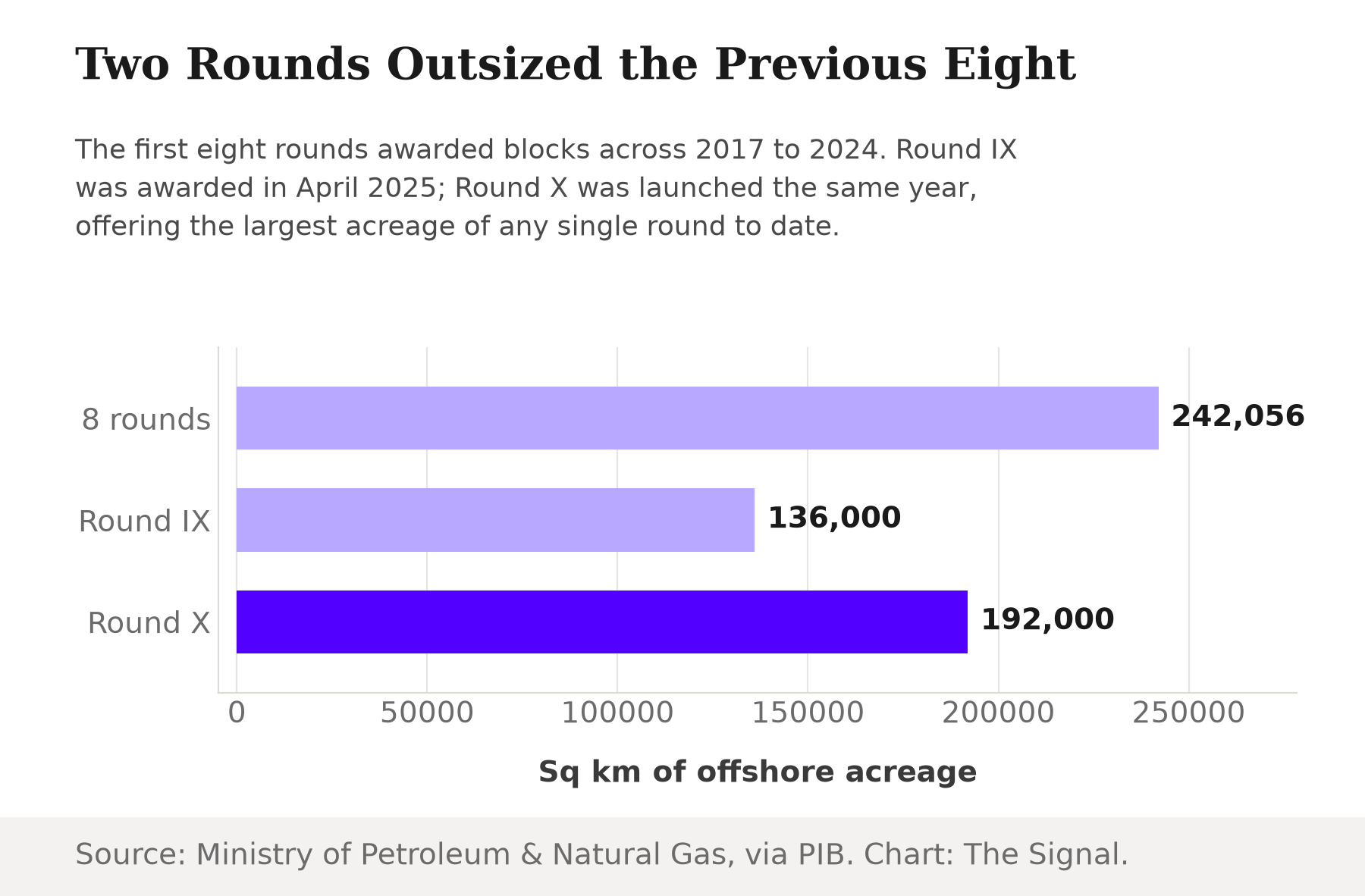
The acreage keeps accelerating faster than the conversion record does.
| Eight OALP rounds, through Dec 2024 | Samudra Manthan, approved Jul 2026 | |
|---|---|---|
| Outlay / committed investment | About $3.137 billion | Rs 84,084 crore |
| Blocks / area awarded | 144 blocks, over 2,42,056 sq km | Targets the 1.32 million sq km deep-water frontier |
| Discoveries | 13 | Target: reserve accretion over 600 MMTOE by FY2030-31 |
| Reached production | 1 (0.44 MMSCMD gas, Gujarat) | Not yet applicable, scheme just approved |
Source: Ministry of Petroleum & Natural Gas' Year End Review 2024 and the Prime Minister's Office.
The honest objection
The strongest case for patience is that offshore exploration is a slow business by nature, and the government's own account backs this up: most of OALP's 13 discoveries were, as of December 2024, still in the appraisal phase rather than abandoned. Deep water is a harder, costlier target than the shallow shelf OALP mostly worked, and Samudra Manthan is aimed squarely at the 1.32 million sq km beyond the 400m isobath, with a runway through FY2030-31 to develop it. On that reading, the scheme may simply be solving a different, newer constraint: capital for deep-water appraisal and development, not a shortage of exploration acreage.
That case is real, and it is why one producing field out of 144 blocks is not proof the program failed. But eight rounds is enough bidding history that some of those blocks were awarded years before the December 2024 review, and the Ministry's own account still places most discoveries in appraisal rather than production at that review. A program that keeps adding acreage faster than it clears its own appraisal backlog is not obviously short of blocks to bid on. It looks more short of whatever turns a discovery into a flowing field, and Samudra Manthan's headline number is an outlay for exploration, not a stated fix for appraisal or development capacity.
The Signal
Samudra Manthan buys more exploration in harder water. It does not, on the evidence of the program it extends, obviously buy more production. The number to watch is not the outlay or the reserve accretion target of over 600 MMTOE, both are years away from being tested. It is what the Ministry's next Year End Review says about the 13 discoveries already on the books: if more of them convert to flowing fields, the constraint was capital and patience, and Samudra Manthan is aimed at the right place. The reverse is just as telling: if the discovery count simply grows again while the production count stays at one, the bottleneck was never the acreage, and no new bidding round fixes it.
Reporting basis: the Samudra Manthan approval and its Rs 84,084 crore outlay are per the Prime Minister's Office's own release. The OALP eight-round record, its block and discovery counts, and the single producing field are from the Ministry of Petroleum & Natural Gas' Year End Review 2024, via the Press Information Bureau. India's import dependence and domestic production figures are from the government's written reply to the Rajya Sabha, as reported by ThePrint. The sedimentary basin and deep-water acreage figures are from the Directorate General of Hydrocarbons' National Data Repository, as of February 2024. The OALP Round-IX and Round-X acreage figures are from the Ministry of Petroleum & Natural Gas' account of the Round-IX and Special DSF signing ceremony. The combined Round-IX-and-X acreage total and its comparison to the prior eight rounds are The Signal's calculations from those figures.