On 8 July 2026, the Delhi High Court ordered Paytm Payments Bank wound up, granting "the prayer of the RBI seeking winding up of the company under Section 38 read with Section 39 of the Banking Regulation Act, 1949," Bar and Bench reports. The court appointed Girikumar M. Nair, a former State Bank of India chief general manager, as Official Liquidator, on a monthly compensation of ₹5.5 lakh drawn from the bank's own assets. That order followed an earlier one by three months. The Reserve Bank of India had already cancelled the bank's licence with effect from the close of business on 24 April 2026, under Section 22(4) of the Banking Regulation Act, 1949, saying the bank's management was "prejudicial to the interest of depositors as also the public interest." It added that "no useful purpose or public interest would be served by allowing the bank to continue." Read on its own, the sequence looks like the closing chapter of one company's regulatory troubles.
It is worth slowing down on that reading. Paytm is not the only name from the original class of payments-bank licensees to disappear, and among the ones still standing, the record confirms a profitable business at only two. Aditya Birla Idea Payments Bank had already ceased to be a banking company with effect from 28 July 2020, just over two years after launch, after telling the regulator its economic model was unviable. Two others, Airtel Payments Bank and Fino Payments Bank, are the only ones with a confirmed profit for the year ended March 2025. Set against the ambitions the Reserve Bank of India had for the licence category, that is a thin scorecard.
Two of the original eleven payments banks are now confirmed gone. Two more are confirmed profitable.
A licence granted wide
The payments bank was meant to be India's answer to a specific gap: a lightly capitalised, deposit-taking institution that could push basic banking into places full-service banks found unprofitable to serve, without the risk of a bank that lends. The Reserve Bank of India's original press release states that it "received 41 applications for payments banks" and gave in-principle approval to 11 of them on 19 August 2015: Vijay Shekhar Sharma's Paytm, Airtel, Reliance Industries' Jio, the Department of Posts, Aditya Birla Nuvo, Vodafone m-pesa, Fino PayTech, NSDL, Tech Mahindra, Cholamandalam and Sun Pharma's Dilip Shanghvi. It was a wide, deliberately diverse list: telecom operators, an industrial conglomerate, a state postal network, a pharma promoter and specialist fintechs, all betting the same licence would work for very different starting points.
Eleven years on, the public record only allows a scorecard on four of those eleven names. Two are gone. Two are profitable. The other seven simply have not surfaced, one way or the other, in the sources this piece can verify.
Paytm's own path to the exit
Paytm's route from a household payments brand to a wound-up bank ran through a sequence of escalating central bank restrictions, not one single event.
Every restriction on Paytm Payments Bank tightened the bank's scope further; none reversed it.
| Date | RBI or court action |
|---|---|
| 11 March 2022 | RBI directs the bank to stop onboarding new customers with immediate effect, citing material supervisory concerns |
| 15 March 2024 | RBI bars fresh deposits, credit transactions, top-ups and UPI-linked activity across accounts, wallets and FASTags (deadline pushed back once already from 29 February 2024) |
| 24 April 2026 | RBI cancels the bank's licence under Section 22(4) of the Banking Regulation Act, 1949 |
| 8 July 2026 | Delhi High Court orders the bank wound up on RBI's petition; Official Liquidator appointed |
Source: Reserve Bank of India press releases and Bar and Bench.
The RBI's first restriction on the bank came in March 2022, and the licence was not cancelled until April 2026, four years later. The gap between each step and the next only widens: two years from the onboarding freeze to the deposit freeze, then two more from the deposit freeze to cancellation, before the wind-up order followed within months. That is not the shape of a sudden collapse. It is the shape of a regulator that kept narrowing what the bank was allowed to do, for four years, before deciding nothing useful was left to preserve.
The two names that made money
While Paytm's bank was working through that sequence, two of its 2015 peers were doing the thing a payments bank is supposed to do: cover its costs on thin, deposit-only margins.
Source: Inc42; India Infoline. Chart: The Signal.
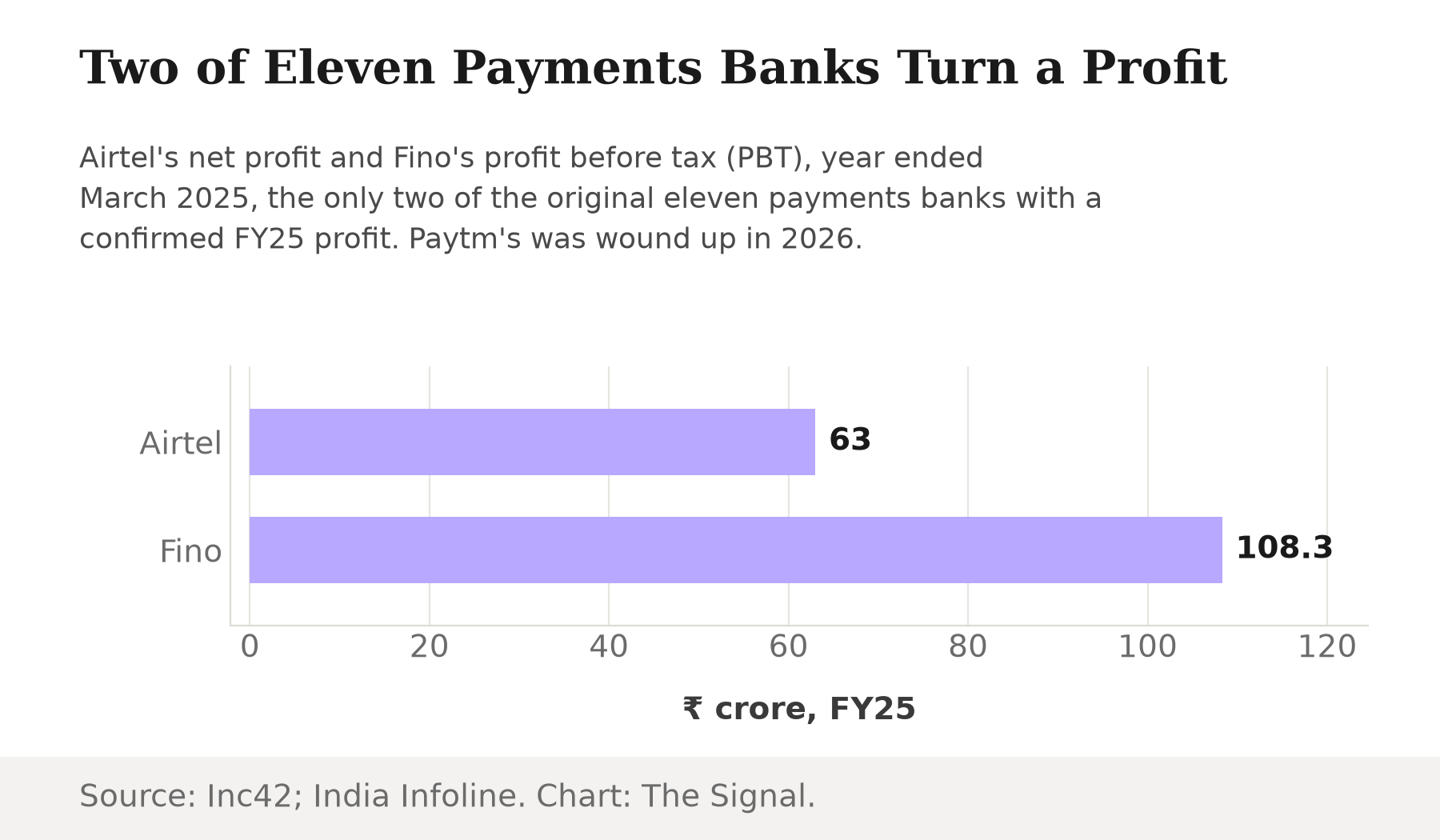
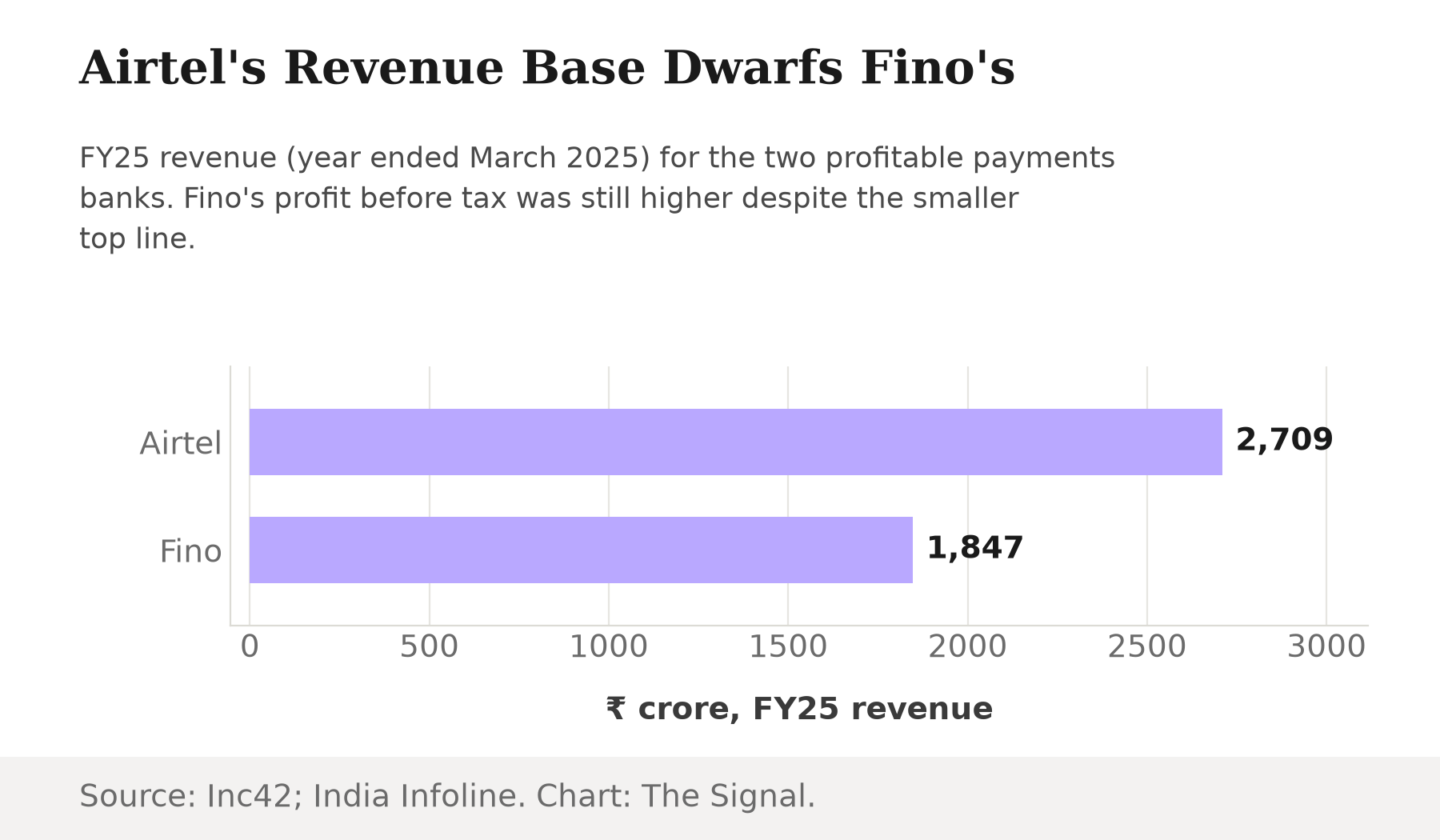
Airtel Payments Bank's consolidated net profit jumped 82.6% to ₹63 crore in the financial year ended March 31, 2025 (FY25) from ₹34.5 crore in the previous fiscal year, Inc42 reports, citing the bank's results. Fino Payments Bank registered a 25% year-on-year increase in revenue for FY25 to ₹1,847 crore, while its profit before tax increased 26% year-on-year to ₹108.3 crore, India Infoline reports, citing the bank's results. Fino's pre-tax profit is not directly comparable to Airtel's net-of-tax figure, but on either measure both businesses grew their bottom line in the same year Paytm's licence was being cancelled.
Source: Inc42; India Infoline. Chart: The Signal.
Scale runs the other way. Airtel Payments Bank's FY25 revenue of ₹2,709 crore is roughly 47 percent bigger than Fino's ₹1,847 crore, yet Fino converted more of its smaller revenue base into profit before tax than Airtel converted into net profit. Both companies lean on the same structural advantage: an existing distribution network, telecom retail for Airtel, banking-correspondent agents for Fino, that a deposit-only licence can piggyback on instead of building branches from scratch.
The honest objection
The strongest case against reading this as a category-wide verdict is that the sample is small and skewed. The public record here confirms outcomes for only four of the original eleven licensees, not all of them; the other seven may simply not have generated the kind of reporting this piece can verify, rather than having failed. And Paytm's specific troubles were compliance failures the RBI named explicitly, not evidence that deposit-only banking cannot work: a founder-led fintech with know-your-customer lapses is a different animal from a telecom subsidiary or a fifth-year profitable niche bank.
That case is real, and it is why this piece stops short of calling the payments-bank model a broad failure. But it does not explain away the pattern in the four names the record does confirm: the two backed by an existing distribution network turned a profit, and the two that did not, a founder-led fintech and a conglomerate-backed venture, are both gone. A regulator citing depositor harm at one bank is a company-specific story. Look at the licence category as a whole, though, and the surviving winners share the same structural advantage while the surviving losers do not. That pattern is closer to a design story.
The Signal
Paytm's wind-up will be read, correctly, as a story about one company's compliance record. But the RBI's own sequence of narrowing restrictions before cancellation and the RBI's own 2015 list of eleven names picked for their breadth together set the frame for a second, quieter question: what does it take for a payments-bank licence to survive on its own economics. Airtel and Fino's answer, so far, is an existing retail network and years of patience before the FY25 numbers turned solidly positive. Watch what happens to the remaining licensees whose fate has not yet surfaced in public reporting. If more of them turn out to be quietly profitable, Paytm's exit is a company story. But if more of them turn out to have failed quietly, without ever making news, then the story belongs to the licence itself, not to Paytm.
Reporting basis: the licence cancellation and the original 2015 in-principle approvals are per Reserve Bank of India press releases; the 2022 onboarding freeze and 2024 deposit freeze are per separate Reserve Bank of India press releases. The Delhi High Court's winding-up order, including the Official Liquidator's appointment and compensation, is per Bar and Bench's coverage of the court proceeding. Aditya Birla Idea Payments Bank's exit is per a Reserve Bank of India notification. Airtel Payments Bank's FY25 results are per Inc42's reporting, citing the bank's own results; Fino Payments Bank's FY25 results are per India Infoline's reporting, citing the bank's own results. The revenue comparison between Airtel and Fino is The Signal's calculation from those two reported figures.