On July 28, 2026, Minister of State for Finance Pankaj Chaudhary gave Parliament a number banks do not put in their advertising. Private sector banks collected Rs 4,948.71 crore from customers in FY26 for failing to maintain the minimum average balance in their current and savings accounts, more than double the Rs 2,137.92 crore public sector banks collected for the same shortfall, a written reply to the Rajya Sabha disclosed. Add the two together and Indian commercial banks collected Rs 7,087 crore in FY26 from account holders who could not keep their balance above the line their bank had set. The easy read is that private lenders are simply better than public ones at running a fee business.
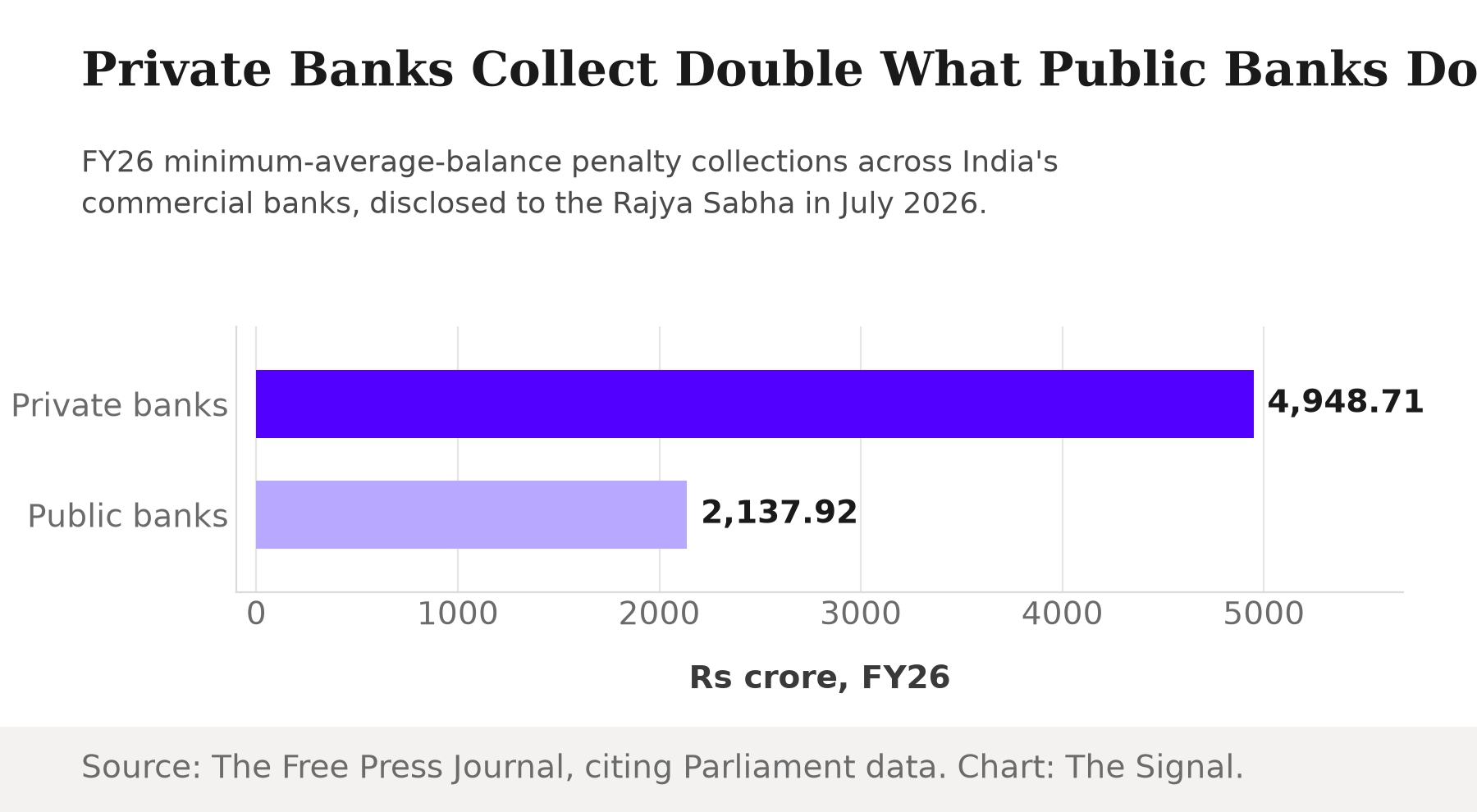
Source: The Free Press Journal. Chart: The Signal.
It is worth slowing down on that framing, because "private banks" is not one actor. HDFC Bank alone collected Rs 1,798.14 crore and Axis Bank Rs 1,081.33 crore in FY26, together Rs 2,879.47 crore, which is 58 percent of the total collected by all 19 private-sector banks. Two lenders out of nineteen collected more on their own, Rs 2,879.47 crore, than every public sector bank in the country collected combined, Rs 2,137.92 crore. The "private versus public" gap is really a story about two balance sheets.
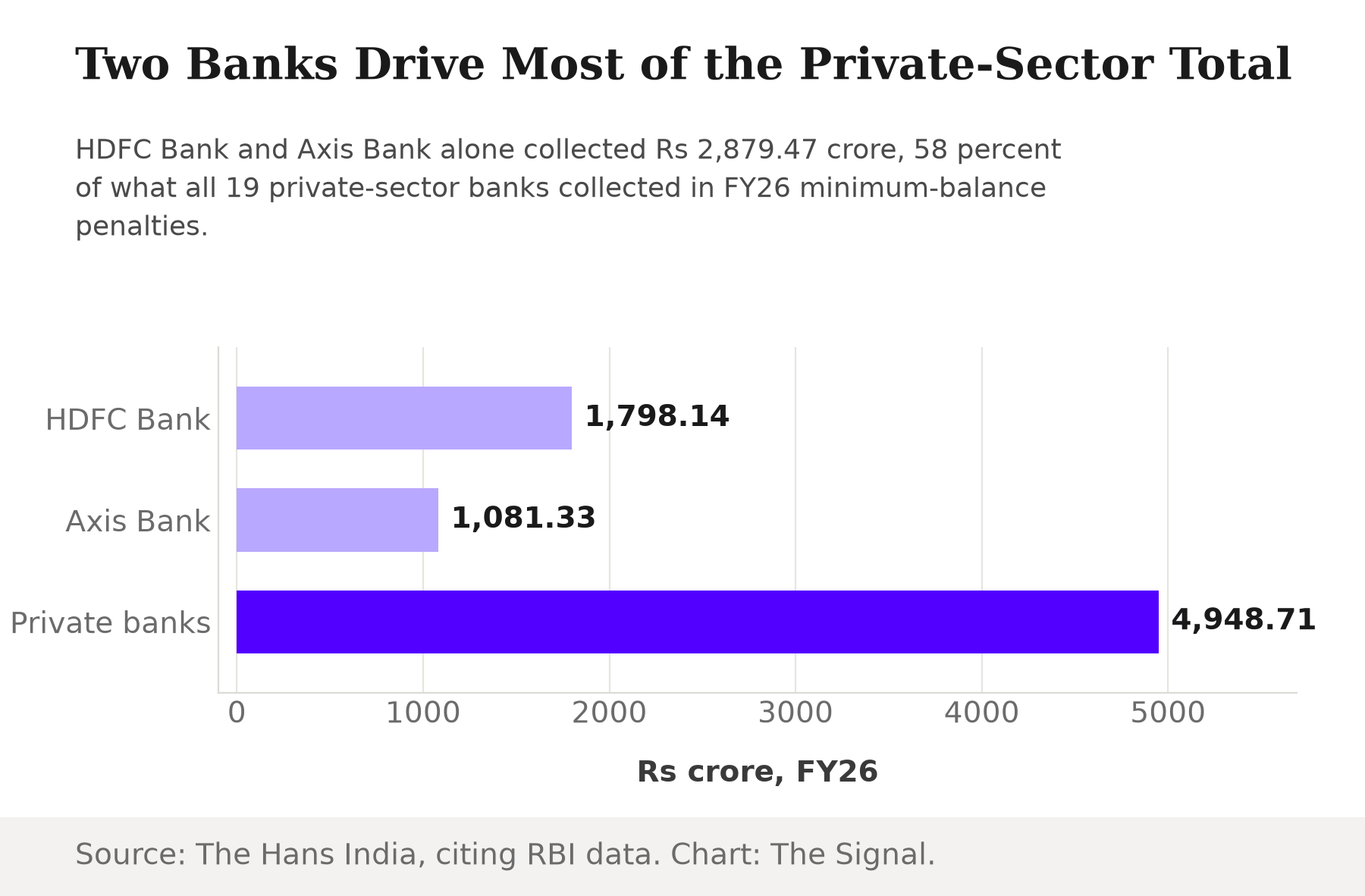
Source: The Hans India. Chart: The Signal.
Who Sets the Price
The reason 19 boards can land on such different numbers is that no one outside the bank sets this fee. The RBI's Master Circular on Customer Service in Banks tells lenders only that service charges should be "reasonable and are not out of line with the average cost of providing these services", language written for the whole category of bank service charges, of which the minimum-balance penalty is one. There is no published ceiling, no standard formula, and no bank-by-bank benchmark. Each bank's own board decides what "reasonable" means for its own customers, then prices accordingly. A fee that can range from a rounding error to Rs 1,798.14 crore at a single lender is not a natural market outcome so much as nineteen separate judgment calls, made under one vague national instruction.
Two of those judgment calls show exactly how wide the range runs. HDFC Bank's Regular Savings Account requires an average monthly balance of Rs 10,000 in metro and urban branches, Rs 5,000 in semi-urban branches and Rs 2,500 in rural branches, with a shortfall penalty of 6 percent of the gap or Rs 600, whichever is lower. State Bank of India, the country's largest public sector bank, requires no minimum balance in its regular savings account at all, and has not levied a single rupee of this penalty since March 2020, the same minister told the Lok Sabha five months before he gave the Rajya Sabha the FY26 collection totals this piece opened with. Both boards operate under the identical "reasonable, cost-linked" instruction. One landed on Rs 10,000; the other landed on zero.
The Accounts This Fee Cannot Touch
The RBI has, in fact, already shown it knows how to switch this fee off entirely, for one category of account. Basic Savings Bank Deposit Accounts, the category that covers every Jan Dhan (PMJDY) account, require no initial deposit and carry no minimum-balance floor to fall short of in the first place; a BSBDA cannot generate this penalty because it was designed, by rule, never to have a threshold to miss. That is not a small carve-out. As of February 28, 2025, the government's Jan Dhan dashboard listed 54.97 crore PMJDY accounts holding Rs 2,52,750 crore in deposits nationally, the last published tally, tens of crores of accounts sitting entirely outside the fee this article is about.
A zero-balance account cannot be fined; a standard account is priced by whichever bank holds it.
| Account type | Minimum balance requirement | Who sets the penalty |
|---|---|---|
| BSBDA / Jan Dhan (PMJDY) | None, no initial deposit required | Not applicable, no minimum-balance charge can be levied |
| Standard savings or current account | Set by the bank | Each bank's own board, per its own "reasonable" policy |
Source: RBI, BSBDA FAQs; RBI, Master Circular on Customer Service in Banks.
So the fee that produced Rs 7,087 crore in FY26 collections was never a risk for the accounts the government built specifically to guarantee financial access. It is a risk only for the much larger population of ordinary savings and current accounts, priced entirely at each bank's own discretion.
The Honest Objection
The strongest case for the banks is that this is exactly how the system is supposed to work. The RBI's rule explicitly leaves the number to each bank's board, and nothing in Parliament's disclosure says any lender breached the "reasonable, cost-linked" standard the circular sets. Private banks could reasonably argue their higher collections simply reflect a larger base of full-service, non-exempt accounts and a different cost structure than public sector banks carry, and that board-approved pricing within a regulator's own framework is not evidence of anything improper.
That case holds up only until you look at the range the same rule tolerates. All 19 private banks together collected Rs 4,948.71 crore, and HDFC Bank and Axis Bank alone accounted for Rs 2,879.47 crore of that, leaving the other seventeen private banks to split just Rs 2,069.24 crore between them (our calculation, the total less HDFC's and Axis's combined collections). One "reasonable and cost-linked" standard is being used to justify outcomes that differ by orders of magnitude between banks of similar scale. A rule flexible enough to cover both ends of that range is not really constraining anyone; it is a disclosure requirement dressed up as a price control.
The Signal
Parliament made this number visible. The RBI's own rule did not require it to be. Its Master Circular still asks only that the charge be "reasonable" and cost-linked, with no published cap, no standard formula tying the fee to an actual cost, and no bar that HDFC Bank or Axis Bank had to clear before their combined FY26 collections outran every public sector bank in the country. What to watch next is whether this Rajya Sabha disclosure becomes a one-off answer to a question, or the first data point the RBI uses to actually define what "reasonable" means. Until it does, the exemption is written into the rules only for the zero-balance account. For everyone else, the price of falling short still depends less on the balance in the account than on which bank's name is on the passbook.
Reporting basis: the FY26 bank-wise minimum-balance-penalty collections rest on one origin, a written reply to the Rajya Sabha by Minister of State for Finance Pankaj Chaudhary citing RBI data, as reported separately by The Free Press Journal, The Hans India and OrissaPost. The RBI's service-charge standard is from its own Master Circular on Customer Service in Banks; the BSBDA exemption is from the RBI's own FAQ on that account category; both are primary RBI documents. The Jan Dhan account and deposit totals are from the Department of Financial Services' PMJDY dashboard, as of February 28, 2025, the latest published figure. SBI's zero-minimum-balance policy is from the same minister's separate written reply to the Lok Sabha, five months earlier; HDFC Bank's average-monthly-balance requirement and penalty rate are from HDFC Bank's own published service-charges schedule. The remaining Rs 2,069.24 crore attributed to the other 17 private-sector banks is The Signal's calculation, the FY26 private-sector total less HDFC Bank's and Axis Bank's combined collections.