India's AI build-out has a headline number now. A report by OmniScience Insights Labs puts the investment needed for the country's AI and data-centre infrastructure at USD 350-435 billion by 2030, covering chips, buildings, and the power connections that feed them. The same report estimates that supporting that capacity could require around 160 terawatt-hours of electricity a year by 2030, about 6 percent of India's projected electricity consumption, rising to around 8 percent by 2035 as adoption expands. Read at that level, this is a familiar story: a fast-growing digital economy needs more power, and India's renewable capacity has been growing too. Six to eight percent of total consumption sounds like a manageable slice for a grid this size to absorb.
It is worth slowing down on that framing. The government's own numbers for this specific load have moved sharply in a short window, and the mismatch is not really about total energy consumed. It is about how steadily that power must be delivered, against a source that, by India's own regulatory design, does not deliver steadily.
The estimate that moved twice
In March 2026, the Ministry of Electronics and IT told the Rajya Sabha that India's data centre capacity had grown from about 375 MW in 2020 to around 1,500 MW by 2025, and that the Ministry of Power expected electricity demand from data centres to reach 13.56 GW by 2031-32. Four months later, in July 2026, the Ministry of Power itself told the Rajya Sabha that an additional load of 26.3 GW specifically from AI data centres is now projected by 2031-32, nearly double its own March estimate, and that this load is expected to be integrated into the grid and served primarily by renewable capacity.
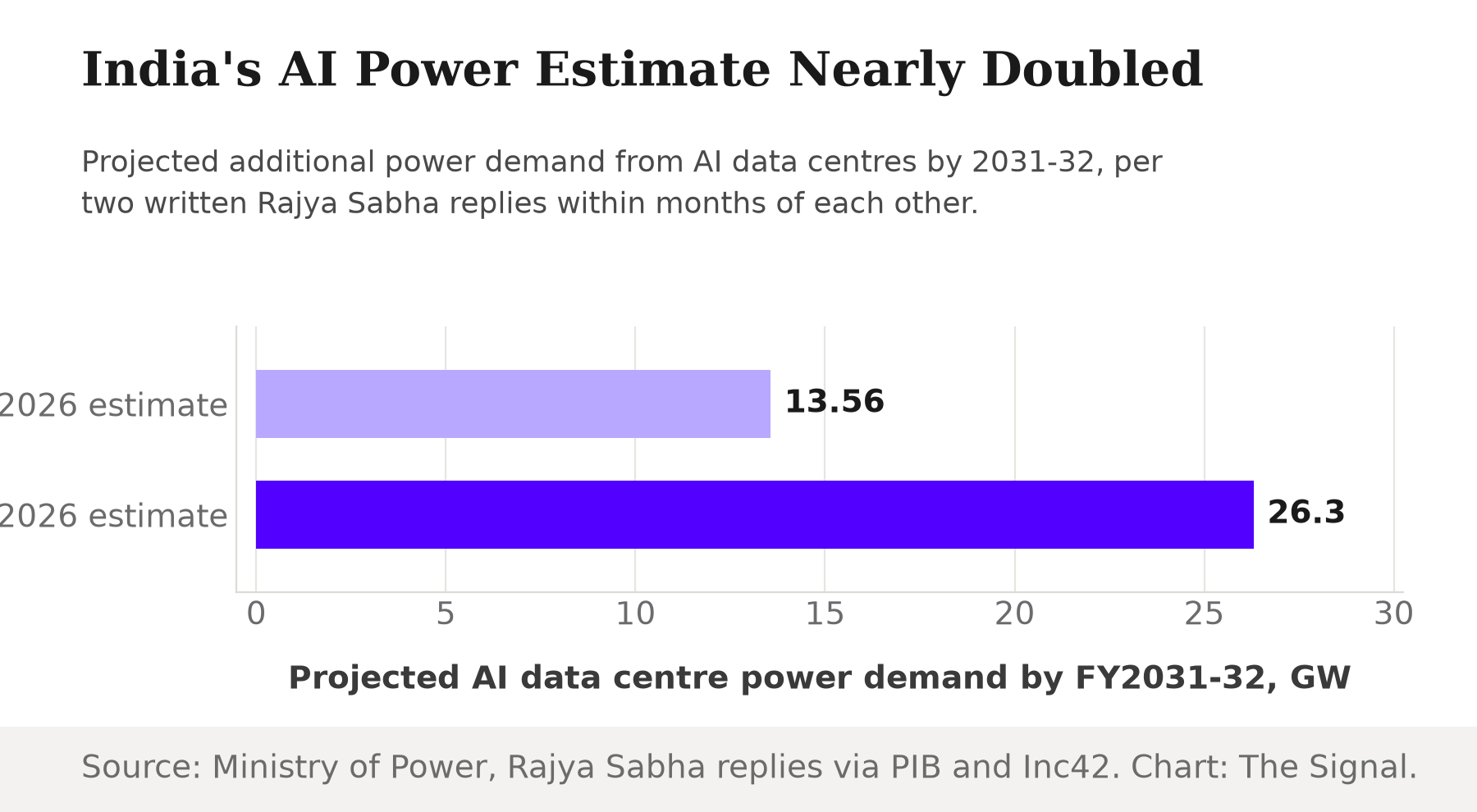
A government forecast that nearly doubles in four months is not a small revision. It says the planners are still finding out how big this load is, years before it lands. And the plan for meeting it rests on a specific, checkable assumption: that renewable capacity can be counted on to serve a load that a data centre, unlike a factory or a home, draws close to continuously.
Nameplate is not delivered power
That assumption runs into India's own tariff regulation. The Central Electricity Regulatory Commission sets a minimum normative capacity utilisation factor of 21 percent for solar PV projects, and between 22 and 35 percent for wind projects depending on how windy the site is. In plain terms: a 100-megawatt solar plant is expected to deliver about 21 megawatts on average. A wind farm on a modestly windy site clears roughly 22 percent of its nameplate; only the best wind sites reach 35 percent.
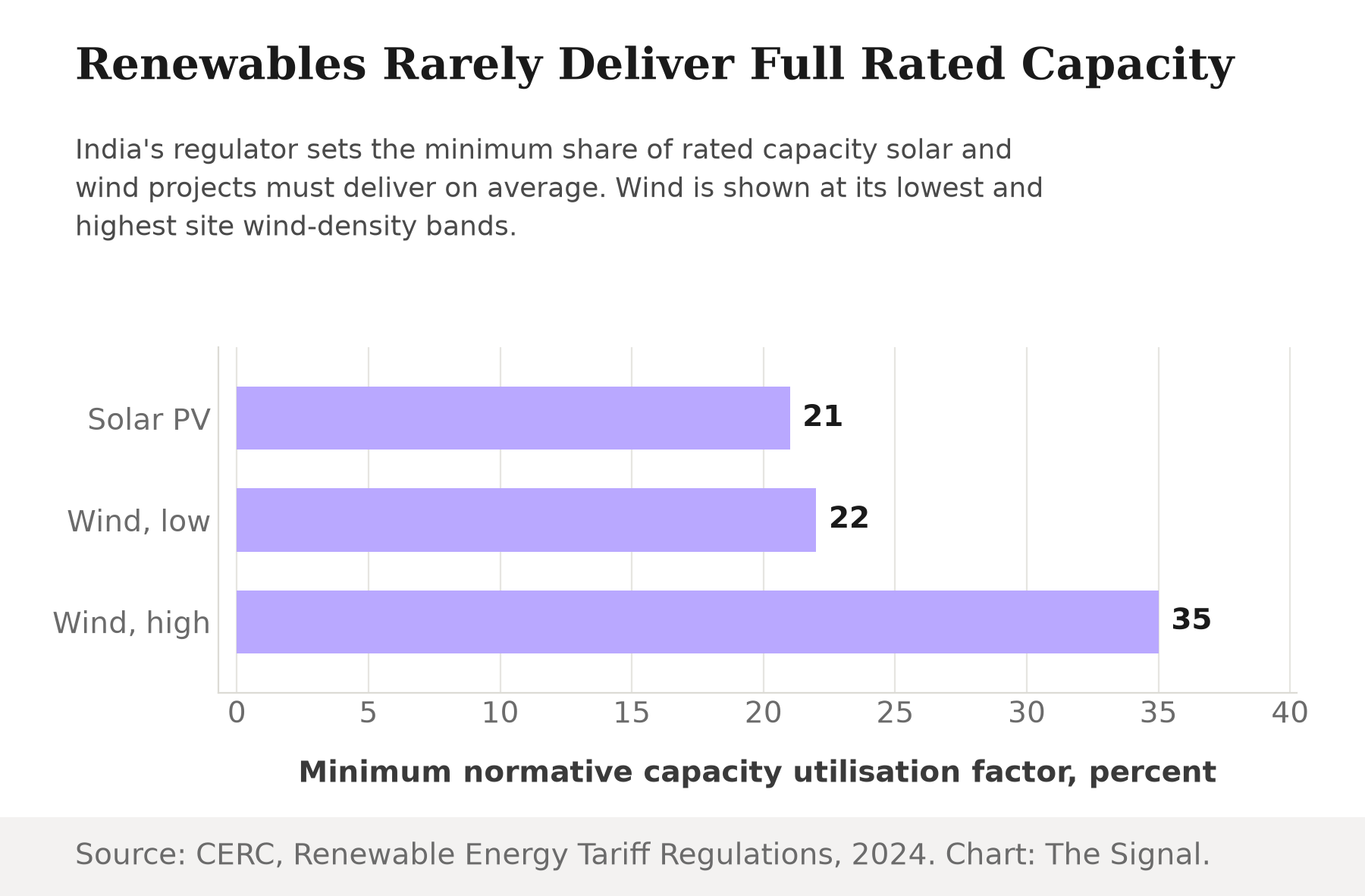
That regulatory floor is not just a paper assumption. In the CEA's own generation-planning studies, existing solar plants are assumed to run at a region-wise capacity utilisation factor of only 16.67 to 19.76 percent, below the 21 percent regulatory floor, with newly planned solar projects assumed to reach 20.02 to 24.5 percent. The plants already on the ground clear less of their rating than the regulator's own minimum implies, in every region of the country.
A data centre does not spread its demand evenly the way the capacity utilisation factor does. Its servers, and increasingly its AI accelerators, draw power in a narrow band close to their peak, hour after hour, night included. To serve that load reliably from a resource that clears only a fifth to a third of its rated capacity by regulatory design, a grid operator has two options: install several times more renewable nameplate capacity than the load itself, so the shortfall hours are still covered, or lean on capacity that does not have this problem, chiefly coal and gas, to fill the gap. Either way, "served primarily by renewable energy capacity" understates the engineering the phrase is doing.
The capacity math behind the promise
The system this load lands on is itself mid-expansion. India's total installed power generation capacity stood at 520.51 GW as of January 2026, and the National Electricity Plan projects that rising to 874 GW by 2031-32, an addition of roughly 353 GW over about six years.
The new AI load is a real, but not dominant, share of the planned build.
| Metric | Figure |
|---|---|
| Installed generation capacity, January 2026 | 520.51 GW |
| National Electricity Plan target, FY2031-32 | 874 GW |
| Implied capacity addition, FY2026-32 | about 353 GW |
| Projected AI data centre load, FY2031-32 | 26.3 GW |
| AI load as share of the planned addition | about 7 percent (our calculation) |
Source: Ministry of Power, Rajya Sabha reply, via PIB; Inc42. Share is The Signal's calculation.
About seven percent of a system-wide build is not, on its own, an impossible ask. But that comparison uses nameplate megawatts on both sides. This is not a hypothetical "if": the CEA's own National Electricity Plan projects that of the roughly 291,802 MW of new capacity the country's planning studies call for between 2027 and 2032, only about 32,080 MW is conventional (coal and nuclear); the remaining 259,722 MW, led by solar (179,000 MW) and wind (49,000 MW), is renewable-based capacity, close to 90 percent of the planned addition, by the government's own generation-planning document. Since that renewable share is wind and solar clearing 21 to 35 percent of their own rating, the delivered, reliable power available to match a continuous AI load is smaller than the nameplate math implies, at exactly the hours it matters: still nights, calm afternoons. The gap does not show up in the capacity-addition column. It shows up at 2 a.m. on a windless night.
The money math
The financing side raises its own question about pace. The lower end of the USD 350-435 billion AI and data-centre investment need runs through 2030, while India's total FDI equity inflow across the first nine months of FY2025-26, April to December 2025, was USD 47,874 million. The lower estimate for AI and data-centre capex alone is more than seven times everything India brought in as foreign equity investment across those nine months, in a single sector, on a compressed timeline. The comparison holds on a clean annual basis too: India's total FDI equity inflow for the full prior fiscal year, FY2024-25, was USD 50,018 million, so even a complete twelve-month FDI equity haul covers barely a seventh of the lower-end capex estimate.
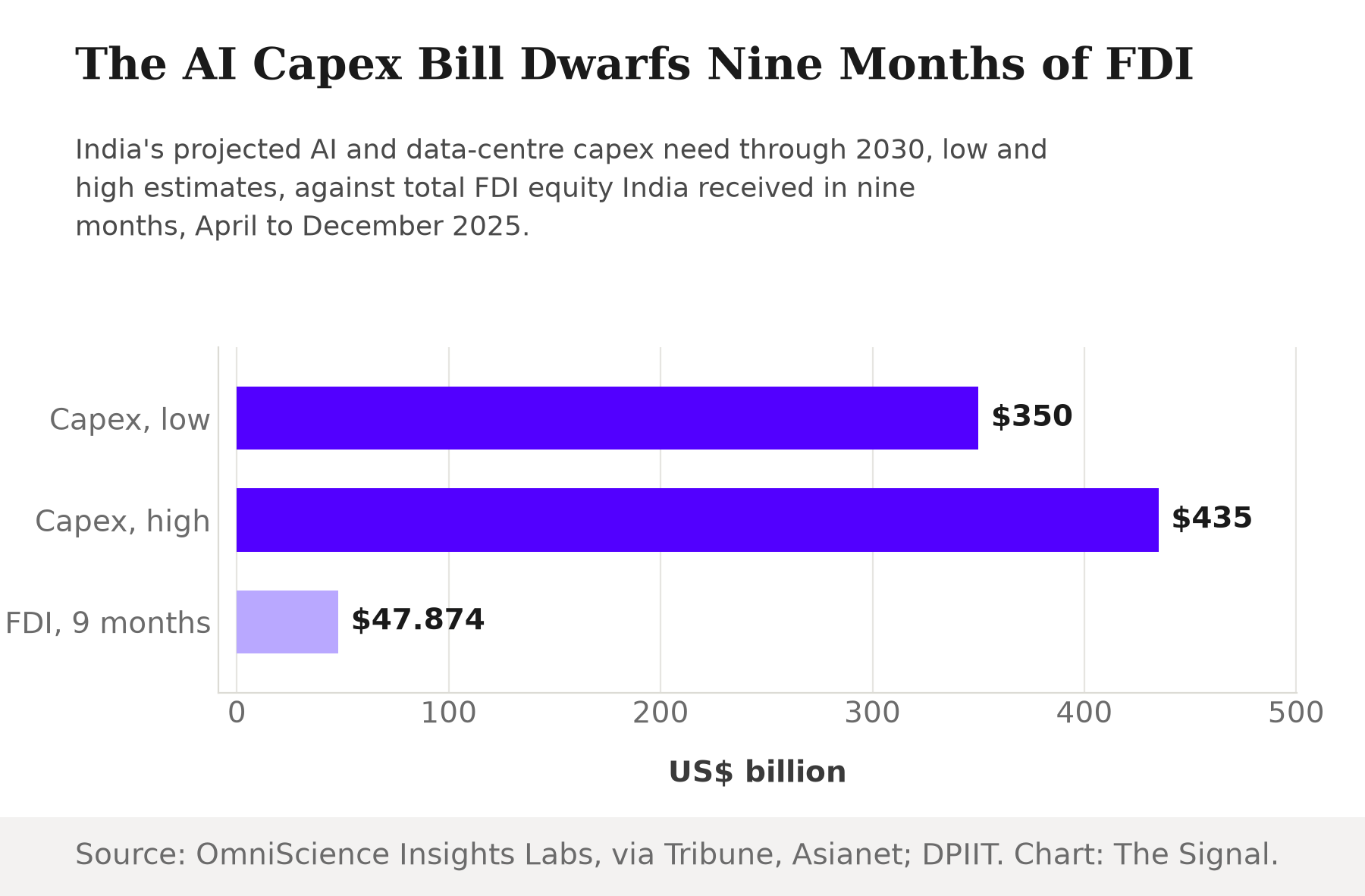
That does not mean the number is unreachable. FDI is one financing channel among several; domestic capital, debt, and reinvested corporate cash all count toward an infrastructure build of this kind, and none of those show up in the DPIIT figure. But it does mean the capex figure and the power figure are testing the same thing from different directions: whether India can absorb a single new demand category, at this scale, on this clock, without displacing capital and grid capacity that other sectors are also competing for.
The honest objection
The strongest case against reading this as a shortfall is that the Ministry of Power said what it said for a reason: officials wrote "expected to be integrated into the grid and primarily served by renewable energy capacity" into a formal Rajya Sabha reply, on the record, months after their own estimate for this load rose sharply. A ministry planning to lean on coal and gas for a load this size would have little reason to frame it that way in Parliament. The 874 GW target itself is part of a national plan that assumes continued heavy renewable additions, batteries, and better grid balancing between now and 2032, all of which chip away at the mismatch this piece describes.
That case deserves to be taken seriously, but it answers a different question than the one the capacity utilisation numbers raise. Regulatory intent to serve a load with renewables is a policy choice; a solar panel clearing 21 percent of its rating on a cloudy week is a physical constraint no policy statement changes. The 6 to 8 percent of projected electricity consumption cited in the investment report is an energy figure, a total measured in terawatt-hours across a full calendar. The capacity utilisation factor describes power, the megawatts available in a given hour. A load that is small as a share of total energy can still be large, and hard to guarantee, as a share of firm capacity in the hours renewable output runs thin, precisely because that output is not spread evenly across the calendar the energy total assumes.
The Signal
Two numbers in this story deserve to be watched past the headline investment figure. One is the composition of the capacity India adds to reach 874 GW by 2031-32: how much of it is renewable capacity running at 21 to 35 percent of its rating, and how much is firm, dispatchable capacity that does not have that problem. The other is whether the AI and data-centre capex figure clears at anything like the pace the 2030 deadline implies, against an FDI run-rate that currently covers a fraction of it. The Ministry of Power has already revised its own demand estimate once, sharply, within a single year. The next test is not whether India can eventually generate enough electrons to cover an AI data centre's annual draw. It is whether the grid can put firm power behind that draw at 2 a.m., not just on the ledger by 2032.
Reporting basis: the USD 350-435 billion AI and data-centre infrastructure investment estimate and the electricity projection are from a single OmniScience Insights Labs report, as reported by The Tribune and Asianet Newsable respectively; both outlets describe the same underlying report, so this is one origin carried by two publishers. The data-centre capacity growth and the March 2026 demand estimate are from the Ministry of Electronics and IT's written reply to the Rajya Sabha, via a Press Information Bureau release. The July 2026 estimate is from the Ministry of Power's own written reply to the Rajya Sabha, as reported by Inc42. The capacity utilisation factors are from the Central Electricity Regulatory Commission's Renewable Energy Tariff Regulations, 2024, the primary regulatory text. India's installed capacity and the National Electricity Plan target are from the Ministry of Power's written reply to the Rajya Sabha, via PIB. The FDI equity inflow figure for the nine-month period and the full FY2024-25 figure are both from DPIIT's official factsheets. The capacity-addition breakdown for 2027-32 is from the Central Electricity Authority's National Electricity Plan (Volume I: Generation). The existing and planned solar capacity utilisation factors by region are from the Central Electricity Authority's Report on Optimal Generation Capacity Mix for 2029-30. The addition of roughly 353 GW, the AI load's share of that addition, and the multiple of the FDI figures represented by the capex estimate are The Signal's calculations from those figures.