
In a written reply to the Lok Sabha on 27 July 2026, the Minister of State for Finance disclosed that 576 individuals reported gross total income above Rs 100 crore in Assessment Year 2025-26, the highest count in five years. The obvious reading writes itself: a fast-growing economy is minting more very-large incomes, exactly as it should. And the economy has grown. India's nominal GDP rose 9.8% to Rs 330.68 lakh crore in FY2024-25, up from Rs 301.23 lakh crore the year before.
It is worth slowing down on that pairing. The Rs 100 crore-plus headcount and the underlying economy are not moving at the same speed, not even close.
The bracket of ultra-high earners is outrunning the economy that produced it.
The count moved from 415 in AY2024-25 to 576 in AY2025-26, a rise of 38.8%. Because an assessment year taxes income actually earned the financial year before it, AY2025-26's count is built on FY2024-25 income, the same twelve months in which nominal GDP grew 9.8%. Line the two up and the Rs 100 crore bracket expanded at nearly four times the rate of the economy generating the income in the first place.
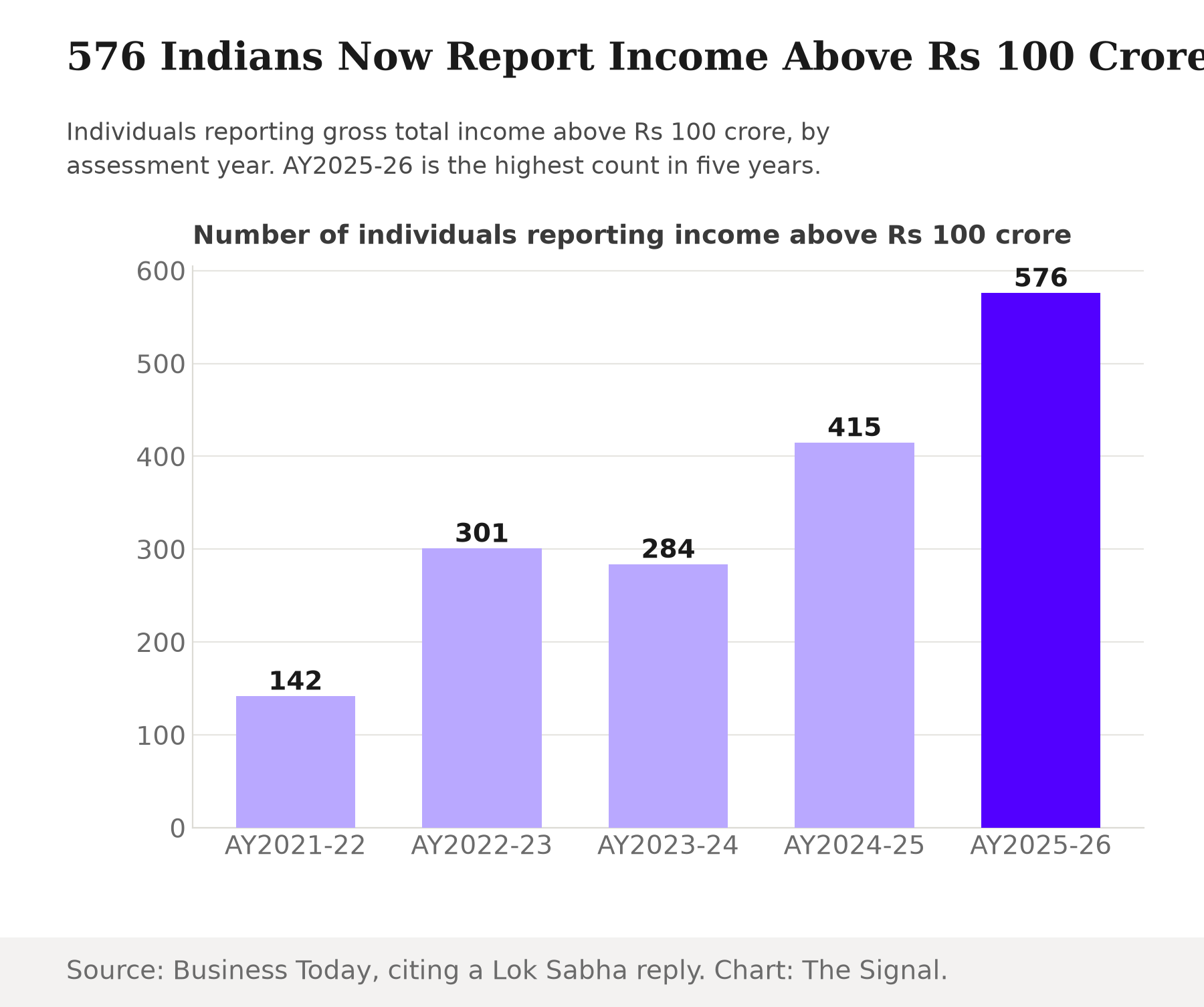
Source: Business Today, reporting a Lok Sabha written reply by the Minister of State for Finance. Chart: The Signal.
A five-year climb, not a straight line
The headcount has moved 142, then 301, then 284, then 415, then 576 across the five assessment years from 2021-22 to 2025-26. That run is not a straight line: the count fell from 301 to 284 between AY2022-23 and AY2023-24 before resuming its climb. Over the full five years the bracket is up roughly 306%, our calculation from the same series, close to the roughly 300% rise the Lok Sabha disclosure itself points to.
The bracket fell one year, then very nearly quadrupled over five.
A group that can shrink in one year and still nearly quadruple over five is not behaving like a broad, economy-wide pay rise. It behaves like a narrow bracket where a handful of unusually large years move the count sharply in either direction.
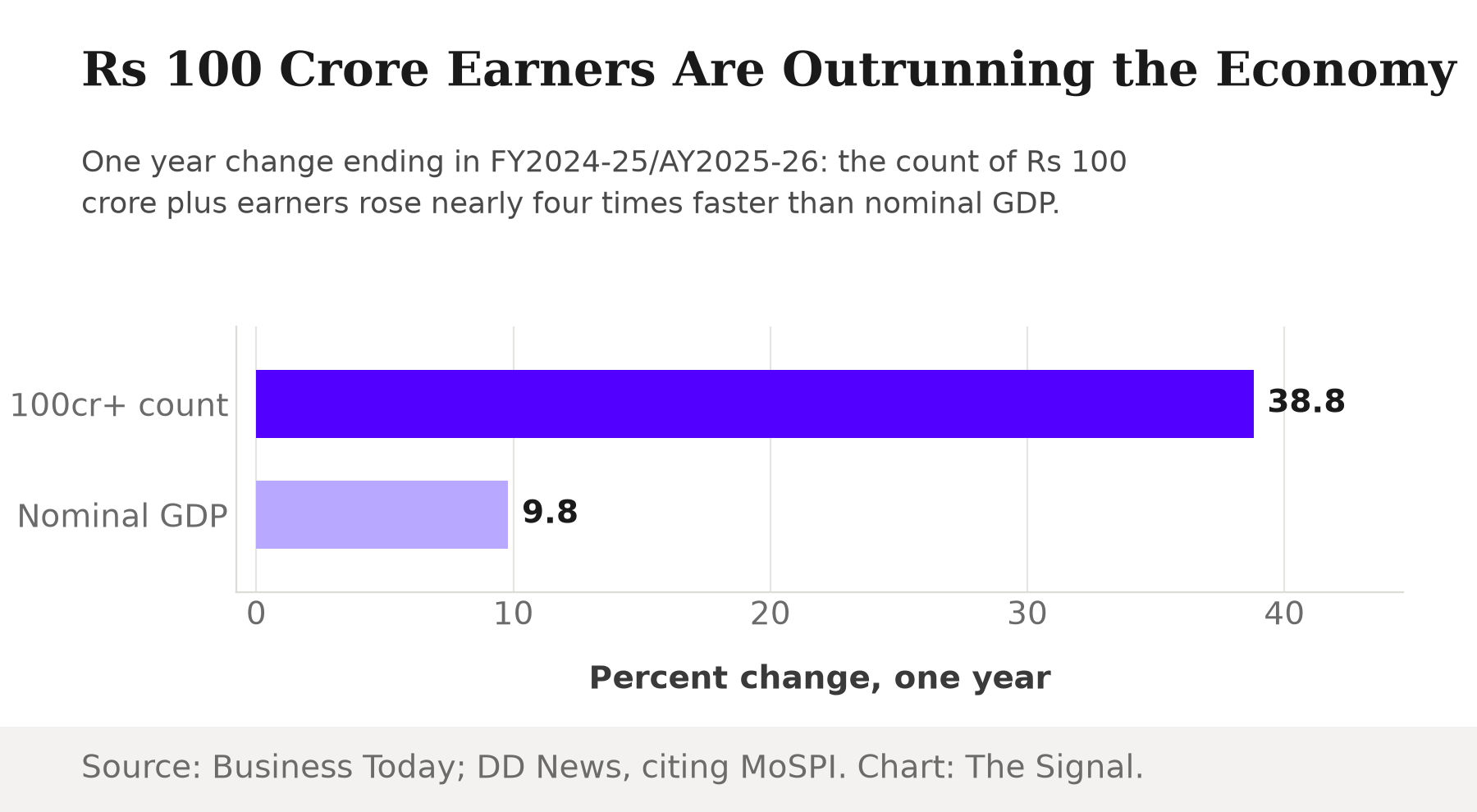
Source: taxpayer count per Business Today; nominal GDP per DD News, citing MoSPI. Growth-rate calculation: The Signal. Chart: The Signal.
A small bracket, filed among crores
Scale is where this bracket looks smallest. India recorded 7.28 crore income tax returns for Assessment Year 2024-25 as of 31 July 2024, 7.5% more than were filed by the same date a year earlier. Only 415 of that same assessment year's filers reported gross income above Rs 100 crore. Set one against the other and the ratio is about 1 filer in every 175,000, our calculation from those two disclosures. Whatever is driving the bracket's growth, it is happening inside a rounding error of India's total filing pool.
The revenue numbers looked soft early, then the year closed
Reading the AY2025-26 count against today's revenue figures needs one clarification first: an assessment year taxes the previous financial year's income, so every Rs 100 crore-plus filer counted in AY2025-26 earned that income in FY2024-25. FY2025-26 is a separate period, and its own numbers are already out. Gross direct tax collections for FY2025-26 rose 4.86% to about Rs 5.45 lakh crore, while net collections dipped 1.39% to Rs 4.58 lakh crore, as of 19 June 2025, just weeks into that fiscal year, which was still open at that point.
Refunds erased the year's entire headline gross growth, and then some.
| Direct tax metric, FY2025-26 (as of 19 June 2025) | Level | Change versus the same date a year earlier |
|---|---|---|
| Gross collections | Rs 5.45 lakh crore | +4.86% |
| Net collections | Rs 4.58 lakh crore | -1.39% |
Source: Akashvani (All India Radio) News, citing CBDT data.
That was an early, partial reading, not a verdict on the full year, and the full year has since closed. For the complete FY2025-26, ended 31 March 2026, net direct tax collections rose 5.12% to Rs 23,40,406 crore, while gross collections rose 4.03% to Rs 28,11,936 crore. The early net dip did not hold: net collections still finished the year growing, just more slowly than the gross figure and well behind the 38.8% pace of the Rs 100 crore-plus headcount.
A parallel story in the billionaire count
A separate, privately compiled ranking points the same direction. India had 308 dollar billionaires in the Hurun Global Rich List 2026, the world's third-largest count, up 57 from the prior year, putting last year's count at 251. Their combined wealth stood at about Rs 112 lakh crore. This is a separate data set, compiled by a different organisation using a different methodology than the CBDT figures above, and the two should not be treated as one series. But on two independent measurements, one governmental and tax-based, one private and wealth-based, the very top of India's income and wealth distribution is compounding quickly at the same time.
The honest objection
The strongest case against reading anything alarming into this is that a fast-growing, bull-market economy is supposed to produce a top bracket whose income rises faster than GDP. The top decile holds most of the equity and business wealth that rallies hardest in good years, so a widening gap between the ultra-high-income count and headline GDP growth is closer to what a maturing, rising market predicts than an anomaly. And in absolute terms the bracket stays tiny: barely more than 1 in every 175,000 AY2024-25 filers reported income that high, using that year's total return count as the base, hardly enough to move national accounts either way.
That argument holds for the headcount. It only partly settles the revenue question. A base does not need to be numerous to be load-bearing if a government is counting on a small number of very large filers to keep gross collections climbing, and on that count the early-June softness did not survive the rest of the year: FY2025-26 closed with net direct tax collections up 5.12%, actually outpacing the 4.03% rise in gross collections. Even so, both figures still trailed the 38.8% pace of the Rs 100 crore-plus headcount by a wide margin, so the concentration at the very top is still growing far faster than what the exchequer is actually banking.
The Signal
None of these numbers is alarming by itself. A record 576 Indians clearing Rs 100 crore of income is unambiguously good news about the scale of fortunes being made. A nominal economy that expanded 9.8% in a year is unambiguously good news about growth. The dip recorded in June did not last: FY2025-26 finished with net direct tax collections up 5.12%, recovering past the gross figure rather than confirming the softness the June reading flagged. What is still worth watching is the gap that does not close: the Rs 100 crore-plus bracket's headcount grew 38.8% in FY2024-25, the year that income was earned, while the exchequer's own take grew just 5.12% in the following year, FY2025-26. If the next Lok Sabha disclosure shows that gap narrowing as this bracket's revenue keeps pace with its headcount, the concentration is feeding the exchequer exactly the way a maturing economy's top bracket should. Should the gap keep widening even after a fiscal year of recovered net collections, the story stops being about how many Indians got rich this year and starts being about how little of that concentrated growth shows up in what the government actually collects.
Reporting basis: the AY2021-22 through AY2025-26 taxpayer counts are per Business Today's account of a Lok Sabha written reply by the Minister of State for Finance. Nominal GDP for FY2024-25 and FY2023-24 is per DD News, citing MoSPI's provisional annual GDP estimates. Gross and net direct tax collections for FY2025-26, both the early reading current to 19 June 2025 and the full-year figures as of 31 March 2026, are per Akashvani (All India Radio) News and Business Today respectively, both citing CBDT data. The Assessment Year 2024-25 ITR filing count is per a separate Akashvani (All India Radio) News account of Finance Ministry figures. The billionaire count and combined wealth are per Zee News, citing the Hurun Global Rich List 2026, a distinct, privately compiled ranking independent of the government tax data above. The one-year and five-year growth rates for the Rs 100 crore-plus bracket, its multiple of nominal GDP growth, and its ratio to total ITR filings are The Signal's calculations from those figures.