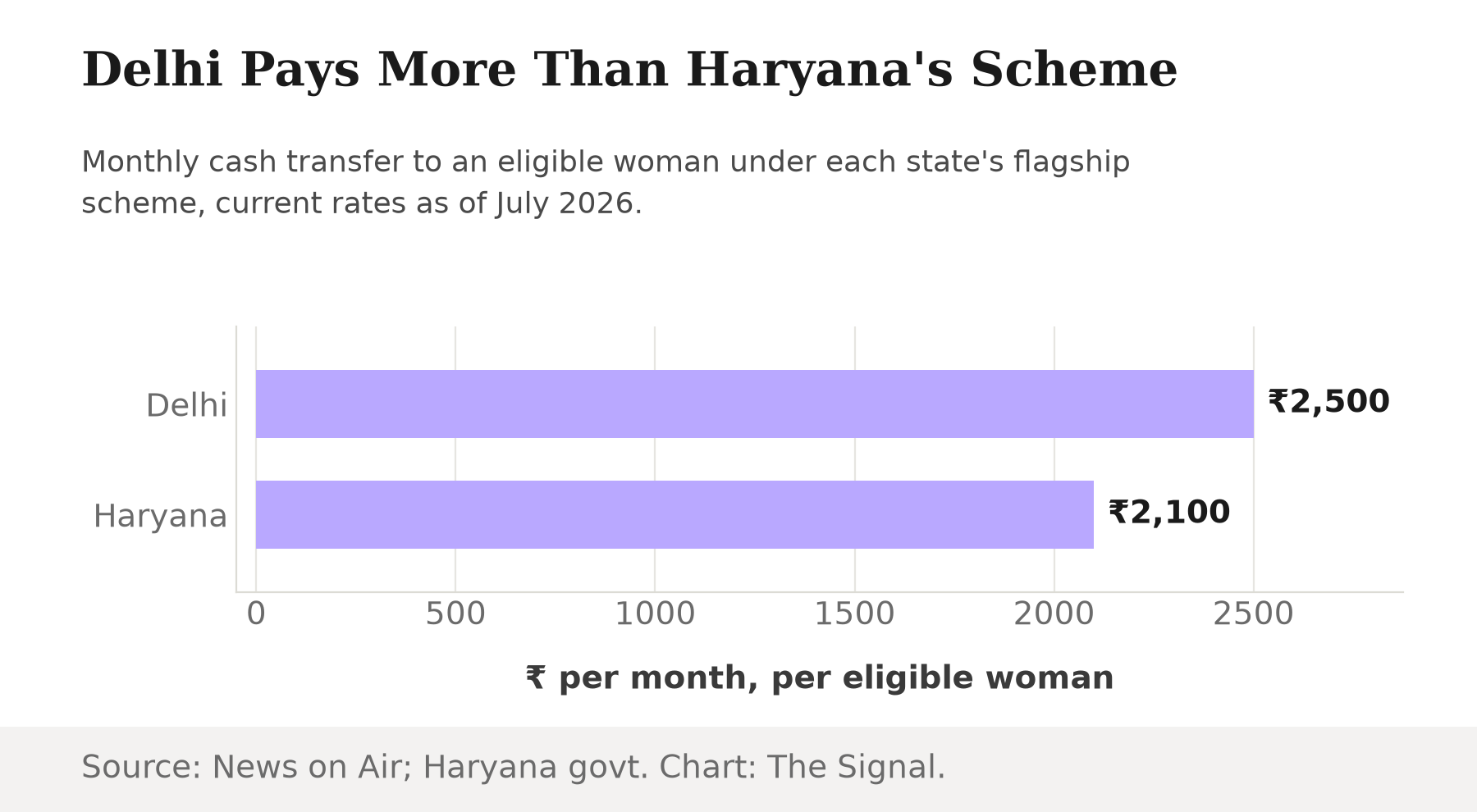
The Delhi cabinet, chaired by Chief Minister Rekha Gupta, approved the guidelines for the Lakshmi Yojana this week, and the government is targeting Raksha Bandhan for the first payments, with the application portal set to open August 1. The scheme itself reads as straightforward: Rs 2,500 a month, backed by a Rs 5,100 crore provision written into the Delhi budget in March 2025, reaching an estimated 17 lakh women aged 21 to 60 from families earning under Rs 2.5 lakh a year. Read only those numbers and Delhi looks like it is simply running the same design already at work in two other states: pick an income line, pay a flat monthly amount, done.
It is worth slowing down on that comparison. Madhya Pradesh's Ladli Behna Yojana sets the same Rs 2.5 lakh annual family-income ceiling Delhi just adopted, so Delhi did not invent its income test, it copied Madhya Pradesh's number exactly. But two of Delhi's other eligibility rules have no match in either comparator scheme, on the terms those states have made explicit. Women with more than three living children are not eligible for the Delhi scheme, and only one woman per family can receive the benefit; where a household has more than one eligible woman, the eldest is the one who gets paid.
Run the government's own figures and the fit is exact. The Rs 5,100 crore budget provision, divided across the 17 lakh women the scheme is meant to reach, works out to Rs 30,000 a year per beneficiary, precisely the Rs 2,500 monthly rate times twelve (our calculation, from those two figures). There is no slack built into that budget for anyone the child cap or the one-woman-per-family rule screens out. Every family the new rules exclude is a family the finance department has already funded room for.
The income line is borrowed. The exclusions are not.
Haryana's Deen Dayal Lado Lakshmi Yojana pays Rs 2,100 a month to women from families earning under Rs 1 lakh a year, a far tighter income test than Delhi's, per the scheme's official terms as of September 2025. But that same official page is explicit that there is no restriction on the number of eligible women in a family who can avail the scheme's benefit: every qualifying woman in a household gets paid, not one. Madhya Pradesh runs the reverse asymmetry. Its Ladli Behna Yojana restricts eligibility by an applicant's birth-year window rather than by the number of children in her family, and places no cap on family size at all.
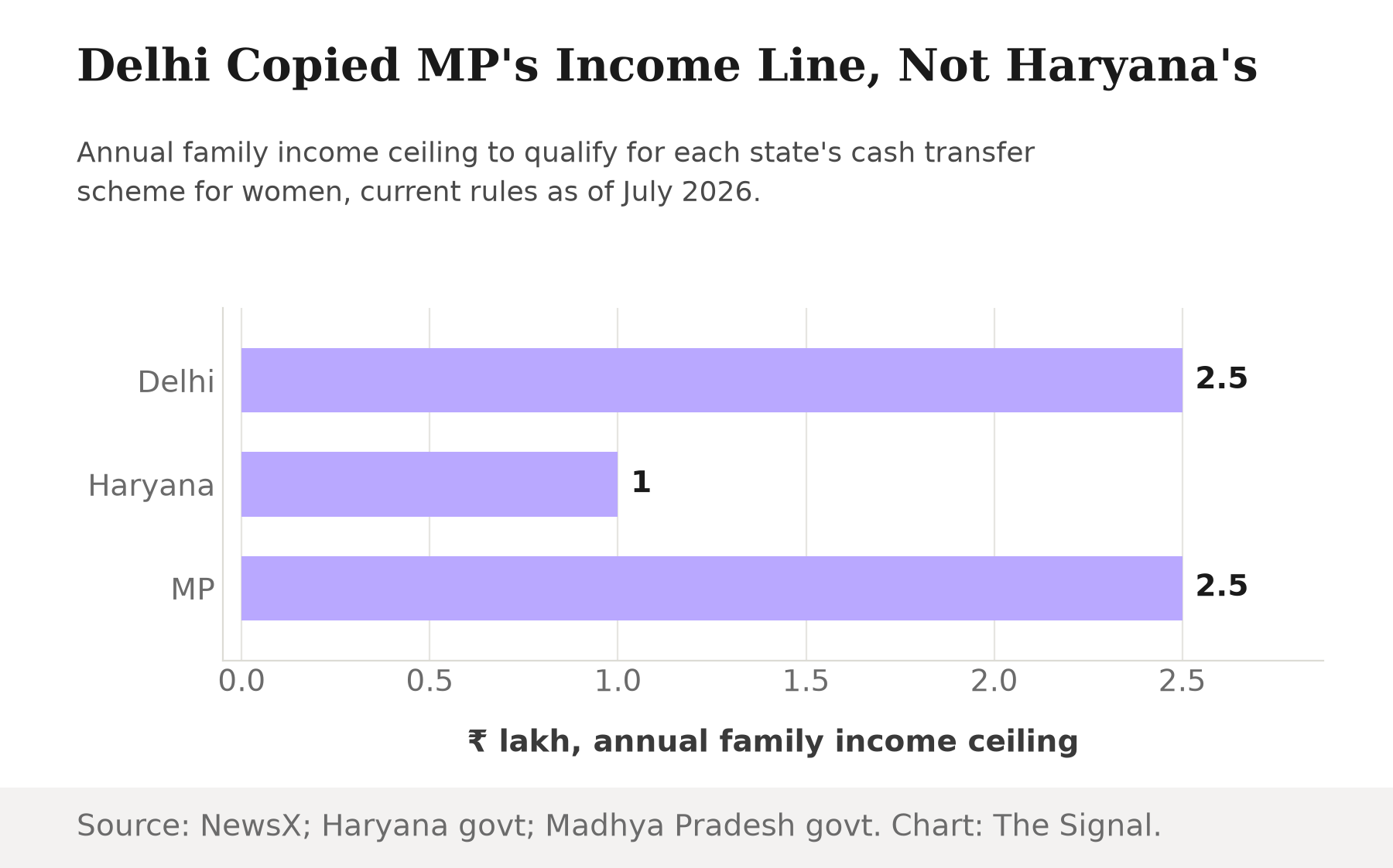
Delhi's rules combine restrictions that, in its two closest comparators, only ever show up one at a time. Madhya Pradesh does not cap by child count, while Haryana leaves the number of paid women per household unrestricted. Delhi, launching this week, does both at once, on the same income line Madhya Pradesh already runs.
Two new gates neither comparator uses
Beyond the income test, Delhi's guidelines add a specific asset and employment screen. Applicants are ineligible if their family consumes more than 2,400 units of electricity a year, owns a four-wheeler, or includes a member employed by the Centre, a state government, a public sector undertaking or another government organisation. That is the familiar shape a means test takes, and Haryana and Madhya Pradesh run their own versions of it through their income lines. What has no match in either comparator scheme is the other two rules: the cap at three living children, and the rule that only the eldest of multiple eligible women in one household is paid.
Delhi is the only one of the three schemes capping both family size and the number of women paid per household. Haryana's official terms state there is no restriction on the number of eligible women in a family, and Madhya Pradesh's official terms state there is no cap on family size at all.
| Scheme | Monthly amount | Annual family income ceiling | Cap on family size / children | Cap on eligible women paid per family |
|---|---|---|---|---|
| Delhi Lakshmi Yojana | Rs 2,500 | Rs 2.5 lakh | Yes: more than three living children excludes the family | Yes: only the eldest eligible woman is paid |
| Haryana Deen Dayal Lado Lakshmi Yojana | Rs 2,100 | Rs 1 lakh | Not stated in the scheme's official terms | No: no restriction on the number of eligible women |
| Madhya Pradesh Ladli Behna Yojana | Not stated in the scheme's official terms | Rs 2.5 lakh | No: eligibility runs on a birth-year window, not family size | Not stated in the scheme's official terms |
Source: All India Radio's News on Air; NewsX; The Tribune; The Federal; Haryana Directorate of Social Justice and Empowerment; Madhya Pradesh Ladli Behna Yojana.
Why Delhi might be moving twice as carefully
This is not Delhi's first attempt at a scheme like this. The Mukhyamantri Mahila Samman Yojana, announced in 2024, was never formally notified by the Delhi government department responsible for it, as reported in December 2024, delaying any disbursal by more than a year before the scheme was relaunched under the Lakshmi Yojana name.
The honest objection
The strongest case for Delhi's two extra rules is fiscal discipline, not family policy. A finance department that has already watched one welfare scheme go unnotified for over a year before it was relaunched, and that has now written a budget with zero slack for anyone it excludes, has a plain incentive to keep the payout predictable and bounded from day one. A child cap and a one-payment-per-family rule are two direct ways to do that. That case does not require assuming anything about Delhi's motives beyond wanting this launch to actually work, and it deserves to be taken seriously.
It runs into a problem, though: the comparator schemes do not behave the way pure cost containment would predict. Haryana runs its scheme with no cap on the number of paid women per family despite an income ceiling of Rs 1 lakh, less than half of Delhi's Rs 2.5 lakh line. The tighter income line, not a per-family payment cap, is Haryana's chosen way to bound its own payout. Madhya Pradesh runs its scheme with no family-size cap at all, at the identical Rs 2.5 lakh ceiling Delhi just copied. If cost containment alone explained Delhi's two new rules, at least one of these two states, working from a similar or tighter budget constraint, would likely have reached for the same tool. Neither did.
The Signal
Delhi imported Madhya Pradesh's income line rather than a whole working template, then built two exclusion rules that show up in neither donor scheme. Once the portal opens August 1, the number worth watching is not the promised 17 lakh beneficiaries but how many women who clear Delhi's income line, and who would qualify under Haryana's or Madhya Pradesh's rules, get filtered out by the child cap or the one-payment-per-family rule instead. A scheme that borrows its income line from one state and its exclusions from neither is not just managing a budget. It is deciding which large, poor families do not count.
Reporting basis: the Delhi Lakshmi Yojana's payment amount and budget provision are from the Government of NCT of Delhi's Department of Women and Child Development, via All India Radio's News on Air, which also reported that the department's earlier Mukhyamantri Mahila Samman Yojana was never formally notified. The beneficiary estimate and the age and income eligibility criteria are as reported by NewsX. The child-count, electricity, vehicle and government-employment exclusions are as reported by The Tribune, citing Delhi government scheme guidelines. The one-woman-per-family and eldest-only provisions are as reported by The Federal, citing the same guidelines. Haryana's Deen Dayal Lado Lakshmi Yojana terms are from the state's Directorate of Social Justice and Empowerment's official scheme page. Madhya Pradesh's Ladli Behna Yojana terms are from that scheme's official government FAQ page. The per-beneficiary budget arithmetic is The Signal's calculation from the Delhi budget provision and beneficiary estimate.