Tata Sons released its FY26 Annual Report this week, and the headline numbers read like a clean win. Chairman N Chandrasekaran told shareholders that Tata Sons' own standalone revenue grew 9.1% to Rs 42,367 crore in the year ended March 31, 2026, while profit after tax grew 21.8% to Rs 31,961 crore. At the aggregate Tata Group level, revenue grew 7.8% to Rs 16,24,030 crore and profit after tax jumped 51.9% to Rs 1,70,525 crore. By the numbers that get quoted, FY26 was one of the group's best years on record.
It is worth slowing down on where that standalone profit actually came from. Dividend income is Tata Sons' main revenue line as a holding company, and it fell 10% in FY26, to Rs 32,528.36 crore from Rs 36,149.05 crore in FY25. The line that is supposed to represent cash actually flowing up from Tata Motors, TCS, Titan and the rest of the portfolio shrank, and Tata Sons' own related-party disclosures show which holding did the shrinking: TCS, its dominant listed subsidiary, cut what it paid up to Tata Sons to Rs 28,290.94 crore in FY26 from Rs 32,184.19 crore in FY25, a Rs 3,893 crore cut that is on its own larger than the entire Rs 3,621 crore fall in Tata Sons' total dividend income: every other investee company's dividends to Tata Sons rose on net even as the total line fell. What lifted the total anyway was a one-time item: Tata Sons' FY26 revenue included a Rs 6,530.64 crore profit from the sale of investments, which is what let standalone profit rise 21.8% even though core dividend income fell. Strip that one-off gain out and the 21.8% profit jump has no comparably-sized recurring line to explain it.
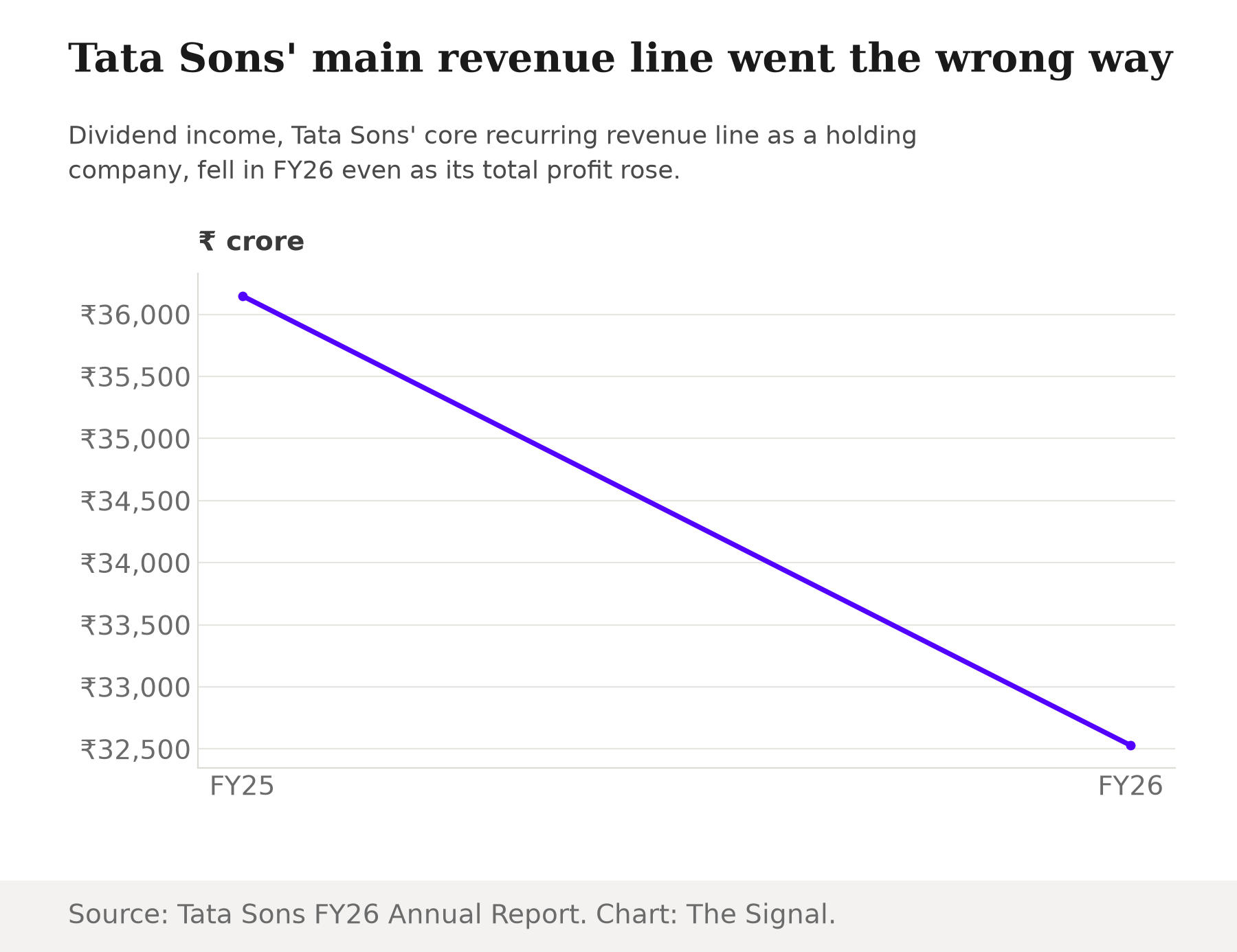
Source: Tata Sons FY26 Annual Report. Chart: The Signal.
That falling core income line matters because of what it is being asked to fund. Tata Sons is simultaneously carrying three loss-making bets, and all three got more expensive to hold in FY26, not less.
The three bets, and why they widened
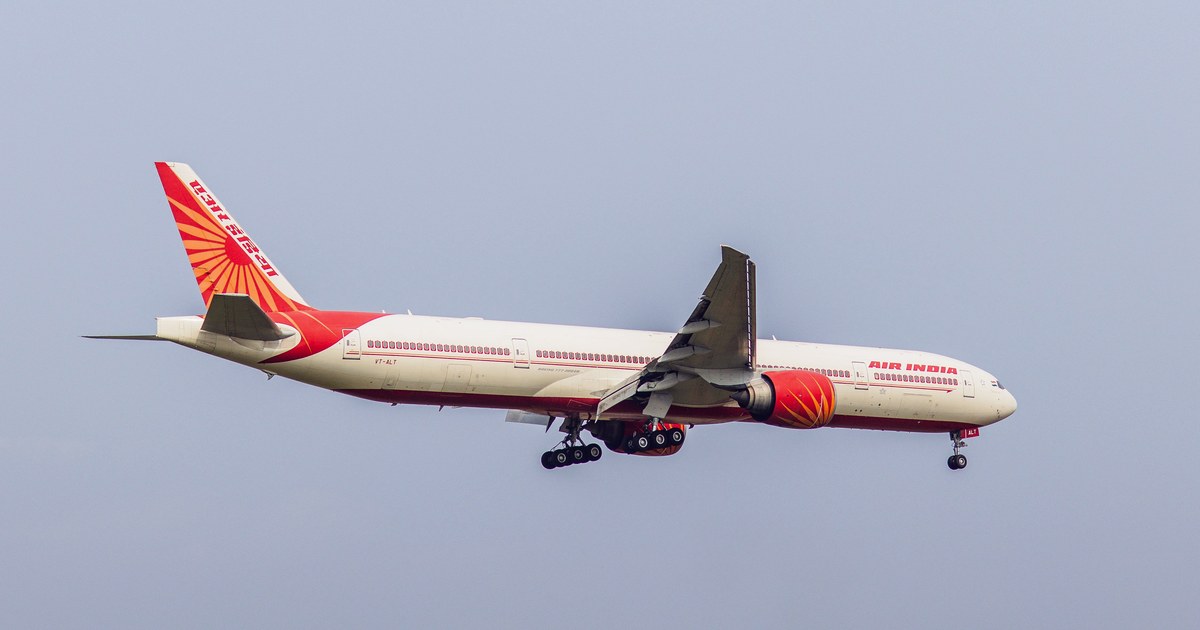
Air India's group net loss more than doubled to Rs 22,238 crore in FY26 from Rs 10,859 crore in FY25, on revenue that fell to Rs 70,087 crore from Rs 76,754 crore. That is the single largest number in this report, and it moved in the wrong direction on both lines: the loss grew while the revenue meant to close it shrank.
Tata Digital's net loss widened 7.9% to Rs 4,974 crore in FY26 from Rs 4,610 crore in FY25, with BigBasket accounting for nearly 64% of the losses even as group revenue rose to Rs 35,990 crore. Unlike Air India, Tata Digital's revenue is growing. The loss is growing with it, more slowly, but still growing.
Tata Electronics' net loss widened to Rs 1,611 crore in FY26 from Rs 70 crore in FY25, even as its revenue nearly doubled to Rs 1,31,082 crore and operating profit reached breakeven. This is the one bet where the scale-up story is visibly working: revenue is compounding fast and the operating line has caught up to it, even though the accounting net loss ticked up.
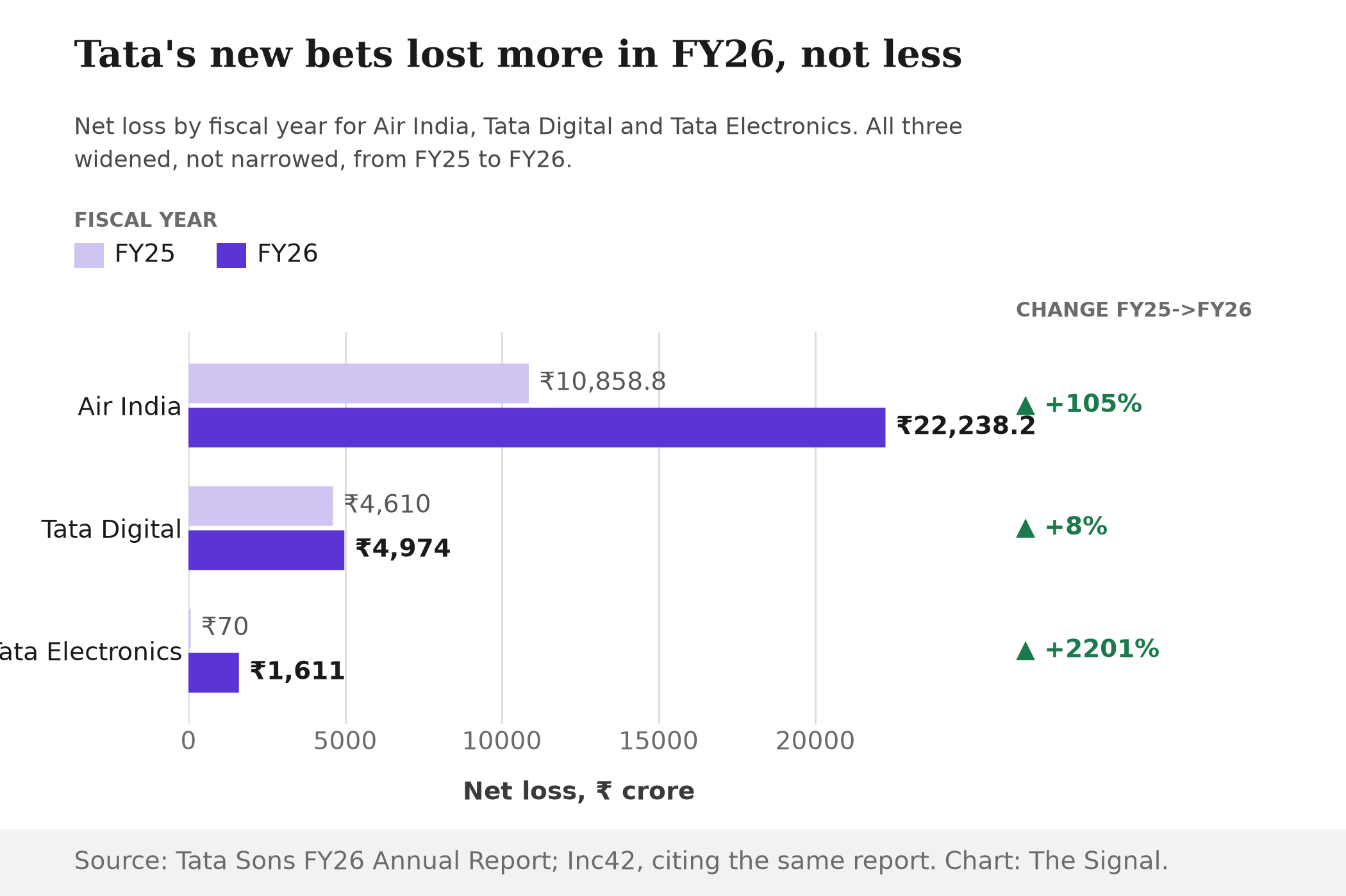
Source: Tata Sons FY26 Annual Report (Air India); Inc42 (Tata Digital); Tata Sons FY26 Annual Report (Tata Electronics). Chart: The Signal.
Add the three together and the group's flagship new bets lost about Rs 28,823 crore combined in FY26 (our calculation, summing the Air India, Tata Digital and Tata Electronics figures above), against a Tata Group aggregate profit after tax of Rs 1,70,525 crore the same year. That is roughly a sixth of the group's total profit, going to cover three businesses that, Tata Electronics aside, are not yet paying their own way.
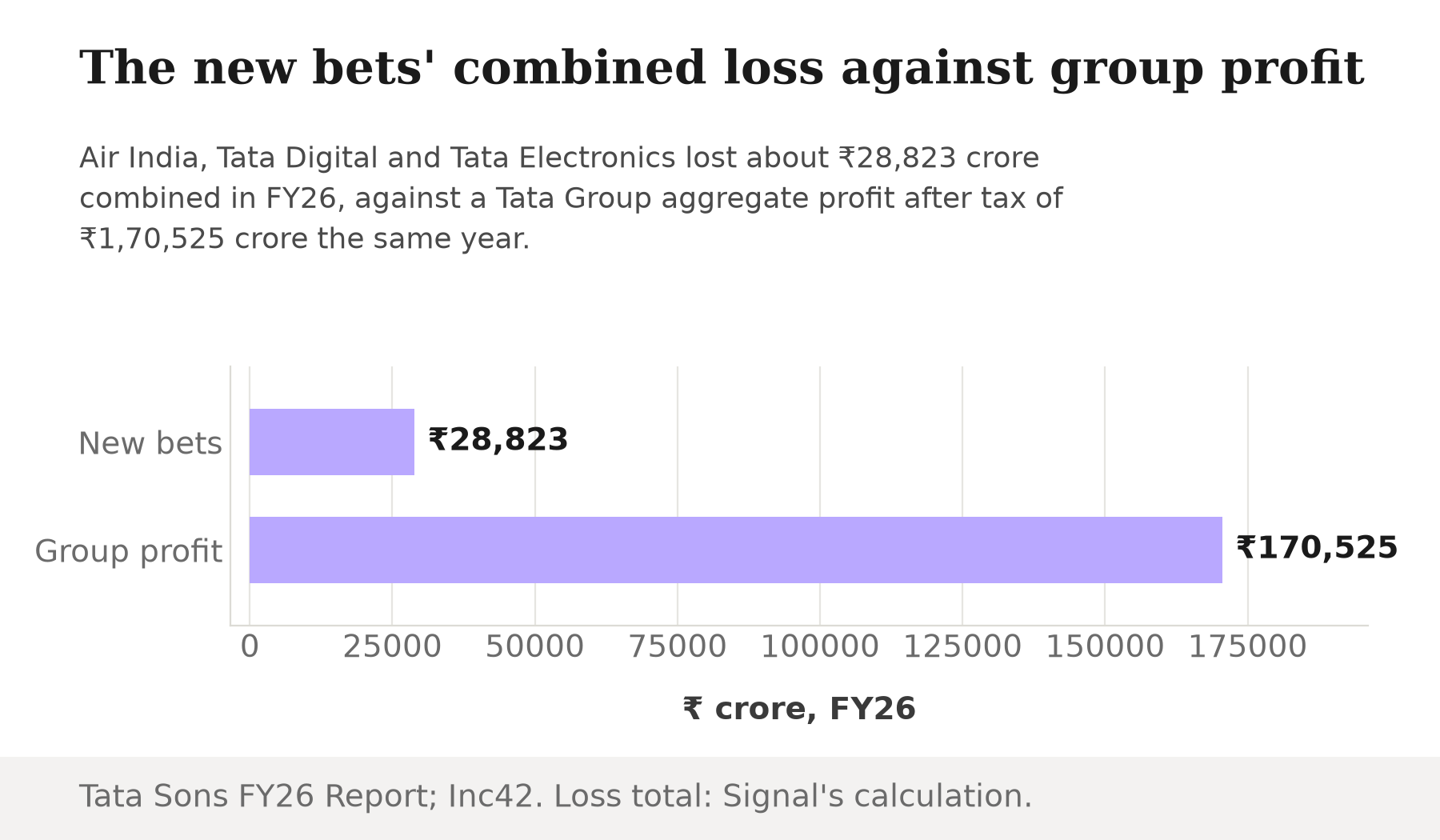
Source: Tata Sons FY26 Annual Report (Group profit after tax). Combined new-bets loss figure is The Signal's calculation. Chart: The Signal.
The chairman's patience argument
Chandrasekaran does not treat the losses as a surprise to explain away. He frames them as the point. He tells shareholders that each of the founders' historic wagers "looked audacious, even imprudent" when they were made, took decades to prove themselves, and "turned out to be exactly what the nation needed", and he places the current bets in that lineage. On Air India specifically, he tells shareholders the turnaround "must be seen as a five- to ten-year journey," citing years-long supply chain disruption, the need to overhaul legacy systems and fleet, and the work of building a new cadre of technical and airline staff.
That argument is coherent, and Tata Electronics is the live evidence for it: a business posting an operating breakeven while its scale compounds is exactly the shape a long-gestation bet is supposed to take before it pays off.
The honest objection
The strongest case for patience is that the group's aggregate profit base is large enough to absorb the new bets' subsidy for years, and that judging a multi-decade wager by one fiscal year misreads the timeline on purpose. Tata Electronics' own FY26 numbers back that argument directly: revenue nearly doubled to Rs 1,31,082 crore and operating profit reached breakeven even as the accounting net loss widened to Rs 1,611 crore, which is precisely the pattern the founders-bets analogy predicts: pain on the bottom line while the underlying business scales.
That case holds for the size of the group's balance sheet. It says less about the specific engine paying for the bets. Tata Sons itself, the entity that actually writes the checks for group-level commitments, is not the group's aggregate profit; it is the Rs 32,528.36 crore of dividend income that fell 10% this year, the specific line examined above. A group can absorb a widening subsidy for a long time on its aggregate profit. The holding company still needs its own income line to hold up, and in FY26 that line went the wrong way while the subsidy it funds went up, and the gap between the two was bridged by a one-off gain that will not repeat automatically next year.
The fairest reading of that line also has to account for how it behaved before this year, not just this year. Dividend income rose 67.9% to Rs 36,149.05 crore in FY25 from Rs 21,528.94 crore in FY24, before this year's 10% fall. FY26's dip follows a sharp prior-year jump rather than an already-established multi-year decline, and even after the fall the line sits 51% above its FY24 level. That cuts against reading FY26 as the start of a slide. It does not, however, make the line a stable base for a decades-long subsidy: an income source that can swing 68% up in one year and 10% down the next is exactly the kind of engine that needs the recovery this year's one-off gain quietly stood in for.
The Signal
None of FY26's numbers falsify the patient-capital thesis on their own; Tata Electronics is proof the model can work. But the year also produced a specific and checkable coincidence: the three bets' combined losses grew, Tata Sons' core dividend income shrank, and the profit growth investors will read as vindication came from selling investments, not from the portfolio companies paying bigger dividends. Watch next year's standalone Statement of Profit and Loss for one line before any other: dividend income. If it recovers while Air India's loss narrows, patience is being rewarded on schedule. Keep dividend income falling while the subsidy widens, though, and Tata Sons will need another one-off gain to keep the story looking like growth.
Reporting basis: Tata Sons' standalone and consolidated revenue, profit, dividend income, TCS-specific dividend and one-off investment-sale gain figures, along with the Air India and Tata Electronics loss and revenue figures and the Chairman's Letter quotations, are all from Tata Sons' own FY26 Annual Report, the primary audited filing. The FY24 dividend income comparison is from Tata Sons' FY25 Annual Report, the prior year's equivalent filing. The Tata Digital loss and BigBasket figures are as reported by Inc42, which cites the same Annual Report. The combined new-bets loss figure, the TCS-cut-versus-total-fall comparison, the FY24-to-FY26 dividend growth rates and the group profit share are The Signal's calculations from those figures.