
On 24 July 2026, a group calling itself TripleX put up what it described as a terabyte of Bank of Baroda customer data for sale on the dark web. The hacking group claims to have leaked 1TB of the bank's customer data, Republic World reports. India's second-largest public sector bank spent the following three days managing the fallout.
It is worth slowing down on that number. Bank of Baroda said in an official statement, as reported by Business Today, that the incident involved compromise of an employee's email account, resulting in unauthorised access to certain data. Not a network intrusion, not a database dump pulled through a systems flaw. One inbox. The bank also said in its statement, as reported by The Week, that its core banking systems were not accessed and continue to remain secure.
Even the headline figure is contested. Reuters reported, carried by The Star, that the listing was advertised as a cache of more than 700 gigabytes, based on a metadata analysis, well short of the 1TB claimed.
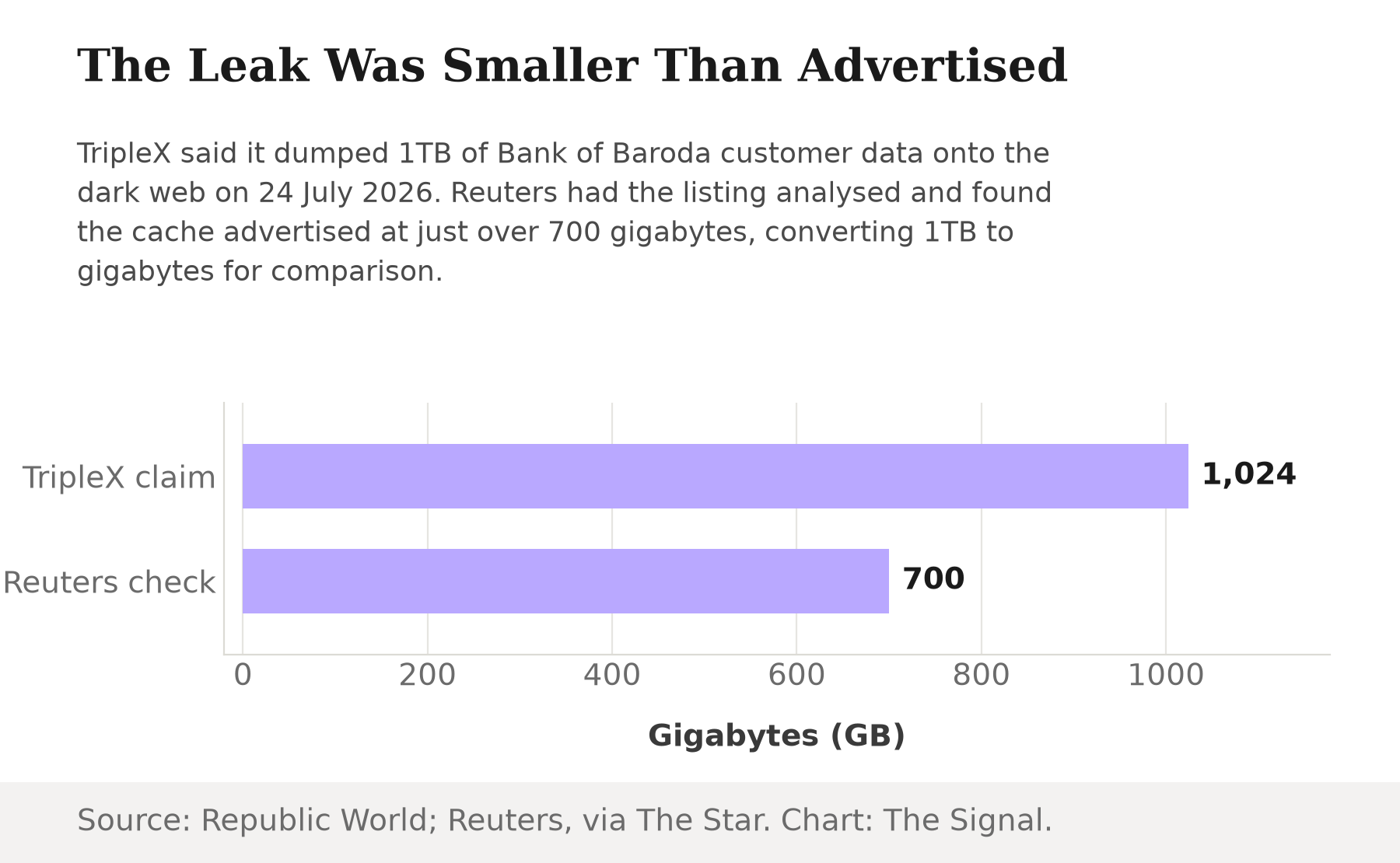
A single credential failure, not a systems breach, produced the leak everyone is calling massive.
That gap is not what caused the leak. A cybercriminal group inflating its own haul is unremarkable. It is something else entirely when a national bank loses customer data to one compromised email account, no matter how contained the bank says the damage was.
One account, not a systemic breach
The distinction the bank draws, a compromised inbox versus a compromised core system, tracks how Indian banking regulation separates the two. But the reporting duty does not bend to it. The Reserve Bank of India's Cyber Security Framework circular requires banks to report all unusual cyber-security incidents to the Reserve Bank, whether they were successful or were attempts that did not fructify.
Customers sit under a second layer of the same regulation. Under the RBI's Customer Protection circular, a bank customer bears zero liability for an unauthorised transaction traced to a third-party or system breach, provided the deficiency lies neither with the bank nor the customer and the customer notifies the bank within three working days. That rule exists for exactly this ambiguity: a breach that starts inside the bank's own infrastructure but is caused by one point of human failure, not its design. Whether a compromised employee email counts as the bank's own deficiency, or a fault elsewhere in the system, is the question this incident tests, and it concerns the customer's money, not the bank's balance sheet.
The number that could actually bite
None of that is where the real exposure sits. India's newer, harsher law is.
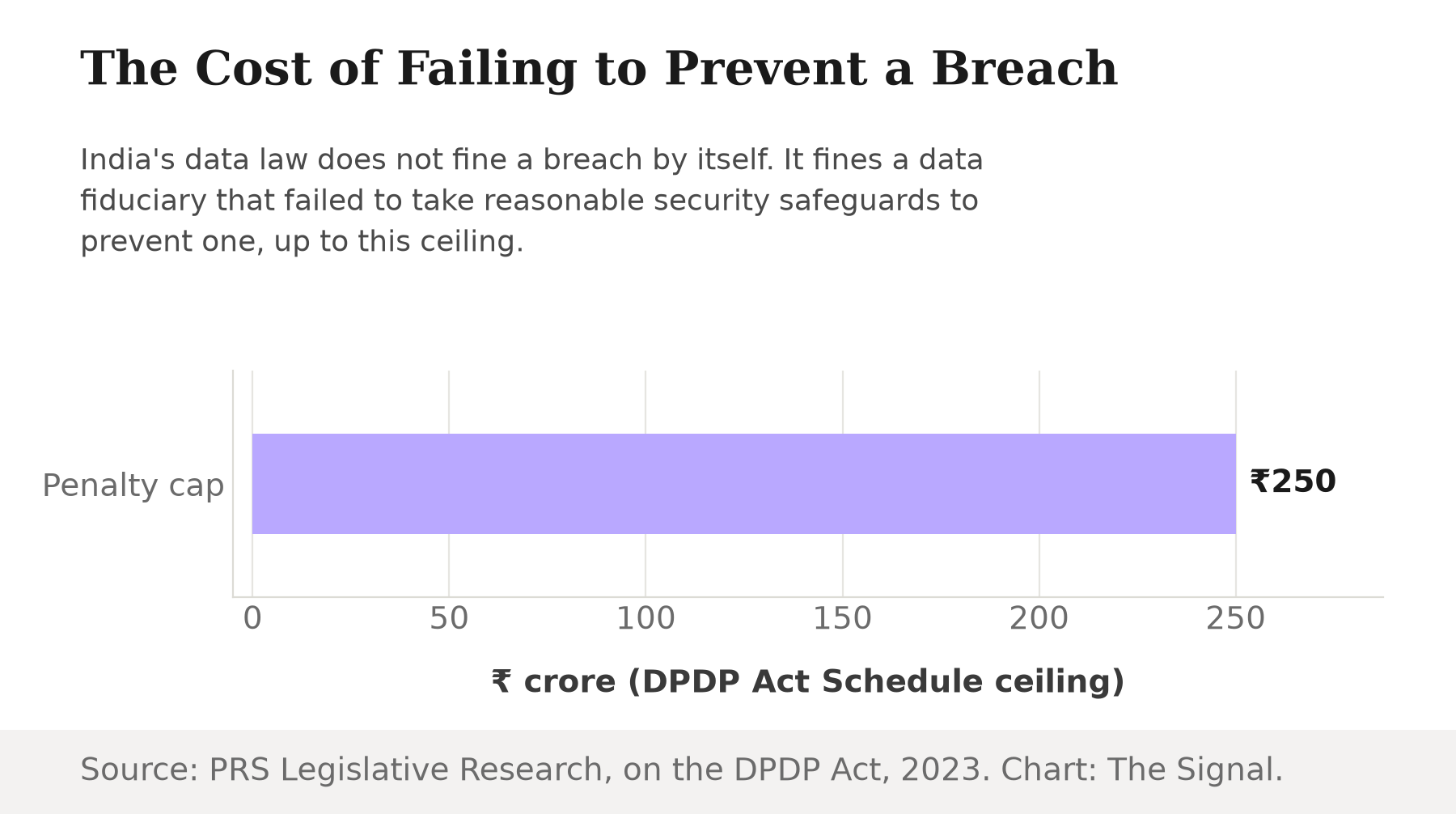
India's data law does not fine banks for suffering a breach. It fines them for failing to prevent one.
PRS Legislative Research's analysis of the Digital Personal Data Protection Act notes that its Schedule sets a penalty of up to ₹250 crore for a data fiduciary's failure to take reasonable security safeguards to prevent a personal data breach. The wording matters: the penalty attaches to inadequate safeguards, not the breach itself. A bank with reasonable protections that still lost data to a determined attacker has a real defense; one whose safeguards did not extend to basic email hygiene for staff with customer-data access has a thinner one.
The clock is also explicit. The DPDP Rules 2025 give a data fiduciary a 72-hour limit to give the Data Protection Board a full description of a personal data breach, including its nature, extent, timing, location and likely impact. That obligation is triggered by the breach, not by the bank's own assessment of its severity.
Bank of Baroda does have some cushion against that exposure. It has reportedly filed a preliminary notification under a cyber-insurance programme led by National Insurance, which provides total cover of ₹750 crore ($78 million), the Economic Times reported, via The Asian Banker, though the value of any claim from this incident has not been established. That cover would absorb a ₹250 crore DPDP penalty three times over, if an insurer accepts it; whether a breach traced to one compromised inbox counts as the ordinary risk the policy was written for is a separate question from what regulators decide.
Where this incident sits in India's rulebook
Four separate rules now apply to a single compromised inbox, each written years before this leak.
| Rule | What it requires | Source |
|---|---|---|
| RBI Cyber Security Framework | Banks must report every unusual cyber incident to the RBI, successful or not | RBI |
| RBI customer liability protection | Zero customer liability for a third-party/system breach if reported within 3 working days | RBI |
| DPDP Act penalty schedule | Up to ₹250 crore for failing to take reasonable security safeguards against a breach | PRS Legislative Research |
| DPDP Rules, breach reporting | 72 hours to give the Data Protection Board a full description of the breach | Bar & Bench |
None of these four rules were written for this incident specifically. The RBI rules are a decade old; the DPDP Act's penalty and its 72-hour clock have never been tested against a breach caused this narrowly.
The honest objection
The strongest case for treating this as ordinary risk, not a safeguards failure, is that phishing and credential theft are close to unavoidable at any large organisation with thousands of employee inboxes. On this view, regulators judge whether a company ran a reasonable security program, not whether one employee clicked a bad link, and punishing a bank for one compromised account sets a standard no institution could meet.
That case is real, and it is why the penalty is not automatic. But it strains against two things. The RBI's own framework treats every incident, successful or not, as reportable, precisely because regulators do not trust a bank's self-assessment of severity, the same self-assessment Bank of Baroda now offers the public. And a compromised employee account with customer-data access is not equivalent to an unrelated phishing hit: it is a credential that, by design, sits inside the perimeter a "reasonable security safeguard" is supposed to protect. Whether that gap was reasonable is a question for the Data Protection Board, not the bank's press office.
The Signal
Strip away the terabyte headline and the real question is sharper: does "reasonable security safeguards" mean protection against a sophisticated intrusion, or against the ordinary failure modes of a large institution, including one employee's inbox. Bank of Baroda is betting on the narrow reading: one bad inbox, a secure core, no systemic failure. If regulators agree, this is a minor entry in the bank's disclosures. If one compromised email account is enough to trigger the DPDP Act's ₹250 crore ceiling, every large Indian company holding personal data has learned that its email security policy, not its firewall, is what a regulator asks about first. Watch whether the Data Protection Board opens a proceeding at all. A ceiling nobody has hit yet is still just a number on a page.
Reporting basis: how the breach happened, a compromised employee email, and the bank's position that core banking was untouched, are per Bank of Baroda's own statement, as reported by Business Today and The Week. The 1TB figure originates with the hacking group TripleX, via Republic World; the competing 700-gigabyte estimate is per Reuters, carried by The Star, citing a researcher's metadata analysis. The RBI's incident-reporting duty and customer-liability rule are drawn from the Reserve Bank's own circulars. The DPDP Act's penalty schedule is per PRS Legislative Research's analysis, and the 72-hour breach-description deadline is per Bar & Bench's analysis of the DPDP Rules, 2025. The bank's reported cyber-insurance cover is per The Asian Banker, citing the Economic Times. The 1,024-gigabyte figure charted against the advertised cache is The Signal's conversion of the 1TB claim for comparison.