The Reserve Bank of India's 1 May 2026 status release states that 98.47% of the ₹2,000 banknotes in circulation as on 19 May 2023 has since been returned to the banking system, with ₹5,451 crore still outstanding nearly three years after the withdrawal was announced. Read as a scoreboard, that looks like a rout. Fewer than two rupees in every hundred are still outside the banking system.
It is worth slowing down on that framing. The number worth sitting with is not 98.47. It is 1.53, the share that has still not come back after three years of an unusually patient, penalty free window to do exactly that.
1.53% of the withdrawn ₹2,000 note has still not returned to the banking system after three years.
That residue is strange only once you notice what RBI never did. It never told holders of the ₹2,000 note that time was running out.
A facility, not a deadline
The ₹2,000 note has remained legal tender throughout its withdrawal, with exchange available at the Reserve Bank's 19 Issue Offices since 19 May 2023 and, from 9 October 2023, deposit into bank accounts at those offices too, RBI's 1 February 2024 status release states. That is a standing facility, not a fixed window. There was never a date after which a ₹2,000 note became worthless paper, and never a penalty for holding on to one past some cutoff. A holder could walk in a year late, or three, and still get full value.
The four month sprint, then the crawl
The pace of return makes the design's effect visible. Within 4.3 months of the announcement, 96% of ₹2,000 notes had already returned, ₹3.42 lakh crore of ₹3.56 lakh crore, by 29 September 2023, RBI's 30 September 2023 review states. RBI kept the exchange facility open indefinitely rather than setting a hard cutoff, so the remaining 2.47 percentage points have taken over two and a half years more to narrow, and had still not closed as of the 1 May 2026 release.
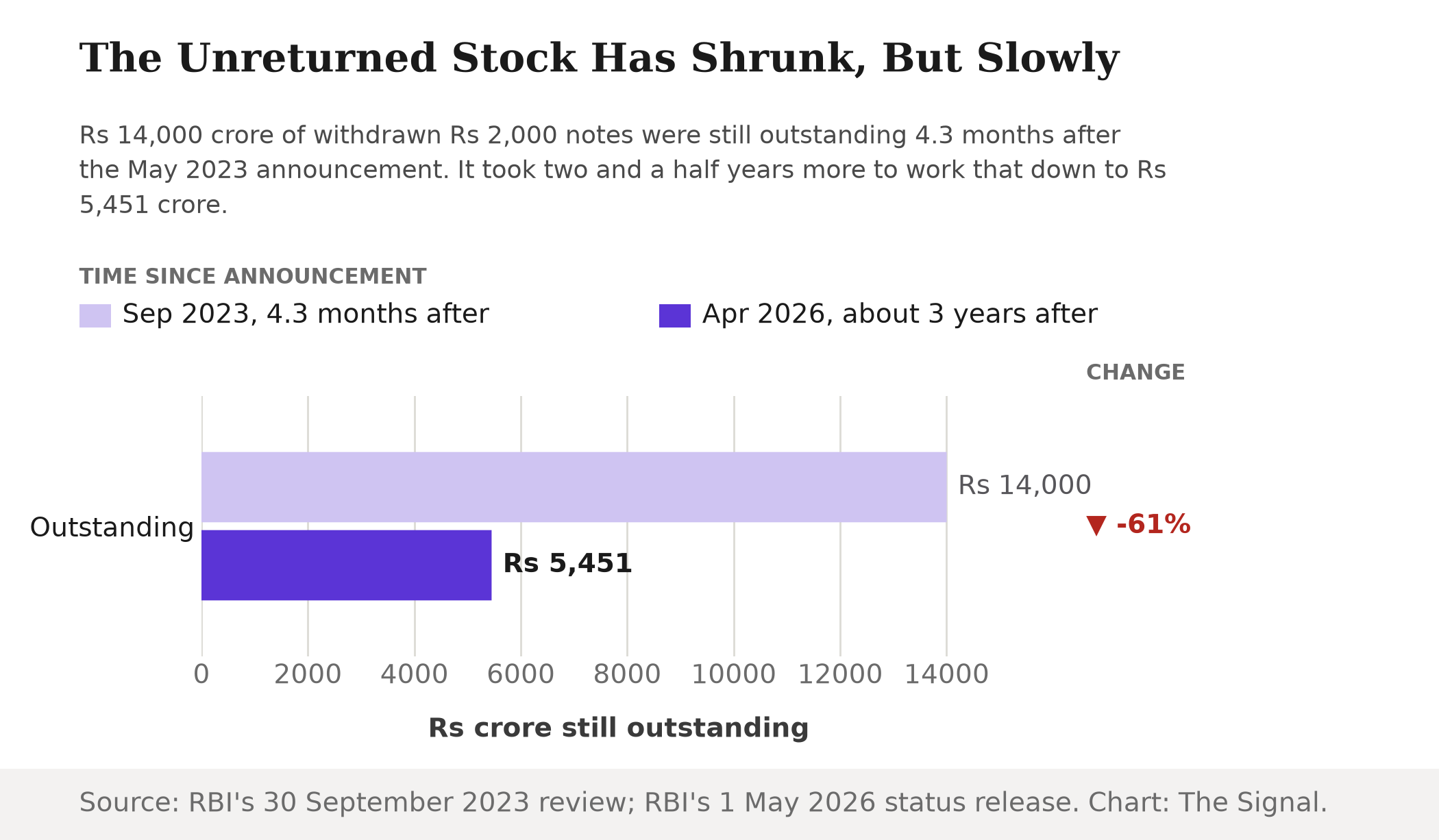
The bulk of the stock returned quickly, since holders had every incentive to bank it as soon as the facility opened. What remains is the part an open ended window has not moved.
What 2016 did that 2023 did not
Compare that trajectory with the last time India pulled high value notes out of circulation. Nearly 86% of the value of all banknotes in circulation lost legal tender status overnight on 8 November 2016 under demonetisation, RBI's Annual Report 2016-17 states. There was no standing facility and no penalty free grace period. A ₹500 or ₹1,000 note left in a drawer past the deadline became void.
RBI's Annual Report 2017-18 states that the total value of Specified Bank Notes returned to the banking system reached ₹15,310.73 billion, about ₹15.31 lakh crore, with SBN processing completed at all Reserve Bank centres. BusinessToday, citing that report, puts the return rate at 99.3%, ₹15.31 lakh crore of the ₹15.41 lakh crore in banned notes, with only 0.7%, ₹10,720 crore, never traced, a near complete return within about 21 months of the ban.
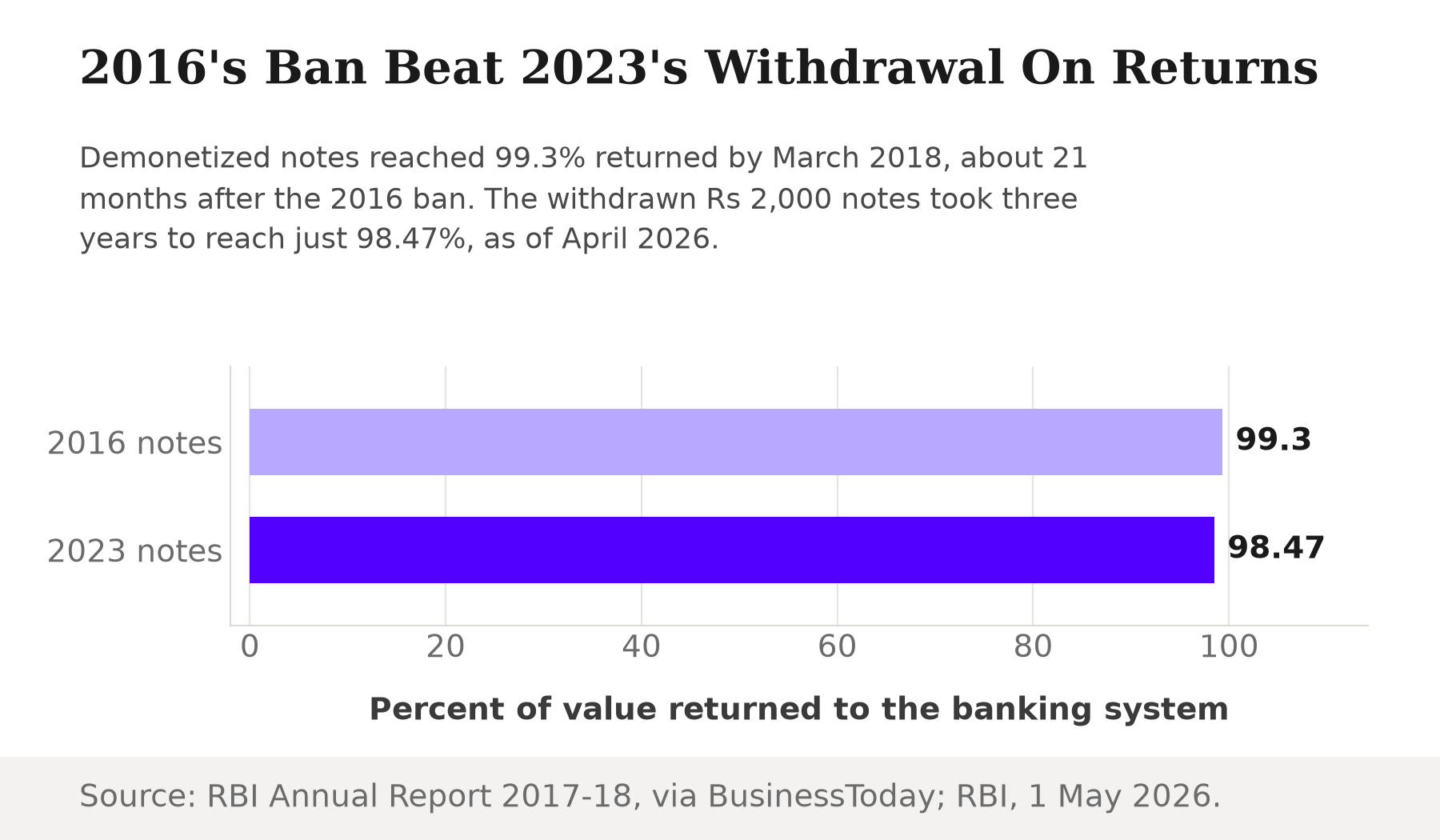
The 2016 ban closed its return gap faster, and closed more of it, than the 2023 withdrawal has managed in longer.
The 2023 withdrawal has had three years, not 21 months, and a note that never risked becoming worthless. It has still not closed a gap that the harsher, faster 2016 ban closed in under two years.
Already a shrinking pile
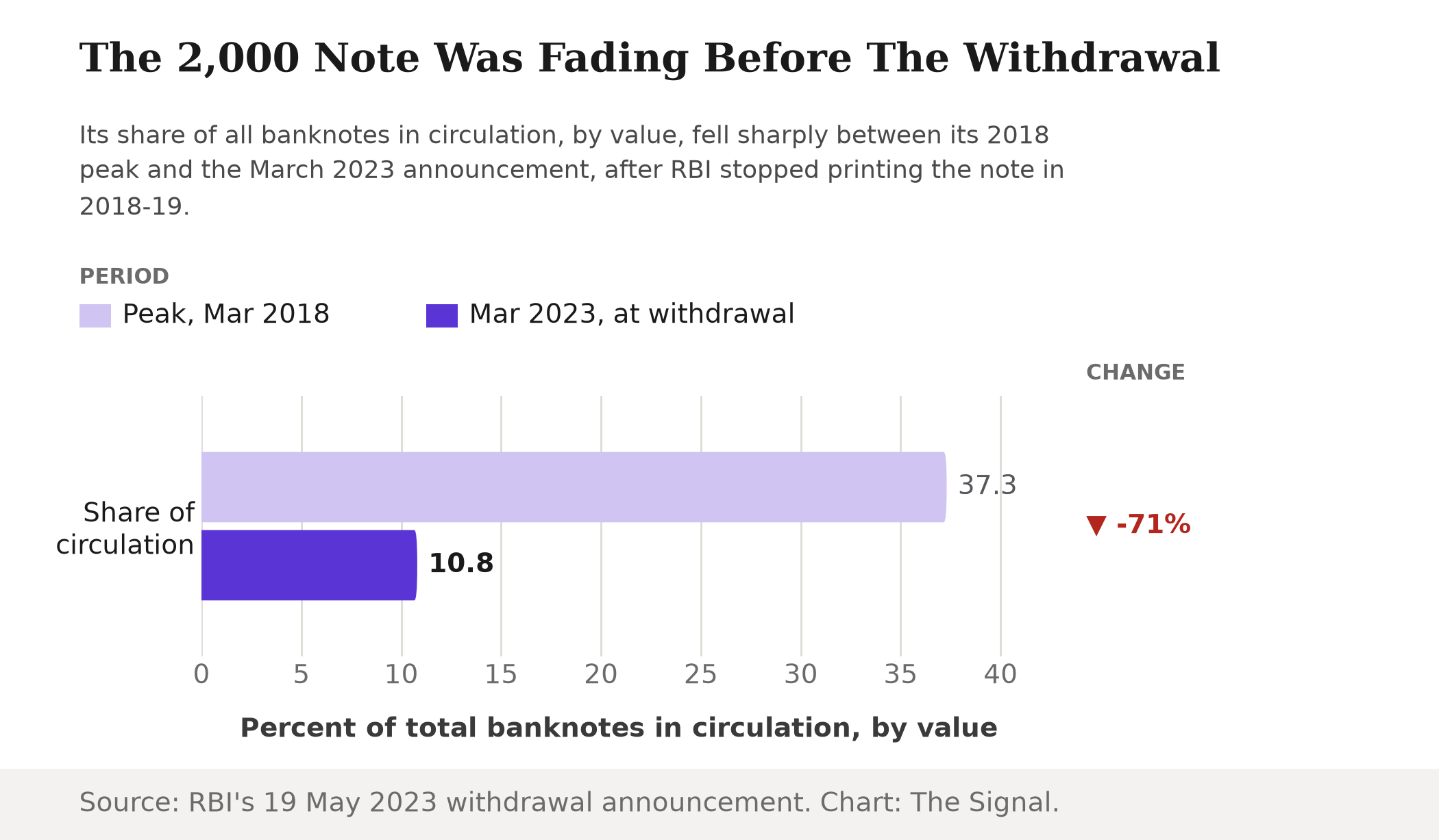
None of this means the ₹2,000 note was central to India's cash economy by the time it was pulled. Its value fell from a peak of ₹6.73 lakh crore, 37.3% of all banknotes in circulation, on 31 March 2018 to just 10.8% of notes in circulation by 31 March 2023, after RBI stopped printing the denomination in 2018-19, RBI's 19 May 2023 withdrawal announcement states. The withdrawal targeted a note whose retreat had already begun five years earlier.
The honest objection
The strongest case for shrugging off the residue is that it barely registers next to the size of India's cash economy. Total currency with the public stood at ₹41.42 lakh crore as of 15 April 2026, RBI's Weekly Statistical Supplement of 1 May 2026 shows, so the ₹5,451 crore of still unreturned ₹2,000 notes now equals roughly 0.013% of all currency in circulation, by our calculation, a residue that is economically negligible against the cash India actually uses day to day. On that view, chasing the last 1.53% is a rounding exercise, not a policy problem.
That case is real, but it answers a different question than the one the withdrawal was actually testing. RBI was never trying to recover a specific sum of money; ₹5,451 crore is trivial to a central bank. It was testing whether pulling a note out of active use, without ever threatening its legal validity, is enough on its own to bring all of it back. Three years and a still open counter say it is not quite enough. Some of that residue is likely notes lost, damaged beyond redemption, or held outside India, and part of it is plausibly cash whose holders would rather not walk into an RBI Issue Office and explain where it came from.
The Signal
RBI's own numbers make the mechanism visible side by side: revoking legal tender status brought back more of the 2016 notes in 21 months than a penalty free window has brought back of the ₹2,000 note in three years. A penalty free, indefinite exchange window is the gentler policy tool, and it is also the slower, less complete one. Watch what RBI does next. Should the still unreturned 1.53% keep shrinking on its own in the releases still to come, the patient approach was simply patient. If the counter effectively freezes instead, RBI faces the choice it avoided in 2023: force the last notes in, or let them sit outside the system for good. A note that is legal tender forever is also a note nobody is ever quite forced to spend.
Reporting basis: the ₹2,000 note's return figures across the withdrawal are from the Reserve Bank of India's successive status releases; the note's legal tender status and exchange facility terms are from RBI's February 2024 status release; the peak and pre-withdrawal share of notes in circulation are from RBI's May 2023 withdrawal announcement. The 2016 demonetisation figures are from RBI's Annual Report 2017-18 and its Annual Report 2016-17, with the return rate and untraced total as reported by BusinessToday from that same 2017-18 report. Total currency with the public is from RBI's Weekly Statistical Supplement. The unreturned notes' share of total currency in circulation, and the percentage point gap in the return timeline, are The Signal's calculations from those figures.