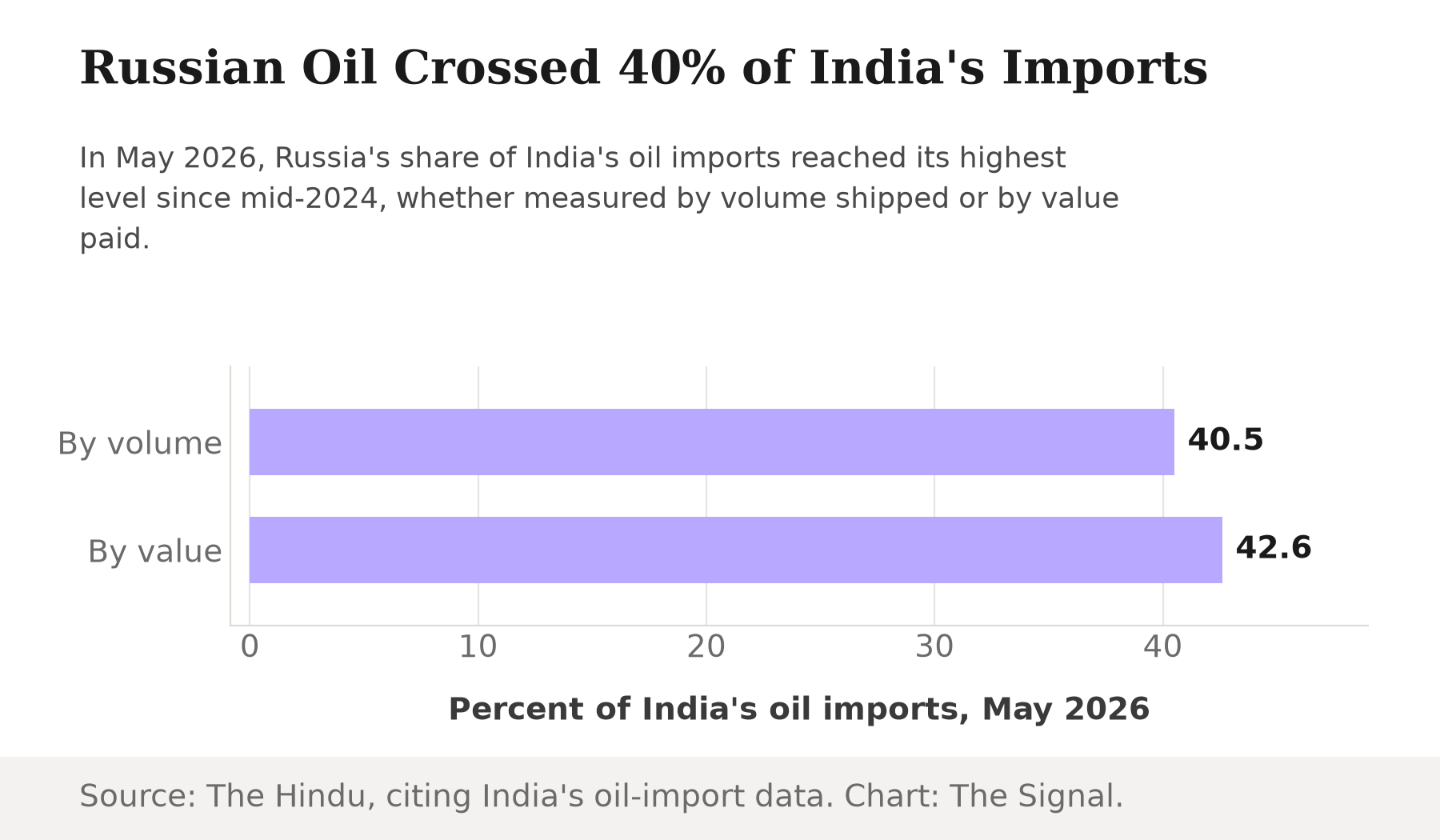
Russian crude made up 40.5% of India's oil imports by volume and 42.6% by value in May 2026, the highest share since mid-2024. Officials on both sides have pointed to trade this size, still running more than three years into Western sanctions on Russia, as proof that a rupee payment channel the Reserve Bank of India built for exactly this trade is doing its job: India keeps its discounted oil, Russia keeps a buyer, and neither side has to touch the dollar-clearing system the sanctions were built to choke off.
It is worth slowing down on that read. The rupee mechanism does let India pay without routing through the dollar system. What it does not do is hand Russia money it can freely spend. The Reserve Bank confines whatever rupees a foreign counterparty piles up in a Special Rupee Vostro Account to a narrow menu: government treasury bills, government securities, and, as of an October 2025 circular, non-convertible debentures, bonds and commercial paper issued by Indian companies. That is not a currency Russia can wire out to a supplier in Beijing or Dubai. It is a claim on Indian paper.
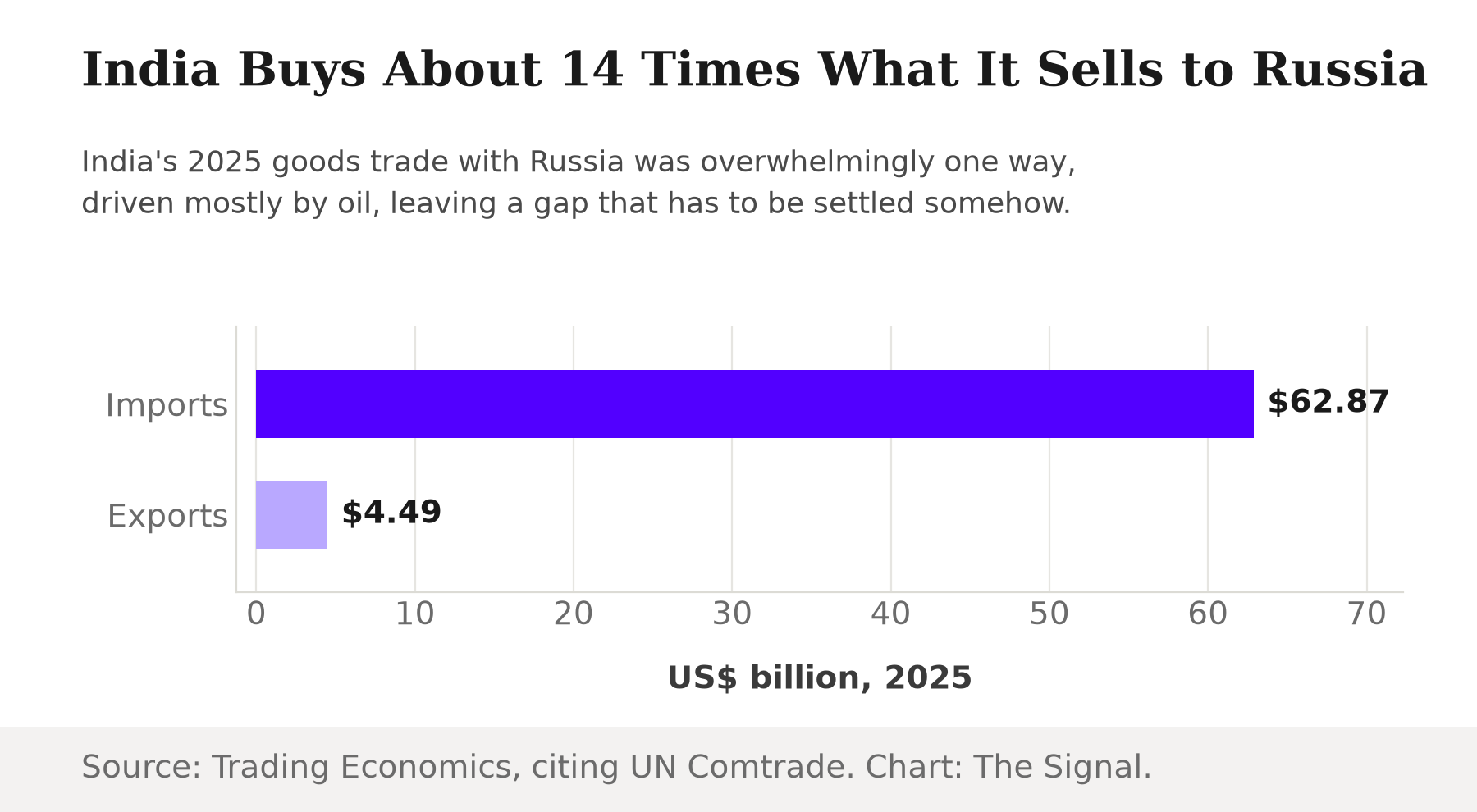
India ran a nearly 14-to-1 trade gap with Russia in 2025, and rupees are how the gap gets settled.
India imported $62.87 billion worth of goods from Russia in 2025, more than 85% of it mineral fuels and oil, against just $4.49 billion of goods exported the other way over the same year: imports outran exports nearly 14 to 1. That is the scale of money that has to be settled somehow, and whatever part of it flows through the rupee mechanism the RBI built for this trade lands in Russian accounts in India, not as hard currency Russia can spend anywhere it likes.
The vostro trap is not new, it is scaling up
This is not the first time Russia has ended up holding rupees it struggled to place. Indian officials estimated in February 2024 that Russia had built up more than $8 billion in vostro-account rupee balances, mostly from defence-related payments, at a time when oil imports, worth over $40 billion, were still being paid for in other foreign currencies, not rupees, and by that point Indian officials said Russia had managed to use up most of the balance. It did not convert the money out. The same rules that apply today left it little choice but to spend the rupees inside India.
What has changed since that February 2024 snapshot is the scale of the trade now sitting behind any rupee balance, nearly 14 to 1 in India's favor on 2025 goods trade alone, and the Reserve Bank has kept widening the menu of rupee-denominated instruments a vostro account can hold, adding corporate bonds and commercial paper on top of treasury bills and government securities in October 2025. Each widening looks like progress for the mechanism, but functionally it is the central bank building another wall inside the same room: more places for the money to sit in India, not more ways for it to leave.
Why the rupees do not travel well
The deeper problem is not regulatory, it is structural. Russian exporters, who do not themselves face US sanctions, generally prefer payment in dollars over rupees, because the tightly controlled rouble has no deep direct market against the rupee and converting between the two typically means routing through the dollar at extra cost. A rupee India pays is only as useful to a Russian counterparty as the next thing it can buy with it, and as of August 2025, using SRVA rupee balances to pay for exports to third countries, including a proposed trilateral mechanism involving the UAE, was still only a proposal under discussion, not a working channel. Nearly a year on, that is the honest state of the plumbing: a currency Russia is accumulating in size, with no confirmed route to spend it outside India.
Washington can turn the tap
The arrangement is also more exposed than either side has advertised. In August 2025, the United States imposed an additional 25% tariff on Indian goods, explicitly because India was directly or indirectly importing Russian oil, on top of duties already in place. In February 2026, Washington eliminated that tariff after India committed to stop directly or indirectly importing Russian oil, to buy US energy products, and to expand defence cooperation over the next decade. Three months later, in May 2026, Russian oil's share of India's imports stood at its highest level since mid-2024.
| Executive order | Dated | What it did | Stated reason |
|---|---|---|---|
| EO 14329 | August 6, 2025 | Added a 25% tariff on Indian goods | India directly or indirectly importing Russian oil |
| EO 14384 | February 6, 2026 | Removed that 25% tariff | India's commitment to stop importing Russian oil, buy US energy, expand defence ties |
Source: Federal Register, Executive Order 14329; Federal Register, Executive Order 14384.
That is not proof the commitment has been broken. It is proof the tariff, once used, remains available to Washington as a lever any time it wants to reopen the question, and that the rupee-trade arrangement India and Russia have built survives at Washington's discretion, not by mutual agreement between New Delhi and Moscow alone.
The case for calling this progress anyway
The strongest case against reading this as a trap is that the mechanism keeps getting more useful, not less. The October 2025 widening that let Russia's rupee balances flow into corporate bonds and commercial paper, on top of the government-securities access it already had, is a real expansion of what the money can do, and a Russia that can earn a market return on Indian corporate debt has more reason to keep accepting rupees than one restricted to treasury bills. On this view, Russia is not stuck, it is a patient investor building a rupee-asset book inside a fast-growing economy, exactly as the 2022 vostro-account architecture intended.
That case has merit, but it answers a different question than the one that matters. A better yield on Indian corporate paper makes the rupees more attractive to hold, not more convertible to spend. Every instrument the RBI has added, from treasury bills to commercial paper, keeps the balance inside India's rupee system; none of them lets Russia pay a supplier in Turkey or China with money earned from selling oil to India. The mechanism has gotten better at being a savings account, not any closer to being a currency.
The Signal
None of this makes the rupee-payment channel worthless. It lets India keep buying discounted Russian oil without wiring dollars through a system built to block exactly that, and it gives Russia a market for its crude that sanctions have not managed to close off. But the traders and officials calling this de-dollarization are describing the wrong thing, and India's own government does not actually claim otherwise. Asked about it directly in March 2025, External Affairs Minister S. Jaishankar said India has "no interest in undermining the dollar" and that there is no unified BRICS position against it, framing India's actual goal as the internationalisation of the rupee, not a coordinated move away from the dollar. De-dollarization means a currency other actors want to hold and can freely spend. What India has built with Russia is closer to an escrow account: money goes in, and the Reserve Bank keeps deciding, one circular at a time, what it is allowed to buy while it is stuck there. Watch two things from here. Whether the SRVA rules ever open a real route for Russia to spend rupees on trade with a third country, rather than just adding another Indian asset class to hold. And whether Washington reaches for the tariff lever again if Russian oil's import share keeps climbing. Until that changes, Moscow is not being paid in a currency. It is being paid in Indian IOUs.
Reporting basis: the May 2026 Russian oil import-share figures and the RBI's Special Rupee Vostro Account investment rules are per The Hindu and the Reserve Bank of India's own circular and FAQ page respectively. India's 2025 goods trade with Russia is Comtrade data as compiled by Trading Economics. The February 2024 vostro-balance figure and its drawdown by that point are per an Indian government official's account, as reported by The Hindu BusinessLine, and it is a single source for that figure. Russian exporters' preference for dollar payments and the status of third-country rupee settlement is per The Times of India, reporting as of August 2025. The two tariff executive orders are the primary Federal Register texts. External Affairs Minister Jaishankar's remarks on de-dollarization and the dollar's role are per The Tribune's coverage of his March 2025 comments. The 14-to-1 trade ratio is The Signal's calculation from the Trading Economics import and export figures.