Apple wants an exception. Chief executive Tim Cook and other senior Apple executives have lobbied US officials, including Commerce Secretary Howard Lutnick and Treasury Secretary Scott Bessent, to let the company use memory chips from ChangXin Memory Technologies (CXMT) and Yangtze Memory Technologies (YMTC) in devices it sells outside the United States, The News International reports. Both firms sit on US restricted lists. The surface read is a supply-chain scramble: memory has gone scarce and expensive, and Apple wants a cheaper, faster source to keep building iPhones. It is worth slowing down on what Apple is actually arguing, though. This is not a company asking for a blanket favor. It is a company that has looked at who benefits from the shortage squeezing it, and named that beneficiary directly to the government that built the wall.
Apple told officials Micron's gross margins have climbed past 80 percent during the shortage.
Apple has told US officials that Micron's gross margins now exceed 80 percent amid the memory shortage, and has accused Micron of steering new production capacity toward AI customers rather than easing the broader squeeze, the Wall Street Journal reports, via Investing.com. That accusation goes beyond a supply complaint: Apple is naming the company it says is profiting from that shortage, in the same market it wants Washington to open up to that company's blacklisted rivals.
The shortage behind the accusation
The numbers behind Apple's complaint are not subtle. Conventional DRAM contract prices jumped by roughly 93 to 98 percent quarter on quarter in the first quarter of 2026 as AI server demand strained supply, TrendForce reports. Apple's own figure for Micron, a margin north of 80 percent, sits on a similar scale to that price move, in the same window.
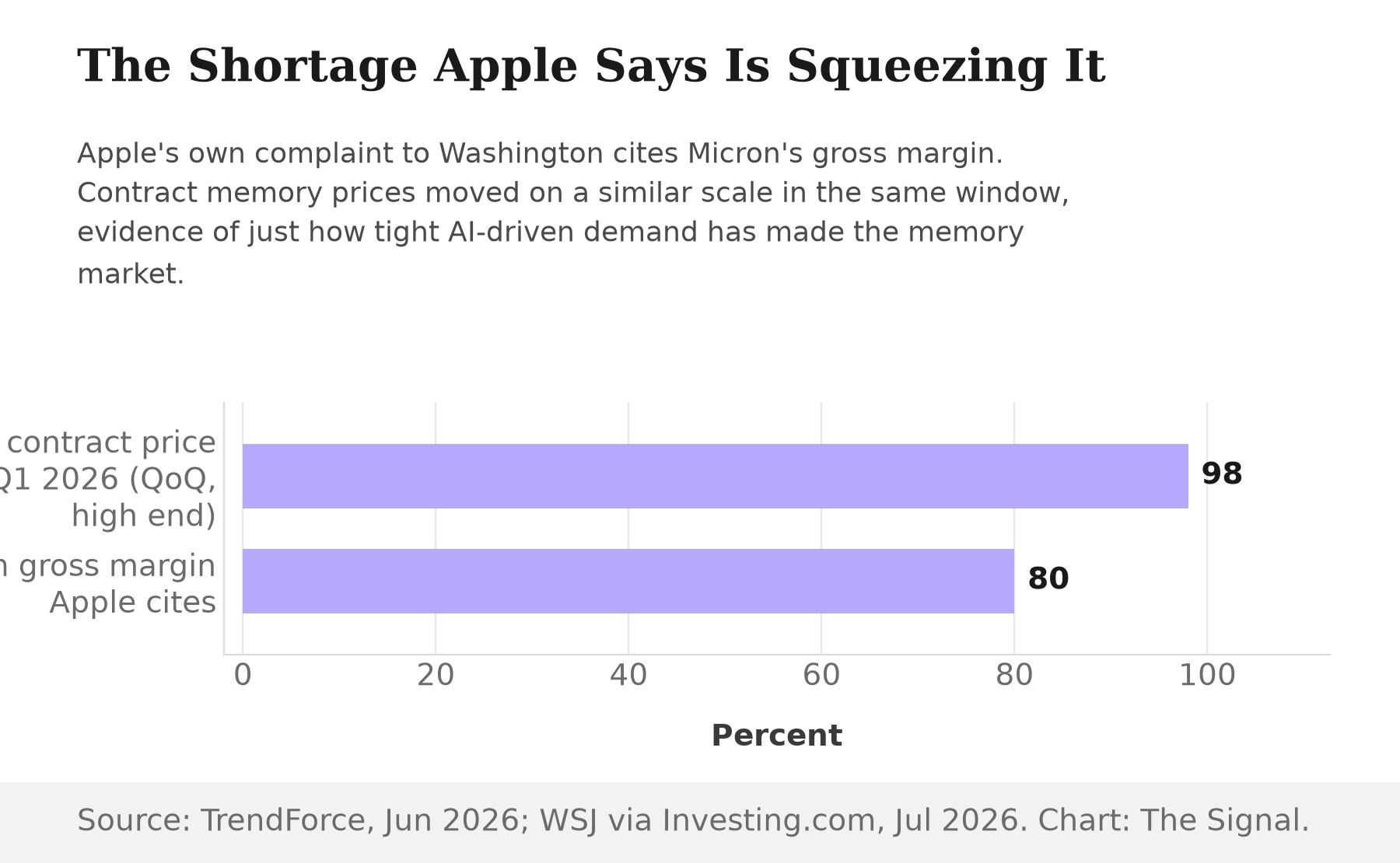
Source: TrendForce; The Wall Street Journal, via Investing.com. Chart: The Signal.
Micron was already gaining before this quarter turned extreme. Global DRAM industry revenue rose 30.9 percent quarter on quarter to $41.4 billion in the third quarter of 2025, with Micron's own share of that revenue climbing to 25.7 percent, up 3.7 percentage points from the prior quarter, TrendForce reports. That prior-quarter share, 22.0 percent, is a straightforward subtraction from the reported gain.
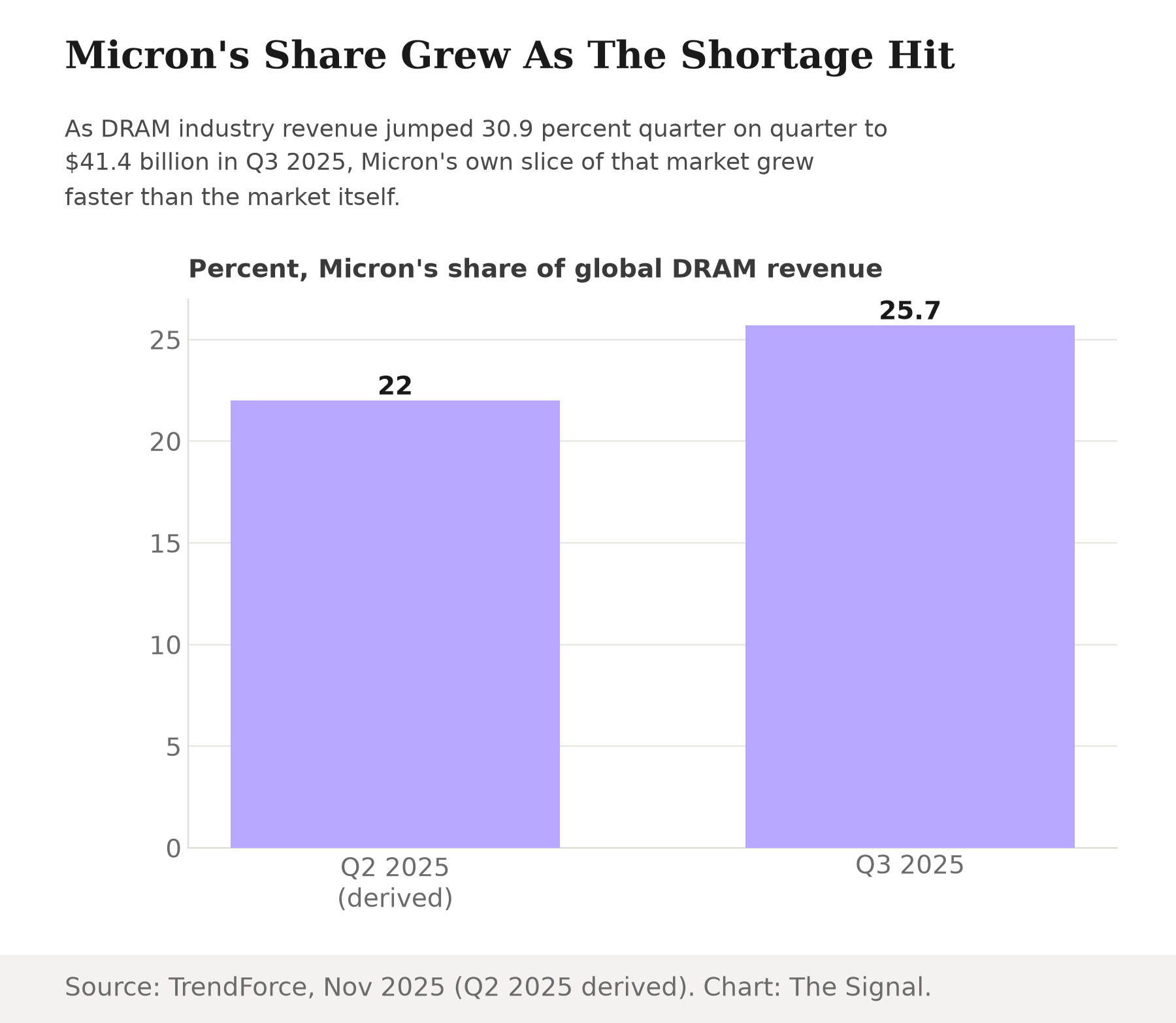
Source: TrendForce. Q2 2025 share is The Signal's calculation. Chart: The Signal.
A company gaining share and margin in the same shortage that is squeezing device makers like Apple does not need Apple to prove a coincidence. The arithmetic makes the point on its own.
A wall Micron already leans on
Micron is far from a neutral bystander here. Washington has already bet on it heavily, within the same trade architecture Apple now wants bent, and Micron is fighting Apple's request directly rather than leaving the defense to regulators. Micron executives, including chief executive Sanjay Mehrotra, have warned Commerce Secretary Howard Lutnick and other administration officials that letting CXMT and other Chinese chipmakers sell to US tech companies, regardless of where the products ship, would damage the domestic chip industry the way China's rise once damaged US steel and manufacturing, 9to5Mac reports. This is not just Apple pointing at Micron's margins; it is Micron lobbying, by name, against the exception Apple wants.
In December 2024 the US Commerce Department awarded Micron up to $6.165 billion in direct CHIPS Act funding for memory-fab projects in Idaho and New York. Six months later, the Trump administration announced that Micron had committed to a roughly $200 billion investment in US semiconductor manufacturing and R&D, framed as bringing the full spectrum of memory chip production back to the United States.
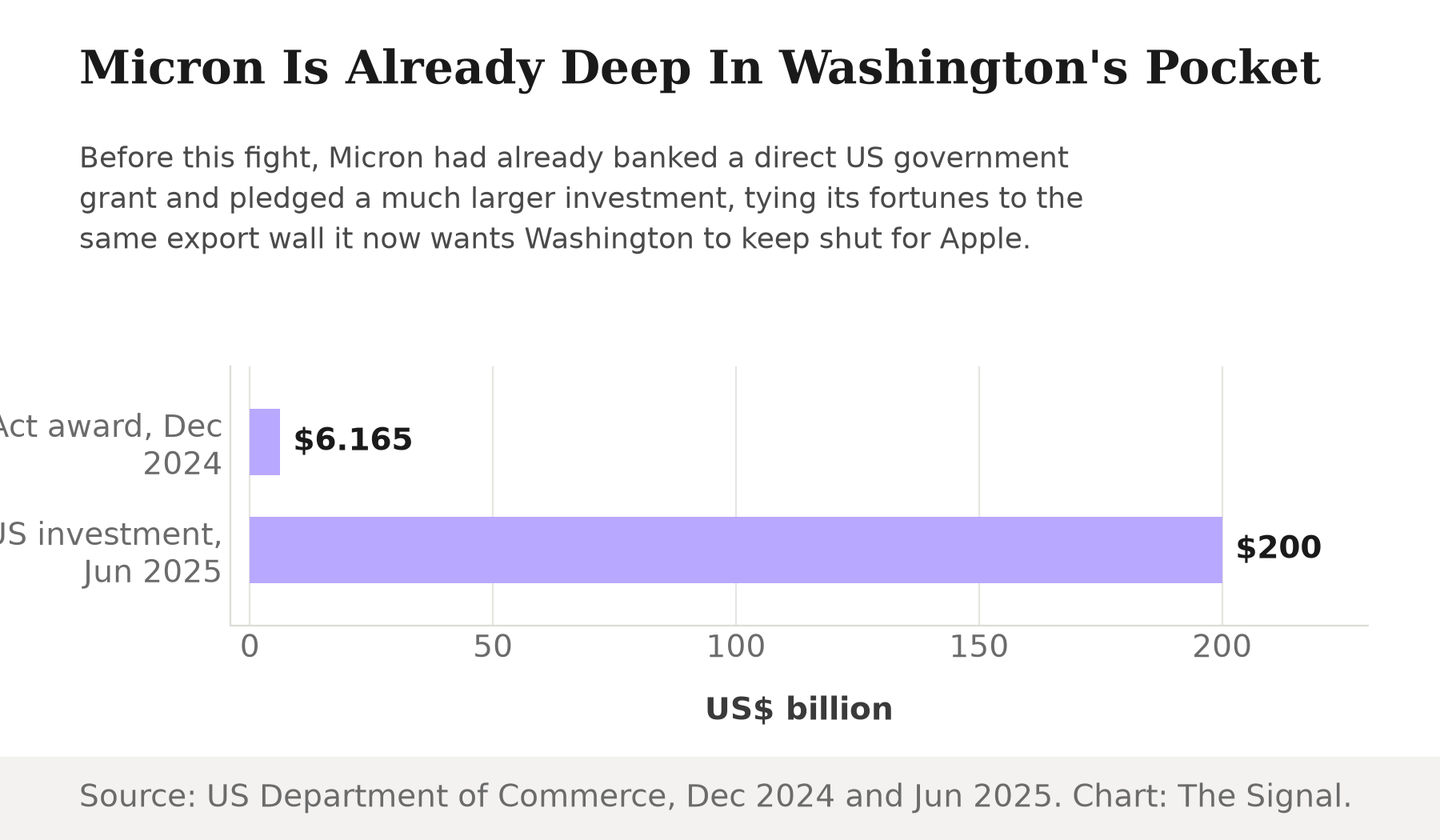
Source: US Department of Commerce, via NIST; a second NIST-archived announcement. Chart: The Signal.
Micron's financial future is bound to the same government Apple is now lobbying. Keeping CXMT and YMTC out of the market Micron sells into is the difference, for Micron, between a memory market it dominates and one it has to compete in on price, against exactly the low-cost rivals it has been shielded from.
A wall that already moves
The idea that this wall is fixed does not survive contact with 2026. The Commerce Department's Bureau of Industry and Security added YMTC to its Entity List, the strictest US export blacklist, effective December 16, 2022, citing reasons tied to China's military modernization. That designation is more than three years old and has not been reversed. But the rest of the export-control architecture around it has been anything but static.
The clearest table for this is the one Washington itself has been editing all year.
The chip wall is not one rule. It is several, and they move on different clocks.
| Policy tool | What it says on paper | What just happened |
|---|---|---|
| BIS Entity List (Dec 2022) | Bars YMTC from most US technology transfers on national-security grounds | Apple is now asking Washington for an exception to use YMTC chips abroad |
| BIS export licensing (Jan 2026) | Had been a blanket restriction on advanced AI chips to China | Reversed to case-by-case review for Nvidia's H200 and AMD's MI325X |
| Pentagon Section 1260H list | Names Chinese firms with military ties | CXMT and YMTC were dropped from a version that briefly appeared in February 2026, then restored in June 2026 |
Sources: US Bureau of Industry and Security; Fortune; The News International.
In January 2026, the Bureau of Industry and Security reversed its blanket restriction and moved to case-by-case licensing for advanced AI chip exports to China, including Nvidia's H200 and AMD's MI325X. And the Pentagon's Section 1260H list of Chinese military-linked companies dropped CXMT and YMTC from a version that briefly appeared in February 2026, only to restore both firms in its June 2026 update. None of this proves Apple's specific request will succeed. It shows that the wall Apple is petitioning against is several doors, controlled by different parts of the government, that have already opened and shut more than once this year.
The lesson for India
This is not only a US-China story. India's Union Cabinet approved India Semiconductor Mission 2.0, with a total outlay of ₹1.27 lakh crore, on July 15, 2026, Outlook Business reports, citing Union Electronics and IT Minister Ashwini Vaishnaw. Part of the strategic case for that kind of outlay is that the US-led export-control regime keeps China's most advanced chipmakers boxed out of the global market, leaving room for other manufacturing bases, India included, to compete for supply chains the West is not willing to hand to Beijing.
That case assumes the wall is a durable structural feature of world trade. This dispute shows it is closer to a live setting that Washington adjusts under pressure, sometimes for a chip category, sometimes for a single firm, sometimes twice in the same year for the same company. A strategy built on the assumption that containment is permanent is building on the same ground Apple's own executives are, right now, trying to move.
The honest objection
The strongest case against reading this as a wall "bending under pressure" is that the underlying national-security rationale for the YMTC blacklist has not moved at all. It has stood since December 2022 without reversal, and the Pentagon's own list, after its brief February gap, put CXMT and YMTC straight back on. A skeptic would say the system is working exactly as designed: narrow licensing carve-outs for a handful of AI chips are not the same as dismantling the memory blacklist, and Apple asking for an exception is not Apple getting one.
That case is real, and it is why nothing here proves Apple's request will be granted. But it does not explain why the architecture keeps producing carve-outs and reversals at all, on a list built around chips a rival superpower could weaponize. A wall that has already flexed once for AI accelerators, and already flip-flopped once on the exact firms in question, is not the same as a wall that has never moved.
The Signal
Micron did not become one of Washington's heavily subsidized chipmakers by accident, and it will not lose the wall protecting its margins without a fight. Apple's own margin accusation against Micron is not an accident either: Apple is the company footing the bill for the shortage that made that margin possible. The wall between them is a set of levers, pulled by different offices on different clocks, and the story of 2026 so far is how often those levers have already moved for someone. Watch whether Apple's specific request gets granted, denied, or quietly slow-walked. Any of the three tells you whose pressure the wall currently answers to.
Reporting basis: Apple's lobbying of Commerce Secretary Howard Lutnick and Treasury Secretary Scott Bessent is per The News International; Apple's margin and capacity accusation against Micron is per the Wall Street Journal, as reported via Investing.com. Micron CEO Sanjay Mehrotra's own warning to Lutnick against admitting CXMT and YMTC is per 9to5Mac. Micron's CHIPS Act award and its investment pledge are per US Department of Commerce announcements archived by NIST and a second NIST-archived announcement. The 2022 YMTC Entity List designation and the January 2026 shift to case-by-case AI chip licensing are per the US Bureau of Industry and Security and its January 2026 policy revision. The Pentagon's 2026 Section 1260H reversal on CXMT and YMTC is per Fortune. DRAM contract price and industry revenue figures, and Micron's market-share gain, are per TrendForce and a second TrendForce report. India's Semiconductor Mission 2.0 outlay is per Outlook Business, citing the Union Electronics and IT Minister. Micron's prior-quarter DRAM market share is The Signal's calculation from TrendForce's reported percentage-point gain.