At 12:01 a.m. Eastern time on July 24, 2026, a tariff that had applied to nearly every country trading with the United States expired on schedule. It had already been replaced. A day earlier, a presidential memorandum imposed a permanent 10 percent Section 301 tariff on Indian goods over forced-labor enforcement, effective July 23-24, 2026, alongside identical 10 percent rates on sixteen other economies, from Bangladesh to Canada to the United Kingdom. Read only the headline number, and nothing appears to have happened to India's access to its largest single-country export market this week.
It is worth slowing down on that. The tariff that just lapsed was a temporary, economy-wide 10 percent import surcharge under Section 122 of the Trade Act of 1974, in force since February 24, 2026 and set by statute to expire at 12:01 a.m. Eastern time on July 24, 2026. The tariff that replaced it is not a renewal of that one. It is a different law, resting on a different finding, that happens to land on the same number for India. A Section 122 surcharge is blunt: a flat rate applied to every trading partner at once, tied to the US trade deficit, and built to expire. A Section 301 forced-labor tariff is none of those things. It is assigned economy by economy, it carries no sunset clause, and it stays attached to whatever finding justified it.
The number that actually describes India's position is not 10. It is 17.
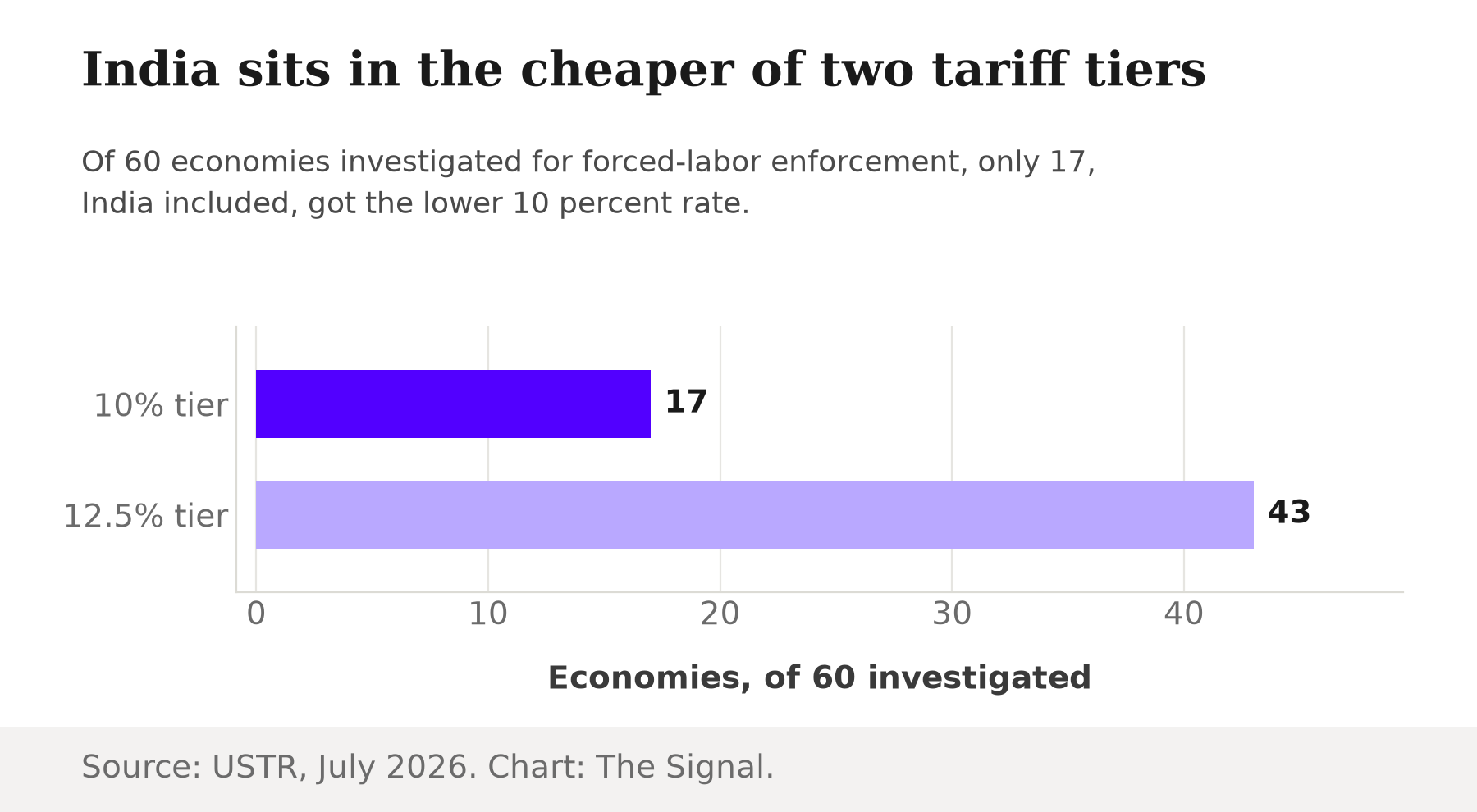
USTR's July 23, 2026 final action sorted the economies it investigated for forced-labor enforcement into two tiers: India was one of only 17 that qualified for the 10 percent rate, while every other investigated economy was set at 12.5 percent. Those investigations covered 60 economies in total, together accounting for more than 99 percent of US imports. Seventeen paid the lower rate. Forty-three paid more.
From the wrong bracket to the right one
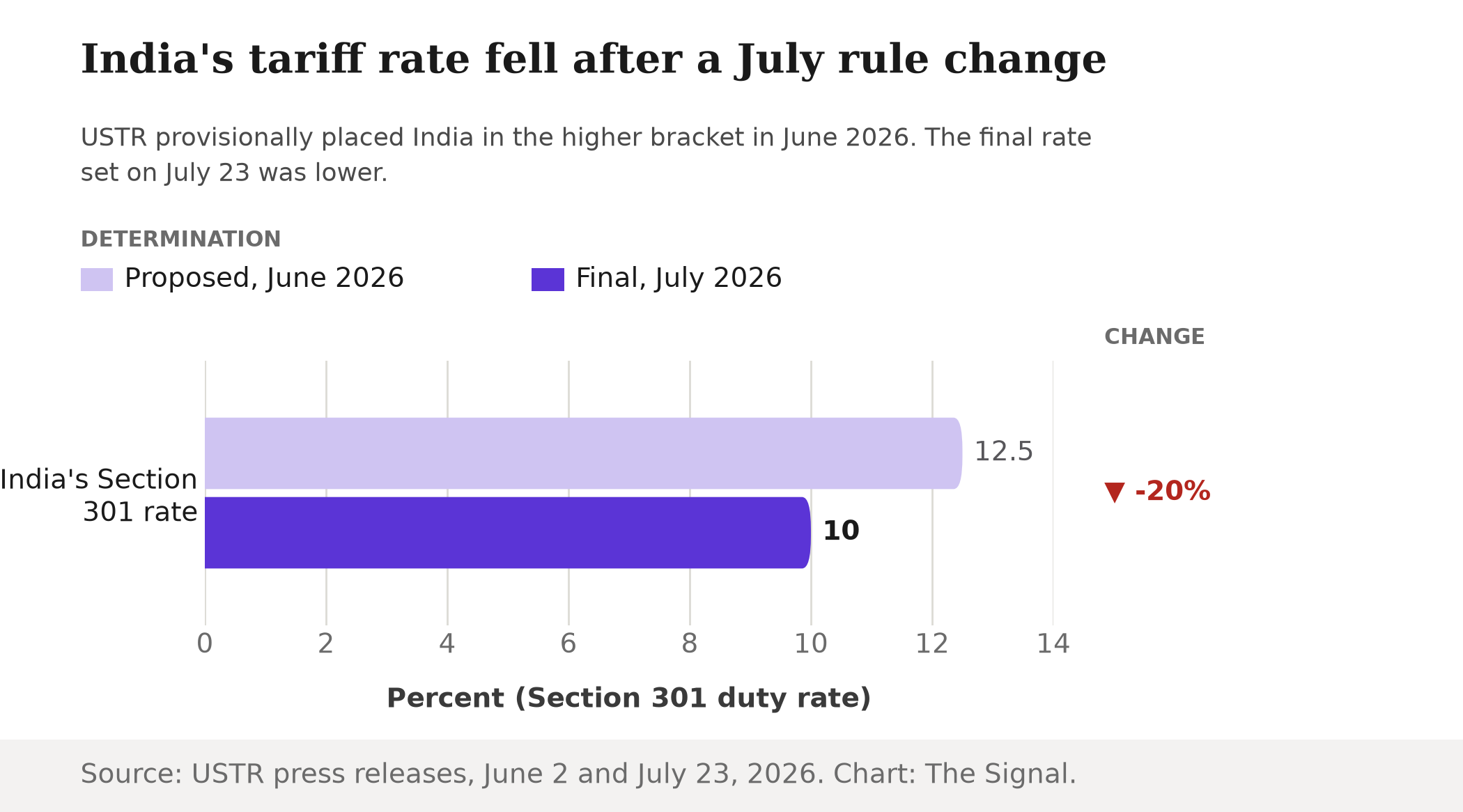
India did not start in the cheap tier. USTR's original determination on June 2, 2026 placed India among 54 economies found not to have a qualifying forced-labor import ban, provisionally in the higher 12.5 percent bracket. By the July 23 final action, only 43 economies remained in that bracket, eleven fewer in seven weeks, while the other 17, India now among them, had qualified for the lower rate.
India's own move was procedural, not diplomatic. In July 2026, India's Directorate General of Foreign Trade amended the country's Foreign Trade Policy to add a new provision, Paragraph 2.20B, banning the import of goods produced wholly or in part using forced labour. USTR's own criteria for the cheaper tier make the link explicit: the 10 percent rate covers economies that impose a forced-labor import prohibition, that have committed to enforce one through a reciprocal trade agreement, or that operate a partial regime achieving the same effect. A single customs rule, filed weeks before the deadline, was enough to move India across an entire tariff bracket.
What the tariff actually touches
The duty lands on most of what India actually sells to the United States. About 70 percent of India's shipments to the American market, spanning engineering goods, textiles, garments, chemicals, machinery, plastics, leather, gems and jewellery, and furniture, will carry the new 10 percent duty on top of existing Most Favoured Nation tariffs, according to the Global Trade Research Initiative's estimate, cited by the Free Press Journal. It also changes India's position against the exporter it most directly competes with in several of those same categories: China, which rivals India in textiles and engineering goods, landed in the 43-economy bracket paying 12.5 percent rather than India's 10 percent.
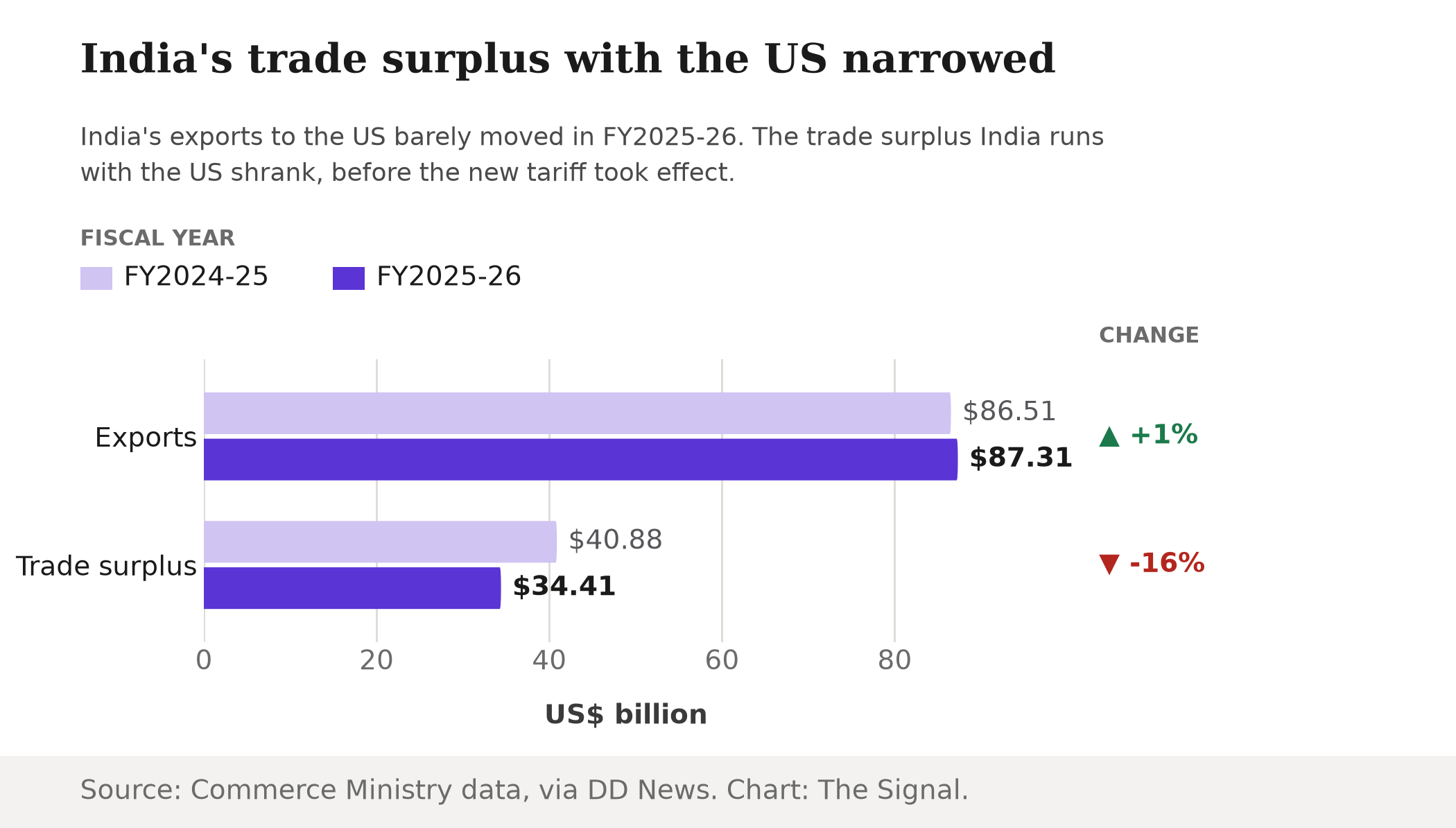
It lands, too, on a trade relationship that was already cooling on its own terms. India's exports to the US were $87.31 billion in the year to March 2026, essentially flat on $86.51 billion the year before, while the trade surplus India runs with the US narrowed to $34.41 billion from $40.88 billion.
The honest objection
The strongest case for shrugging this off is that nothing changed for an Indian exporter's landed cost this week. The Section 122 surcharge that just expired and the Section 301 tariff that replaced it both land at 10 percent, and firms have been paying that rate since February. On that view, July 23 was a legal technicality: a label swap a customs broker notices and nobody else does.
That case does not survive the permanence of the swap. The Section 122 surcharge was, by statute, temporary and built to expire on schedule, while the tariff that replaced it was finalized as permanent, specific to India's own compliance record rather than a shared global number. A blanket deficit surcharge is a macro dial Washington can turn for any country, for any reason, and turn back. A forced-labor finding is a standing judgment attached to India's own supply chains, one that stays on the record long after the trade balance that justified the original surcharge has moved. The cost held. The category it is filed under did not.
A sharper objection comes from GTRI itself, and it is aimed at the law rather than the number. The think tank argued the investigation exceeds Section 301's own scope, which is meant to address market-access barriers facing US firms abroad, not what a country imports and from where. That is a case that the finding rests on shaky legal ground even if India's compliance record is genuinely uneven. India's own government has made a related, narrower complaint through official channels rather than a think tank: a Commerce Ministry official told a USTR public hearing that the exemptions built into the action undermine its own stated rationale for existing at all. Neither objection disputes that India cleared the lower bar. Both dispute whether the bar was drawn honestly.
The Signal
India spent seven weeks turning a customs paperwork gap into the difference between two tariff tiers, and the rate it landed on looks, on paper, like nothing changed. That is the wrong read. India now carries a permanent, forced-labor-specific US tariff instead of a temporary, deficit-driven one, at a rate 43 other investigated economies did not get. The number to watch from here is not 10 percent. It is whether Paragraph 2.20B gets enforced at India's ports as rigorously as it was written into the Gazette, since USTR's own criteria tie the cheap tier to enforcement, not just a rule on the books. A tariff bracket that was won with a notification can be lost the same way.
Reporting basis: the final Section 301 tariff rates and their July 23-24, 2026 effective date are from the White House's presidential memorandum and USTR's press release announcing the final action. The provisional determination is from USTR's earlier press release. The Section 122 surcharge and its scheduled expiry are from the White House's February proclamation. India's Foreign Trade Policy amendment is per the Tribune's report of the Directorate General of Foreign Trade notification. The shipment-coverage estimate is from the Global Trade Research Initiative, as reported by the Free Press Journal. China's placement in the 12.5 percent bracket is per Gulf News's compilation of the full tier list. India's trade figures with the US are Commerce Ministry data, via DD News. The count of investigated economies is per USTR's fact sheet. GTRI's separate argument that the investigation exceeds Section 301's own scope is per Outlook Business. India's government complaint that the action's exemptions undermine its own rationale is per a second Tribune report, of a Commerce Ministry official's remarks at a USTR public hearing. The count of economies in each tariff tier, and the change between the two determinations, are The Signal's calculations from USTR's actions.