
Uber cut 10 percent of the jobs within its customer service operations on July 22, 2026, tying the reduction to its embrace of artificial intelligence. It was the first time in company history Uber has attributed layoffs to AI, and its second round of cuts to simplify team structures in under two months. The team affected, community operations, handles rider and driver complaints, refunds and account disputes: the scripted, high-volume, low-judgment tier of support work every consumer platform runs.
As of December 31, 2025, Uber had about 34,000 employees globally, roughly 20,300 of them outside the United States, across operations in more than 70 countries and more than 15,000 cities. A cut inside a workforce that size, credited explicitly to AI, is a real staffing decision, not a survey response or an executive's forecast.
A company just chose AI over its own scripted support staff, in public, and said so.
Uber is not the only one to say it. Salesforce cut its own customer-support headcount from roughly 9,000 to roughly 5,000 after deploying AI agents to handle interactions, with CEO Marc Benioff putting the logic bluntly in 2025: "I need less heads". Two large platform companies naming the same job category, within a year of each other, for the same reason, is not a coincidence to read as one data point.
It is worth asking what kind of job that actually was, because the answer says more about who should be paying attention than the 10 percent figure does. Community operations is the category India's outsourcing industry was built to sell to companies like Uber: telephone and chat support, ticket resolution, account troubleshooting. That category sits closer to the center of India's tech-export economy than its size in headlines suggests. India's business process management segment, the export category built on that exact kind of work, generated $54.6 billion in FY2025, just a billion dollars short of the $55.7 billion generated by engineering R&D, the segment that designs and builds rather than answers phones.
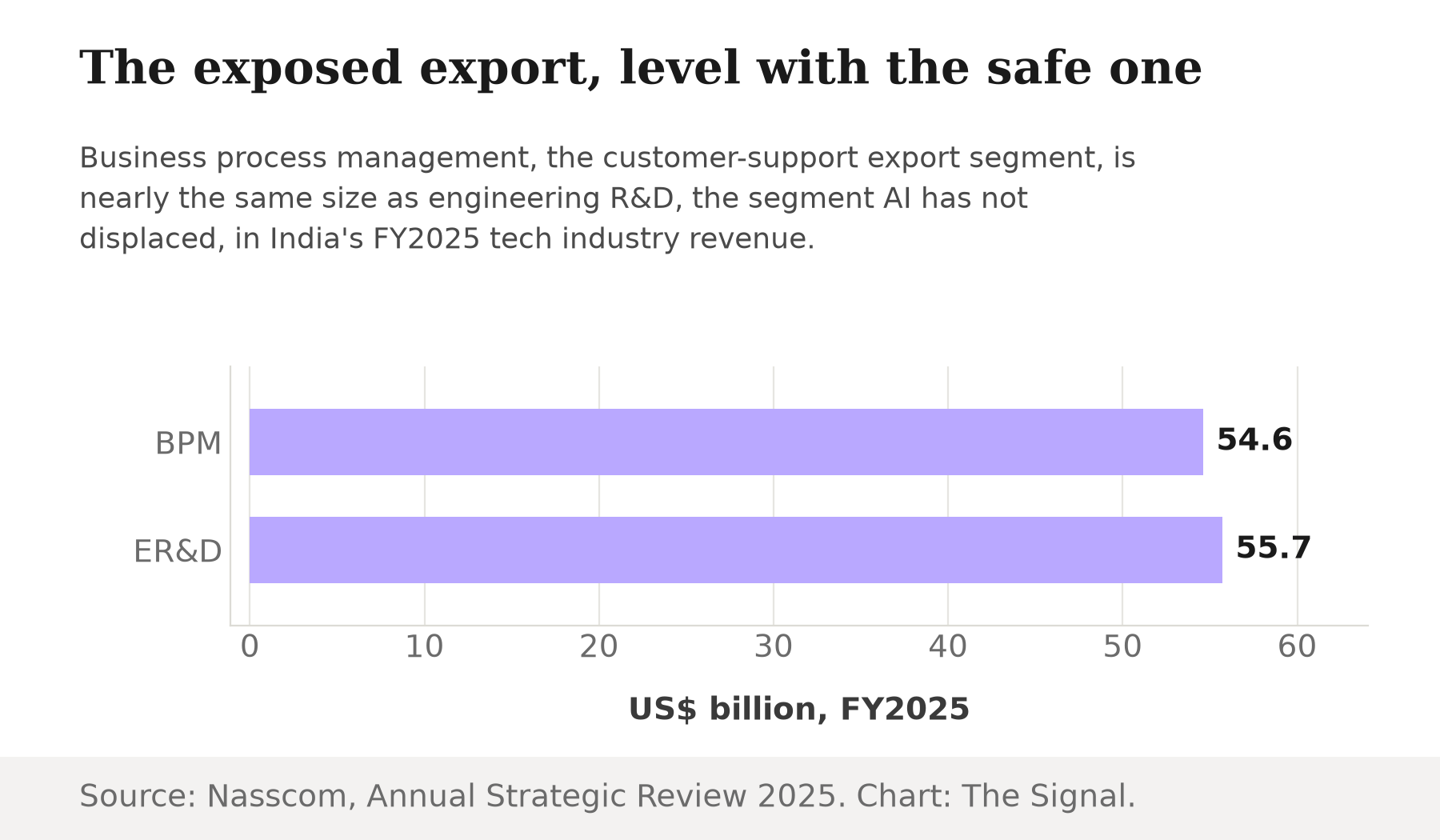
Source: Nasscom Annual Strategic Review 2025. Chart: The Signal.
That is the number worth sitting with. The segment doing the kind of work Uber just cut is not a rounding error next to the segment that has so far kept expanding untouched. It is nearly the same size.
Which layer AI actually eats first
Uber did not say which employees it let go or why those specific roles, but the pattern matches what the best available research on generative AI and support work has already found. A field study of 5,179 customer support agents using a generative AI assistant found the tool raised productivity, measured as issues resolved per hour, by 14 percent on average. That average hides the real split: novice and low-skilled agents gained 34 percent, while experienced, highly skilled agents saw minimal benefit.
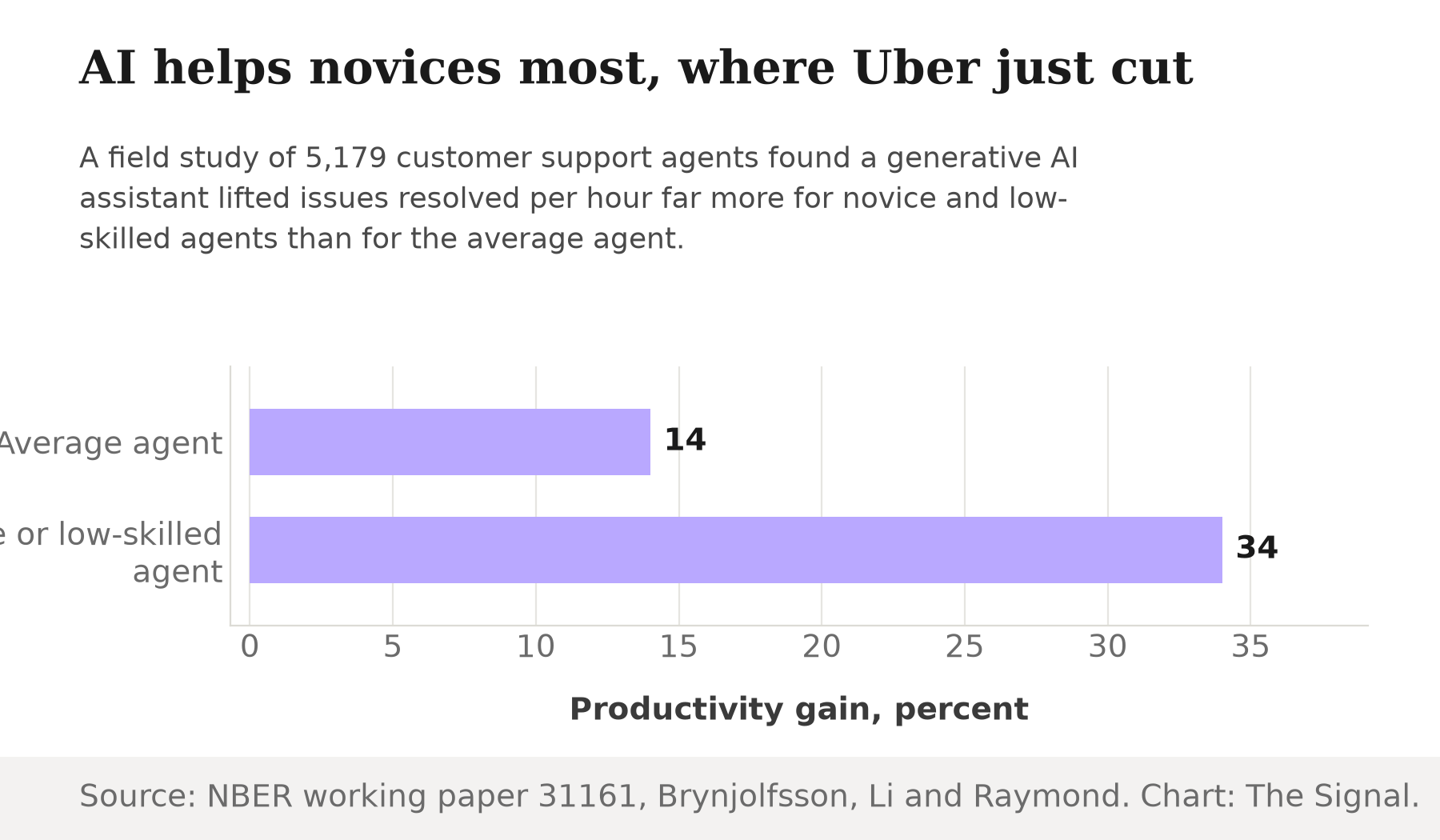
Source: NBER Working Paper 31161, Brynjolfsson, Li and Raymond. Chart: The Signal.
Read that finding as a displacement map, not just a productivity one. A tool that makes a novice agent perform like a seasoned one removes the reason to employ as many seasoned agents, and eventually the reason to employ novices at all once the software can do a novice's job on its own. The International Labour Organization's 2025 refined Global Index of Occupational Exposure to generative AI found clerical occupations carry the highest exposure of any occupational group, with 3.3 percent of global employment falling into the very highest exposure category. Customer service is clerical work with a headset: high volume, scripted, low ambiguity, no capital equipment beyond a keyboard.
The layer that isn't moving yet
Set that against India's other big services export. Global Capability Centres, the arm of India's tech industry running engineering, product and complex service delivery for multinational clients, grew combined revenue from $40.4 billion in FY2019 to $64.6 billion in FY2024, a 9.8 percent annual pace, and now employ over 1.9 million people.
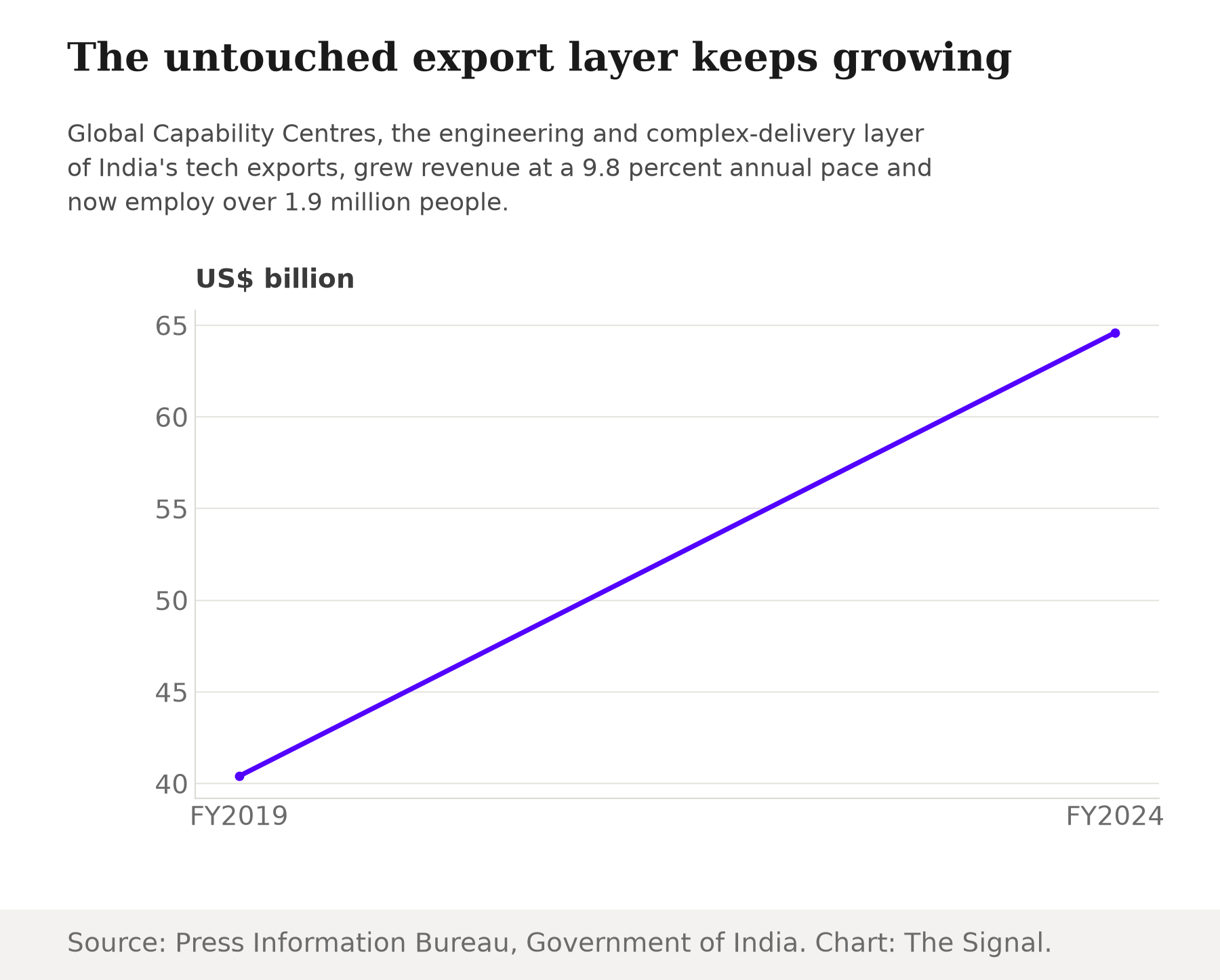
Source: Press Information Bureau, Government of India. Chart: The Signal.
That growth ran through the same years generative AI tools went from novelty to default at many large software organizations. Engineering, judgment-heavy service delivery and product work kept expanding while a generative AI assistant was closing the gap between a novice and an expert one tier down, in support roles. The ordering is the finding: AI has proven it can compress the distance between a weak support agent and a strong one long before anyone has shown it can compress the distance between a junior and a senior engineer.
The honest objection
The strongest case against reading Uber's cut as a warning for India is that it may simply not be one. Uber never said where those jobs sat, and nothing here confirms a single one of them was in India. What is confirmed is that the org chart in question has an India address: Uber runs a Customer Support Center of Excellence in Hyderabad, sitting alongside its Engineering Center there, part of the same Community Operations organization the July cut came out of. The mechanism does not need an inference to reach India, only a disclosure Uber has not made. Nasscom's own review found the industry added a net 126,000 jobs in the year the BPM-versus-ER&D figures above were measured: an industry shedding its most exposed layer would not, on its face, look like an industry still hiring. And the ILO's own number cuts both ways. 3.3 percent of global employment in the highest exposure category means the large majority of jobs, clerical included, are not there yet.
That case is real, but it answers a different question than the one this piece is asking. Net hiring across an industry that size can rise even as one exposed sub-segment shrinks in share, if the growth is concentrated in GCCs and engineering, which is exactly the pattern the two charts above show. Uber's silence on location is not evidence the mechanism does not apply to India either. It is evidence the mechanism is generic: it targets a job description, not a postcode. Uber operates at a scale far larger than any single market, and it just showed, in public, which layer of that global service work it no longer needs as many humans for.
The Signal
Uber's cut will not by itself move an export segment worth tens of billions of dollars. What it does is confirm, with a real staffing decision rather than a stated intention, which tier of service work a global platform company is now willing to automate first: not engineering, not complex delivery, but scripted customer support, the tier India built an industry on selling to companies exactly like Uber. The number to watch from here is not Uber's headcount. It is whether BPM's share of India's tech-export revenue starts falling relative to ER&D's, the way one company's org chart just did.
Reporting basis: Uber's community-operations cuts and their AI framing are as reported by Bloomberg News. Uber's global headcount and country footprint are from the company's own FY2025 Form 10-K, filed with the SEC. Uber's Hyderabad Customer Support Center of Excellence is described on Uber's own careers site. Salesforce's AI-attributed customer-support headcount reduction is as reported by Fortune, quoting CEO Marc Benioff. India's BPM and ER&D export figures, and the sector's net hiring, are from Nasscom's Annual Strategic Review 2025. Global Capability Centre revenue and employment figures are from a Press Information Bureau release of the Government of India. The productivity findings on customer support agents are from a single NBER working paper by Brynjolfsson, Li and Raymond, and are the only source for those figures. The occupational exposure figures are from the International Labour Organization's 2025 refined Global Index. The near-parity between BPM and ER&D revenue is The Signal's own comparison of two figures in the same Nasscom release.