
Banks and NBFCs in India have operated under an explicit rulebook against strong-arm loan recovery for more than a decade. RBI's Master Circular on Fair Practices Code states that lenders "should not resort to undue harassment viz; persistently bothering the borrowers at odd hours, use muscle power for recovery of loans etc," a bar that has stood since July 2015. In August 2022, the Reserve Bank of India's notification on Outsourcing of Financial Services (RBI/2022-23/108) states that "the ultimate responsibility for their outsourced activities vests with" banks and NBFCs, who are "responsible for the actions of their service providers including Recovery Agents." The same notification also bars intimidation, public humiliation of debtors, and calls before 8am or after 7pm.
Three rounds of RBI rules already target recovery-agent conduct.
| Rule | In force since | What it bars |
|---|---|---|
| Fair Practices Code | July 2015 | Persistent harassment, odd-hour visits, "muscle power" in loan recovery |
| Outsourcing of Financial Services directions | August 2022 | Intimidation, public humiliation of debtors, calls before 8am or after 7pm; full bank liability for agents |
| Revised Integrated Ombudsman Scheme | July 2026 | Strengthens how complaints get resolved, not what agents may do |
Source: RBI's Fair Practices Code, 2022 outsourcing directions, and 2026 press release.
Read plainly, that rulebook already closes most of the doors a recovery agent could use. It is worth slowing down on that. A written reply tabled in the Rajya Sabha on July 21, 2026, tells a different story about what is actually happening. Deccan Chronicle reports, citing that written reply by the Minister of State for Finance: "In FY26, 18,021 complaints were received against banks regarding recovery agencies, which was more than double the 8,623 complaints in the previous year." Not a marginal rise. More than double, in a single fiscal year, under a rulebook that has banned the underlying conduct since 2015.
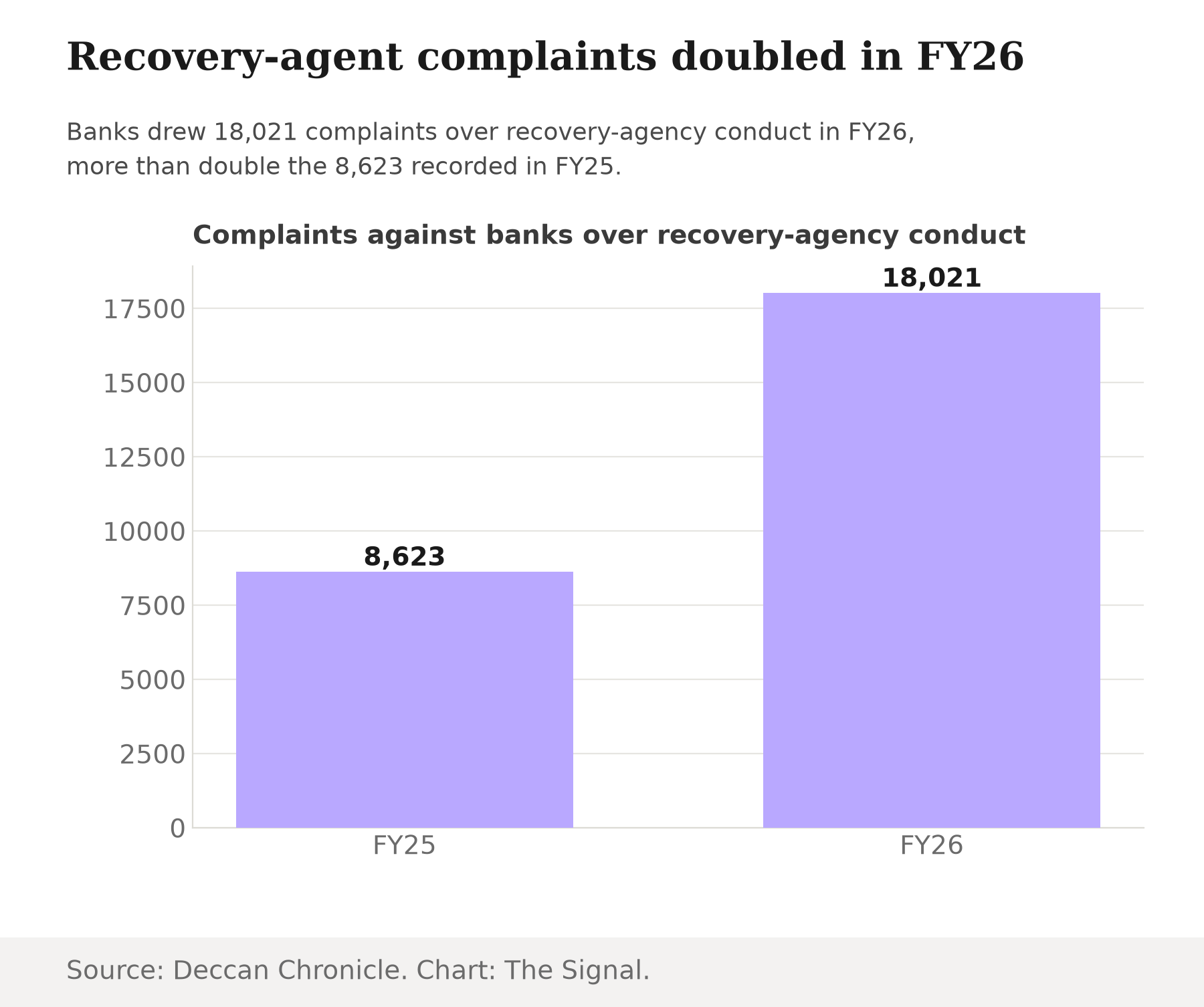
Source: Deccan Chronicle, reporting a written reply to the Rajya Sabha by the Minister of State for Finance. Chart: The Signal.
The code already has teeth
The Fair Practices Code is not a dead letter. Business Today reports, citing an RBI penalty order dated January 5, 2021, that "the RBI has imposed a monetary penalty of Rs 2.50 crore on Bajaj Finance Limited, Pune, by an order dated January 05, 2021, for violation of...directions issued by RBI on Managing Risks and Code of Conduct in Outsourcing of Financial Services by NBFCs and Fair Practices Code." That penalty predates the FY26 complaint count by five years and shows the regulator will act on individual violations when it finds them. What it has not done, in the five years since, is bend the complaint curve down.
The same curve runs across the whole complaint book
Recovery agents are not the only place the trend shows up. The Tribune reports, citing RBI's Annual Report of the Ombudsman Scheme, 2024-25, that total complaints under RBI's Integrated Ombudsman Scheme rose 13.55% to 13.34 lakh in FY25, up from 11.75 lakh in FY24, with loans and advances the single largest category at 29.25% of the total.
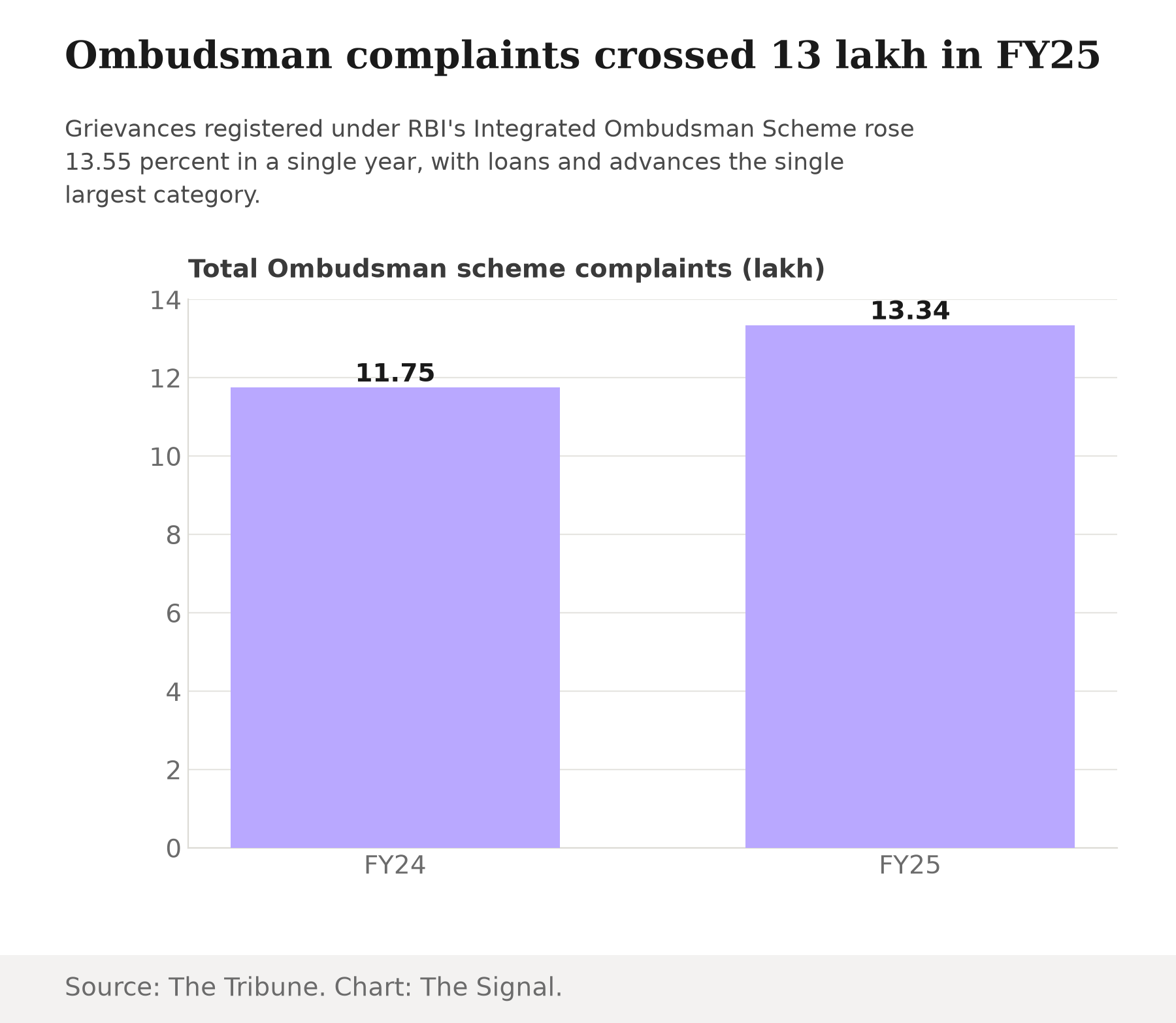
Source: The Tribune, citing RBI's Annual Report of the Ombudsman Scheme, 2024-25. Chart: The Signal.
The rate of complaints, not just the raw count, is what should worry a regulator. India Tracker reports, citing RBI's Annual Report of the Ombudsman Scheme, 2023-24, that the national average of complaints per 100,000 bank accounts spiked from 2.85 in March 2022 to 8.9 in March 2024, more than three times over in two years, even as the share of complaints the ombudsman managed to dispose of slipped from 97.99% to 95.1% across the same period. Complaints are growing faster than the accounts that generate them, and the machinery meant to resolve them is falling slightly behind rather than catching up.
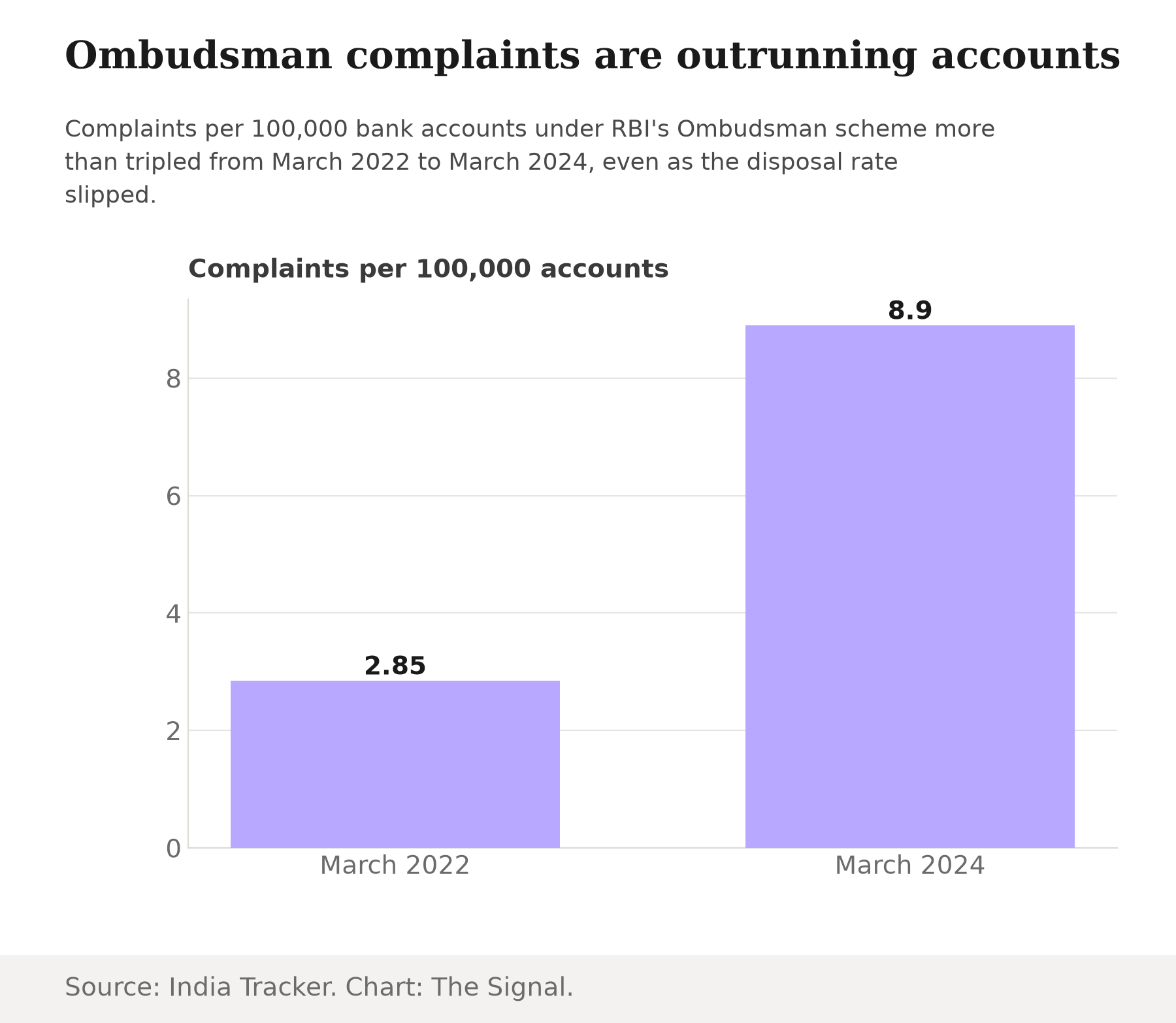
Source: India Tracker, citing RBI's Annual Report of the Ombudsman Scheme, 2023-24, the only source for that specific series. Chart: The Signal.
The debt behind the doorbell
The lending backdrop behind these numbers has been growing fast. Policy Circle reports, citing RBI's Financial Stability Report of June 2026, that household debt in India reached 45.5% of GDP by September 2025. More households carrying more debt means more accounts falling behind at any given moment. That pushes more files to recovery agencies, and more agents knocking on doors. The complaint numbers are not happening in isolation from the credit boom that produced the loans in the first place.
The honest objection
The strongest case against reading the FY26 jump as worsening conduct is that it may simply track lending growth: a bigger book of personal loans and unsecured credit means more accounts in default at any moment, so a proportional rise in recovery complaints could just mirror portfolio growth rather than a change in how agents behave. RBI has also moved to make complaining easier. The Reserve Bank of India's press release states that its revised Reserve Bank - Integrated Ombudsman Scheme, 2026, "will come into force from July 01, 2026," a date that has already passed, aimed at strengthening how efficiently the ombudsman framework resolves complaints. A faster, more accessible channel could itself pull in complaints borrowers previously gave up on filing, inflating the count without any change in what happens at the door.
That case has real force, but it does not explain why the rate, not just the count, is climbing. Complaints per 100,000 accounts more than tripled between March 2022 and March 2024, and the ombudsman's own disposal rate fell rather than held steady in that same window. A system merely keeping pace with loan growth, or one that just got easier to complain into, would still show a steady resolution rate. Instead it is slipping. Something in the conduct on the ground, not just the paperwork around it, is moving too.
The Signal
The rulebook was never the missing piece; Bajaj Finance's 2021 penalty proves RBI will use it. What has not kept pace is enforcement against a lending book that has grown faster than the compliance apparatus watching it. Household debt at 45.5% of GDP by September 2025 is the reason recovery agents have more doors to knock on than they did a few years ago, and a code written for a smaller book does not automatically scale with it. Watch the FY27 numbers next. Recovery-agent complaints growing slower than the personal-loan book behind them would mean the code has caught up with the lending. If they keep outrunning it, the Fair Practices Code is a rule banks can point to, not one their borrowers can count on.
Reporting basis: the FY26 and FY25 recovery-agency complaint figures are per Deccan Chronicle's report of a written reply tabled in the Rajya Sabha by the Minister of State for Finance. RBI's Fair Practices Code and its 2022 outsourcing directions are drawn directly from the Reserve Bank of India's own notifications, as is its press release on the revised 2026 Ombudsman Scheme. The Bajaj Finance penalty is per Business Today's report of RBI's January 2021 order. Total Ombudsman Scheme complaint figures for FY24 and FY25 are per The Tribune, citing RBI's Annual Report of the Ombudsman Scheme, 2024-25; the complaints-per-100,000-accounts and disposal-rate figures are per India Tracker, citing RBI's Annual Report of the Ombudsman Scheme, 2023-24, the only source for that specific series. The household-debt figure is per Policy Circle, citing RBI's Financial Stability Report of June 2026. The tripling of the per-account complaint rate is The Signal's calculation from those figures.