On July 21, 2026, Donald Trump used a Truth Social post to lay out a tariff schedule for generic pharmaceuticals: two years at zero percent, then a 100 percent duty from August 2028, doubling to 200 percent from August 2029, as Bloomberg's wire report, carried by The Spokesman-Review, states. Indian pharmaceutical stocks did not wait for anyone to read the fine print. Lupin fell 4.32 percent and Aurobindo Pharma 4.13 percent, while the BSE Healthcare index dropped 978 points to 50,464 the next trading day. Put the headline number, 200 percent, next to that stock chart and the story writes itself: Washington has opened a tariff war on India's biggest pharmaceutical export, and the market is pricing in the damage.
It is worth slowing down on that timeline. The 200 percent rate that spooked traders does not arrive until August 2029, three years after the announcement, a year after an initial 100 percent duty that itself does not begin until August 2028. For the next two years, the tariff on generic drug imports from India is zero.
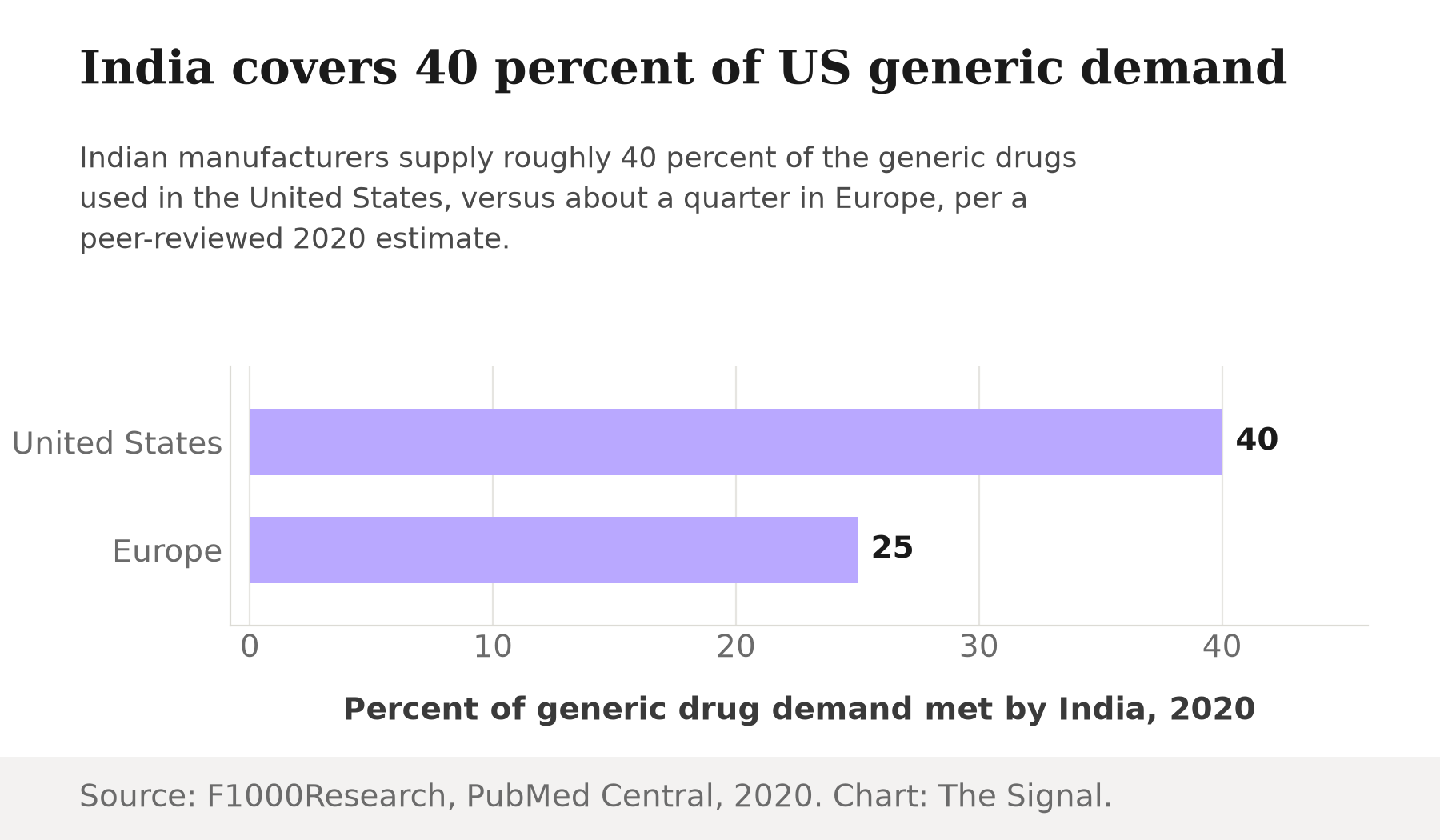
The number that actually matters here is not 200. It is 40. Indian manufacturers meet roughly 40 percent of the generic drug demand in the United States, versus about a quarter of Europe's, a share built over decades of FDA-approved manufacturing capacity that does not relocate on a three-year clock. That is not a niche corner of the market either: generic drugs make up more than 90 percent of all prescriptions dispensed in the United States, so India's share of the generic segment translates into a meaningful slice of every prescription filled in the country, not just of some specialist sub-market. A tariff this severe, with a runway this long, reads less like proof that the US is ready to decouple from Indian generics and more like proof that it cannot yet.
The three-year runway
The tariff has a paper trail that predates the July 2026 announcement by more than a year. The Commerce Department's Bureau of Industry and Security opened a Section 232 national security investigation into pharmaceutical and pharmaceutical-ingredient imports on April 1, 2025, the legal mechanism that gives the president tariff authority on national security grounds. That investigation produced its first major action on April 2, 2026, when a presidential proclamation imposed a 100 percent duty on patented pharmaceuticals but explicitly declined to touch generics, stating the administration had determined not to adjust imports of generic pharmaceuticals and their associated ingredients, including biosimilars, "at this time". Generics got a specific carve-out while patented drugs took the hit first.
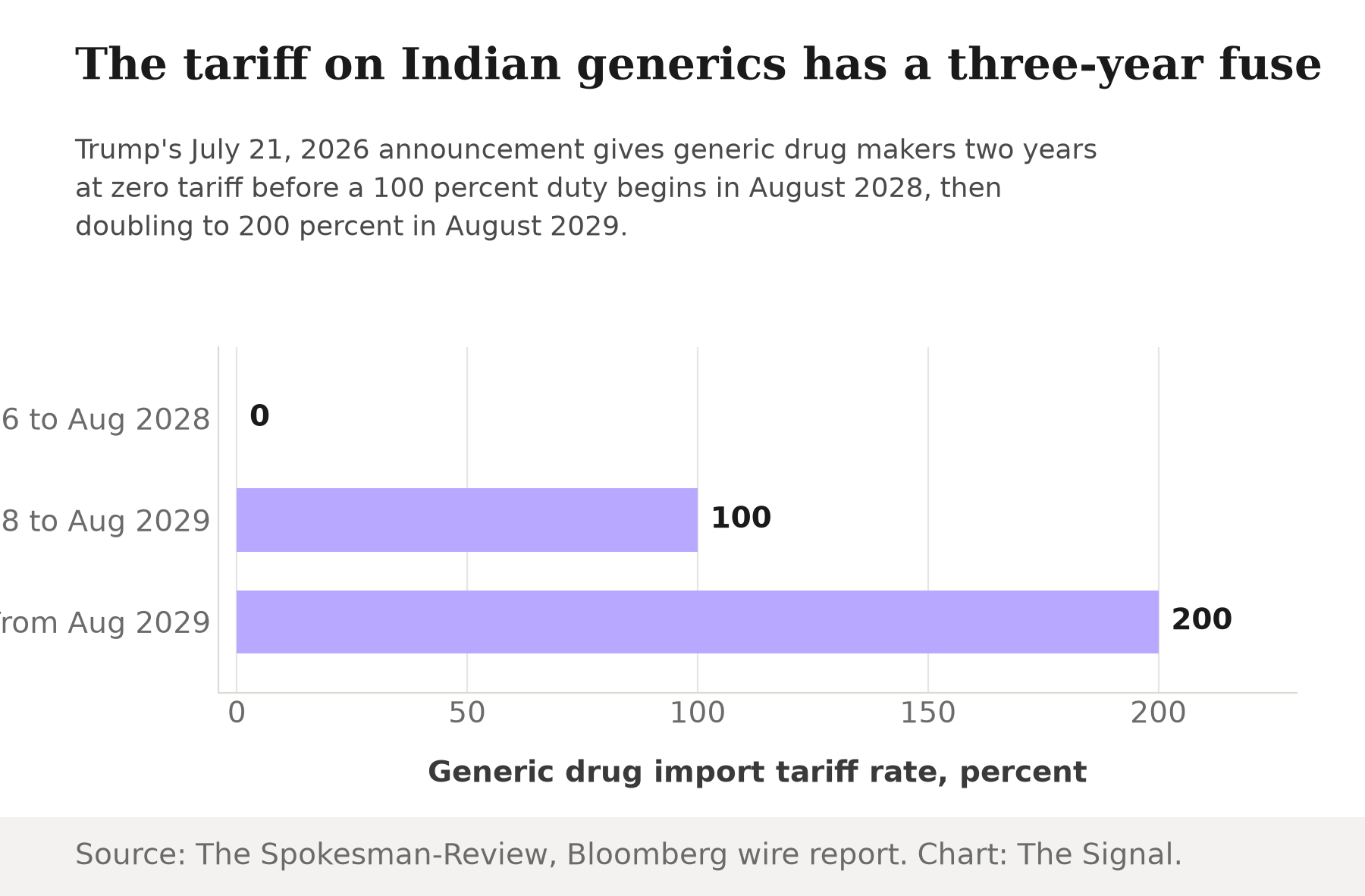
July 21, 2026 is when that carve-out got its expiration date. The two-year, zero-tariff window followed by a 100 percent duty in August 2028, doubling to 200 percent in August 2029, is the schedule the administration set once it decided generics could not stay exempt indefinitely. A government that wanted to squeeze Indian generics quickly had a tariff instrument sitting ready since April 2025. It chose instead to phase generics in last, and slowest.
Trump did put a rationale on the record for the delay itself. "This is done in order to RESHORE Generic Pharmaceutical Production into America, with a penalty to those Companies that decide not to build Plant and Equipment within the stated period of time given to them," he said in the same post that set the schedule. That is an explicit statement that the two years are meant as construction time, not a negotiating window or a courtesy to a trading partner. It only sharpens the question of why the industry needs three years to build plants that the same announcement says it must build.
How dependent the US already is
No other single country's generics industry sits as deep inside the US prescription-drug supply chain as India's. Indian manufacturers supply roughly 40 percent of the generic drugs used in the United States, compared with about a quarter of Europe's, according to a peer-reviewed 2020 estimate published in F1000Research.
That reliance runs in both directions. India's pharmaceutical exports crossed $30 billion in the fiscal year ending March 2025, up more than 9 percent from the year before, with exports to the US alone growing more than 14 percent in FY2024-25. In calendar year 2025, India shipped $9.7 billion of pharmaceuticals to the United States, 38 percent of its $25.8 billion in total global pharma exports in 2025, making the US easily India's single largest pharmaceutical export market.
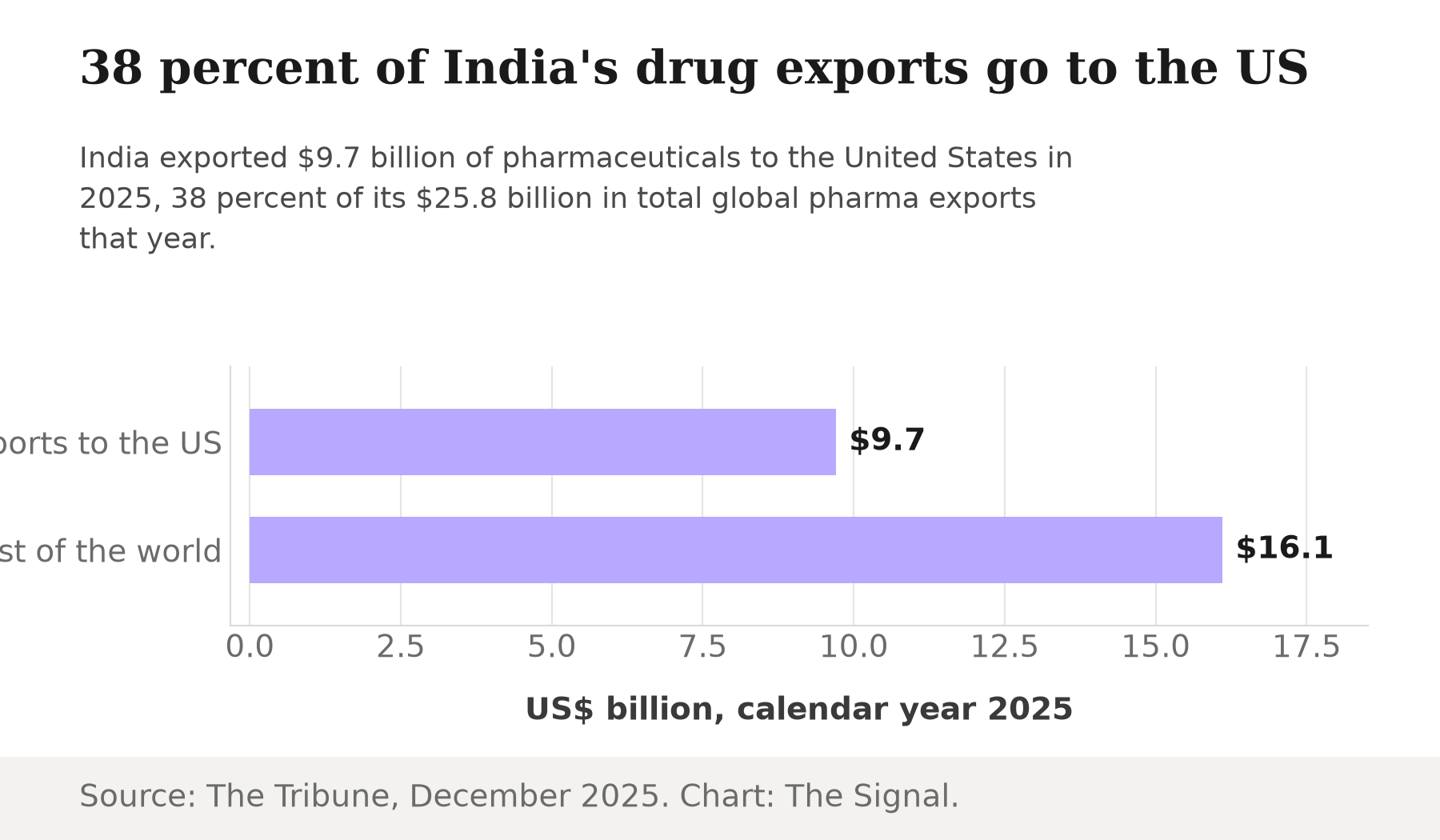
Put the two data points together. America is the largest external buyer of an industry that already fills 40 percent of its own generic-drug shelves. That looks less like a supply chain being tariffed into extinction inside three years, and more like one being reshaped carefully, so the pharmacy counter does not run short in the meantime.
The market priced the headline, not the mechanics
None of that stopped Indian pharma stocks from selling off the day after the announcement.
Indian pharma stocks fell hard on the announcement, even though the new duty carries a three-year delay.
| Stock or index | Move on July 22, 2026 |
|---|---|
| Lupin | -4.32 percent |
| Aurobindo Pharma | -4.13 percent |
| BSE Healthcare index | -978 points, to 50,464 |
Source: Business Today.
The names that fell hardest are not a random sample. Among the largest Indian generic makers, US exports account for 46.16 percent of Aurobindo Pharma's FY26 sales, 43.85 percent of Zydus Lifesciences' revenue, 41.04 percent of Lupin's revenue from North America, and 30.26 percent of Sun Pharma's revenue. That is why those are the tickers moving on a tariff that does not bite for two years. The market is not reacting to India's pharma exports in the abstract; it is repricing the specific companies with the most US-dependent revenue base.
The sell-off makes sense as a reaction to headline risk. A 200 percent tariff is the kind of number that forces every India-exposed pharma desk to mark a scenario down, whatever the actual timeline attached to it. It makes less sense as a reaction to near-term earnings: the duty does not apply to a single shipment for at least two years, and does not reach its full 200 percent severity until August 2029. Markets are supposed to discount future cash flows. This cash flow might not exist for three years, and could still be renegotiated, waived, or reshaped by two more US election cycles before it bites. Discounting that is a different exercise from pricing an immediate cost increase.
The honest objection
The strongest case for taking the sell-off at face value is that three years is not actually a long runway for a pharmaceutical company. Retooling manufacturing, qualifying new facilities with the FDA, and rewriting supply agreements are multi-year projects even when a company starts immediately, and the 100 percent tariff arriving in August 2028 is a real deadline, not a hypothetical one. On that view, the market was not overreacting to a distant risk. It was correctly pricing in that Indian manufacturers now have a hard, dated reason to start relocating production, or renegotiating margins with US distributors, starting now rather than in 2028.
That case holds for the companies most exposed to a full relocation. It does not explain why the destination is 200 percent, phased over three years, rather than an immediate, lower duty that would have forced faster action while still respecting due process. A government that opened its Section 232 investigation into pharmaceutical imports in April 2025 and then chose in April 2026 to exempt generics from its first pharma tariff "at this time" has had fifteen months to move faster than it has. The length of the runway is itself information about how replaceable the administration believes India's generics supply actually is.
The Signal
Washington has now put a number on how long it believes it can wait before American healthcare needs another source for the roughly 40 percent of its generic drug supply that Indian manufacturers meet: three years, with two of them at zero tariff. That is either a genuine plan to rebuild domestic and allied generic manufacturing by 2029, or an acknowledgment that no such plan exists yet, and the deadline is leverage more than policy. Watch what happens between now and August 2028: if US and allied generic manufacturing capacity actually expands, the tariff will look like industrial policy that gave itself room to work. If the exemption keeps getting extended past that date, the runway will have been the real message all along, and 200 percent will have been theater aimed at a different audience. Either way, the figure worth tracking from here is not the tariff rate, but how much of that 40 percent share India still holds the week the exemption actually ends.
Reporting basis: the July 21, 2026 tariff schedule is per Trump's Truth Social announcement, as reported by Bloomberg's wire service and carried by The Spokesman-Review. The Section 232 investigation timeline is from the Commerce Department's Bureau of Industry and Security, and the April 2026 proclamation exempting generics "at this time" is from the White House's own published text. India's FY2024-25 pharmaceutical export figures are Government of India trade data, via All India Radio's Newsonair; the calendar-year 2025 US export share is per The Tribune's trade-data reporting. The 40 percent US and 25 percent Europe generic-demand shares are a 2020 peer-reviewed estimate from F1000Research, hosted on PubMed Central; the greater-than-90-percent share of all US prescriptions filled by generics is a peer-reviewed analysis of US pharmaceutical supply geography, also hosted on PubMed Central. The July 22, 2026 stock reaction is per Business Today's market reporting, and the FY26 company-level US revenue shares are from a separate Business Today report on the same announcement. The rest-of-world export total in the second chart is The Signal's calculation from The Tribune's reported figures.