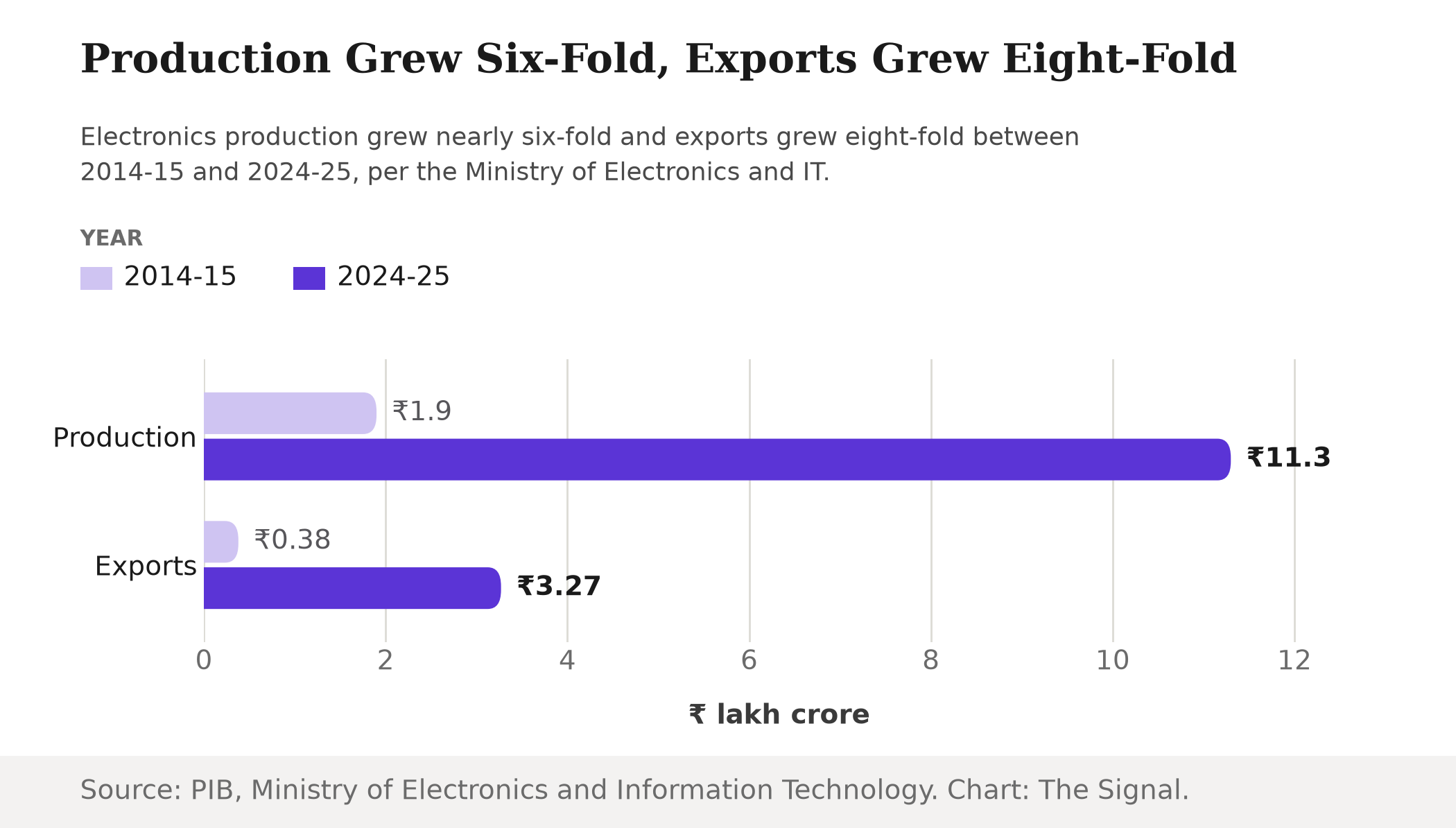
By April 2026, India's flagship electronics production scheme had done what government targets rarely do: beaten its own numbers. MeitY's written reply to the Lok Sabha, released via PIB, shows the Large Scale Electronics Manufacturing scheme had reached Rs 11.02 lakh crore in cumulative production, 136% of its target, and Rs 6.21 lakh crore in exports, 127% of target. Zoom out from that one scheme to the whole sector and the trend looks even sharper: electronics production grew nearly six-fold economy-wide, from Rs 1.9 lakh crore in 2014-15 to Rs 11.3 lakh crore in 2024-25, while exports grew eight-fold, from Rs 38,000 crore to Rs 3.27 lakh crore, over the same decade. Read only the top line, and Indian electronics manufacturing looks like a policy success story with the numbers to prove it.
It is worth slowing down on that. In the same written reply that logged the target-beating numbers, the ministry supplied a second figure that gets far less attention. Industry estimates put domestic value addition in electronics manufacturing at just 18% to 20%, as of April 2026. That is not a projection or an outside critique. It is the government's own answer, in the same document, to a narrower question than "how much did India make." It answers "how much of what India made did India actually add."
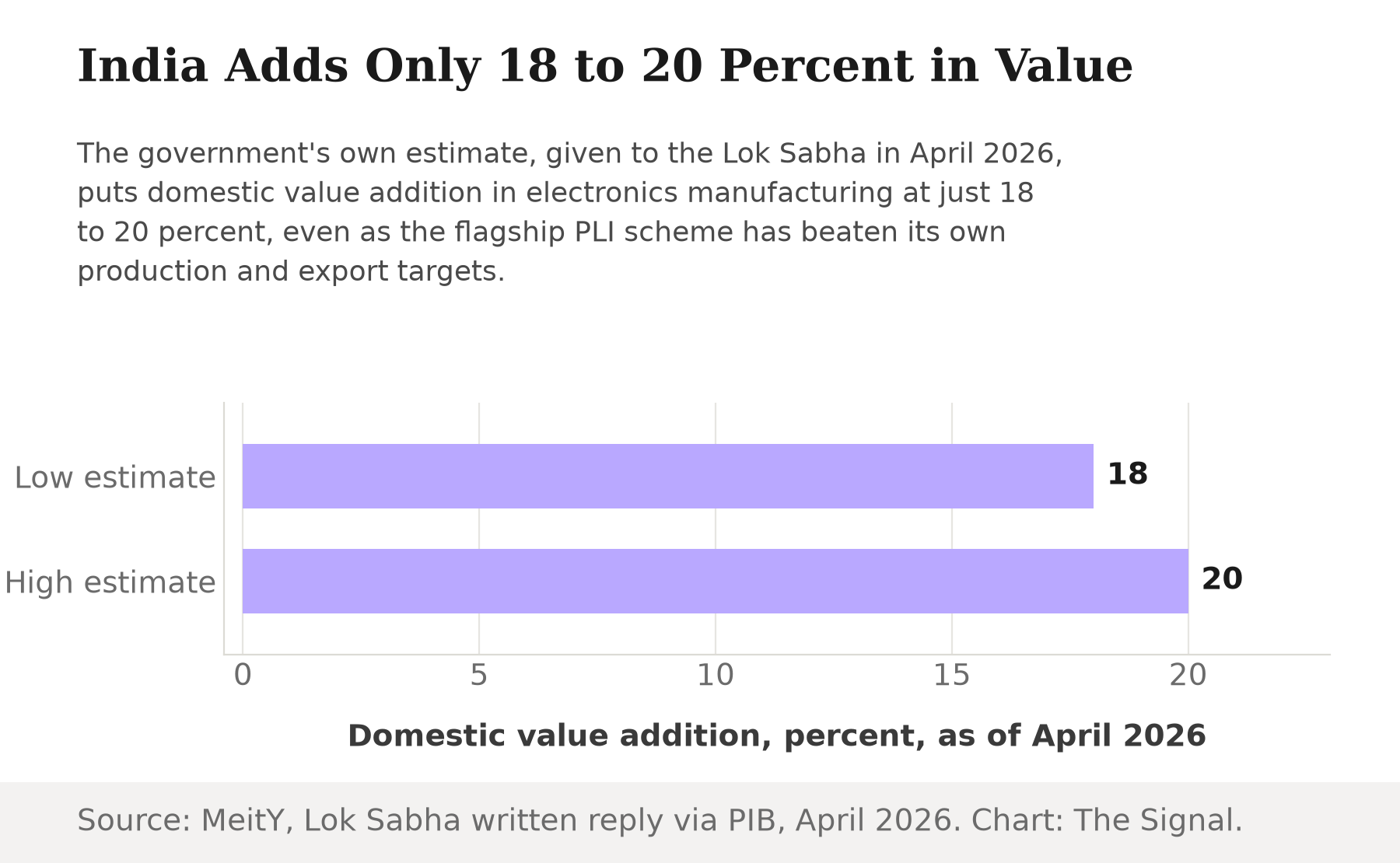
That range is not new, and it has barely moved. NITI Aayog's own report on India's electronics sector put the same domestic value-addition figure at 15% to 18% for FY2023-24, when the sector's production stood at $101 billion. Almost two years and a full parliamentary reply later, the range has crept up by a couple of points at most, to 18% to 20%, while production and exports kept climbing sharply over the same stretch. The scoreboard numbers move fast, while the value-addition number crawls.
Where the value doesn't sit
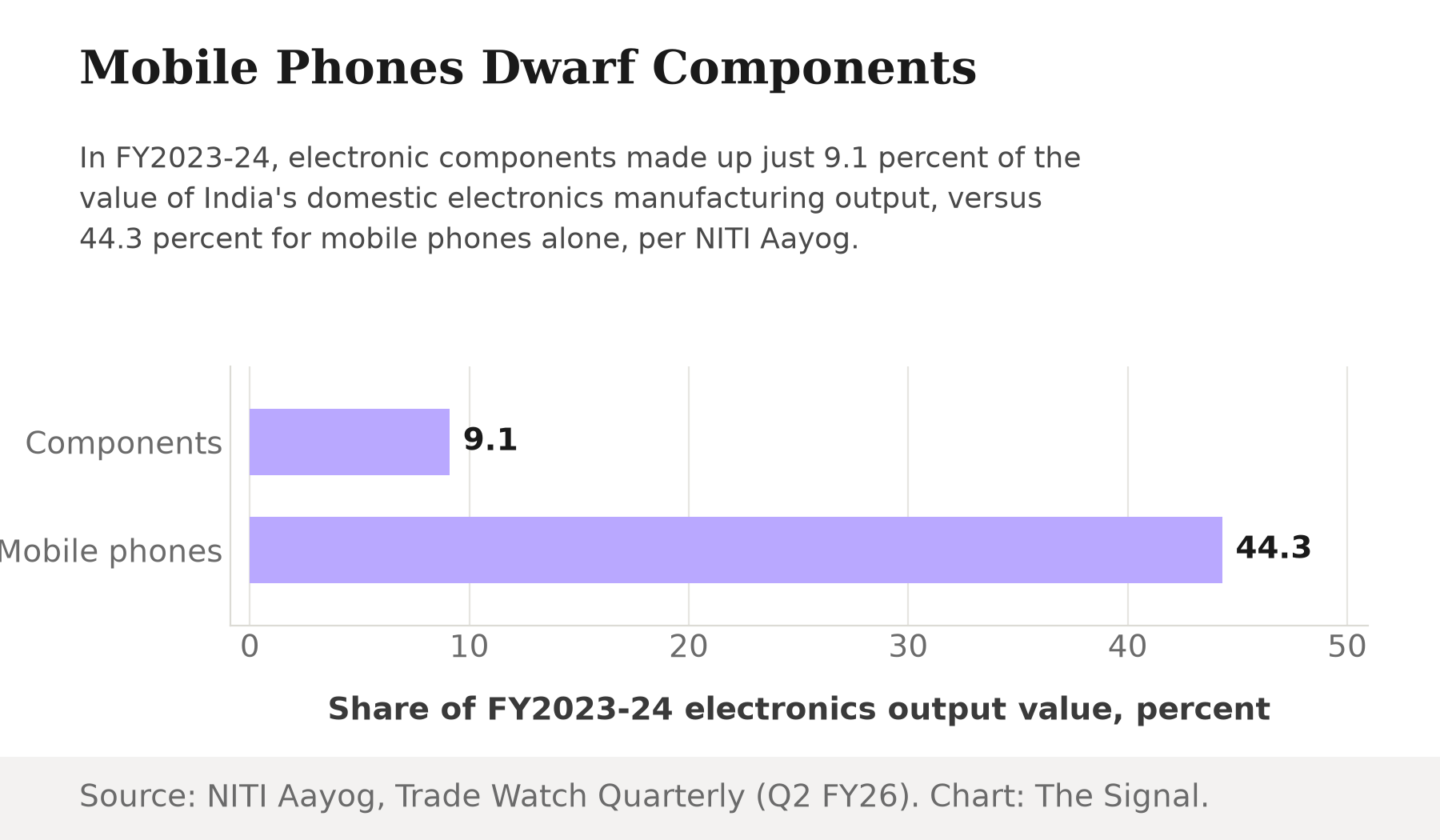
The gap between output and value added has a location, and it is not a mystery. In FY2023-24, electronic components made up just 9.1% ($10.5 billion) of the $115 billion value of India's domestic electronics manufacturing output, versus 44.3% ($51 billion) for mobile phones alone, according to NITI Aayog's Trade Watch Quarterly. Mobile assembly, not the components that go inside a phone or a circuit board, is what carries India's electronics output.
The same report puts a number on the other side of that ledger. In calendar year 2024, India's integrated-circuit imports reached $23.8 billion, the single largest item in the country's electronics import basket, a scale NITI Aayog reads as a sign of strong dependence on external suppliers for core components. NITI Aayog's own conclusion is that India's electronics strategy must transition from assembly-led gains to component-led manufacturing. India has scaled assembly. Chips, and the deeper component layer beneath them, are still what it buys.
The trade bill outgrew the value added
India's electronics import bill crossed $100 billion for the first time in FY2025-26, hitting a record $116.17 billion, up 17.76% from $98.65 billion in FY2024-25, against electronics exports of $48.0 billion, The Week reported, citing Ministry of Commerce and Industry data. Set the two numbers from FY2025-26 side by side and the gap between what India imported in electronics and what it exported comes to roughly $68 billion. That is the trade bill in the same fiscal year, FY2025-26, that the ministry's own scheme was posting 136% of its production target. A production number and an export number can both be true and rising, and the country can still be a far larger net buyer of electronics than the headline growth implies.
The fix leans on components, not chips
The government is putting far more new money into component assembly than into the chips underneath it.
| Programme | Fresh funding, FY2026-27 budget |
|---|---|
| Electronics Components Manufacturing Scheme (ECMS) | Rs 40,000 crore (up from Rs 22,919 crore at launch) |
| India Semiconductor Mission (ISM) 2.0 | Rs 1,000 crore |
Source: PIB, Ministry of Electronics and IT, on the ECMS outlay; PIB, Ministry of Electronics and IT, on ISM 2.0.
The Union Budget 2026-27 raised the ECMS outlay to Rs 40,000 crore, up from Rs 22,919 crore at launch, roughly 75% higher, and the ministry frames the scheme explicitly as support for India's shift from assembly-based manufacturing to high-value component manufacturing. The same budget also launched India Semiconductor Mission 2.0, the push into chip design, equipment and materials, with a fresh provision of just Rs 1,000 crore for FY2026-27. Even the more ambitious of the two programmes still points at the assembly layer, printed circuit boards and modules built around foreign-made silicon, rather than at the silicon itself.
That same lean shows up in what the first ECMS-funded plants are actually built to do. The first tranche of ECMS-approved plants, announced in October 2025, will meet only 20% of India's domestic demand for printed circuit boards and 15% of demand for camera modules, with 60% of their combined output slated for export, Union Minister Ashwini Vaishnaw said, per a PIB release from the Ministry of Electronics and IT.
The initial wave of new component plants is built to export, not to feed India's own supply chain.
| Component | Share of India's domestic demand met |
|---|---|
| Printed circuit boards | 20% |
| Camera modules | 15% |
| Copper clad laminate | 100% |
Source: PIB, Ministry of Electronics and IT, October 2025. The remaining 60% of the plants' combined output is slated for export.
The honest objection
The strongest case for patience is sequencing. Component manufacturing at the PCB and camera-module level often scales through export orders before it can compete for a domestic market that has spent a decade sourcing cheaply from established Asian suppliers; building anchor customers abroad is a normal way to reach the cost structure a domestic buyer would accept. On that view, the roughly 75% jump in ECMS funding is exactly the kind of scaling a young component industry needs before it can turn inward, and 60% of first-tranche output going abroad is a ramp, not a leak.
That case holds up reasonably well for PCBs and camera modules, which are closer to commodity manufacturing and can plausibly bootstrap on export orders. Chips have their own version of the patience argument: India Semiconductor Mission 1.0, approved by the Union Cabinet in December 2021, carries a Rs 76,000 crore incentive framework, and by December 2025 it had already helped land 10 approved projects worth a combined Rs 1.60 lakh crore in investment across six states, more than double the mission's own outlay, and on a multi-year view a larger chip commitment than this year's fresh money for components. But that Rs 76,000 crore was mostly sanctioned in years past. What's new in this budget is India Semiconductor Mission 2.0's fresh Rs 1,000 crore, next to the Rs 40,000 crore now earmarked for components, and that gap is not a rounding error inside a components strategy so much as a signal of where the new money is actually going, and that is not the layer that produced the $23.8 billion chip-import bill in the first place.
The Signal
India's electronics story has, for a decade, been told in the units the ministry counts best: rupees produced, rupees exported, percent of target beaten. On that scoreboard the sector is winning comfortably. The government's own value-addition estimate is the number that the scoreboard leaves out, and it says that something closer to a fifth of what the industry makes is actually made, in the economic sense, in India. Watch three things from here: whether the next parliamentary reply moves that 18% to 20% range at all, whether the ECMS plants that come online after the first tranche start meeting more than a fifth of India's own component demand, and whether India Semiconductor Mission 2.0's token first allocation grows in the next budget instead of shrinking further behind components funding. Assembly can be scaled with a subsidy line and a shipping manifest. Value addition has to be built, layer by layer, and the ministry's own number for that still reads one-fifth.
Reporting basis: the decade-long production and export growth figures are from a Press Information Bureau release from the Ministry of Electronics and Information Technology. The LSEM scheme's target-beating performance and the 18% to 20% domestic value-addition estimate are from MeitY's written reply to the Lok Sabha, released via PIB. The raised Electronics Components Manufacturing Scheme outlay is from a separate PIB release on the Union Budget 2026-27, and the India Semiconductor Mission 2.0 provision is from a further PIB release on the same budget. The first ECMS tranche's domestic-demand coverage is from a PIB release quoting Union Minister Ashwini Vaishnaw. The chip-import figure and the components' share of domestic electronics output value are from NITI Aayog's Trade Watch Quarterly. The record FY2025-26 electronics import bill is as reported by The Week, citing Ministry of Commerce and Industry data. The FY2023-24 domestic value-addition baseline of 15% to 18% is from a PIB release on NITI Aayog's report on India's electronics sector and global value chains. India Semiconductor Mission 1.0's Rs 76,000 crore incentive framework and its approved-project tally as of December 2025 are from a PIB Backgrounder on India Semiconductor Mission 2.0. The trade gap between that import bill and electronics exports, and the percentage increase in the ECMS outlay, are The Signal's calculations from those figures.