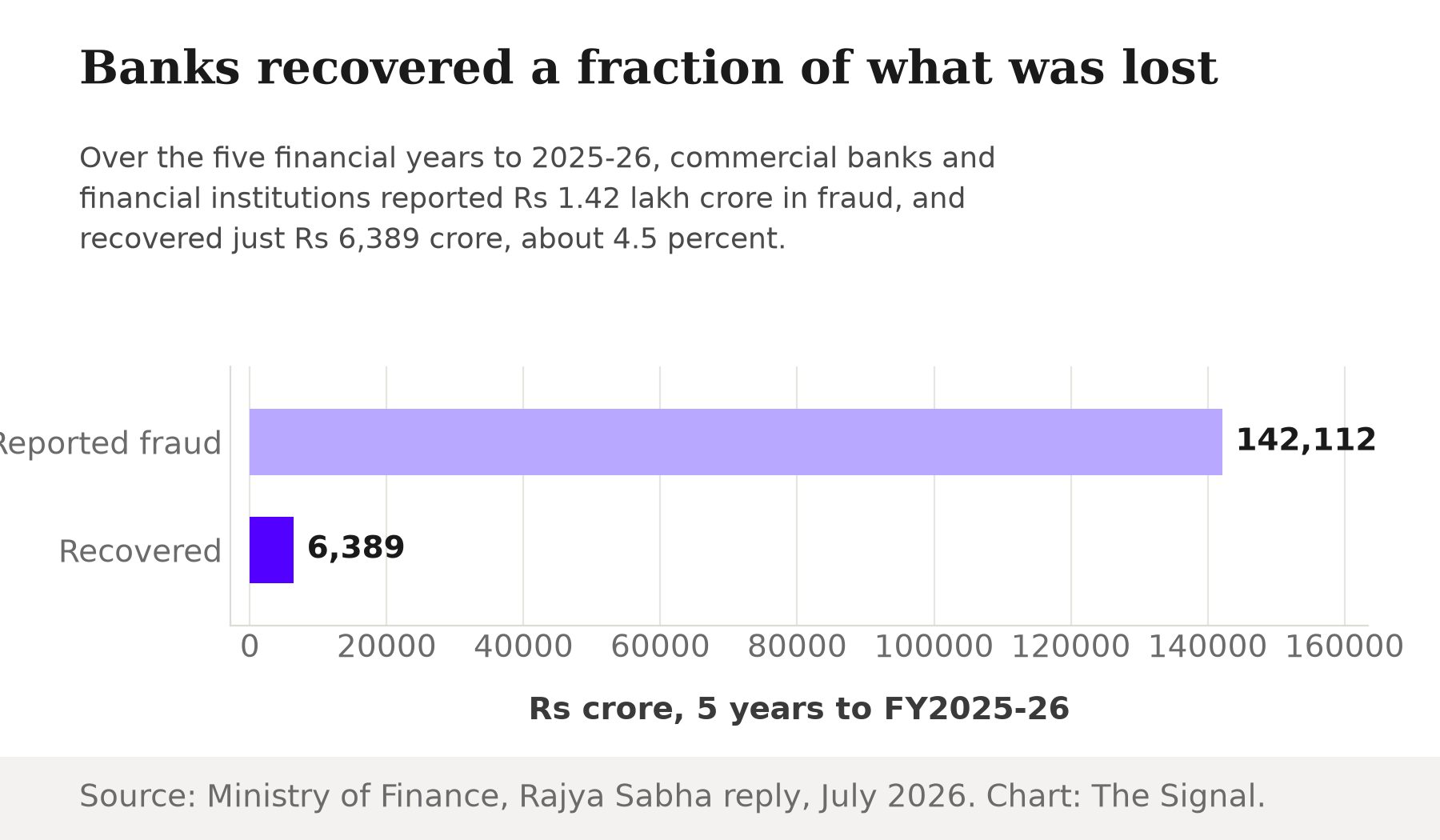
On July 21, 2026, the Ministry of Finance told the Rajya Sabha that commercial banks and financial institutions reported an aggregate Rs 1,42,112 crore, about Rs 1.42 lakh crore, in fraud over the last five financial years. In the same reply, recoveries in those fraud accounts stood at just Rs 6,389 crore over the same five years, a recovery rate of about 4.5 percent. The easy version of this story writes itself: India's banking system is close to giving up on getting fraud money back.
It is worth slowing down on that number. Two things sit underneath the Rs 1.42 lakh crore headline that change what it means. One is timing: how much of that five-year total is new fraud versus a single year's accounting catch-up. The other is the recovery comparison itself: fraud money and an ordinary bad loan are not the same problem, and treating their recovery rates as comparable flatters neither.
A third of the five-year total landed in one year
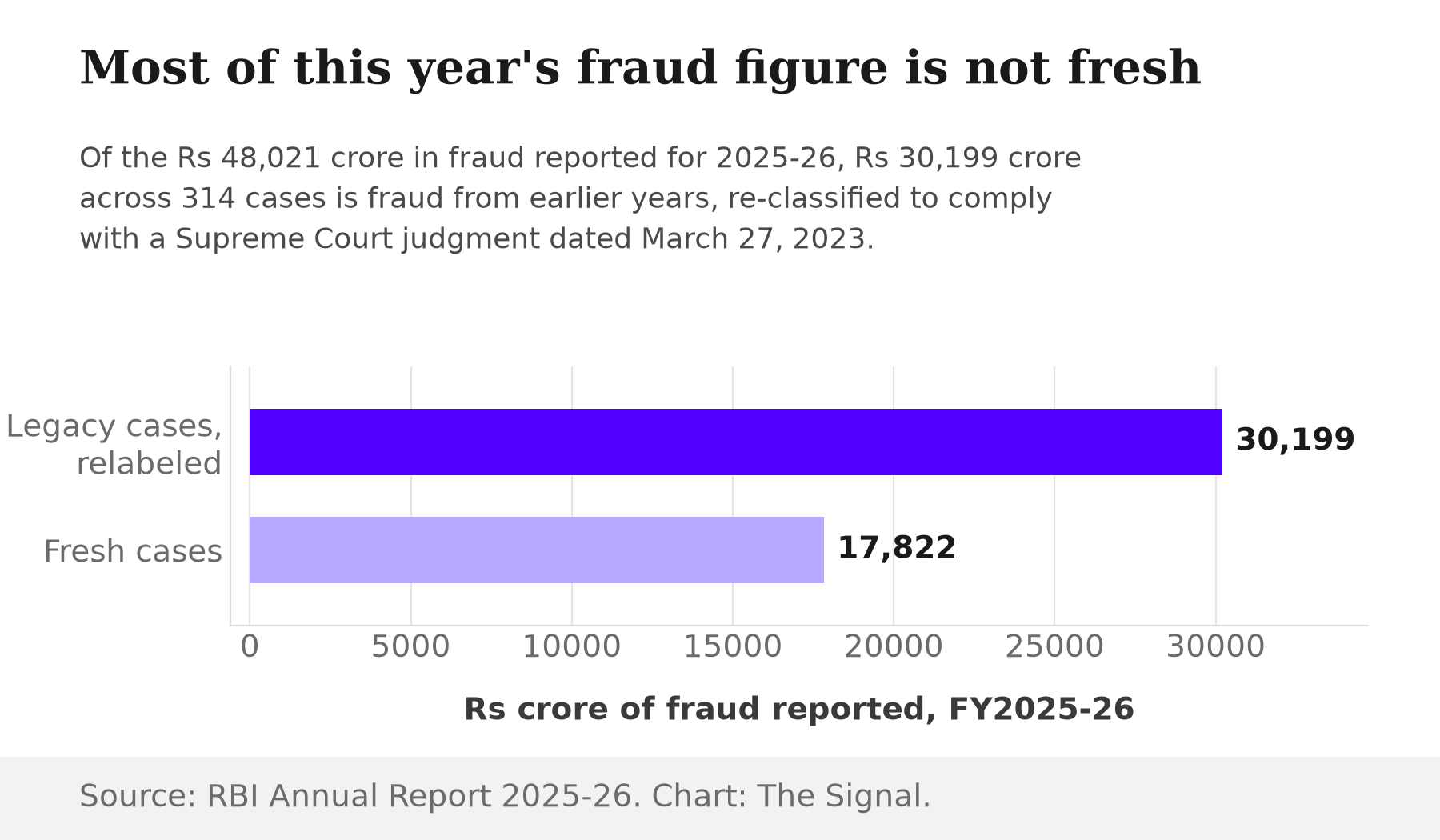
The RBI's Annual Report for 2025-26 shows banks reported Rs 48,021 crore in fraud in that year alone, nearly a third of the Rs 1.42 lakh crore reported over the entire five years. Most of that single year's number was not new fraud. Rs 30,199 crore of it, across 314 cases, was fraud from earlier years that banks re-classified only in 2025-26, to comply with a Supreme Court judgment dated March 27, 2023.
Most of this year's reported fraud is old cases relabeled to catch up on paperwork, not new losses.
Strip the relabeled cases out and fresh fraud reported in 2025-26 falls to roughly Rs 17,822 crore (our calculation: Rs 48,021 crore minus the Rs 30,199 crore of re-classified legacy cases). Put differently, close to a fifth of the government's five-year Rs 1.42 lakh crore headline is not fraud newly surfacing. It is older fraud finally getting the paperwork a compliance order required.
The losses concentrate at public sector banks
In 2025-26, public sector banks carried three quarters of the money but roughly half the case count.
| Bank type | Share of fraud cases, FY2025-26 | Share of fraud value, FY2025-26 |
|---|---|---|
| Public sector banks | 53.6% | 74.5% |
Source: RBI Annual Report 2025-26.
The same pattern held the year before. In 2024-25, private banks accounted for 59.3 percent of the number of frauds reported, while public sector banks accounted for 70.7 percent of the amount involved. Two years running, the case count skews toward private lenders and the rupee value skews toward public sector ones, which points to public sector banks losing fewer, bigger-ticket frauds rather than more of them.
A different kind of recovery problem
The government's reply also contains a separate, much larger recovery number that is easy to mistake for progress on the fraud figure. As of March 31, 2026, public sector banks had initiated SARFAESI Act recovery action in 10,894 cases and filed 7,173 FIRs against wilful defaulters, and recovered an aggregate Rs 52,360 crore from wilful defaulters by that date. Rs 52,360 crore looks like banks recovering plenty.
But wilful-defaulter recovery is a different bucket from the Rs 6,389 crore recovered specifically from fraud-classified accounts. It draws on SARFAESI seizures and asset sales against borrowers who simply refuse to pay, many of whom still run functioning businesses with plant, stock or property a bank can seize. Fraud accounts are a harder problem by construction, and the ordinary recovery machinery shows it. In 2024-25, banks recovered non-performing assets at a 31.5 percent rate through the SARFAESI Act and a 36.6 percent rate through the Insolvency and Bankruptcy Code, roughly seven to eight times the 4.5 percent recovered from fraud accounts over five years (our calculation, comparing the Rajya Sabha reply's five-year fraud recovery rate against the RBI's one-year SARFAESI and IBC rates; the periods differ, but the gap is far wider than a timing mismatch alone would produce).
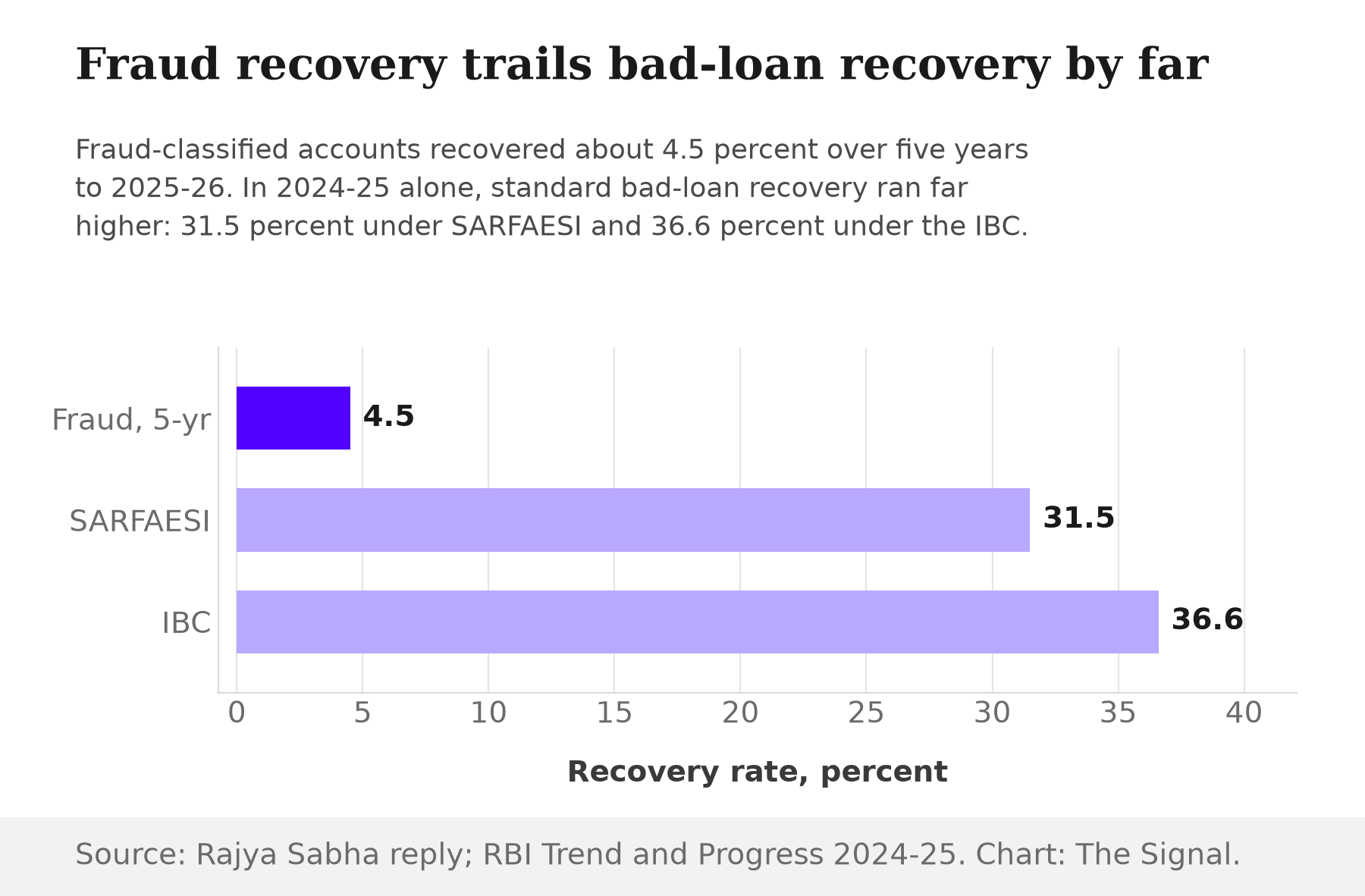
Money that a bank has formally classified as fraud does not behave like an ordinary bad loan. By the time an account earns that label, the underlying cash has typically been diverted or spent, not merely delayed, which is precisely what the standard recovery tools are built to handle.
The honest objection
The strongest case against reading 4.5 percent as a policy failure is that fraud accounts are self-selected for being hard to recover. By definition, they are loans where the money already went missing, often years before the fraud was detected and classified, so a lower recovery rate than an on-time bad loan is close to definitional. Some of the Rs 1.42 lakh crore reported over five years describes cases that were years, even decades, old before the paperwork caught up, which is exactly the pattern behind the FY2025-26 reclassification.
That case is real, but it does not explain a rate sitting seven to eight times below the very recovery benchmarks India's banking system posts on its other bad debt, in the same period the fraud figures cover. If self-selection alone drove the gap, fraud recovery would be low. It would not be close to a rounding error next to SARFAESI and IBC's own results.
The Signal
The Rs 1.42 lakh crore headline was built to alarm, and on the recovery rate alone, it should. But the number worth tracking from here is not this year's aggregate. It is the fresh-fraud figure once the Supreme Court-driven reclassification finishes clearing out of the data. If next year's RBI Annual Report shows the newly reported total settling back toward the run rate implied by this year's Rs 17,822 crore in fresh cases, the compliance catch-up explanation holds and the panic over the five-year number was misplaced. But if the fresh figure stays elevated instead, something else is driving fraud higher, and public sector banks, already carrying three quarters of the money, will carry more of it. Either way, a rupee stamped fraud is a rupee banks have all but written off. Recovering it looks nothing like recovering an ordinary loan, and no amount of SARFAESI cases against wilful defaulters changes that math.
Reporting basis: the five-year fraud and recovery totals, the aggregate wilful-defaulter recovery figure, and the SARFAESI/FIR case counts are all from the Ministry of Finance's written reply to the Rajya Sabha on July 21, 2026, as reported respectively by ANI, Deccan Chronicle, News9 Live and Daily Pioneer, all citing the same parliamentary reply. The FY2025-26 fraud total, its public-sector-bank share, and the legacy reclassification tied to the Supreme Court's March 2023 judgment are from the RBI's Annual Report 2025-26. The FY2024-25 public and private bank fraud split and the SARFAESI and IBC recovery rates are from the RBI's Report on Trend and Progress of Banking in India 2024-25. The share of the five-year total attributable to a single year, the fresh-fraud residual for 2025-26, and the multiple between the fraud recovery rate and the SARFAESI and IBC recovery rates are The Signal's calculations from those figures.