The pitch, as it is being reported, is straightforward. India's aviation ministry is weighing whether to let airport operators own and run airlines, relaxing a rule that currently caps operators of major airports, including Delhi and Mumbai, at no more than a 10 percent stake in any airline. The case for doing it writes itself: India's domestic skies are dominated by two carriers. IndiGo's market share climbed to 66.3 percent in June 2026, up from 64.9 percent in May, while Air India Group's fell to 23.9 percent from 25.6 percent. Together, the two now hold 90.2 percent of the market. Bring in well-capitalised infrastructure conglomerates as new airline owners, the thinking goes, and the duopoly finally gets a real challenger.
IndiGo and Air India Group now control 90.2 percent of India's domestic market between them.
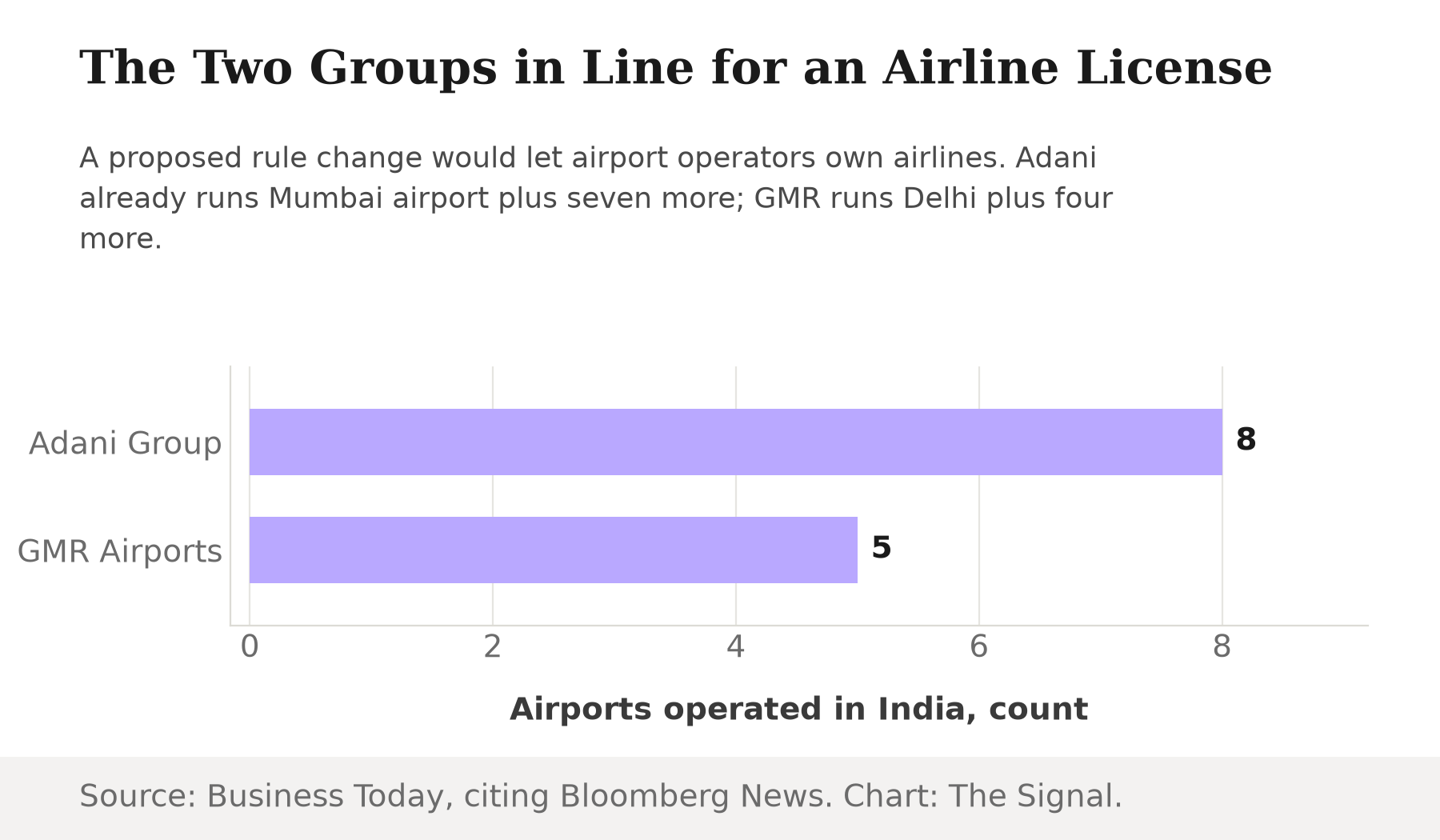
It is worth slowing down on that framing. The two companies best positioned to become India's newest airline owners are not outsiders to the industry. They are its landlords. Adani Group runs Mumbai airport plus seven others, eight in total. GMR Airports manages Delhi airport plus four more, five in total. Together, they are the two conglomerates that would become eligible to launch airlines if the ownership cap is eased. Every airline flying out of Delhi or Mumbai already answers to one of these two companies for its gates, its slots and its ground infrastructure. The reform would let them stop being just the landlord and start being a competitor too.
The fee every airline already pays
Strip the policy debate down to a single number and it is this one: 775. That is the rupee figure, per departing domestic passenger, that AERA's tariff order sets as the User Development Fee at Ahmedabad airport, payable to Ahmedabad International Airport Limited, Adani's operating subsidiary there, for FY2025-26. Every airline serving that airport, IndiGo, Air India, Akasa, SpiceJet, anyone else, hands that fee to an Adani-run entity on every domestic passenger who leaves through it. Adani does not need to own an airline to extract revenue from its rivals. It already regulates, at the level of a government-approved tariff, what its rivals pay it to operate.
That is the mechanism the airline-ownership proposal would layer a second role on top of. Today, Adani and GMR set fees and control access nominally as neutral infrastructure operators, for every carrier using their airports. If either launches its own airline, it would be setting terms for its own competitors while also flying against them, at the same gates, under the same slot allocations, that it controls.
The market the reform is meant to fix
The stated target of the reform is the duopoly, and the numbers back up why it looks urgent. The smaller carriers the policy is pitched as helping have not been closing the gap. Akasa Air's market share rose to 6.4 percent in June 2026 from 5.8 percent in May, while SpiceJet's fell to 1.9 percent from 2.5 percent. Akasa gained; SpiceJet, already the smallest of the four, lost nearly a quarter of what little share it had.
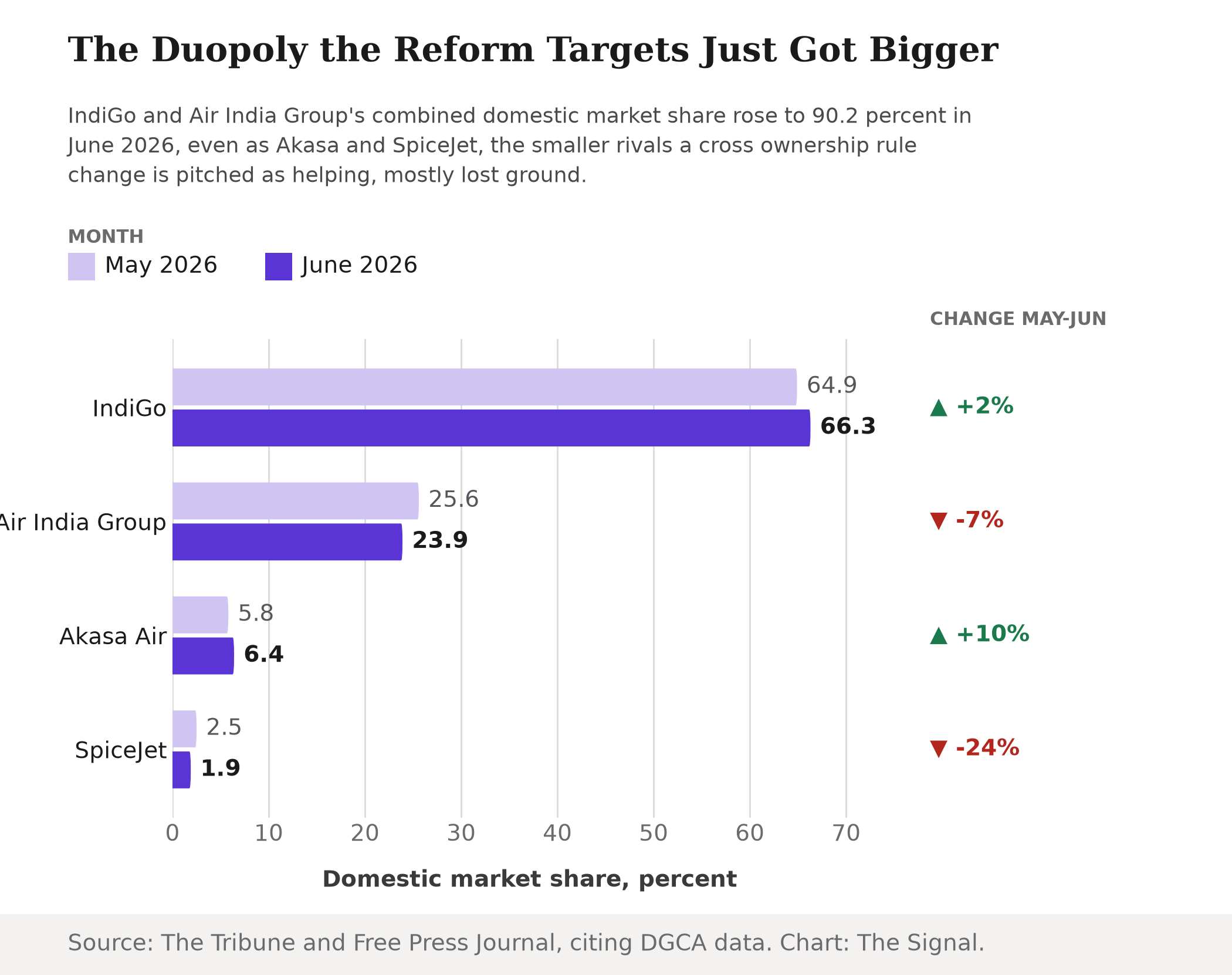
This is not a market short on traffic. Indian domestic aviation carried a record 5,38,429 passengers in a single day on November 23, 2025, across 3,356 flights, the highest single-day total in the country's history, per the Ministry of Civil Aviation. Demand is not the constraint. Structure is: two carriers hold nine in every ten domestic seats sold, and the two smaller incumbents trying to chip away at that have moved by fractions of a point in either direction month to month.
The two companies already positioned to win
If the cap is eased, the eligible entrants are not a wide field. They are the two firms already named in the reporting on the proposal, Adani and GMR, which between them already run 13 airports in India, roughly one in every twelve of the country's airports. India's civil aviation minister told the Lok Sabha in December 2025 that the country's airport network had grown to 160 airports, up from 74 in 2014.
Both companies describe far larger portfolios on their own terms. As of March 2026, Adani Airport Holdings' own portfolio page states it operates eight airports, accounting for 25 percent of India's passenger footfalls and 33 percent of the country's air cargo traffic. As of the same period, GMR Airports' own portfolio page states it runs nine airport assets, handling more than 135 million passengers a year, a 27.5 percent share of India's passenger traffic.
| Operator | Airports/assets (self-reported) | Share of India's air traffic | Cargo share |
|---|---|---|---|
| Adani Airport Holdings | 8 | 25% of passenger footfalls | 33% |
| GMR Airports | 9 | 27.5% of passenger traffic | not stated |
Each figure is the company's own reported total, as of March 2026, not necessarily counted on an identical basis. Source: Adani Group; GMR Group.
A rule change built to loosen concentration in the airline market would hand a new airline license to two companies that, on the passenger and cargo figures above, already sit astride a meaningful share of the infrastructure the entire market depends on to fly at all.
The honest objection
The strongest case for the reform is that the 10 percent cap on airport-operator ownership has not obviously worked. It has kept two entrenched incumbents unchallenged for years while doing nothing to stop IndiGo and Air India Group from tightening their grip to 90.2 percent. Akasa and SpiceJet, the carriers without airport backing, have not been able to dent that on their own. Adani and GMR bring capital, existing infrastructure knowledge and balance sheets that could genuinely fund a serious third force in a way small independent entrants have not managed. On that view, the conflict-of-interest risk is a manageable regulatory problem, not a reason to keep the market exactly as concentrated as it is today.
That case is real, but it understates what an airport operator already controls. A capital-rich outsider with no stake in the airports it flies from is a different kind of new entrant than an airport operator that already sets the AERA-approved fee schedule its own future rivals pay. Akasa and SpiceJet's slow, fractional gains in May and June 2026 happened while the airports they use were run by companies with no airline of their own to protect. That neutrality, however imperfect, is the thing the reform would remove for exactly the two entrants best capitalised to exploit its absence.
The Signal
The reform is being sold as a fix for a two-airline market. What it would actually do, on the numbers, is hand a license to enter that market to the two companies that already set the physical terms every existing airline, including the two the policy is meant to check, has to operate under. IndiGo and Air India Group have the scale to negotiate around a landlord that is also a rival. Akasa, SpiceJet and any future entrant do not. Watch what the final rule does with slot allocation and fee-setting oversight once an airport operator also owns a carrier: if that oversight moves to an independent regulator, the conflict is contained. If it stays with the operator itself, the fix for one duopoly will have quietly built the foundation for another.
Reporting basis: domestic market-share figures for IndiGo, Air India Group, Akasa Air and SpiceJet are per DGCA data as reported by The Tribune and Free Press Journal. The 10 percent airport-operator ownership cap and the airport counts naming Adani and GMR as the eligible entrants are per Free Press Journal and Business Today's report of a Bloomberg News story, respectively. Adani Airport Holdings' and GMR Airports' portfolio statistics are each company's own self-reported figures from its investor-facing portfolio page. The Ahmedabad airport User Development Fee is from AERA's own tariff order. The single-day domestic passenger record is from the Ministry of Civil Aviation's Year End Review, via the Press Information Bureau. The 90.2 percent combined IndiGo and Air India Group share is The Signal's calculation from the DGCA figures above.