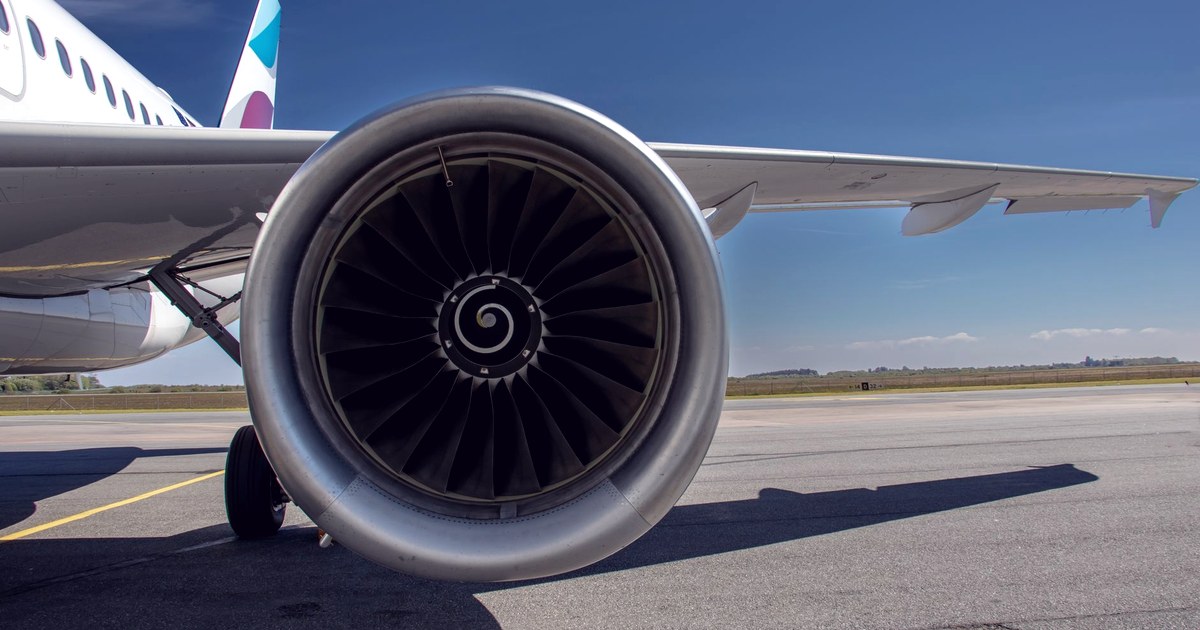
On 20 July 2026, IndiGo signed an MoU with CFM International for more than 1,000 LEAP-1A engines to power 510 Airbus A320neo family aircraft, a deal GE Aerospace's newsroom announced as the largest single order ever placed for LEAP engines and a record for CFM International itself. Read as a headline number, the story writes itself: India's largest airline, whose domestic market share rose to 65 percent in April 2026 from 63.3 percent in March, per DGCA data, is growing fast enough to hand out the biggest engine order any airline has ever given CFM.
It is worth slowing down on that framing. In the same window this record order became public, IndiGo's own earnings disclosures showed more than 40 of its aircraft grounded (AOG) because of Pratt & Whitney GTF engine issues, out of a 441-plane fleet at the end of FY26 in March 2026. Set against that backdrop, an order this size, placed entirely with Pratt & Whitney's rival, reads less like a growth flex and more like an airline moving as much of its future fleet as it can toward the supplier that isn't currently causing it pain.
Every one of the more than 1,000 new engines in this order comes from CFM, not Pratt & Whitney.
| Metric | Figure |
|---|---|
| LEAP-1A engines ordered | 1,000+ |
| A320neo family aircraft to be powered | 510 |
| Record status | Largest single LEAP order ever; a CFM International record |
| India's rank among CFM's global markets | 3rd largest |
| Indian carriers flying LEAP-powered jets | 5 |
| LEAP-powered aircraft already flying in India | 400+ |
| LEAP engines already on order across India | 2,000+ |
| IndiGo's CFM-powered aircraft already in service | 375+ |
| IndiGo a CFM customer since | 2016 |
Source: GE Aerospace; The Free Press Journal; CAPA, Centre for Aviation.
An order for planes it already had
IndiGo was not short of new airplanes to fill with engines. As of April 2024, the last public breakdown of the airline's Airbus order book, its outstanding orders already stood at almost 1,000 A320 Family aircraft plus 30 firm A350-900 widebodies, with purchase rights for 70 more. That figure is more than two years old by the time this MoU was signed, and IndiGo's backlog has moved since. But the mechanism it illustrates has not: airframe and engine are sold separately in this business. Airbus builds the A320neo to fly on either CFM's LEAP-1A or Pratt & Whitney's PW1100G, and an airline can pick, or repick, the engine maker for aircraft it has already ordered. This MoU is not proof IndiGo bought 510 new planes this month. It is proof of which engine the planes it was largely already getting will fly with.
The supplier IndiGo is leaning away from
Pratt & Whitney's problem is not a mystery, and it is not IndiGo's alone. RTX, Pratt & Whitney's parent, said in its own Q1 2026 results that a rare condition in powder metal used to manufacture certain engine parts required accelerated removals and inspections of a significant portion of the PW1100G-JM GTF fleet. For IndiGo specifically, that meant aircraft-on-ground counts in the 40s as of its March 2026 year end, a number the airline expected to fall into the 30s by the end of the year.
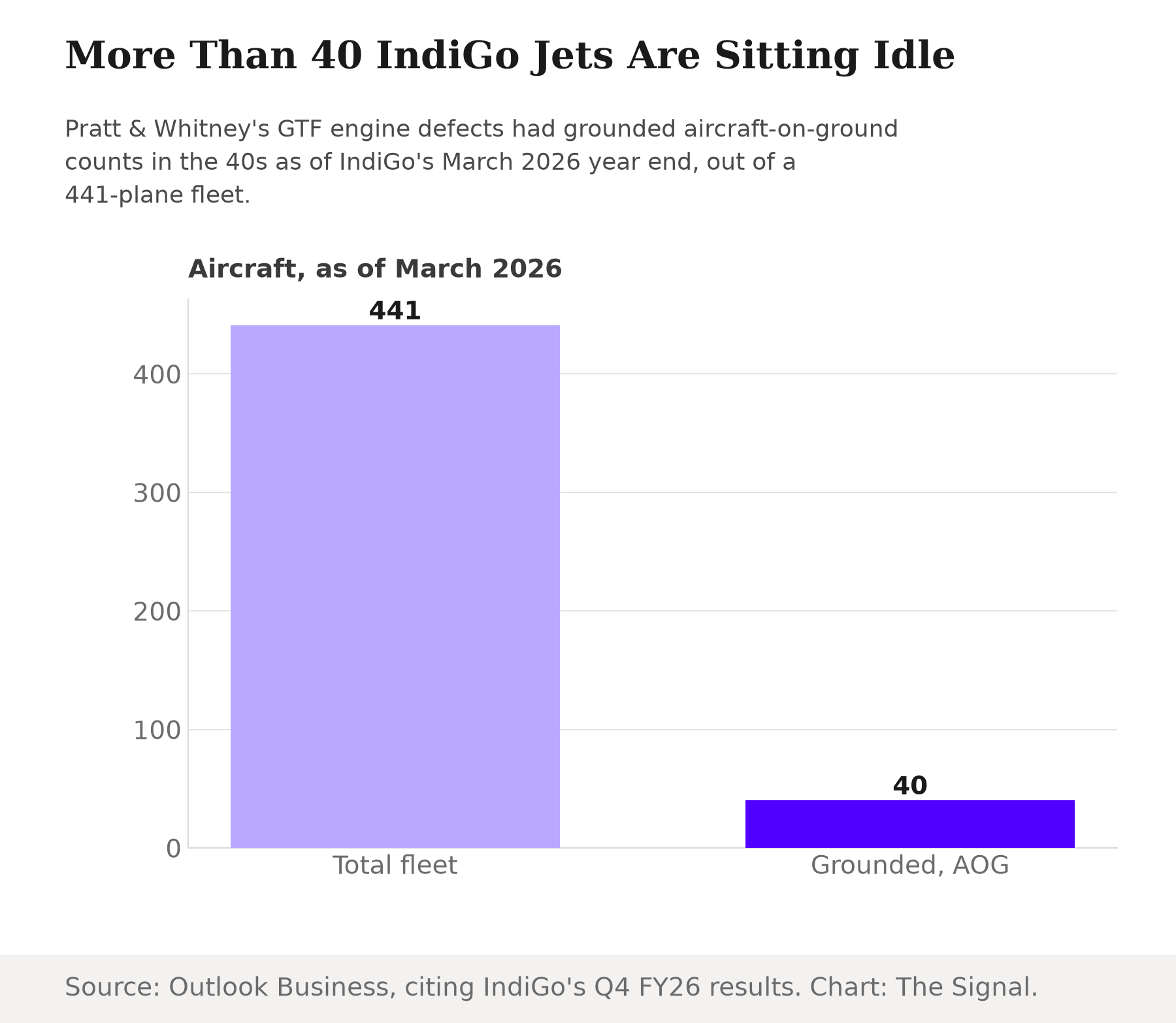
Source: Outlook Business, citing IndiGo's Q4 FY26 results. Chart: The Signal.
To be fair to Pratt & Whitney, the picture was already improving. RTX's own Q1 2026 earnings commentary shows PW1100G aircraft-on-ground levels declining about 15 percent from year-end 2025 through the first quarter of 2026, on the back of 23 percent year-over-year growth in MRO output. Whichever supplier IndiGo picks for new deliveries, the jets already grounded are not coming back faster because of a CFM order signed in July 2026. That order is about the next fleet, not the current one.
Concentration, not diversification
The instinct is to call a move away from a troubled supplier "diversification." IndiGo's numbers say the opposite. CFM has been IndiGo's engine partner since 2016, and its CFM-powered aircraft already exceeded 375 of the airline's fleet before this MoU was even signed.
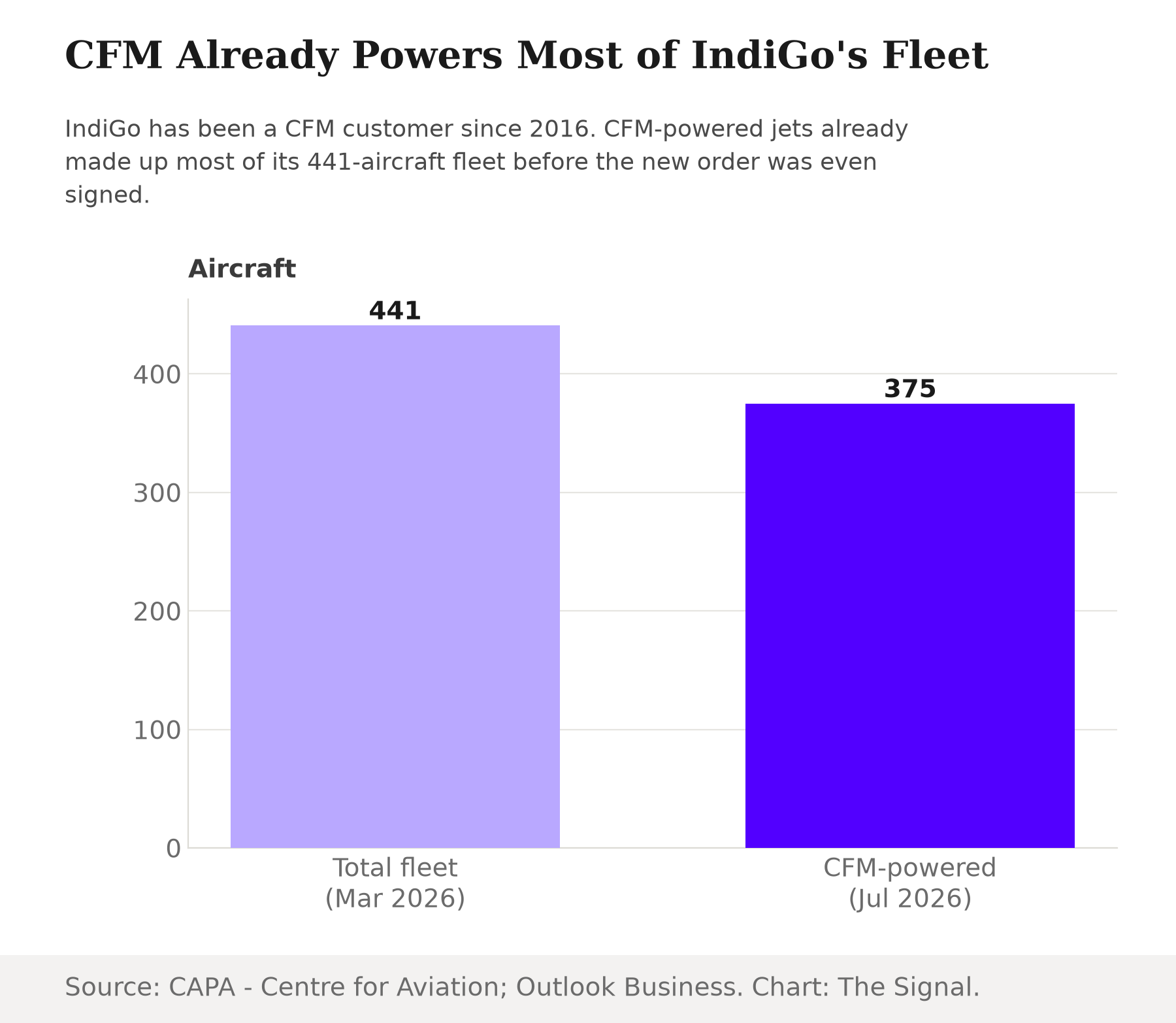
Source: CAPA, Centre for Aviation; Outlook Business. Chart: The Signal.
CFM was already the majority supplier inside IndiGo's fleet. A new order that is exclusively CFM does not spread IndiGo's engine risk across two makers; it commits an even larger share of the airline's future narrow-body fleet to one of them. That is a rational response to Pratt & Whitney's current record. It bets on the supplier performing better today, and it does nothing to reduce IndiGo's exposure to a single manufacturer.
Why IndiGo can afford the bet
IndiGo can make that bet because its market position gives it room. Even through the worst of the grounding crisis, its share of India's domestic air travel kept rising, to 65 percent in April 2026 from 63.3 percent the month before.
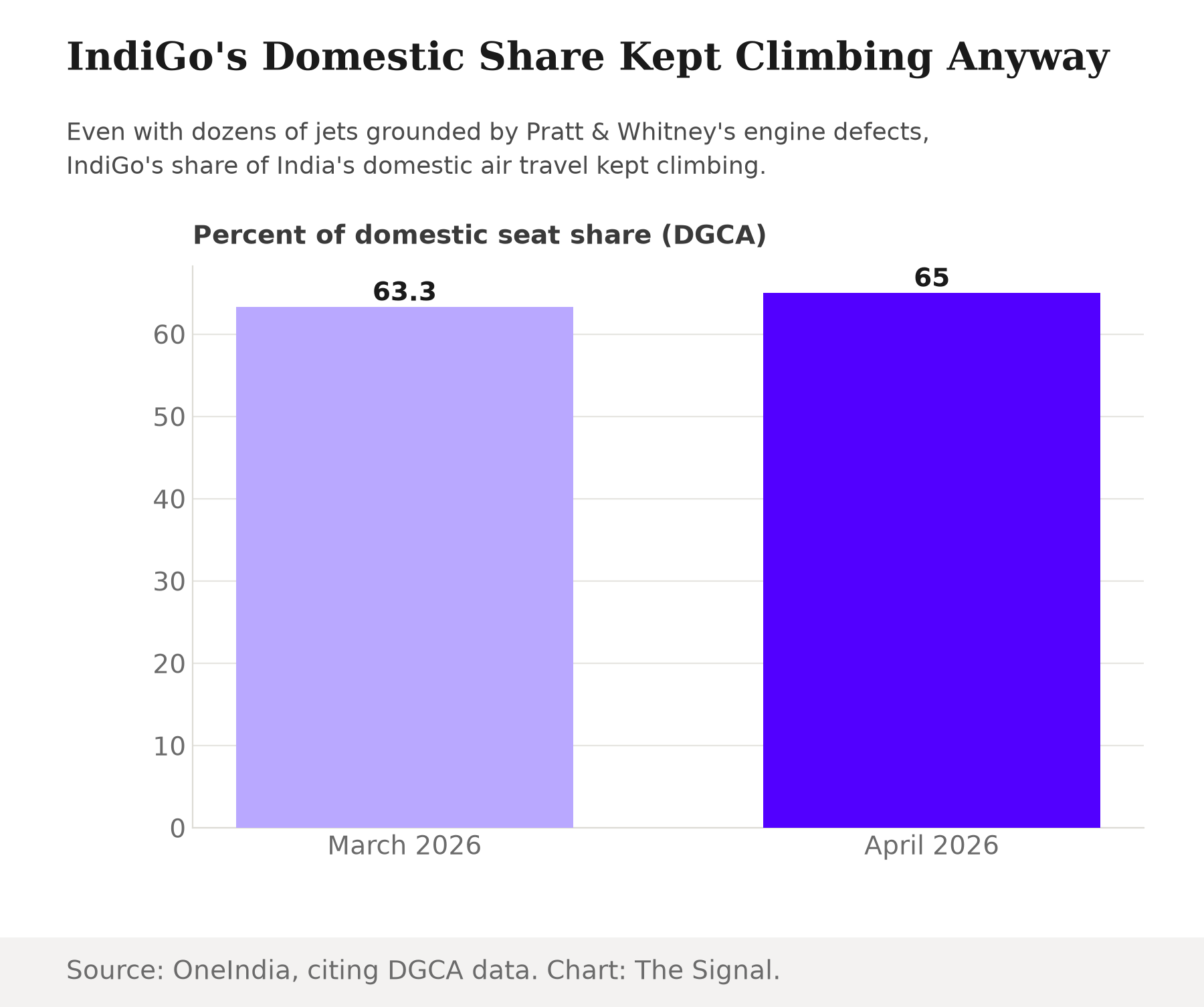
Source: OneIndia, citing DGCA data. Chart: The Signal.
No rival is positioned to punish a supplier bet gone wrong the way a weaker incumbent would be. That headroom is what lets IndiGo make a large, concentrated engine commitment rather than a hedged, split one.
The honest objection
The strongest case against reading any of this as a reaction to Pratt & Whitney is that engine commonality has operational value that has nothing to do with reliability scares. A single engine family across most of a fleet simplifies maintenance schedules, pilot and technician training, and spare-parts pooling, which is why IndiGo has stuck with CFM since 2016 rather than splitting its fleet evenly. The rest of India's market has made the same choice: five Indian carriers already fly more than 400 LEAP-powered aircraft between them, with over 2,000 LEAP engines on order even before this MoU, making India CFM's third-largest market worldwide. CFM's own record is not spotless, either: it has spent the past year building more than 1,200 high-pressure turbine durability kits and fitting a reverse-bleed fix to nearly half the LEAP-1A fleet since a December 2024 certification. None of that required grounding aircraft the way Pratt & Whitney's powder-metal defect has. And the commonality logic is not unique to IndiGo: Akasa Air, a much newer Indian carrier with no GTF-grounding problem of its own to escape, ordered more than 300 CFM LEAP-1B engines in January 2024 to power 150 Boeing 737 MAX aircraft. On this view, IndiGo is not fleeing Pratt & Whitney out of fear. It is simply continuing the commonality logic that governs how most single-aisle operators pick an engine family, and would have ordered heavily from CFM whatever Pratt & Whitney's engines were doing.
That case would be more convincing if the timing said nothing. IndiGo signed this MoU in the same stretch of 2026 that its own results disclosed dozens of grounded jets from the rival engine, and three months after RTX's own Q1 2026 disclosure detailed accelerated removals and inspections across a significant portion of the very engine family IndiGo also operates. Commonality explains why an airline settles on one engine family. That leaves the timing unexplained: an airline already skewed toward that family placed its single largest order ever with it at the exact moment the alternative is under a fleet-wide inspection order.
The Signal
IndiGo has not diversified away from single-supplier risk. It has re-concentrated on the supplier currently working better, which is a rational bet given Pratt & Whitney's own recovery numbers, but still a bet on one manufacturer's execution for a fleet that now carries 65 percent of India's domestic air travel. Watch the sequencing from here: Pratt & Whitney's AOG count is already declining, and CFM has its own delivery math to solve first: it delivered 520 LEAP engines in the first quarter of 2026, 63 percent more than a year earlier, and is guiding to only about 15 percent further growth in full-year deliveries, a pace that will take years to work through 1,000-plus more engines. If Pratt & Whitney keeps improving faster than CFM can deliver on a backlog this size, the jets IndiGo is trying to move away from could end up the more dependable half of its fleet before the new engines arrive. The number to watch next is not the size of this MoU. It is how many aircraft are still grounded on the day it converts into a firm order.
Reporting basis: the MoU's terms and CFM's own characterisation of it as a record order are from GE Aerospace's newsroom, the primary party to the deal. India's standing as CFM's third-largest market and the installed LEAP base across Indian carriers are as reported by The Free Press Journal. IndiGo's CFM relationship and current CFM-powered fleet size are per CAPA, Centre for Aviation, quoting IndiGo. IndiGo's total fleet size and its Pratt & Whitney AOG count are per Outlook Business's account of IndiGo's own Q4 FY26 earnings commentary. IndiGo's domestic market share is DGCA data as reported by OneIndia. Pratt & Whitney's powder-metal issue and its fleet-wide scope are from RTX's own Q1 2026 results disclosure, the primary source for that fact. The pace of Pratt & Whitney's AOG recovery is from RTX's Q1 2026 earnings commentary as summarised by TIKR. IndiGo's pre-MoU Airbus order book is as reported by afm.aero and is dated April 2024, the latest public breakdown available; it is presented as historical context, not a current figure. CFM's Q1 2026 delivery pace and full-year delivery guidance are from Safran's own results release, the primary source for that fact. CFM's LEAP-1A durability-kit rollout is CFM International's own statement, as reported by CompositesWorld and dated November 2025. Akasa Air's 2024 CFM engine order is as reported by Times of Oman and is presented as historical context for the industry pattern, not a current figure.