On 20 July 2026, the government told the Lok Sabha, in a written reply, that nearly 55.49 crore users had been onboarded on the Unified Payments Interface platform as of June 2026. Domestic UPI processed 24,161.69 crore transactions worth Rs 314.23 lakh crore in the 2025-26 financial year, as reported by the Press Information Bureau. In the same reply, the government confirmed that UPI services have gone live across 12 international partnerships spanning person-to-merchant and person-to-person payments, as of June 2026, reported the Free Press Journal. Read as a single announcement, it is a clean story: the world's largest real-time payments network, now exported to a dozen countries, still adding tens of crores of users at home. A soft-power win riding a domestic success story.
It is worth slowing down on that framing. The domestic user count and the 12-country reach are two different achievements, and only one of them says anything about money actually crossing India's borders on UPI rails. The other describes where the app has been switched on, not what it is moving.
Cross-border UPI's rupee value is still under Rs 300 crore a year, next to a domestic system that moves crore multiples of that every day.
Cross-border UPI transactions grew from just 37,060 payments worth Rs 19.7 crore in FY24 to over 755,000 payments worth Rs 258.53 crore in FY25, reports Business Standard, citing NPCI data. A further 601,000 payments worth Rs 169.29 crore followed in just the first four months of FY26, through July 2025. That is real, fast growth off a near-zero base. It is also, in absolute rupee terms, a fraction of a fraction of what the same network moves inside India.
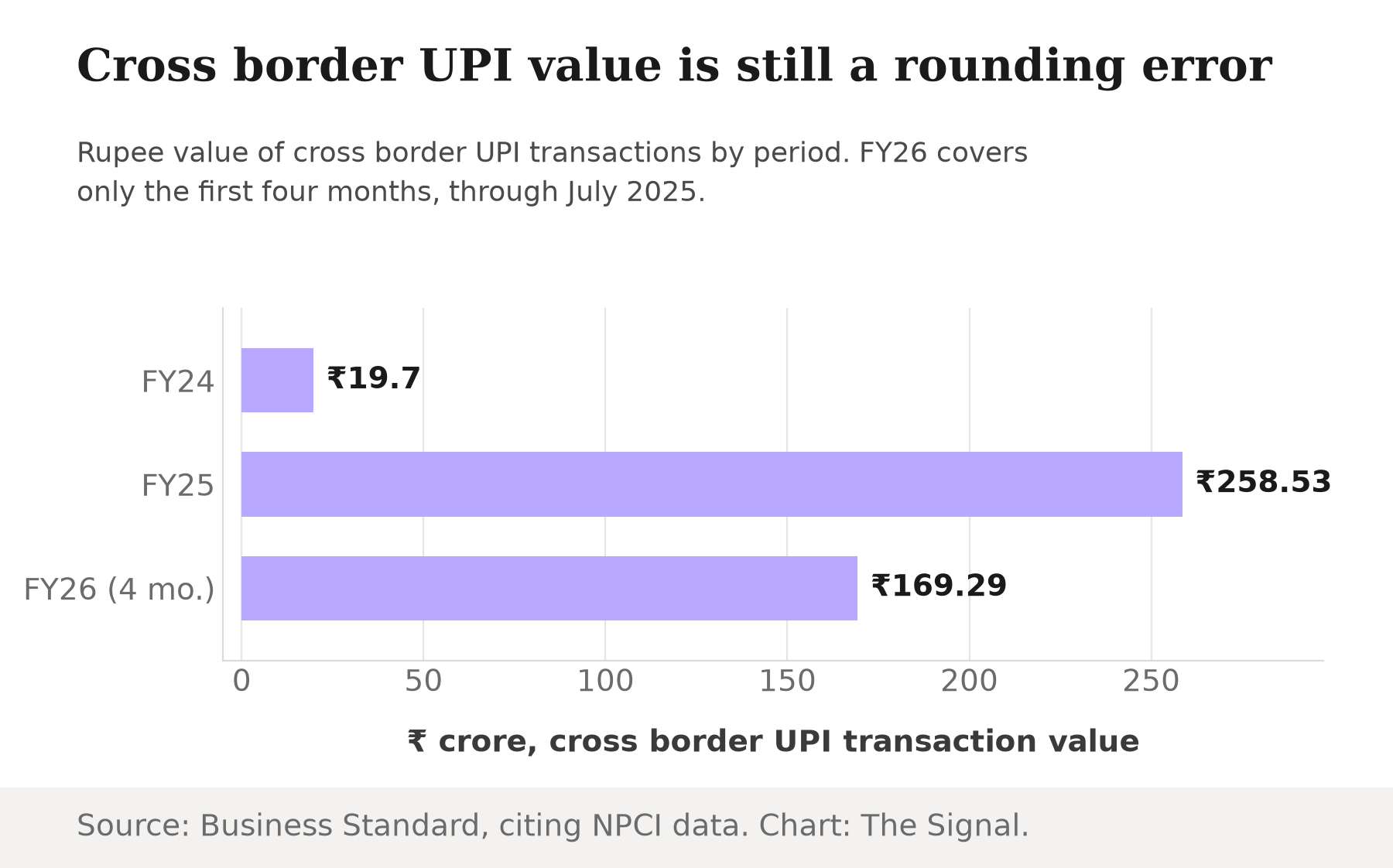
Source: Business Standard, citing NPCI data. Chart: The Signal.
The scale gap in one table
Put the government's own domestic figures next to NPCI's cross-border figures and the gap is not subtle.
| Metric | Domestic UPI (FY 2025-26; user count as of June 2026) | Cross-border UPI (FY25) |
|---|---|---|
| Onboarded users / country reach | 55.49 crore users | Live in 12 countries |
| Transaction volume | 24,161.69 crore transactions | Over 755,000 transactions |
| Transaction value | Rs 314.23 lakh crore | Rs 258.53 crore |
Source: Press Information Bureau and ANI, both citing the government's written reply to the Lok Sabha; Business Standard, citing NPCI data. The domestic transaction figures cover the full FY 2025-26; the user count is as of June 2026. The cross-border figures are for FY25, the last full year reported.
Rs 314.23 lakh crore is Rs 31,423,000 crore. Divided by the FY25 cross-border figure of Rs 258.53 crore, domestic UPI's value is more than 120,000 times its cross-border counterpart, our calculation from those two government and NPCI figures, and the two periods are not identical (one is a partial FY26 year, the other a full FY25), so treat it as an order of magnitude, not a precise multiple. Either way, the international rollout has not yet touched the volume that defines UPI at home.
Twelve countries in five years, most of it since 2025
The country count itself has a growth story worth separating from the money. UPI first went live abroad in Bhutan in July 2021, one country, and reached 12 by June 2026, per the same government reply. But most of that expansion is very recent: as of August 2025, UPI acceptance abroad had reached more than 1.5 million international merchants across seven countries (the UAE, Nepal, Bhutan, Singapore, Mauritius, France and Sri Lanka), reports the India Brand Equity Foundation, citing NPCI data. Five countries were added in the roughly ten months between that count and June 2026.
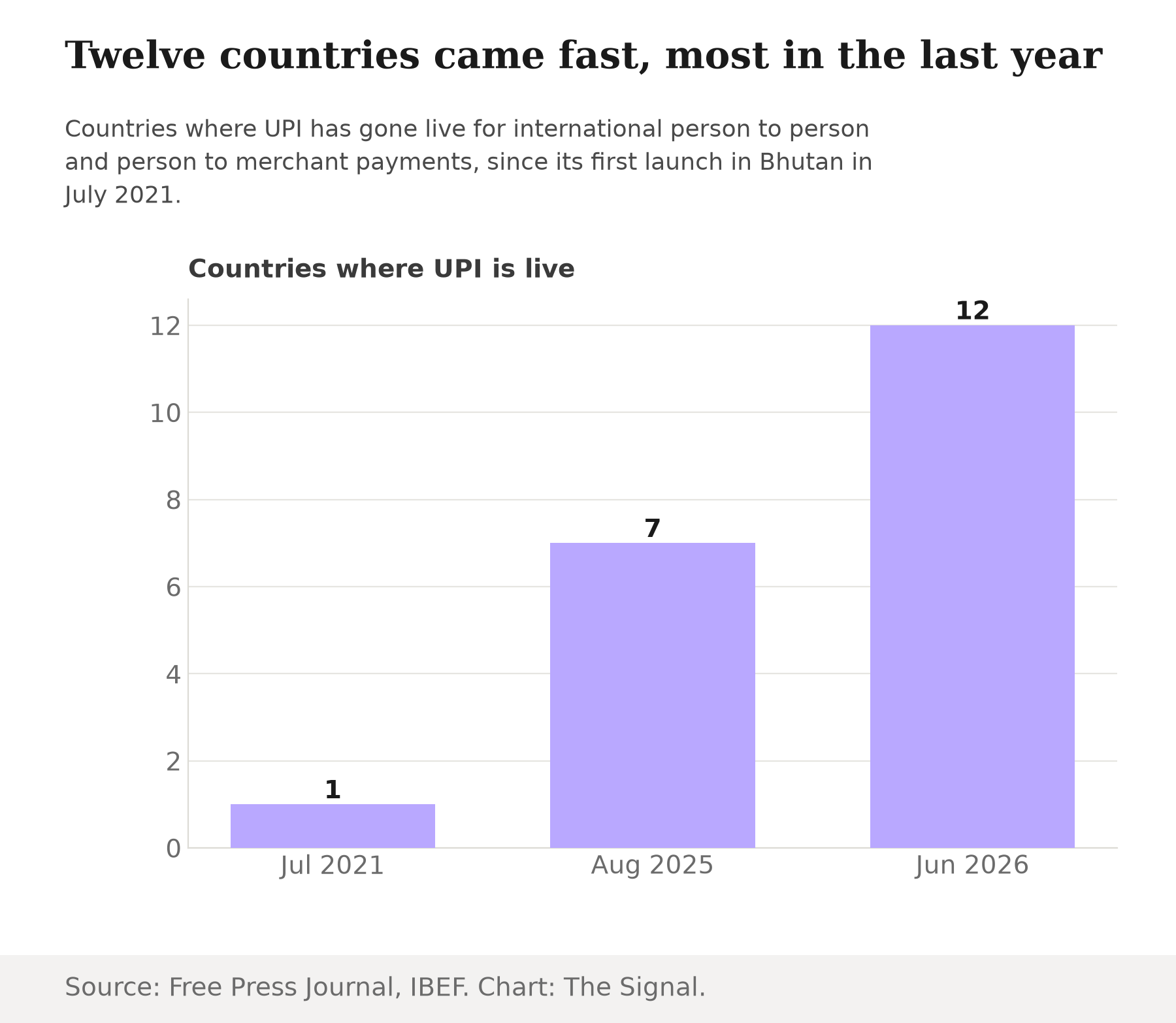
Source: Free Press Journal, citing the government's Lok Sabha reply, for the 2021 and 2026 counts; India Brand Equity Foundation, citing NPCI data, for the August 2025 count. Chart: The Signal.
The pace looks like a network scaling. But a country going "live" is a merchant acceptance switch, not proof of transaction flow, and the transaction data above shows that switch has not yet translated into rupee volume anywhere close to matching the count.
What "live in 12 countries" looks like on the ground
Two concrete cases show why the count and the money diverge. UPI is now accepted at the Eiffel Tower in Paris, with rollout also planned at Paris and Nice airports as of June 2026, reports MediaNama. That rollout is explicitly built for Indian tourists spending abroad, not for French shoppers adopting an Indian app at home. It expands where an Indian card or phone already works, without creating a new base of foreign users who transact on UPI.
The Singapore corridor shows the other constraint: regulatory caps on transaction size. When the PayNow-UPI real-time payments linkage between Singapore and India launched on 21 February 2023, transfers were capped at SGD 200 per transaction and SGD 500 per day, states the Monetary Authority of Singapore, with the per-transaction limit raised to SGD 1,000 only by 31 March 2023. A corridor built for small retail transfers between two of the world's most UPI- and PayNow-literate markets started, by design, too small to move meaningful value. Three years on, the FY25 cross-border total across all 12 countries combined is still Rs 258.53 crore.
None of this touches the channel that actually moves money for Indians abroad. Remittances by Indians working overseas hit a record $135.46 billion in FY 2024-25, a 14 percent increase year over year, reports Akashvani's newsonair.gov.in, citing RBI balance-of-payments data. That is the established, dollar-denominated channel diaspora Indians already use at scale. The Ministry of Finance's Economic Survey 2025-26 Statistical Appendix, citing RBI data, puts the FY25 average exchange rate at Rs 84.576 per US dollar. Converted at that rate, the $135.46 billion works out to roughly Rs 11.46 lakh crore: more than 4,400 times the FY25 cross-border UPI value of Rs 258.53 crore. On a same-currency basis, UPI's rupee-denominated cross-border corridors, still capped and still tiny in absolute terms, are nowhere close to competing with the remittance channel Indians already use at scale.
The honest objection
The strongest case against reading this as pure signaling is that five years is genuinely early for a payments network, and the growth rate is real: cross-border transactions rose from just 37,060 payments in FY24 to over 755,000 in FY25, more than 20-fold, and the live-country count nearly doubled in under a year, from seven in August 2025 to 12 by June 2026. Networks compound. And Singapore's own transfer cap rose from SGD 200 to SGD 1,000 per transaction within about five weeks of the corridor's launch, suggesting regulators loosen limits once a corridor proves itself safe.
That case explains the trajectory, not the current scale: a network effect argument justifies patience, but right now cross-border UPI's FY25 value remains a rounding error against a domestic system running Rs 314.23 lakh crore a year. Even the faster run-rate implied by the first four months of FY26, Rs 169.29 crore through July 2025, tells a similar story. Annualising that figure, our calculation, works out to roughly Rs 500 crore over a full year if the pace holds: still a rounding error next to the domestic number above. Fast growth off a tiny base and financial integration are not the same claim, and only one of them is confirmed by the numbers so far.
The Signal
The government's 12-country, 55.49-crore-user announcement is two real numbers bundled into one press narrative, and the bundling is doing work the underlying data does not support. The user count is a genuine domestic achievement. So is the country count: a diplomatic and merchant-acceptance achievement, most of it built in the last year and aimed at Indian travellers spending abroad rather than foreign consumers adopting UPI at home. Neither number yet describes a financial integration story, because the cross-border transaction value that would prove one is still under Rs 300 crore a year. Watch what regulators do to the transaction caps next, the way Singapore raised its limit within weeks of launch. If those ceilings rise across more corridors, the financial story starts to catch up with the diplomatic one. If they hold, "live in 12 countries" will keep meaning what it means today: a rail that is switched on, not a rail that is used.
Reporting basis: the domestic UPI user count and FY 2025-26 transaction figures come from the Minister of State for Finance's written reply to the Lok Sabha on 20 July 2026, as reported by the Press Information Bureau and separately relayed, with additional detail, by ANI. The 12-country count and the Bhutan launch date are from the same Lok Sabha reply, as reported by the Free Press Journal. Cross-border transaction volumes and values for FY24 through the first four months of FY26 are NPCI data, as reported by Business Standard. The seven-country, 1.5-million-merchant figure as of August 2025 is NPCI and NPCI International Payments Ltd data, via the India Brand Equity Foundation. The Eiffel Tower and Paris and Nice airport rollout is reported by MediaNama. The Singapore PayNow-UPI transaction caps are from the Monetary Authority of Singapore's own press release. Remittance figures are Reserve Bank of India balance-of-payments data, as reported by Akashvani's newsonair.gov.in. The FY25 average rupee-dollar exchange rate is Reserve Bank of India data, as published in the Ministry of Finance's Economic Survey 2025-26 Statistical Appendix. The domestic-to-cross-border value ratio, the rupee-converted remittance figure and multiple, and the FY26 annualised estimate are The Signal's calculations from the PIB, Business Standard, RBI/newsonair.gov.in and Economic Survey figures above.