On 18 July 2026, India's renewable energy ministry gave net-metering and open-access solar projects a fresh exemption from its domestic solar-cell sourcing rule, pushing the cutoff to 31 December 2026 from the earlier 31 May 2026 date. Read as a single memorandum, it looks like routine housekeeping, a compliance date nudged out by seven months. The underlying rule, that these projects buy Indian-made solar cells, stays on the books. Nothing, on its face, has changed.
It is worth slowing down on that reading. Less than two months earlier, on 25 May 2026, the same ministry had gone the other way: it confirmed that every net-metering and open-access renewable project commissioned on or after 1 June 2026 would have to source its cells from the approved domestic list, and it explicitly ruled out a blanket extension of that 1 June deadline. Enforcement began on schedule. Then, within two months of that start date, the ministry carved out precisely the category of projects it had just refused to spare, and gave it seven more months. A rule that survived a direct request for relief in May did not survive contact with its own start date in July.
The list the rule depends on had nine manufacturing lines when it launched.
That domestic list is where the trouble starts. When the ministry, MNRE, published the first version of ALMM List-II, the approved list of solar-cell manufacturers the mandate requires projects to buy from, it enlisted just nine manufacturing lines nationwide, including two Premier Energies plants in Telangana at a combined 1,925 MW. Those nine entries carried a combined 13,067 MW of enlisted capacity, meaning Premier Energies alone, across just two of the nine lines, held roughly 15 percent of the entire approved domestic cell base at launch. That list was less than a year old by the time the sourcing mandate took effect. A national procurement rule was resting on a supplier base that had existed, in its approved form, for under twelve months, and that was this concentrated.
The module engine outran the cell engine
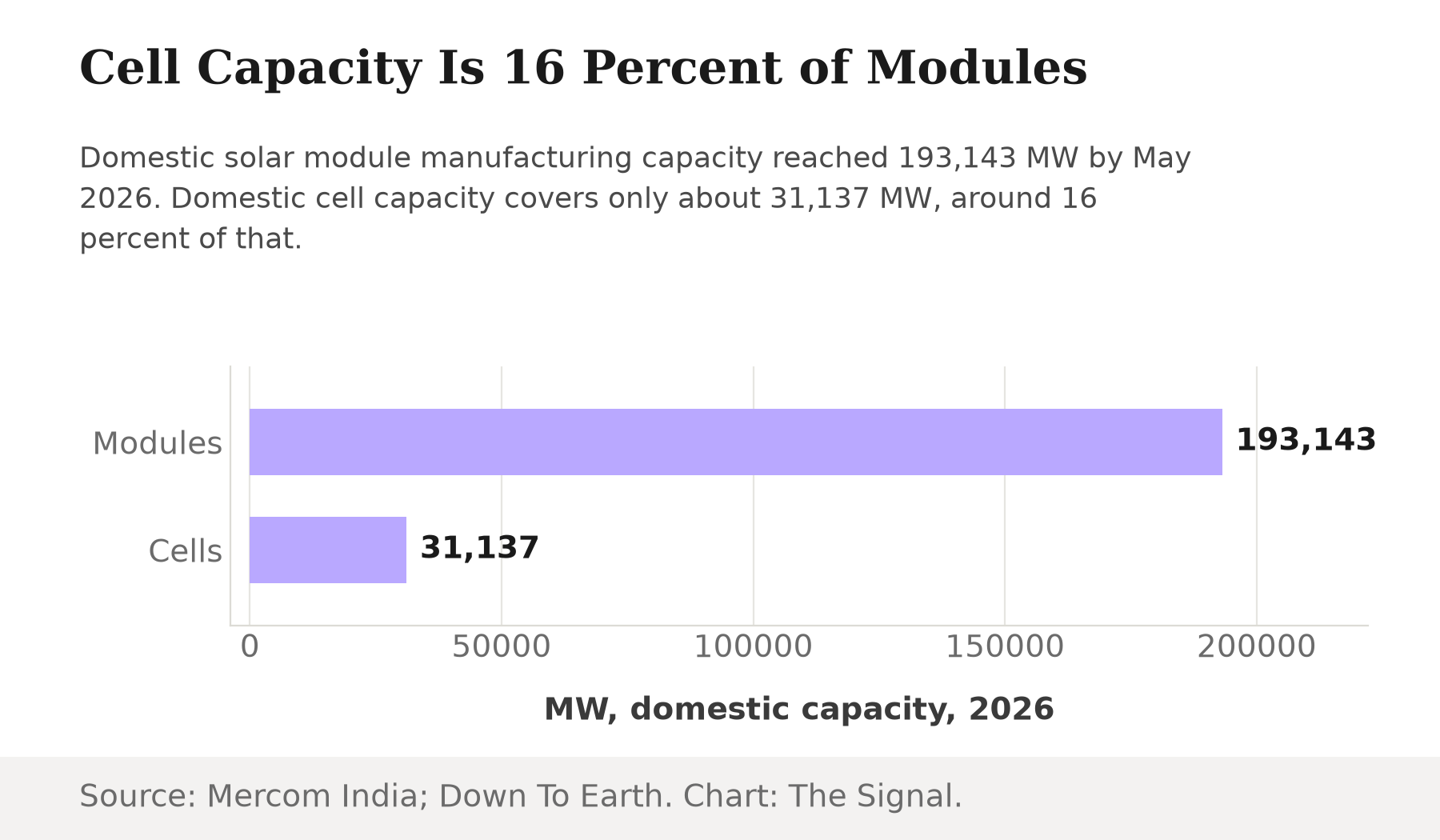
The mismatch shows up cleanly once you compare the two halves of the supply chain the mandate is supposed to link. India's solar module manufacturing capacity crossed 100 GW as a milestone on 13 August 2025, just two weeks after the cell list above was first published, and kept climbing from there. By early May 2026, enlisted module capacity had reached 193,143 MW. By early June 2026, domestic cell capacity covered only about 31,137 MW, around 16 percent of the module base it is meant to feed.
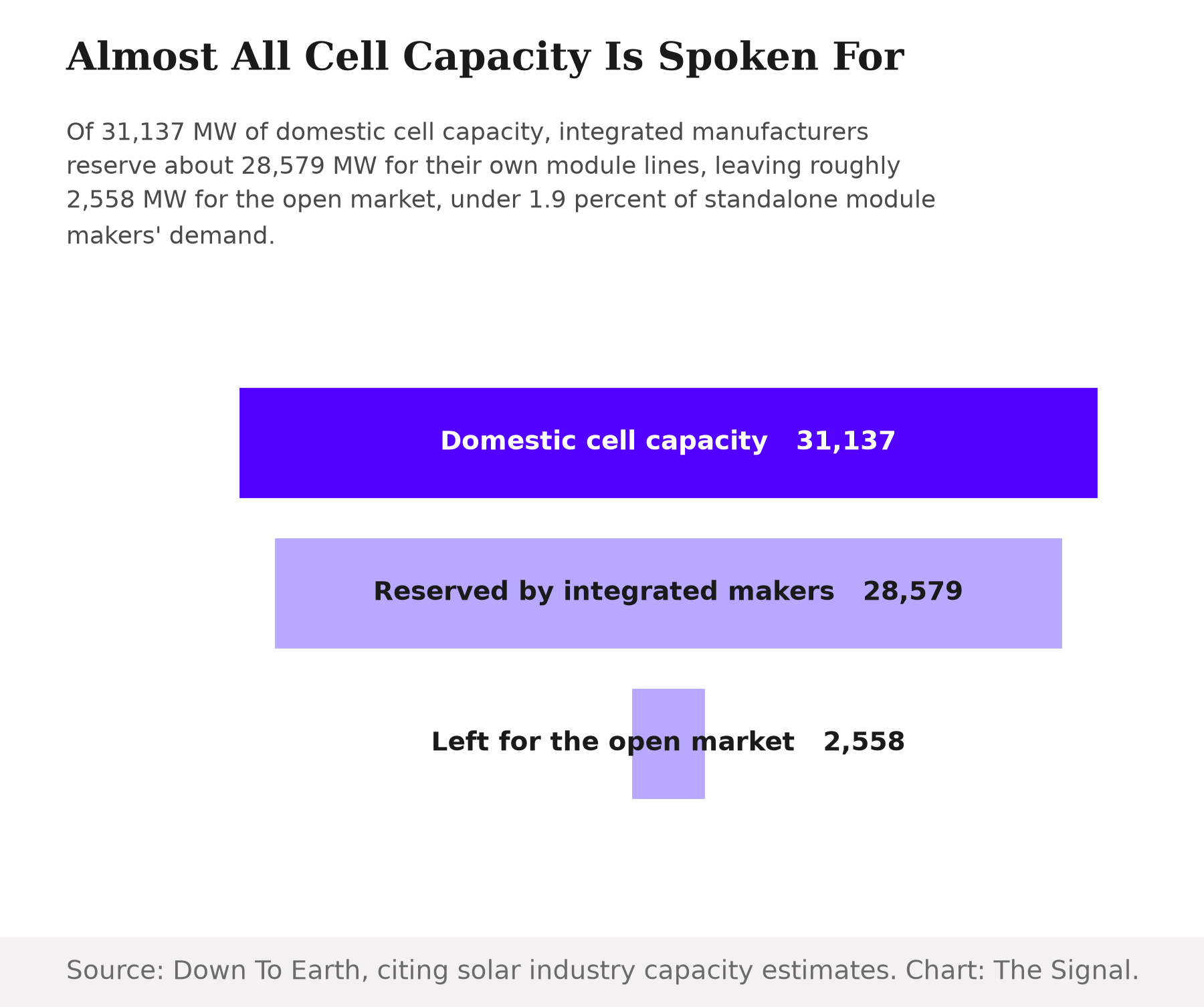
That 16 percent figure understates the actual squeeze on the open market, because most of that cell capacity never reaches it. Once integrated manufacturers reserve roughly 28,579 MW of cells for their own module production lines, only about 2,558 MW is left to sell, meeting under 1.9 percent of the demand from India's roughly 138 standalone module manufacturers, who together represent nearly 134 GW of capacity. A standalone manufacturer told to buy Indian cells is being told to compete for a market that is, in practical terms, almost entirely spoken for before it opens.
The advanced cell gap is even wider
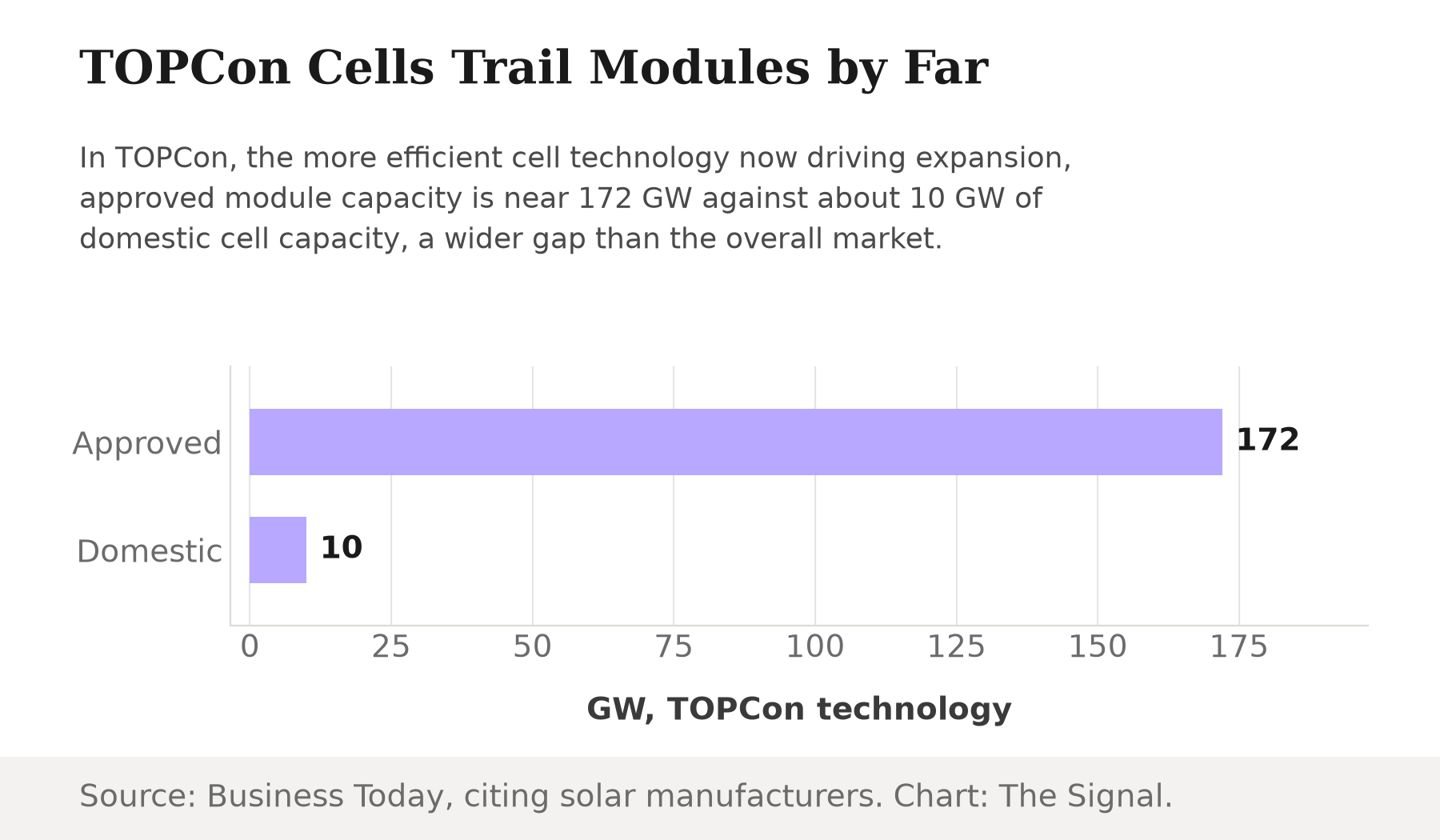
The gap is sharper still in the technology now doing most of the industry's growth. In TOPCon cells, the more efficient technology behind current expansion, approved module capacity was close to 172 GW as of July 2026, while domestic TOPCon cell capacity was only around 10 GW. Building 1 GW of cell capacity costs roughly five to eight times more than building 1 GW of module capacity, Rs 250 to 400 crore against Rs 50 to 80 crore, which is precisely why the cell side of the industry has lagged the module side for years rather than months.
The honest objection
The strongest case for holding the line anyway is that industrial policy needs a deadline with teeth. Cell manufacturing runs roughly five to eight times more capital-intensive than module assembly per gigawatt, and a manufacturer will not commit that capital without confident demand behind it. MNRE's 25 May refusal to grant a blanket extension of the 1 June deadline was a signal that the government intended to hold firm, and the July exemption is narrow: it covers only net-metering and open-access projects, not the wider set of solar procurement the mandate also touches. Even narrowed to that segment, the relief is sized for real demand: the extension opens up a potential market of close to 10-12 GW for the period through December, which is why the ministry judged it worth granting rather than a rounding error it could afford to ignore. On this reading, the deferral is calibration, not retreat, a targeted release valve for the segment least able to absorb a supply shock while the rest of the policy stays intact.
That case is real, but the timeline undercuts it. The cell list a national mandate depends on had nine manufacturing lines when it was first published in July 2025, roughly ten months before the sourcing requirement took effect. Module capacity, meanwhile, had already passed its own 100 GW milestone within two weeks of that list's debut, and had nearly doubled that again by May 2026. A calibration built with that much foresight would have staged the mandate's start against the smaller supply chain, not against a deadline that assumed the cell base would simply catch up. Instead the ministry set a date, watched the market reach for cells that mostly were not there, and corrected six weeks in. That is not evidence of prudence. It is evidence the deadline was set before the arithmetic was checked.
The Signal
The extension is not a policy failure so much as arithmetic finally catching up with ambition. India built an enormous module manufacturing base first, because modules are the cheaper, faster thing to build, and assumed cells would follow at a similar pace. They have not, and the cost gap between the two explains why they will not close quickly. The date to watch is 31 December 2026, the new cutoff, but the number that will decide whether it holds is whether domestic cell capacity has grown meaningfully past the roughly 31,137 MW logged in June 2026, and specifically whether TOPCon cell capacity has moved past its roughly 10 GW mark. If it has not, expect this same ministry to be back at this same table in December, explaining why the timeline needs to move again. A mandate that bends the first time it meets its own market is a mandate still waiting for its market to exist.
Reporting basis: the ALMM List-II exemption extension, the 25 May 2026 decision against a blanket deadline extension, and the original nine-line ALMM List-II are all from Ministry of New and Renewable Energy office memoranda, obtained directly. The 100 GW module capacity milestone is from a separate MNRE notice. Current module capacity and the 13,067 MW total capacity of the original ALMM List-II are per Mercom India's tracking of MNRE's ALMM releases; Premier Energies' roughly 15 percent share of that list is calculated from the two figures. The domestic cell capacity, the open-market squeeze, and the standalone-manufacturer demand figures are per Down To Earth, citing solar industry capacity estimates, a single source for those numbers. The TOPCon capacity gap and the per-gigawatt cost comparison are per Business Today, citing solar manufacturers. The 10-12 GW market size opened up by the exemption is per Saur Energy. The percentage shares shown in the charts are stated as reported in that source; no additional calculation was performed on them.