India's top private banks closed the June quarter with headline numbers that read like a broad credit boom. HDFC Bank's corporate and other wholesale advances grew 18.6% year-on-year in the quarter ended June 30, 2026, and in the same quarter ICICI Bank's domestic corporate loans rose 18.5% while Axis Bank's wholesale banking book jumped 38%. Line up the country's largest private lenders and every one of them posted strong double-digit growth somewhere on the balance sheet. Read only those numbers and Q1 FY27 looks like Indian credit expanding across the board.
It is worth slowing down on that framing. In the same results, HDFC Bank's retail advances grew just 7.2%, while ICICI Bank's retail loans rose 12.0% and Axis Bank's retail advances grew a more modest 8%. The growth is not broad; it is lopsided the same way at every bank, corporate books outrunning retail books rather than growing alongside them.
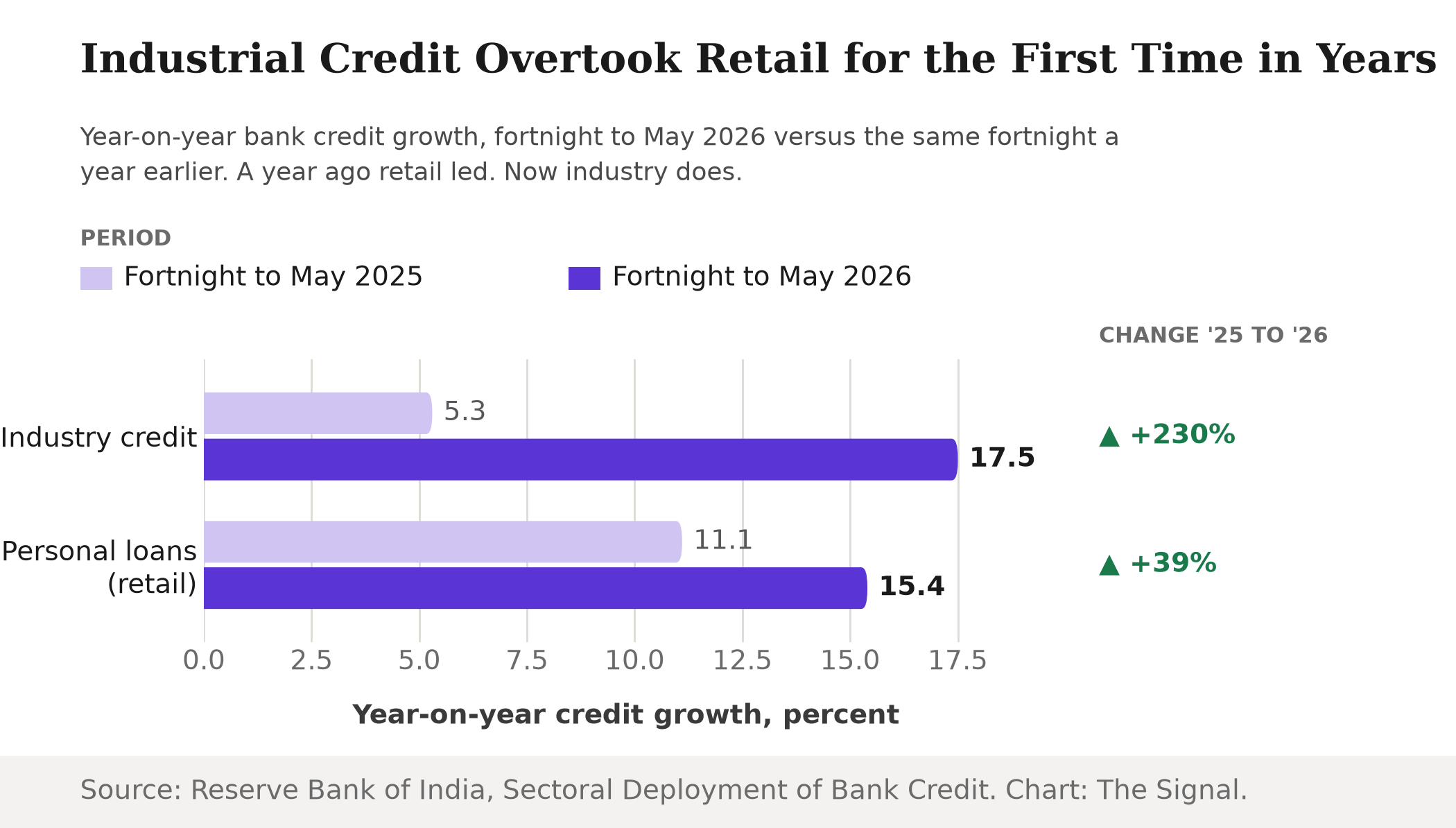
The clearest evidence of the shift is not in any single bank's results but in the Reserve Bank of India's own sectoral data. Credit to industry grew 17.5% year-on-year in the fortnight to May 31, 2026, the most recent period the RBI has published, up from just 5.3% in the same fortnight a year earlier, while credit to the personal loans segment, the retail book, grew 15.4%, against 11.1% a year ago. A year ago, retail was growing faster than industry; today, for the first time in years, industry has taken the lead.
The rule that flipped the mix
The mechanism is not a mystery. In November 2023, the RBI raised the risk weight on banks' consumer credit exposure, including personal loans but excluding housing, education, vehicle and gold loans, by 25 percentage points to 125%, effective November 16, 2023. A higher risk weight means a bank must hold more capital against the same loan, so unsecured retail lending became structurally more expensive to write, loan for loan, than it was before the rule.
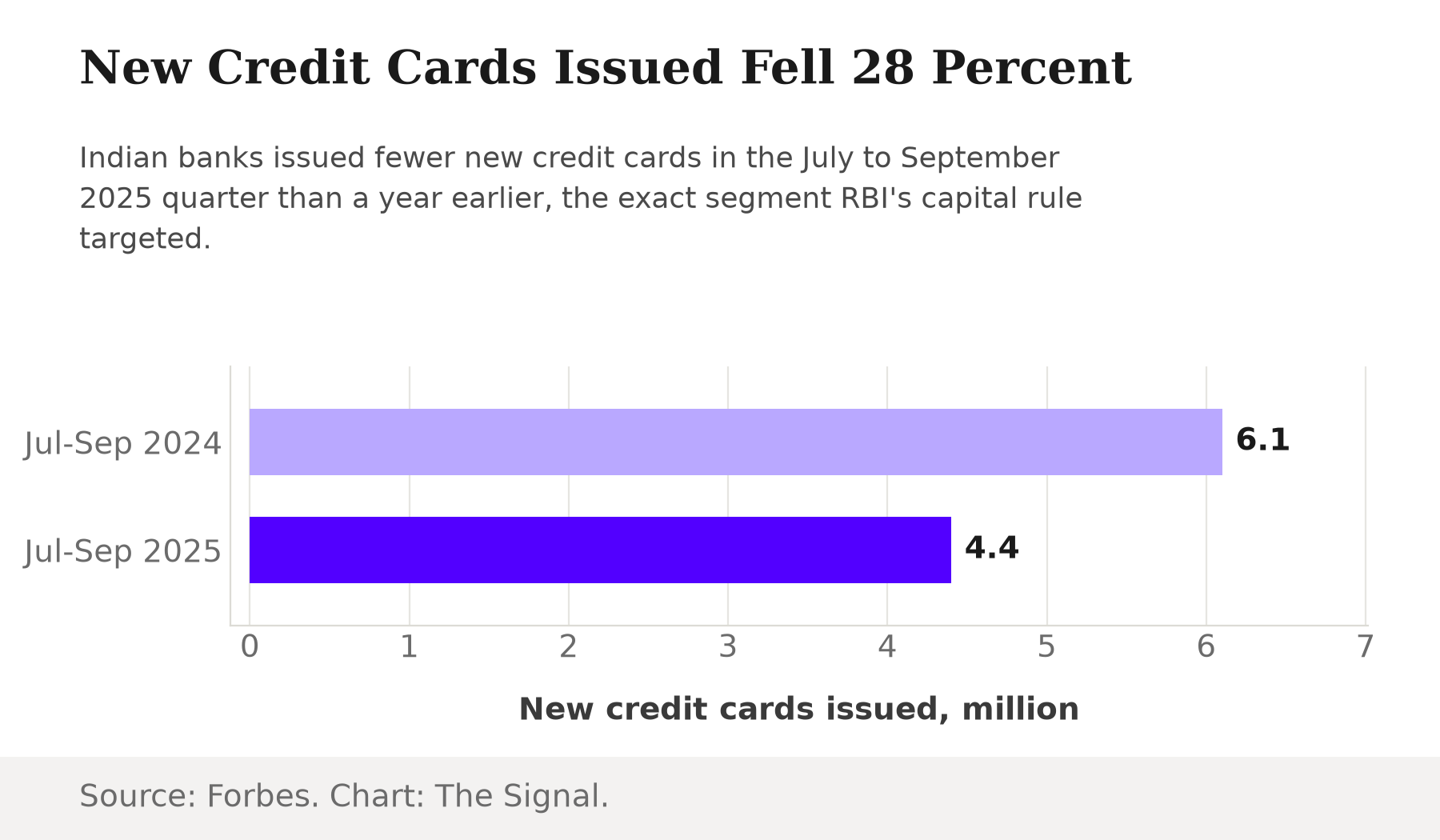
The clearest sign the rule bit is in credit cards, the most unsecured retail product banks sell. Indian banks issued 4.4 million new credit cards in the July-September 2025 quarter, a 28% decline from 6.1 million in the same quarter a year earlier, a slowdown Forbes ties directly to the RBI's late-2023 increase in capital requirements for unsecured retail loans. That is not banks growing retail more slowly. It is banks issuing fewer of the specific unsecured product the rule made costlier.
Four banks, one pattern
Every one of India's four largest private banks grew its corporate or wholesale book faster than its retail book in the quarter ended June 30, 2026, at HDFC Bank, ICICI Bank and Axis Bank, and Kotak Mahindra Bank.
| Bank | Retail loan growth (YoY) | Corporate/wholesale loan growth (YoY) |
|---|---|---|
| HDFC Bank | 7.2% | 18.6% |
| ICICI Bank | 12.0% | 18.5% |
| Axis Bank | 8% | 38% |
| Kotak Mahindra Bank | 12% | 20% |
Retail advances versus corporate, wholesale or institutional advances, year-on-year, quarter ended June 30, 2026 (Q1 FY27). Source: Business Today; Outlook Business; Investing.com.
The gap is widest at Axis, where wholesale banking grew nearly five times faster than retail (38% against 8%), and narrowest at ICICI, where corporate growth beat retail by roughly half again (18.5% against 12.0%). Different banks, different books, same direction.
Cleaner books, more room to lend
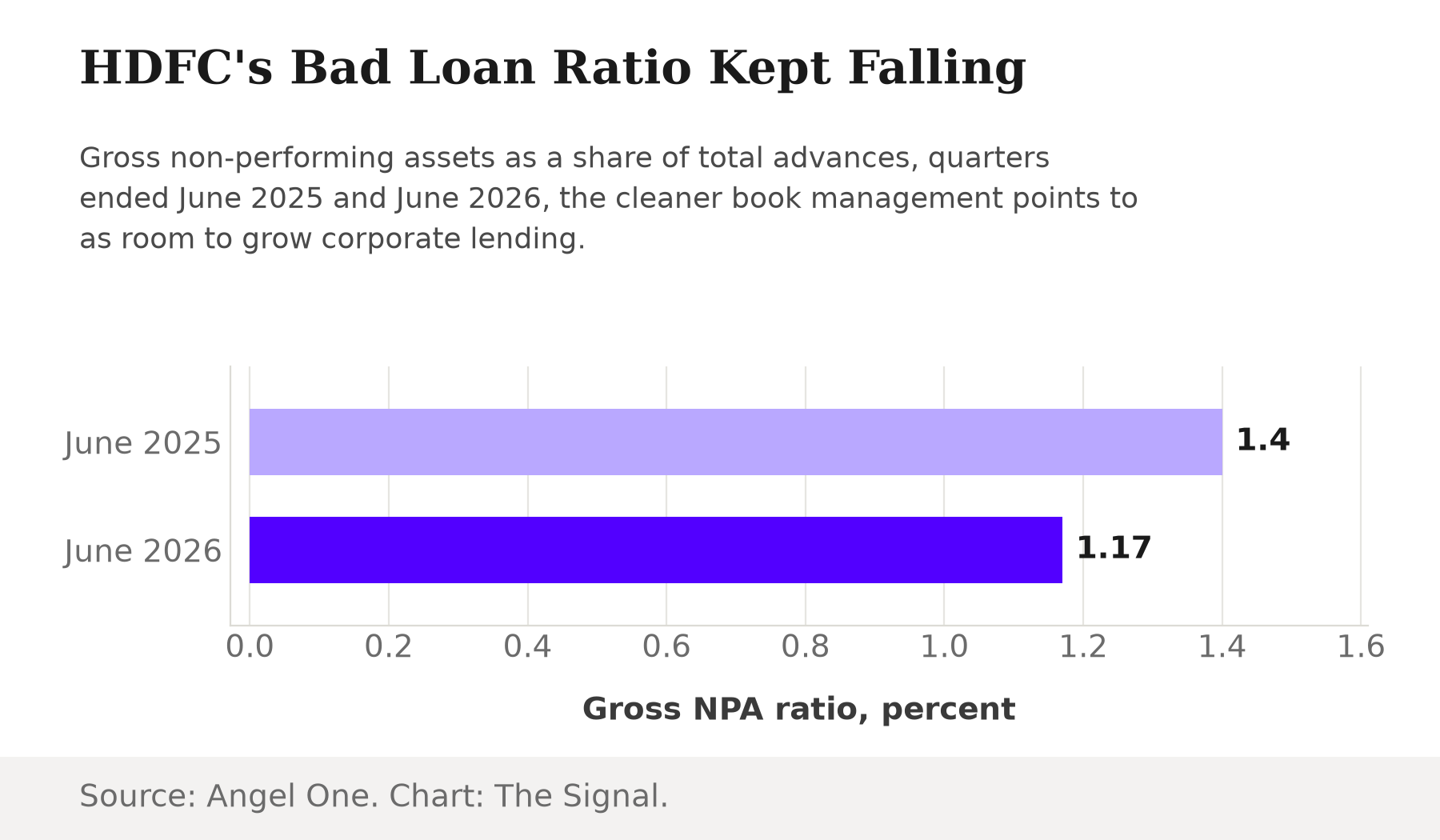
Part of the reason banks can afford to lean into corporate lending is that the corporate book itself is safer to hold than it was a few years ago. HDFC Bank's gross non-performing asset ratio improved to 1.17% in the quarter ended June 30, 2026, from 1.40% a year earlier. A cleaner balance sheet gives a bank more room to grow lending of any kind without setting aside as much capital for expected losses, and the improvement lands in the same quarter the corporate book pulled ahead.
The honest objection
The strongest case against calling this a retreat from retail is that retail lending is not actually shrinking. System-wide personal loan growth accelerated to 15.4% in the fortnight to May 31, 2026, up from 11.1% a year earlier: faster, not slower, than before. On that reading, nothing is being taken away from households. Corporate credit is simply growing even faster on top of already-healthy retail growth, in a broader credit upcycle lifting every segment at once.
That case holds at the system level, but it does not survive contact with credit cards. New credit card issuance fell in absolute terms, from 6.1 million cards to 4.4 million a year later: a genuine decline, not merely a slower rate of growth, concentrated in exactly the unsecured product the RBI's 2023 rule made costlier to write. The system-wide personal loans figure still bundles in housing, education, vehicle and gold-backed loans, the categories the RBI's rule explicitly excluded and left untouched. Pull those apart and an acceleration in the combined number is consistent with banks growing the retail loans the rule left cheap, while pulling back on the one it made expensive.
The Signal
The story of Q1 FY27 is not that Indian bank lending slowed. System-wide credit accelerated by every measure the Reserve Bank of India publishes. What changed is who gets it. Nearly three years after the RBI made unsecured retail lending pricier in capital terms, banks have rebuilt the appetite for corporate credit they spent years working off after the last corporate bad-loan cycle, helped along by balance sheets clean enough to take the risk back on. Watch what happens if the RBI ever eases the risk weight it raised in 2023: retail growth overtaking industry again would confirm the capital rule, not household demand, was driving the split all along. If industry keeps outrunning retail regardless, the shift stops looking like a cycle and starts looking like a new steady state, a banking system that has decided companies are simply the better credit risk for now.
Reporting basis: the system-wide credit growth figures are from the Reserve Bank of India's Sectoral Deployment of Bank Credit release; the risk-weight change is per a separate RBI notification. Both are a single origin, the Reserve Bank of India. HDFC Bank's Q1 FY27 retail and corporate loan growth, and its gross non-performing asset ratio, are as reported by Business Today and Angel One respectively. ICICI Bank's and Axis Bank's Q1 FY27 loan-growth figures are per Outlook Business. Kotak Mahindra Bank's figures are per Investing.com. The credit card issuance decline and its link to the RBI's 2023 rule are as reported by Forbes. The characterisation of Axis's gap as nearly five times and ICICI's as roughly half again are The Signal's calculations from those figures.