On 17 July 2026, Bharatiya Reserve Bank Note Mudran, the Reserve Bank's currency-printing arm, opened a global Expression of Interest for opacified polymer substrate sheets to print Indian banknotes, with bids due by 18 August 2026. The ask, per the tender documents, is an indicative 68,000 reams of BOPP-based polymer substrate, split evenly at 34,000 reams each for Rs 10 and Rs 20 notes. Read that cold and the story writes itself: India is finally getting plastic money.
It is worth slowing down on that. RBI is not trying this for the first time. Its own 2014-15 Annual Report stated an intent to start a pilot project with plastic and polymer banknotes, and the government moved fast on it: in February 2014, it told Parliament that one billion Rs 10 polymer notes would be field-tested across five cities picked for climatic and geographic diversity: Kochi, Mysore, Jaipur, Shimla and Bhubaneswar. That trial never became the national rollout it was meant to preview. The plan was later shelved over technical issues, including ATM compatibility problems, the kind of mundane engineering failure that rarely makes the retelling.
Round one did not die on economics. It died because machines built for paper jammed on plastic. Round two is the same idea, aimed at the same two low denominations, run through a different door: not a domestic field trial, but an open global tender. BRBNMPL's own stated aim for that tender is not simply to import the material: it wants to build domestic manufacturing through technology transfer and collaboration with experienced global players, which is itself a tell that no Indian supplier yet has the three years of central-bank polymer-substrate experience the EOI demands.
What the tender actually specifies
The bidding bar is set high and specific. Suppliers need at least three years' experience supplying polymer substrate with security features to a central bank or a banknote or security-printing organisation, and must offer a minimum of 20,400 reams, 30 percent of the indicative quantity, just to qualify. At 500 sheets to a ream, the full 68,000-ream ask works out to 34 million printable sheets (our calculation, from the ream count and the per-ream sheet count in the same tender). That is a real production order, but it is still a pilot's scale next to the billion physical notes India field-tested in 2014, not a currency-wide changeover.
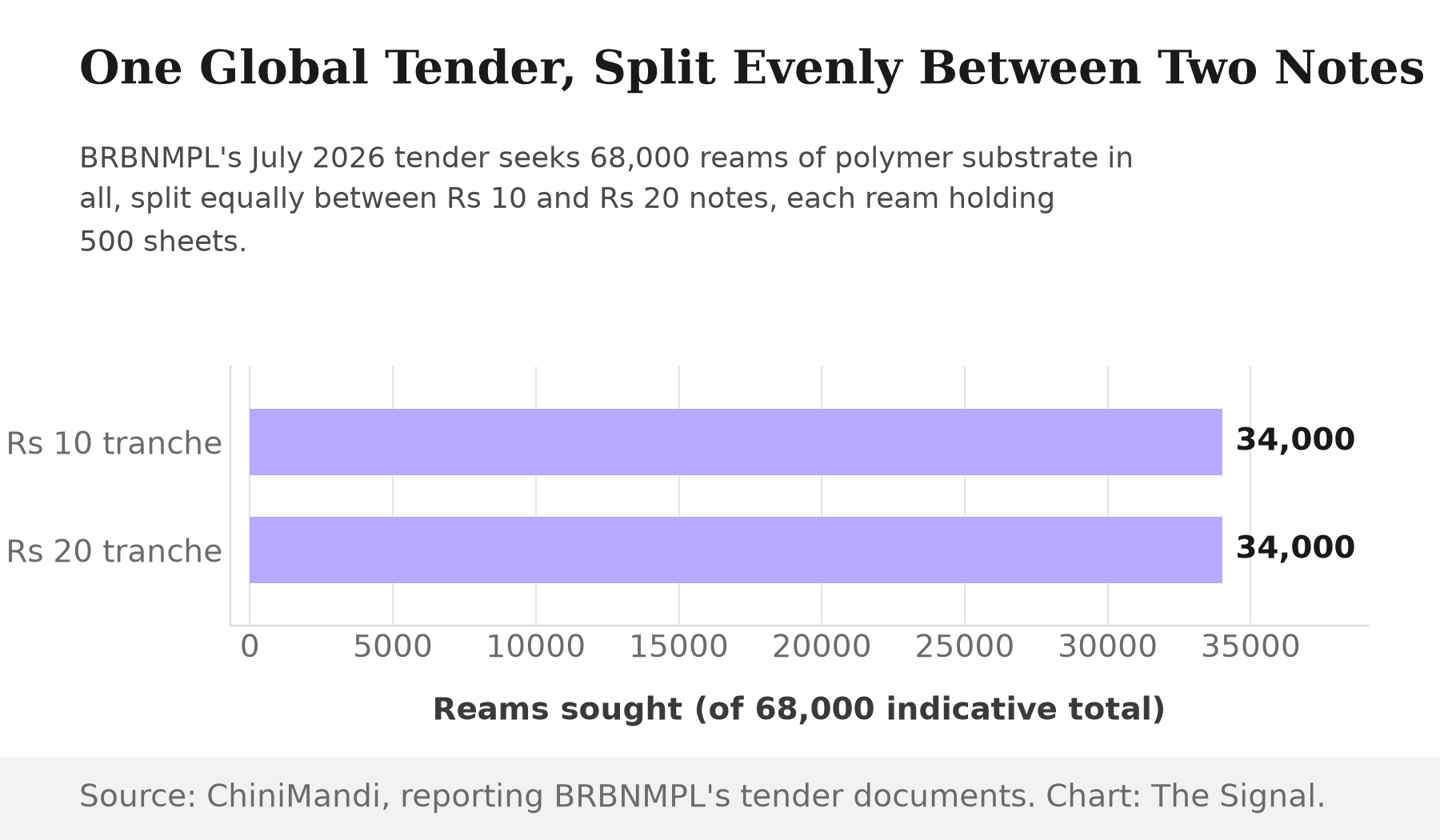
Source: ChiniMandi, from the tender documents. Chart: The Signal.
A tender with a passport check
The 2014 attempt was a domestic field trial. This one comes with a clause the earlier plan never needed. Bidders must obtain security clearance from the government, wall off any operations in China or Pakistan from the India contract, avoid sourcing raw material for India's banknote substrate from either country, and agree not to supply India-specific substrate to any third country. A tender for the paper, so to speak, that the currency is printed on now doubles as a supply-chain security filter, a dimension the original plastic-note push was never built to answer.
The case for trying again
Two numbers explain why RBI might be willing to revisit an idea that once failed on the factory floor. First, the cost of paper wearing out. RBI disposed of 2,380 crore soiled banknotes in the year to March 2025 (FY25), up from 2,124 crore in FY24, while spending more than Rs 4,800 crore printing and replacing worn paper currency.
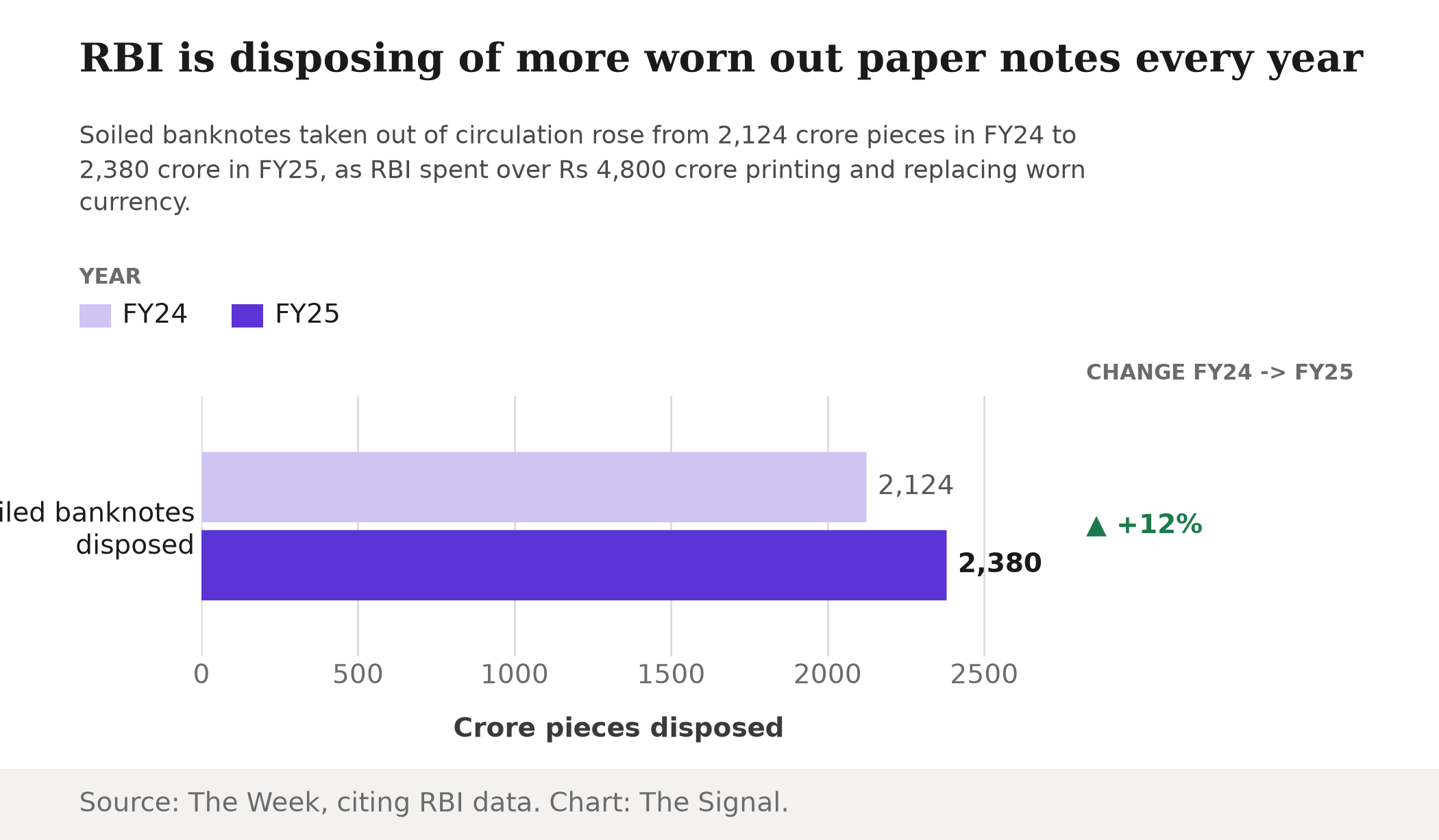
Source: The Week, citing RBI. Chart: The Signal.
Second, another country's finished experiment. A Reserve Bank of Australia Bulletin analysis found its own switch to polymer produced net savings of close to $1 billion over 25 years, driven mainly by polymer's much longer lifespan: Australian paper notes used to wear out within six months to a year. Note durability, not novelty, is the argument. A material that survives years instead of months pays for itself precisely on the line item India's own disposal numbers show climbing.
A wider security backdrop
The tender is about substrate for two of India's lowest, fastest-turning denominations, not about counterfeiting of higher notes. Still, it lands against a backdrop of currency-security concern that RBI has been airing in Parliament. Counterfeit Rs 500 notes detected in the banking system rose more than 37 percent in FY25 to about 1.18 lakh pieces, up from 85,711 in FY24, RBI Governor Sanjay Malhotra told a Lok Sabha panel. That figure says nothing directly about Rs 10 or Rs 20 notes. It does show a central bank that has, in the same period, been telling lawmakers its paper notes are getting harder to trust, at the same time it is shopping the world for a substrate built around security features from the start.
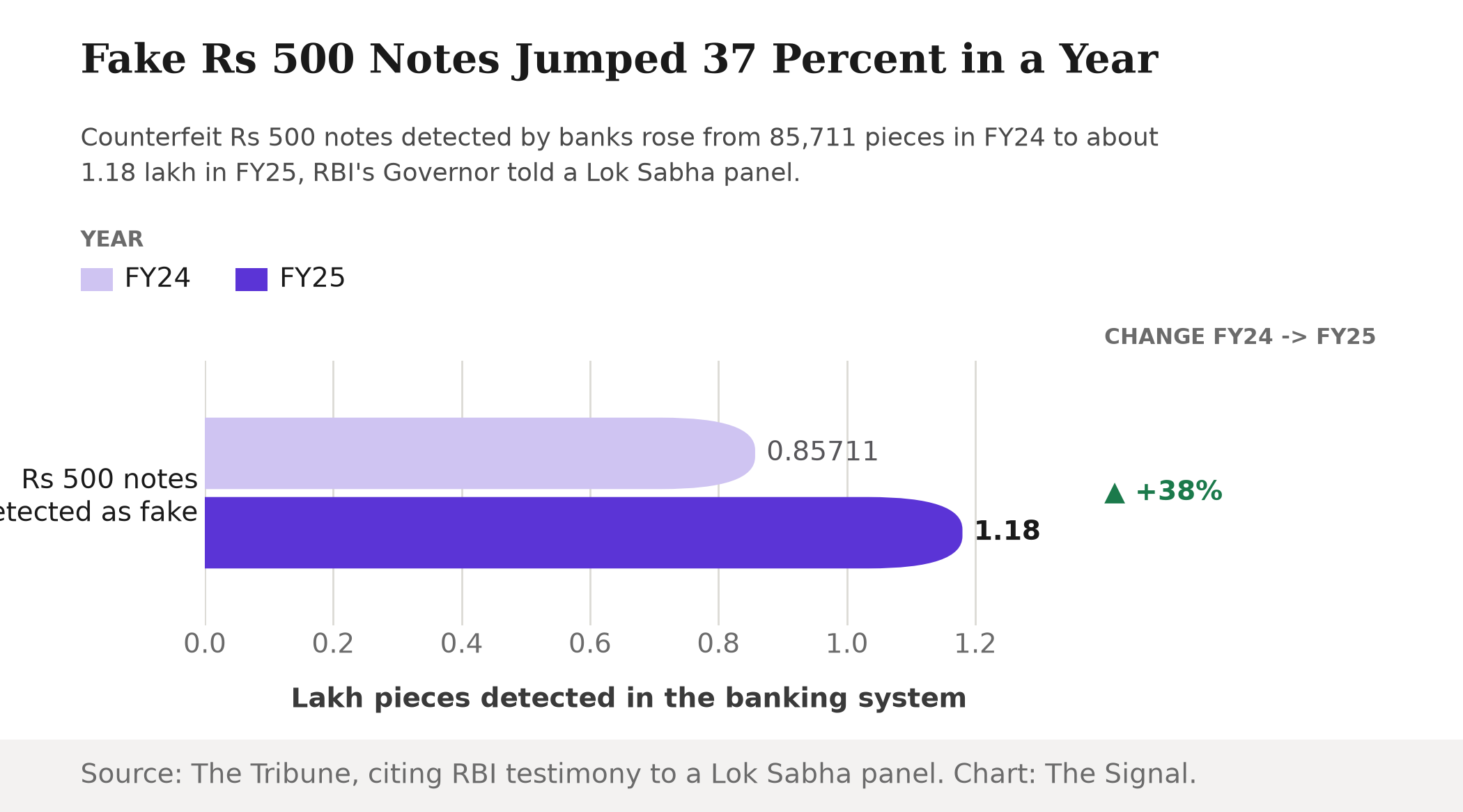
Source: The Tribune, citing RBI Governor Sanjay Malhotra's testimony to a Lok Sabha panel. Chart: The Signal.
How the two attempts compare
| 2014 field trial | 2026 tender | |
|---|---|---|
| Denomination(s) | Rs 10 only | Rs 10 and Rs 20 |
| Scale | 1 billion notes field-tested | 68,000 reams (about 34 million sheets) sought |
| Where | Five Indian cities: Kochi, Mysore, Jaipur, Shimla, Bhubaneswar | Open global tender, bids close 18 August 2026 |
| Distinguishing feature | None beyond the material itself | Security-clearance and China/Pakistan sourcing clauses |
| Outcome | Shelved over technical issues, including ATM compatibility | Bidding in progress |
Source: The Tribune; News24; BRBNMPL; ChiniMandi. Sheet-count figure is The Signal's calculation. Chart: The Signal.
The honest objection
The strongest case against reading anything into this is that a tender is not a rollout. RBI floated intent to pilot polymer notes as far back as its 2014-15 Annual Report, ran an actual billion-note field trial, and still shelved the idea. A 68,000-ream EOI, covering barely more than a domestic pilot's worth of material, could just as easily stall the same way, whatever the security clauses attached to it. Sourcing globally under a strict security-clearance regime can also slow, not speed, a program: fewer qualifying bidders, longer vetting, a narrower pool willing to accept a firewall on their China or Pakistan operations.
That case is real, and the tender could still go nowhere. But it answers a different question than the one that actually killed the first attempt. The 2014 trial did not fail because India could not source enough plastic. It failed because the notes did not survive contact with the machines built to read paper. Nothing in the public record says that engineering problem has been solved. What has changed is the arithmetic around trying: soiled-note disposal is rising, not falling, and Australia's finished 25-year experiment gives RBI an existence proof that the durability math can work. A harder bidder bar and a security clause address who gets to supply the material. They do not by themselves address whether an ATM built for paper will accept it this time.
The Signal
The number to watch is not 68,000 reams or even the 18 August bid deadline. It is whether this EOI ever produces a field trial that gets reported back to the public, the way the 2014 one did before it quietly disappeared. RBI has now stated the intent to try polymer notes twice over more than a decade, run one real field trial, and shelved it once already. A tender with tighter vendor bars and a national-security clause is a more careful second attempt than the first, not proof the underlying problem, plastic notes and paper-era machines, has been solved. Watch for a pilot city list. Its absence is the tell that this is procurement, not yet a plan.
Reporting basis: the July 2026 tender's dates and product description are from BRBNMPL's own tender listing. The reams, denominations, and bidder-qualification terms are as reported by ChiniMandi from the tender documents, and the security-clearance and China and Pakistan sourcing clauses are as reported by IBTimes India from the same documents; both outlets describe the same underlying tender. BRBNMPL's stated aim of building domestic manufacturing through technology transfer, rather than importing the substrate outright, is as reported by Business Today. RBI's stated 2014-15 intent to pilot polymer notes is from its own Annual Report. The 2014 field-trial details are as reported by The Tribune from a government reply to Parliament, and the trial's shelving is as reported by News24. Australia's cost-benefit findings are from a Reserve Bank of Australia Bulletin analysis. RBI's soiled-note disposal and replacement-cost figures, and the counterfeit Rs 500 note figures from RBI Governor Sanjay Malhotra's testimony to a Lok Sabha panel, are both as reported by The Week and The Tribune respectively, each citing RBI as the underlying source. The sheet-count total is The Signal's calculation from the tender's reams and sheets-per-ream figures.