The Competition Commission of India issued two orders against HP India on 13 July 2026, and the headline number is easy to state: a combined penalty of roughly ₹142.37 crore on HP and 21 of its resellers for rigging bids on the Government e-Marketplace, the platform through which the Indian state buys everything from laptops to printer cartridges. Read at face value, this is the system working exactly as designed: a watchdog catches a cartel, fines the company that ran it, and moves on.
It is worth slowing down on how this particular cartel came to light. The case originated from HP India's own application for lesser-penalty treatment under Section 46 of the Competition Act: HP told the Commission about the arrangement itself. That matters because GeM and CCI had already signed a Memorandum of Understanding in February 2019 specifically to pool their knowledge of public procurement and detect anti-competitive practices such as cartelisation on the platform. A monitoring partnership built for precisely this kind of scheme existed for a year before the case was even opened. What actually surfaced it was a confession.
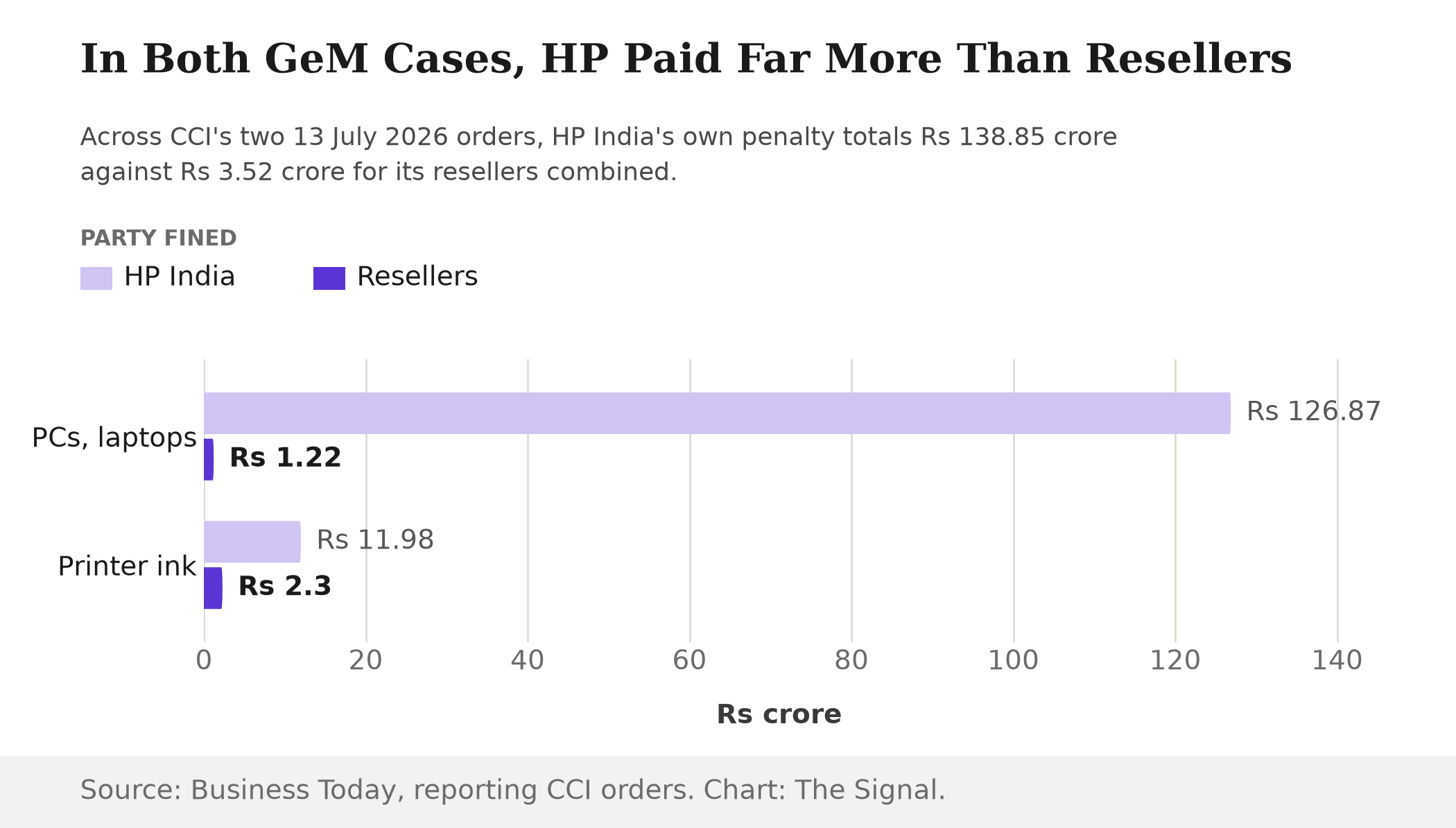
HP India's own penalty across both orders comes to ₹138.85 crore, before counting a single rupee paid by any reseller.
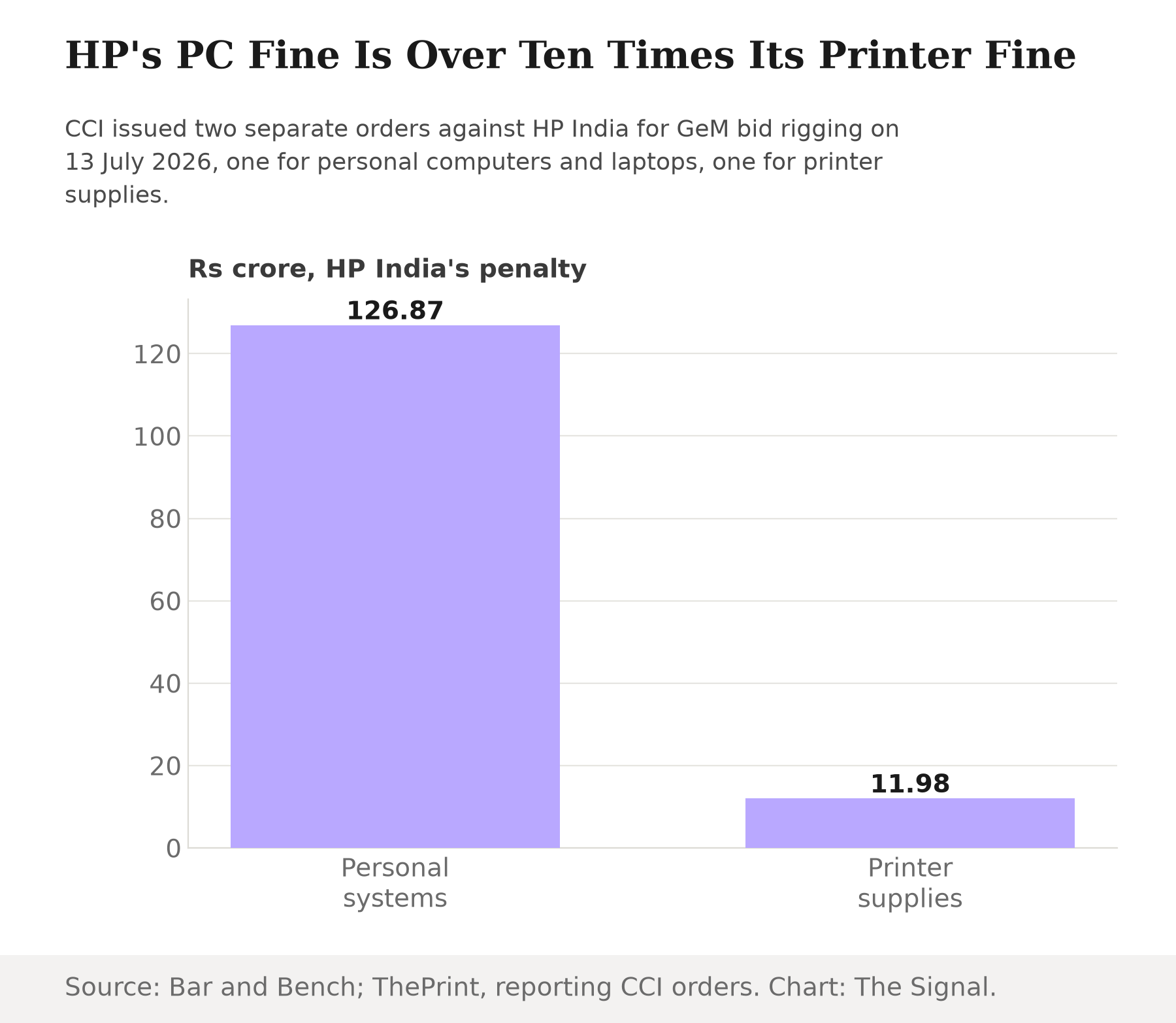
That figure is simple to build: CCI fined HP ₹126.87 crore in the personal-systems case, covering PCs and laptops, and ₹11.98 crore in a companion order the same day for printer supplies, covering ink and toner cartridges. Add the two and HP alone accounts for ₹138.85 crore of the ₹142.37 crore total. Its resellers, 21 of them across both cases, split the remaining roughly ₹3.52 crore.
The mechanism HP controlled
The size of HP's own share is not an accident of two separate orders. In the personal-systems case, CCI found that HP controlled the Manufacturer's Authorisation Forms and the transfer prices that resellers needed just to bid on GeM tenders, and coordinated "cover" bids that protected resellers' legacy "most valuable customer" accounts from real competition. Resellers could not bid without HP's authorisation paperwork, and HP set the price floor they bid from. That is not one participant among many in a cartel; it is the company that owned the gate every other bidder had to pass through. That is also why individual officials at HP India and the five liable resellers in that case, not just the corporate entities, were separately fined under Section 48 of the Competition Act.
| Personal systems (PCs, laptops) | Printer supplies (ink, toner) | |
|---|---|---|
| Case number | Suo Moto Case No. 07 of 2020 | Suo Moto Case No. 08 of 2020 |
| HP India's penalty | ₹126.87 crore | ₹11.98 crore |
| Resellers penalised | 5 resellers, ₹1.22 crore combined | 16 resellers, ₹2.30 crore combined |
Source: Bar and Bench; ThePrint; Business Today, reporting the CCI orders.
Both cases carry the same case-number prefix, "of 2020", the year CCI opened its Suo Moto investigations into HP's conduct on GeM. The order closing them landed more than six years later, in July 2026.
Why the leniency application still cost HP so much
Self-reporting is supposed to buy relief. CCI did give HP leniency under Section 46 for voluntarily disclosing the arrangement, which reduced its penalty rather than eliminating it, but the Commission stopped well short of a full waiver. The reason tracks directly back to the mechanism above: a company that controls the authorisation paperwork and the price floor for an entire cartel is not a peripheral participant confessing to a minor role. It is the architect asking for a discount on its own scheme. CCI's order reflects that HP's centrality, not just its self-report, shaped the number.
The honest objection
The strongest case for reading this as the system working is that leniency programmes are supposed to look exactly like this. Rewarding the first defector, even generously, is how competition regulators everywhere induce cartels to collapse from the inside, since external monitoring alone rarely penetrates a scheme run by the company that also gatekeeps market access. On that view, GeM and CCI's monitoring partnership does not need to have caught HP directly; it only needs to have raised HP's own perceived risk of getting caught enough to make confessing the rational move. And CCI has hardly been a passive regulator during this period: it investigated 35 cartel cases across various sectors in the five financial years to March 2025, well beyond GeM alone.
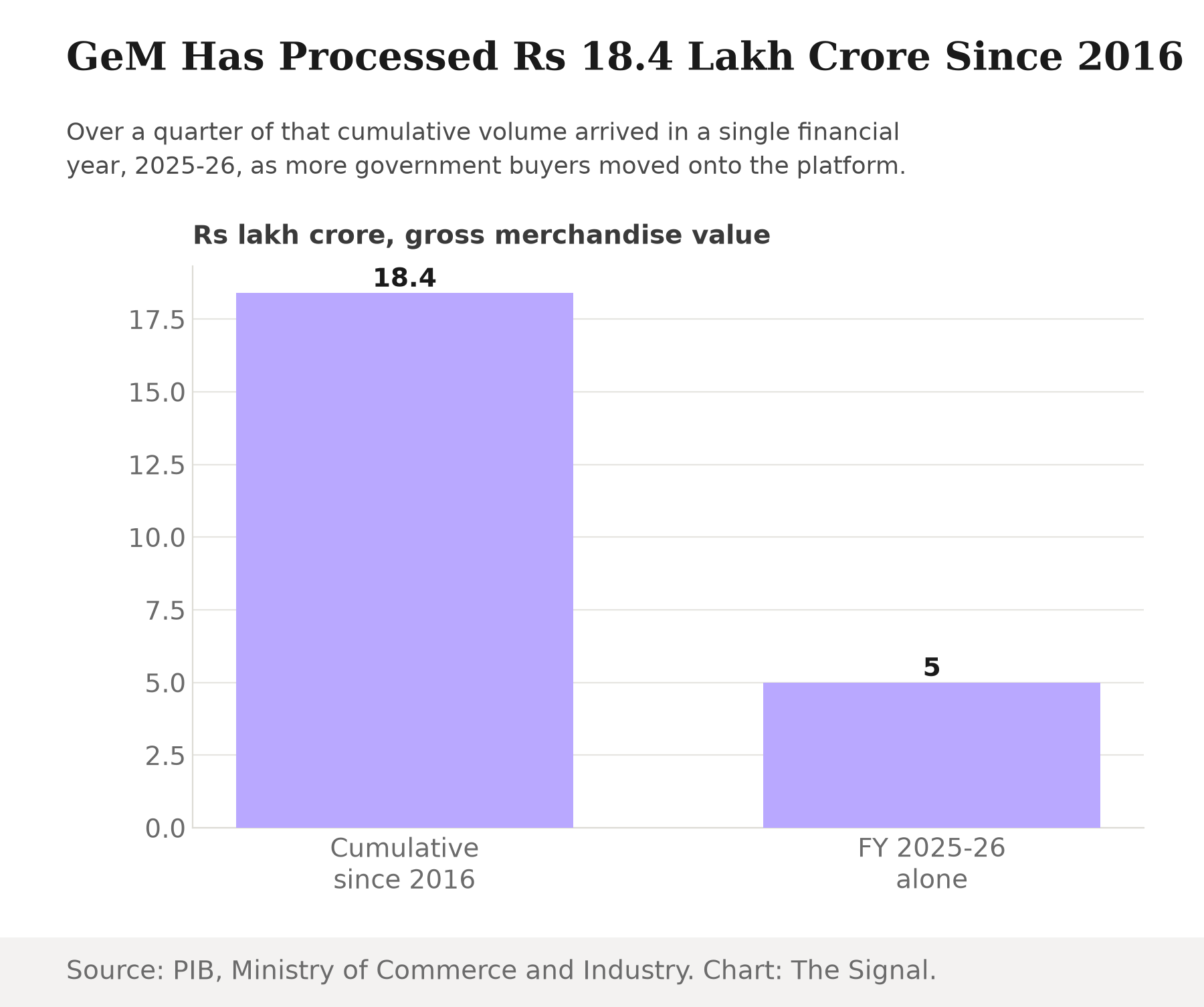
That case is real, but it does not explain the six-year gap between the Suo Moto filings and the order, a gap that ran the entire time GeM kept growing. GeM has processed a cumulative Gross Merchandise Value of ₹18.4 lakh crore since its 2016 launch, and had already crossed ₹5 lakh crore in the 2025-26 financial year alone by the time of that April 2026 tally, meaning the platform added more than a quarter of its entire cumulative volume in the same window the HP case sat unresolved. A leniency programme that works is still a programme that waits for a confession. It does not shrink the years a live cartel gets to operate on a marketplace that size while the case moves through investigation and order.
Set against CCI's own enforcement history, HP's combined bill is not the regulator's largest swing. CCI's biggest cartel penalty to date, ₹873 crore against United Breweries and other companies for beer-price cartelisation, is more than six times the HP/GeM total, and that penalty is itself still in litigation: the Supreme Court has stayed the NCLAT order that upheld it while the appeal proceeds. Even CCI's largest cartel fines do not arrive final on the day they are announced, which is one more reason the HP order's eventual fate, appealed or paid, is worth watching alongside the GeM monitoring question.
The Signal
The number to hold onto is not the ₹142.37 crore combined penalty. It is that the cartel that CCI has just punished most heavily was run by the one bidder positioned to defeat GeM's own anti-collusion design from the inside. It surfaced through a confession; the monitoring partnership built to catch it never did. That is not a failure of enforcement; the fine, the individual penalties on officials, and the reduced-not-waived leniency all show teeth. It is a limit on what detection alone can promise on a marketplace processing lakhs of crores a year. Watch what happens next on GeM: if future cartel cases keep originating from leniency filings rather than from CCI and GeM's own monitoring, the partnership signed in 2019 is functioning as a deterrent, not a detector, and the gap between those two things is exactly as wide as the next confession takes to arrive.
Reporting basis: HP India's personal-systems penalty and the mechanics of its cartel, the Manufacturer's Authorisation Forms, transfer prices and cover bids, are per Bar and Bench's reporting of the CCI order in Suo Moto Case No. 07 of 2020. The printer-supplies penalty is per ThePrint's reporting of the companion CCI order in Suo Moto Case No. 08 of 2020. The combined total across both orders and the case-by-case reseller breakdown are per Business Today's reporting. The leniency application under Section 46 is per Inc42's reporting, and the individual-official penalties under Section 48 are per Indiantelevision.com's reporting, both of the same CCI orders. The GeM-CCI Memorandum of Understanding, GeM's cumulative gross merchandise value, and CCI's five-year cartel caseload are from Press Information Bureau releases by the Ministry of Commerce & Industry. The ₹873 crore beer-cartel penalty and its Supreme Court stay are per Bar and Bench's reporting of the Supreme Court's order. HP India's combined ₹138.85 crore penalty across both orders, its resellers' combined ₹3.52 crore, the more-than-a-quarter share of GeM's cumulative volume added in 2025-26, and the six-times comparison with the beer-cartel penalty are The Signal's calculations from those figures.