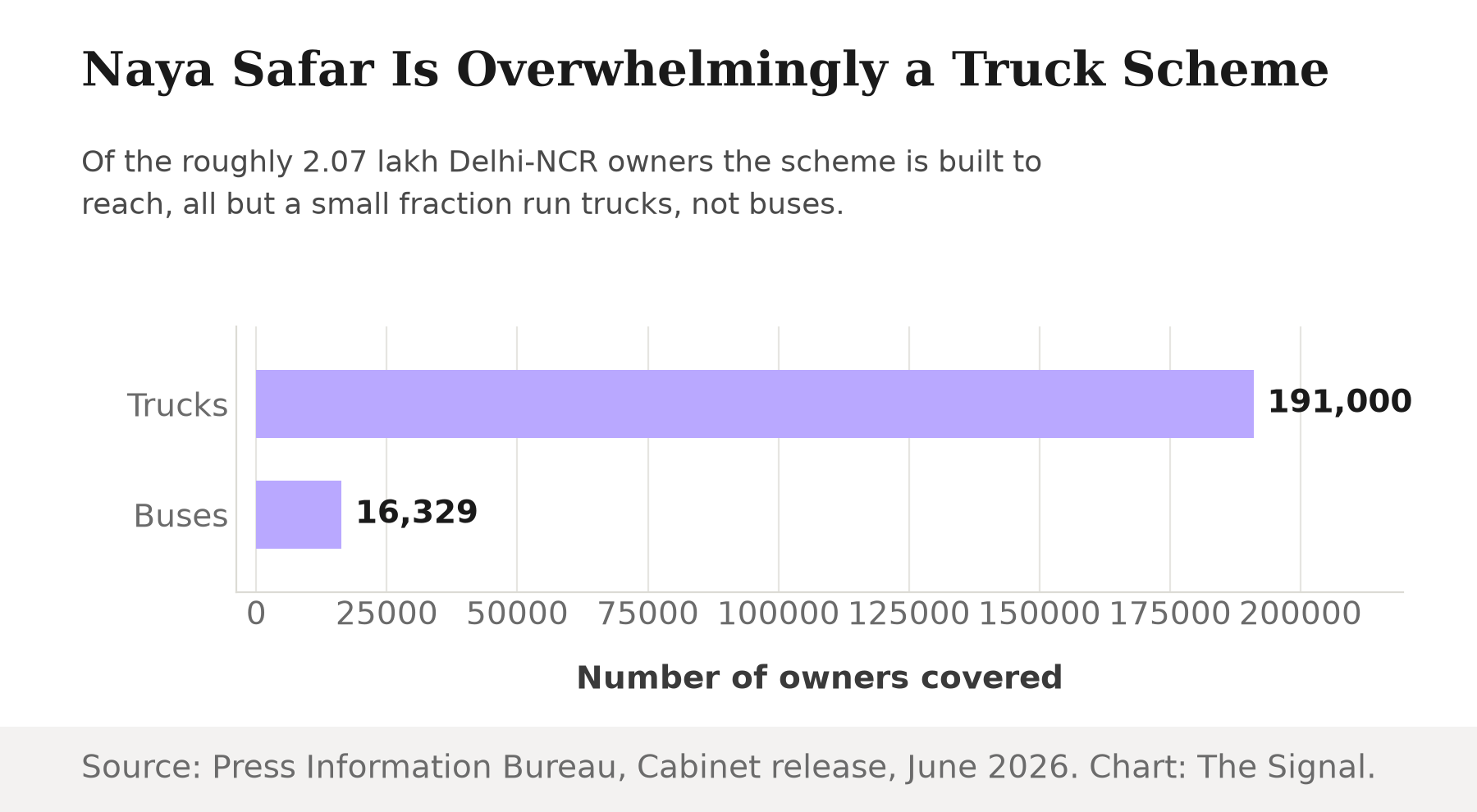
On June 18, 2026, Tata Motors signed a memorandum of understanding with the Road Transport Ministry to supply vehicles under Delhi-NCR's new truck and bus replacement scheme, Prasar Bharati's News on AIR reports, the first big manufacturer tie-up since the Union Cabinet approved the scheme two weeks earlier. The Press Information Bureau's Cabinet release states the scheme, called Naya Safar, carries a total outlay of Rs 9,585 crore, including Rs 5,041 crore from the Central government and an estimated Rs 1,601 crore in state tax concessions. It is expected to benefit approximately 2.07 lakh owners in Delhi-NCR, 1.91 lakh of them running trucks and 16,329 running buses. The Prime Minister's Office's release on the same Cabinet decision states the Centre will add a 5 percent interest subvention on vehicle loans for five years and monthly fuel vouchers worth up to Rs 4,800, while state governments waive up to 100 percent of motor vehicle tax on the new vehicle and 50 percent on a used one for ten years, and participating manufacturers cut 8 percent off the ex-showroom price. Six weeks on from Cabinet approval, read as a single package, it looks comprehensive: tax, fuel and purchase price, all discounted at once.
Every layer of support in Naya Safar sits on the price of the vehicle or the cost of running it. None of it sits on the size of the loan.
| Support | Value | Who provides it |
|---|---|---|
| Interest subvention on the vehicle loan | 5% for 5 years | Centre |
| Monthly fuel voucher | Up to Rs 4,800 | Centre |
| Registration fee, new vehicle | Waived | State governments |
| Motor vehicle tax concession, new vehicle | Up to 100% for 10 years | State governments |
| Motor vehicle tax concession, used vehicle | Up to 50% for 10 years | State governments |
| Discount on ex-showroom price | 8% | Participating OEMs |
Source: Prime Minister's Office. Table: The Signal.
It is worth slowing down on that list. Every line item changes the price of the new vehicle, the cost of running it, or the interest rate charged on the money borrowed to buy it. Not one line item changes how much has to be borrowed to start with. An interest subvention lowers what a loan costs to carry. It does not lower how large that loan is.
Naya Safar is built to reach about 2.07 lakh owners, 1.91 lakh of them running trucks and 16,329 running buses.
This is overwhelmingly a truck scheme, aimed overwhelmingly at owners now arranging financing for a new vehicle, not simply collecting a rebate on one they were already going to buy.
Source: Press Information Bureau. Chart: The Signal.
Why they cannot just keep the old truck
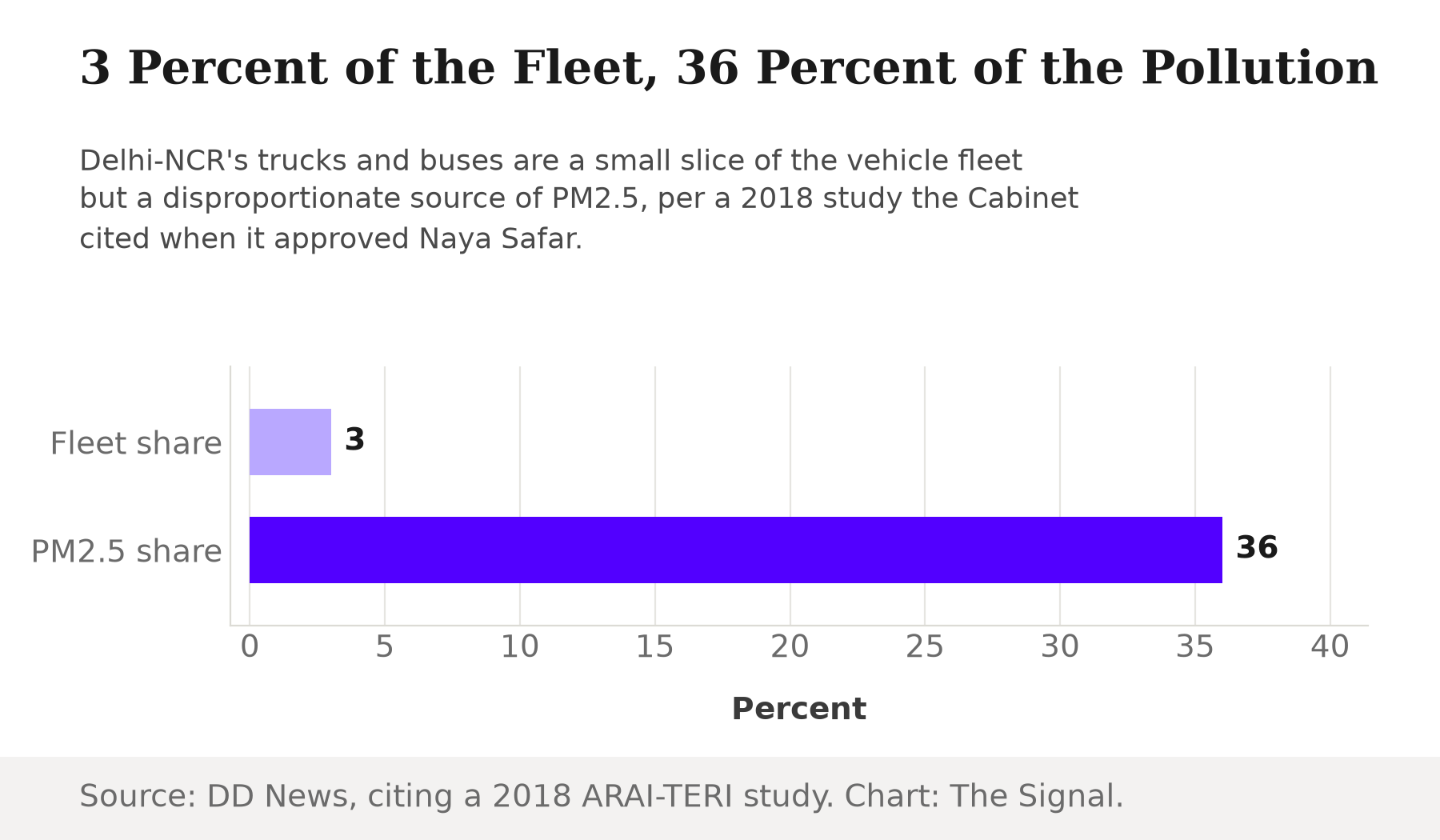
Trucks and buses account for 36 percent of PM2.5 emissions in Delhi-NCR despite making up only 3 percent of the vehicle fleet, DD News reports, citing an ARAI-TERI source apportionment study relayed in the Cabinet's own announcement. The same study found that a single pre-BS heavy-duty vehicle emits as much pollution as 14 BS-VI compliant vehicles. That is the government's case for treating this as urgent rather than optional. It is reinforced by law: a 2018 Supreme Court order enforcing an NGT directive already bars diesel vehicles older than 10 years and petrol vehicles older than 15 years from plying anywhere in the National Capital Region. For an NCR truck or bus owner running a vehicle that has aged out under that order, the choice was never new vehicle versus old vehicle. It was new vehicle versus no vehicle at all.
Source: DD News, citing the Cabinet's ARAI-TERI source apportionment study. Chart: The Signal.
What "up to" leaves out
Read the fine print again: relief "up to" 100 percent, a discount "up to" 8 percent, an interest subvention for "up to" five years. Under the base national Vehicle Scrapping Policy that Naya Safar builds on, a vehicle bought against a Certificate of Deposit already carried a motor vehicle tax concession of up to 25 percent for non-transport vehicles and up to 15 percent for transport vehicles, per a 2021 notification the Ministry of Road Transport and Highways cited in a written Lok Sabha reply. Naya Safar's own concession, up to 100 percent on a new vehicle and 50 percent on a used one, is far richer than that national baseline. Tata Motors' memorandum of understanding with the ministry also fixes how the manufacturer discount applies to electric replacements: for EVs, the discount is capped at whatever discount applies to an equivalent internal combustion vehicle, so switching to electric earns no extra manufacturer sweetener on top. Richer relief is still relief on the price, not on the loan an owner takes out to cover what the discounts do not.
The financing market they are entering
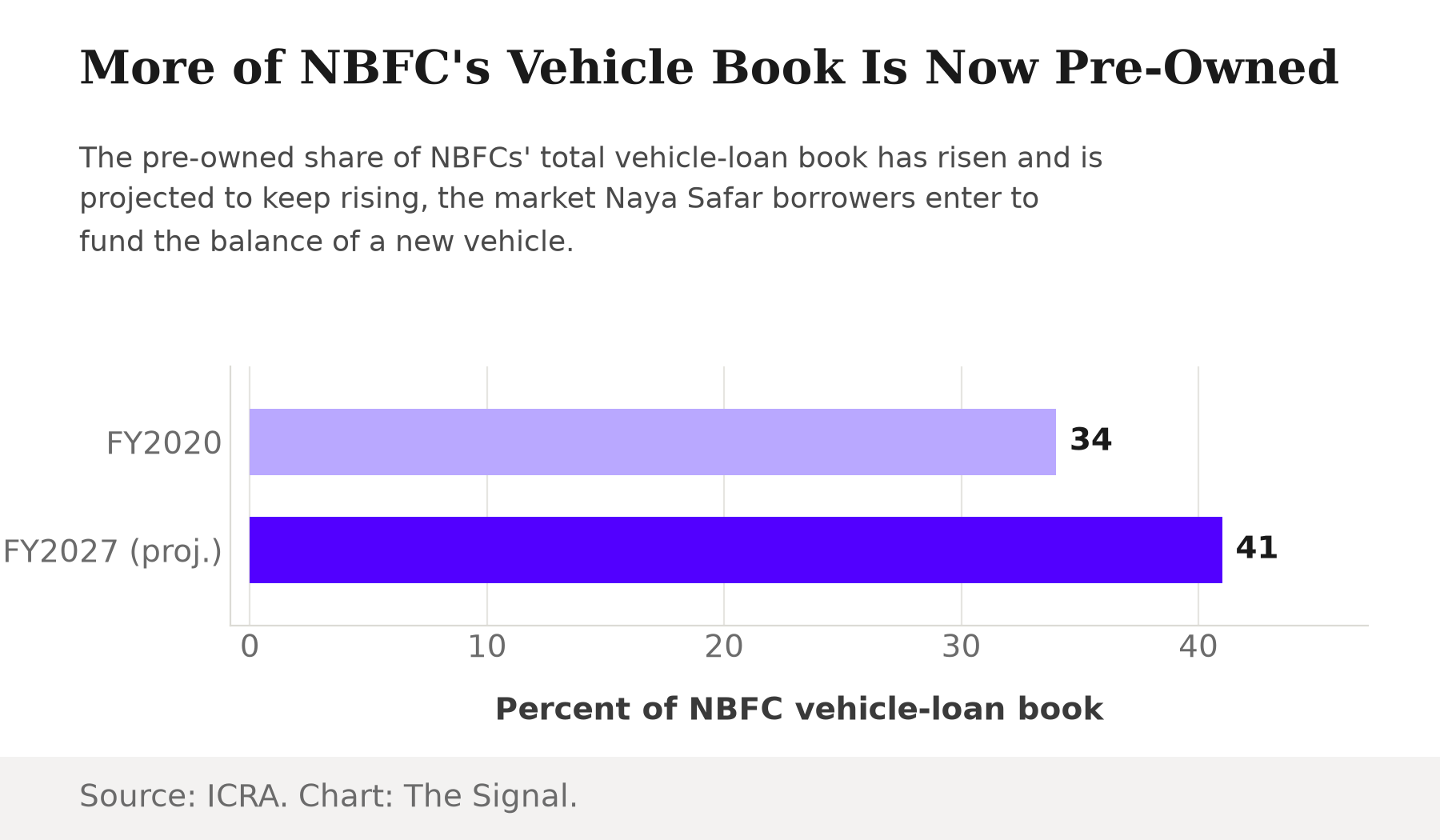
NBFC vehicle-loan assets under management are projected to keep growing about 16 to 17 percent a year, to roughly Rs 11 lakh crore by March 2027, CRISIL Ratings reports, with commercial vehicle financing continuing to be the largest single segment of that book. That is the market a Naya Safar borrower enters to fund the balance of a new truck or bus. It is also a market that is shifting toward older, riskier collateral. ICRA reports that pre-owned vehicles' share of NBFCs' total vehicle-loan book has risen from 34 percent in March 2020 to a projected 41-plus percent by March 2027, meaning a growing share of the book is financing used, higher-risk assets even as the book itself keeps expanding. Naya Safar did not create either trend. But it is sending 1.91 lakh truck owners, many of them small operators, into exactly this market to borrow.
Source: ICRA. Chart: The Signal.
The honest objection
The strongest case against calling this a financing trap is that Naya Safar's 5 percent interest subvention, up to 100 percent tax relief and 8 percent manufacturer discount are generous enough that the loan is close to a formality. Stacked together, they could plausibly bring the effective cost of a new vehicle close to what a small operator was already spending to keep an aging one running through fines, repairs and downtime. On that reading, the scheme has done its job: it made borrowing cheap enough that the loan barely matters.
That case holds for an operator able to comfortably service a loan at any rate, but says nothing about one unable to service one at all, however cheap it is. An interest subvention changes the price of debt. It has no bearing on whether a fleet owner already stretched by an aging vehicle can qualify for one, or survive a bad month once they have it. That is precisely the population Naya Safar targets, and precisely where credit risk lands hardest.
The Signal
Naya Safar solved the part of this transition that a government can solve directly: tax, fuel cost and purchase price, three levers the state controls and pulled hard. It left the remaining piece, the loan itself, to the market, and that is the market where ICRA says risk is already concentrating in older, higher-risk vehicles even as it keeps growing toward March 2027. Watch what happens over the next two years to loan approvals and defaults among the thinnest-margin operators of the 1.91 lakh truck owners this scheme is meant to serve. If Naya Safar's numbers hold up there too, the subsidy worked end to end. If they do not, Delhi will have discovered that a government can waive a tax and still lose an owner.
Reporting basis: the scheme's outlay, beneficiary count and concession structure are per the Press Information Bureau's Cabinet release and the Prime Minister's Office's release on the same Cabinet decision. The PM2.5 and pre-BS vehicle emissions figures are per DD News's account of the Cabinet announcement, which cites a 2018 ARAI-TERI source apportionment assessment as the origin. The 2018 Supreme Court order barring old vehicles from the NCR and the 2021 tax-concession notification under the base national Vehicle Scrapping Policy are both per Ministry of Road Transport and Highways replies carried by PIB. The Tata Motors memorandum of understanding, including its treatment of electric-vehicle discounts, is per News on AIR (Prasar Bharati). The NBFC vehicle-loan projections are from two separate rating agencies, CRISIL Ratings and ICRA. No figure in this piece is The Signal's own calculation.