China's economy grew 4.3 percent year-on-year in the second quarter of 2026, down from 5.0 percent in the first, according to the National Bureau of Statistics. The reading missed the 4.5 to 5 percent growth target Beijing set itself in its 2026 Government Work Report back in March. The easy read on a number like that is simple: China is slowing, so investors go looking elsewhere in Asia, India included. That framing is not wrong so much as it is incomplete.
It is worth slowing down on it. The growth miss is not primarily a story about which stock market foreign money prefers this quarter. It is a story about price. China's factory-gate prices rose 4.1 percent year-on-year in June 2026, the strongest reading since July 2022, which by itself could read as the end of a long run of Chinese producer-price deflation. Underneath that headline, the number that actually matters ran the other way. The sub-index for consumer goods, the category closest to finished, exportable manufactures, still fell 0.9 percent year-on-year the same month, even as mining and raw-material prices spiked 16.5 percent and pulled the headline number up.
The number that carries the thesis is negative 0.9, not positive 4.1.
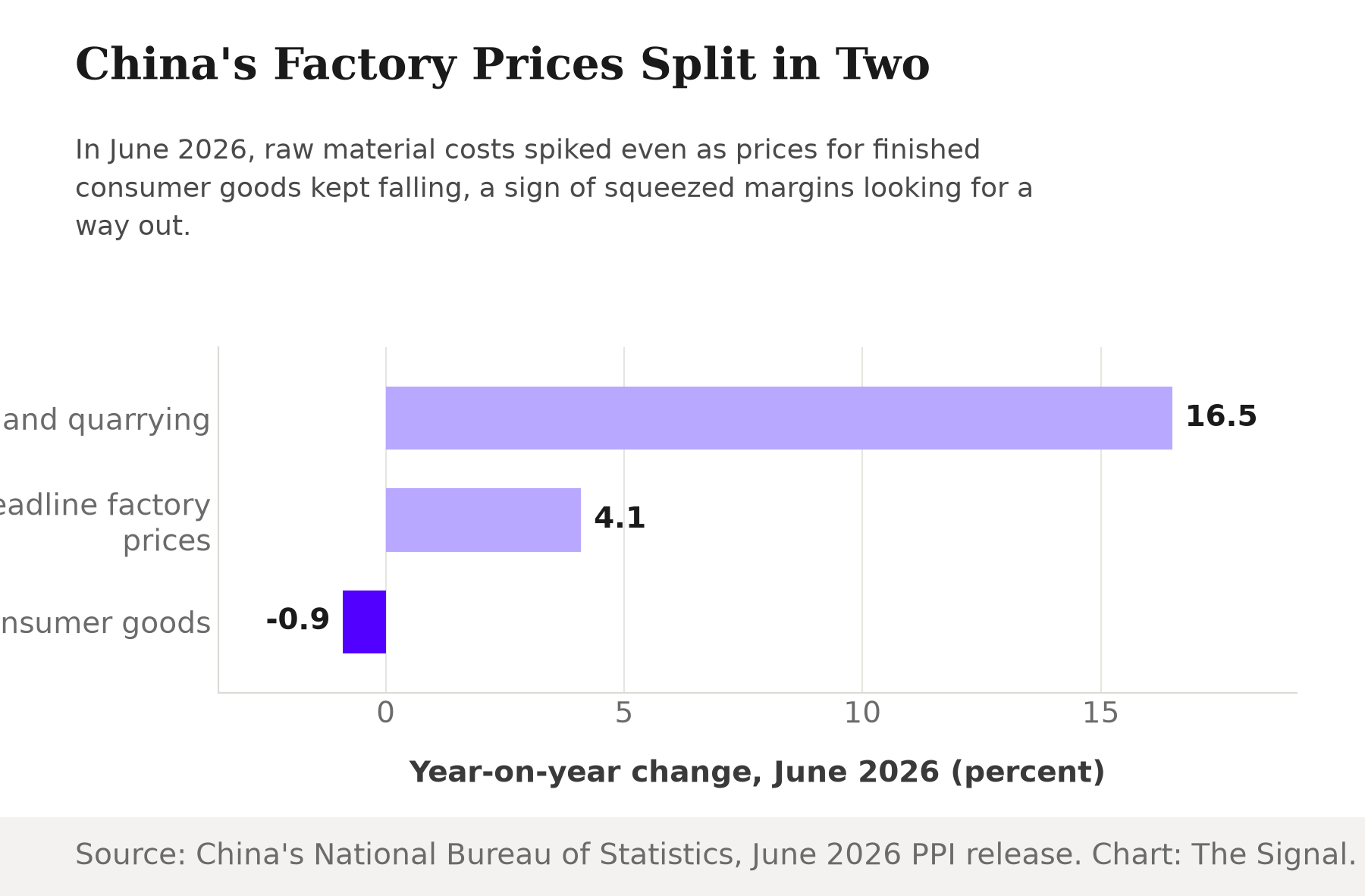
Source: National Bureau of Statistics of China. Chart: The Signal.
That split, not the quarterly growth print, is the mechanism worth tracking. When a manufacturer's input costs climb but the price it can charge for the finished product keeps falling, the incentive is to move the surplus somewhere it will still sell, even at a thin or negative margin. India sits downstream of exactly that surplus.
Where the squeeze lands as steel
China's finished-steel exports to India roughly doubled in April 2026, to about 232,000 tonnes, the most recent month for which trade data is available, making China India's top steel supplier that month. Chinese hot-rolled steel landed priced $11 to $37 a tonne below local mills, per Reuters' review of provisional Indian government trade data.
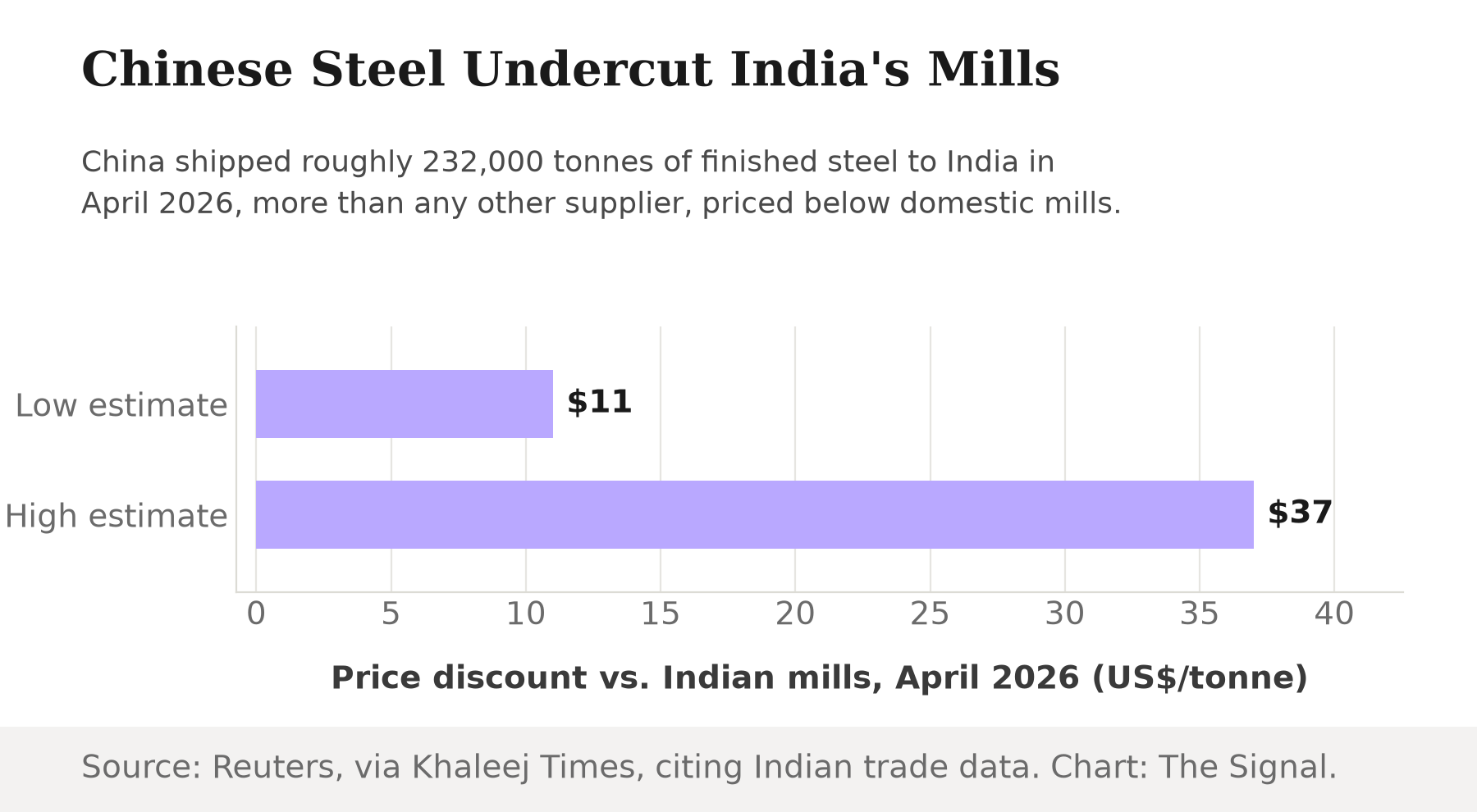
Source: Reuters' review of provisional Indian government trade data, via Khaleej Times. Chart: The Signal.
That April spike sits on top of a longer pattern, not a new one. The most recent full-year figure India's Ministry of Steel has published shows finished-steel imports rose 38 percent year-on-year to 8.32 million tonnes in the fiscal year that ended in March 2024, well before this quarter's Chinese growth miss. The direction matters more than any single month: underpriced Chinese steel has been finding its way into India for years, and a China squeezed into thinner factory-gate margins gives that flow a fresh push rather than starting it.
India's defenses, filed years apart
India's response predates the current headlines by a wide margin. In April 2025, India imposed a 12 percent provisional safeguard duty on non-alloy and alloy steel flat products for 200 days, aimed chiefly at curbing underpriced imports from China, its second-largest steel supplier after South Korea. Years before that, the Union Cabinet approved a Production-Linked Incentive scheme for specialty steel, offering ₹6,322 crore of incentives over five years to draw about ₹40,000 crore of fresh investment and cut import dependence, announced in July 2021. In December 2025, India imposed a definitive five-year anti-dumping duty of $223.82 to $414.92 a tonne on cold-rolled non-oriented electrical steel from China, effective that month.
India has been building tariff defenses against Chinese steel for years, not just since this quarter's growth miss.
| Measure | Announced | What it does |
|---|---|---|
| Provisional safeguard duty | April 2025 | 12% duty on non-alloy and alloy steel flat products, for 200 days, aimed chiefly at China |
| PLI Scheme for Specialty Steel | July 2021 | ₹6,322 crore of incentives over five years to draw about ₹40,000 crore of fresh investment |
| Anti-dumping duty, CRNO electrical steel | December 2025 | $223.82 to $414.92 per tonne, for five years, on imports from China |
Source: DD News (safeguard duty); PIB, Ministry of Steel (PLI scheme); Centax, citing a CBIC customs notification (anti-dumping duty).
The wider trade picture
Steel is one line item in a much larger imbalance. India's imports from China rose 16 percent to $131.63 billion in the fiscal year that ended in March 2026, while exports to China grew 36.7 percent to $19.48 billion, as China overtook the United States to become India's largest trading partner. Imports still ran nearly 6.8 times exports.
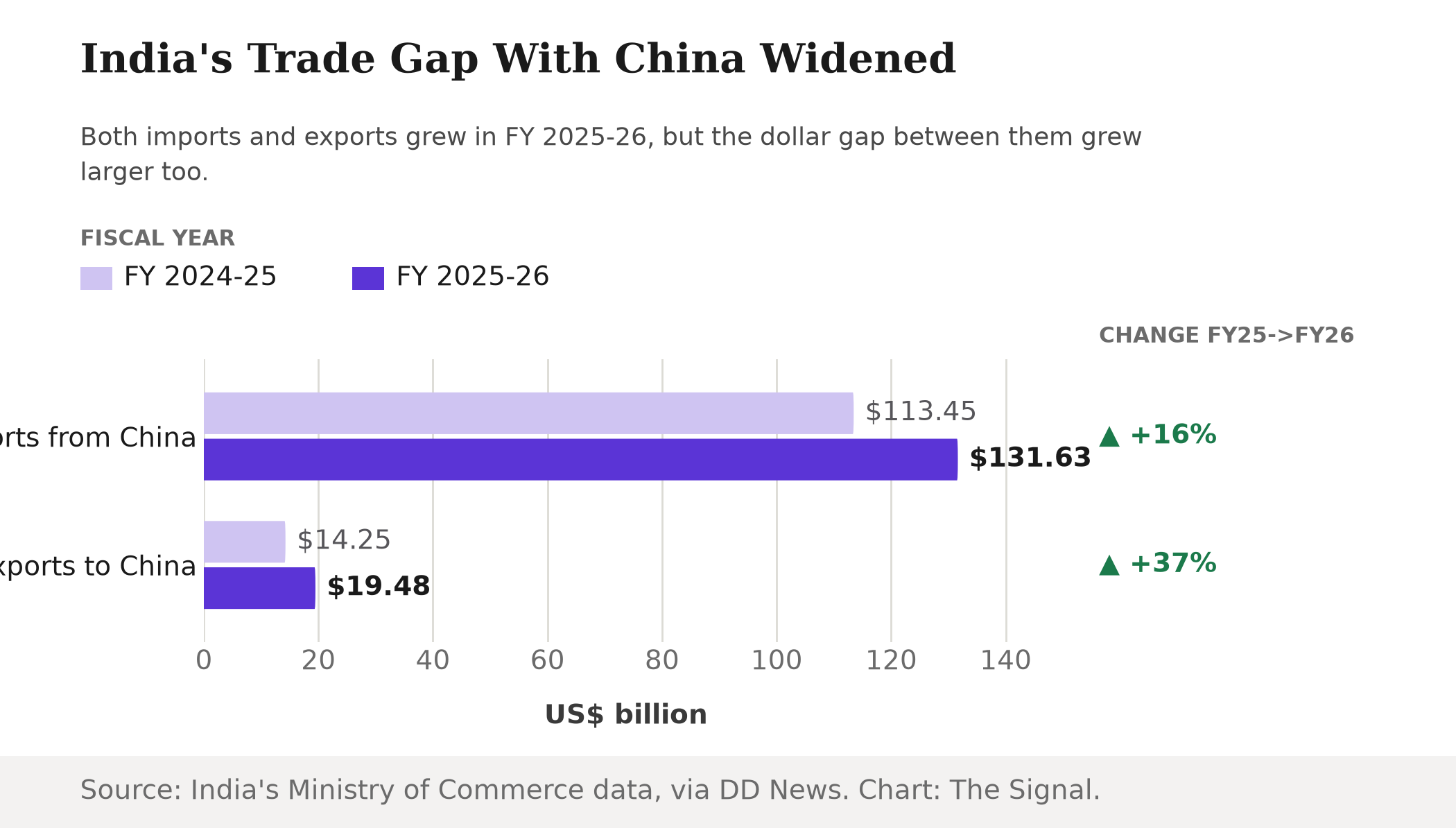
Source: Ministry of Commerce data, via DD News. Chart: The Signal.
Growth on both sides of that ledger is a genuine story. It does not change the shape of the imbalance underneath it, and steel, priced the way it was in April 2026, is one of the more visible reasons that shape persists.
The honest objection
The strongest case against reading this as China exporting deflation is that the headline number just turned convincingly positive. China's factory-gate prices rose 4.1 percent year-on-year in June 2026, the fastest pace since July 2022, a genuine reversal after a long run of falling producer prices, and most of India's steel duties predate this quarter's growth numbers by months or years. Crediting a single GDP miss with driving a multi-year trade pattern overstates the connection.
That case is real, but it treats the headline PPI number as if it describes the goods that actually cross a border. It mostly does not. The consumer-goods sub-index, the closer proxy for finished manufactures, was still falling 0.9 percent year-on-year in the same June release, even as the headline climbed on a 16.5 percent jump in mining and raw-material prices. A commodity rebound in the inputs is not the same thing as pricing power returning to the factories that turn those inputs into finished goods. And the steel numbers describe exactly the mechanism a deflation reading would predict: Chinese export volumes into India nearly doubled in a single month, priced below local mills, arriving on top of a duty regime India built specifically because the underpricing was already a problem before 2026.
The Signal
China's Q2 growth miss is not the number that matters for India. The number that matters is negative 0.9: Chinese consumer-goods prices are still falling even as the headline producer-price index turns positive, which means the pressure on Chinese manufacturers to move overcapacity somewhere else has not eased. It has simply stopped showing up in the headline print. India's steel sector is the clearest place that pressure is landing, with Chinese volumes doubling in a single month even as the trade gap between the two countries widens on both sides of the ledger. Watch the consumer-goods sub-index, not the quarterly GDP print. As long as it stays negative while raw-material costs climb, the goods leaving Chinese factories at a discount will keep finding a home in Indian ports, whatever the next headline growth number says.
Reporting basis: China's Q2 2026 GDP figure and its June 2026 producer price index, including the consumer-goods and mining sub-indices, are both from the National Bureau of Statistics of China. The 2026 growth target is from the State Council's Government Work Report. The April 2026 Chinese steel export volume and pricing figures are per Reuters' review of provisional Indian government trade data, as carried by Khaleej Times. India's finished-steel import figure for the fiscal year ended March 2024 and the PLI scheme details are from India's Ministry of Steel, via Press Information Bureau releases. The safeguard duty is from India's Directorate General of Trade Remedies, via a DD News report. The anti-dumping duty on CRNO electrical steel is per a CBIC customs notification, as reported by Centax. India's FY2025-26 trade totals with China are Ministry of Commerce data, via DD News. The multiple by which India's imports from China exceed its exports to China is The Signal's calculation from those figures.