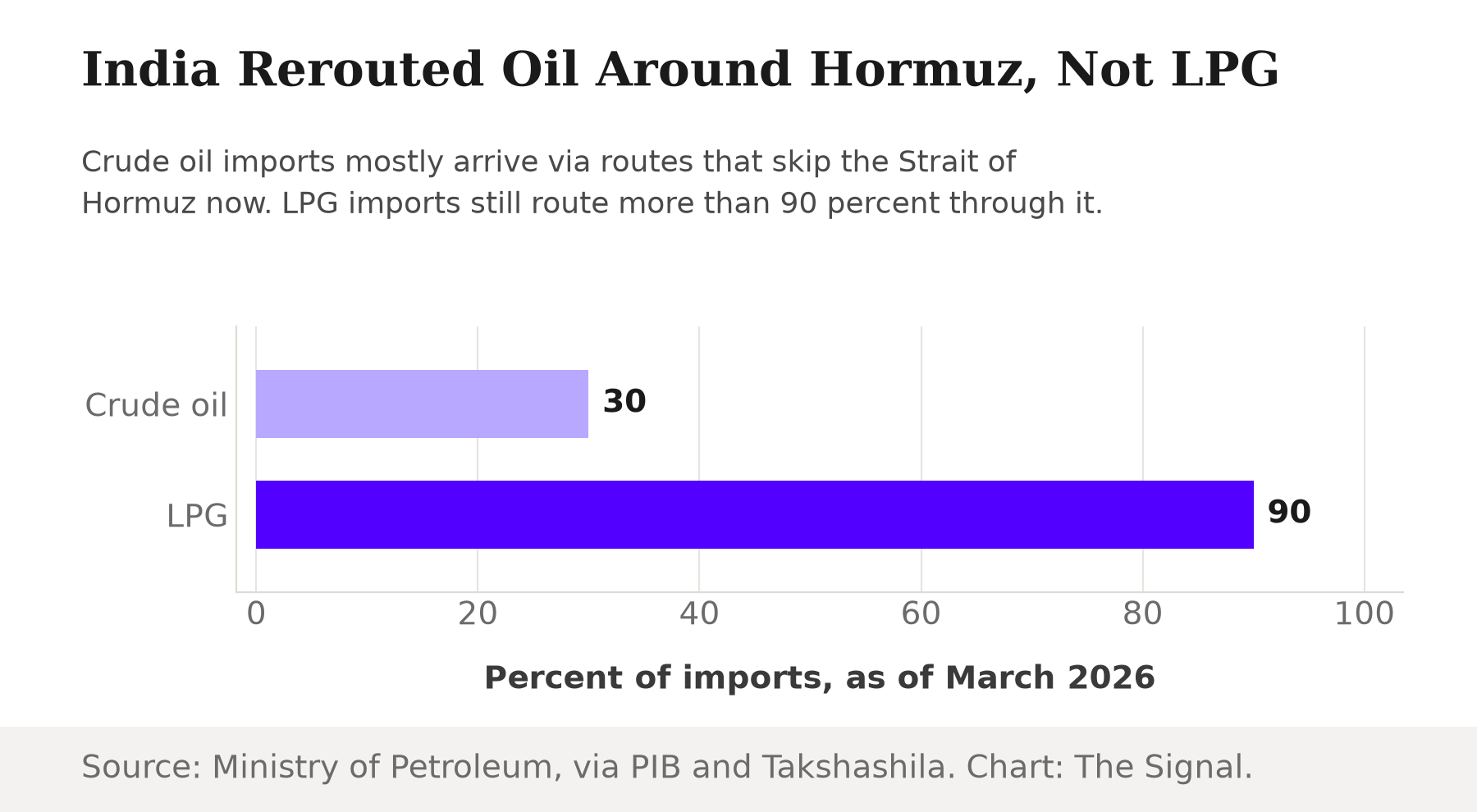
The Strait of Hormuz is not a niche shipping lane. Flows through it in 2024 and the first quarter of 2025 made up more than one-quarter of total global seaborne oil trade, so a US move to control passage through it is, by definition, a global story. On July 13, President Trump said on Truth Social that the United States would collect a toll equal to 20 percent of the value of all cargo shipped through the strait, alongside reinstating a US naval blockade of Iranian ports. For an Indian reader, the instinct is to check that against a story already told: India spent the past two years diversifying its crude oil supply, and about 70 percent of India's crude imports now arrive via routes outside the Strait of Hormuz, up from about 55 percent before. If the toll is an oil story, India has already priced in the risk.
The toll Trump described is not an oil tariff. It taxes cargo of any kind.
Read his own wording closely: he promised reimbursement "at the rate of 20% on all cargo shipped," not oil specifically. That single word, cargo, is the part India's oil-rerouting story does not cover.
It is worth slowing down on that. Even inside energy, the insulation is not complete. India imports about 60 percent of its LPG demand, and more than 90 percent of those LPG imports transit the Strait of Hormuz. Crude oil could be resourced from the Atlantic basin, the United States and Russia; cooking gas has fewer alternative suppliers within tanker range, so it never got the reroute crude did.
What a cargo toll actually costs
Whether Trump can collect this at all is an open legal question from day one. The International Maritime Organization has already said there is no legal basis for a country to impose mandatory tolls on ships transiting an international strait. Nothing about collection or enforcement has been worked out in public.
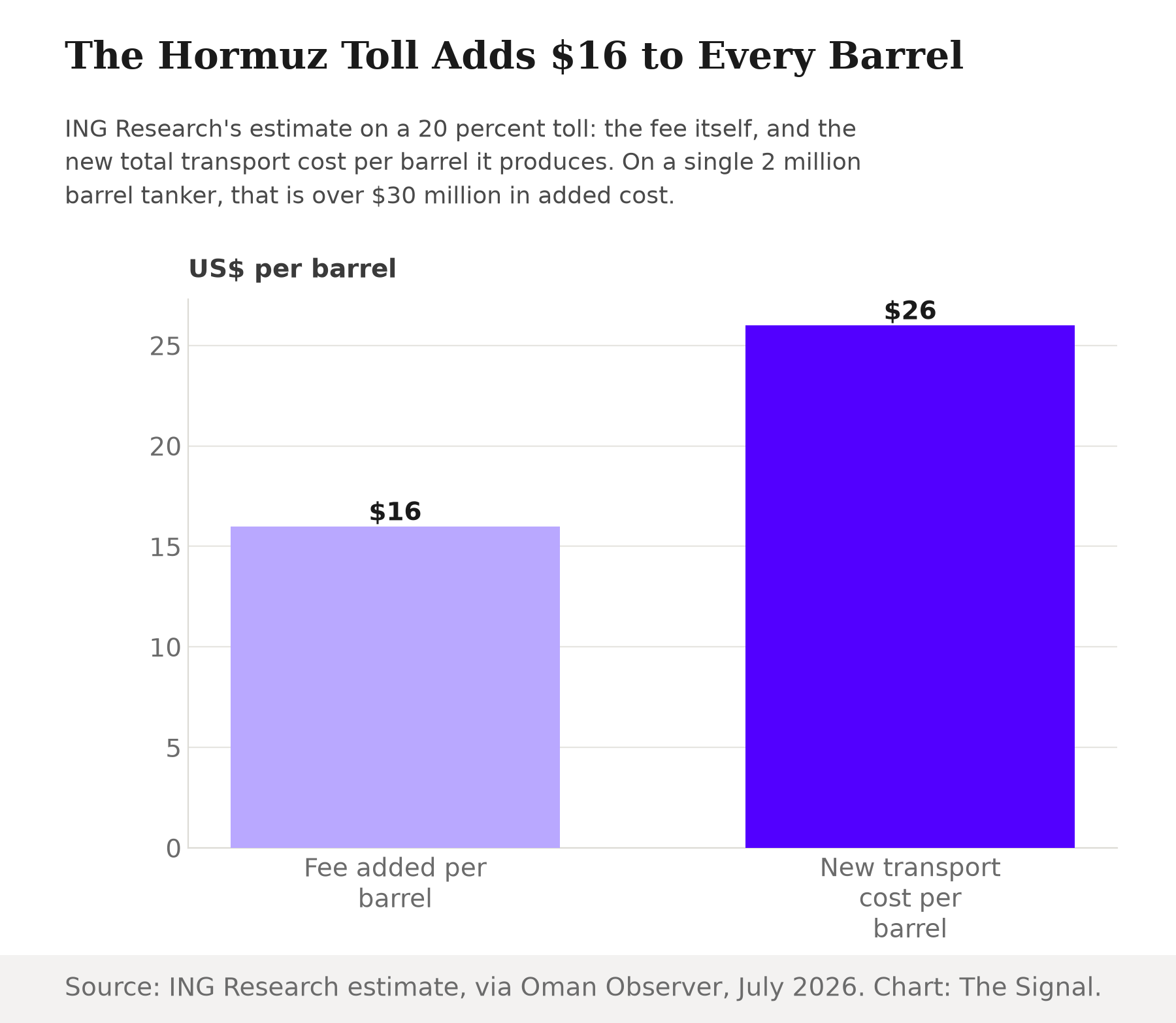
What the toll would cost in practice is easiest to see in oil, the one cargo type with a published estimate already attached to it. ING Research economist Rico Luman calculates that a 20 percent fee would add roughly $16 to every barrel's transport cost, pushing it to about $26 a barrel, and add more than $30 million in cost to a single tanker carrying 2 million barrels.
That math is specific to oil's cost structure and tanker economics; it is not a general per-unit figure for containerized goods. But the mechanism behind it is what Trump described as a 20 percent fee applying to all cargo shipped through the strait, not to oil alone.
The trade that has no detour
Crude oil could be resourced from elsewhere because oil is fungible: a barrel from Nigeria substitutes for a barrel from Iraq. Bilateral trade with a specific country cannot be resourced the same way, and four of India's Gulf trading partners sit inside the Persian Gulf itself, reachable by sea only through the strait that Trump wants to toll.
India's trade with the UAE crossed $100.06 billion in FY2024-25, up 19.6 percent year on year. Most of it is not oil: by FY2025-26, non-oil trade accounted for nearly two-thirds of the two countries' $101.25 billion bilateral total, the part of the relationship a cargo toll, as opposed to an oil tariff, would hit hardest. Trade with Saudi Arabia reached $41.88 billion in FY2024-25, 3.61 percent of India's total trade. Trade with Iraq totaled $33.36 billion in FY2023-24, of which $30.01 billion was India's imports, and as of October 2025, trade with Qatar stood at around $14 billion, with both governments targeting a doubling by 2030.
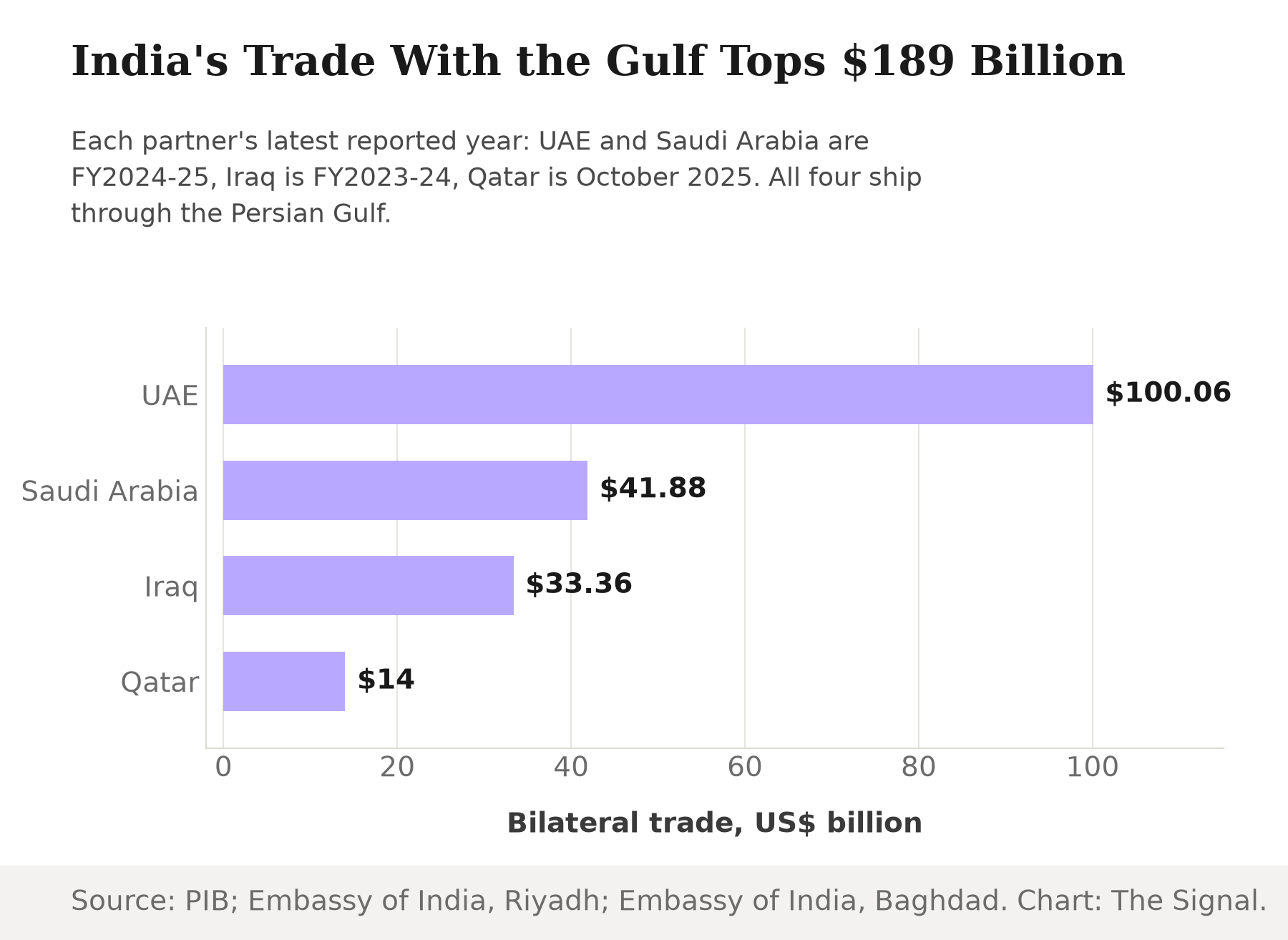
Add the four together, each counted in its own latest reported year rather than one common period, and India runs roughly $189 billion a year in trade with Gulf economies that have no oil-style reroute available (our calculation, summing figures reported for different fiscal years). For scale, that sits against India's total exports of goods and services, which hit an all-time high of $825.25 billion in FY2024-25; the two figures measure different things, one partner group's total trade against the whole country's exports, but they establish that the Gulf relationship is not a rounding error next to India's broader trade.
Saudi Arabia is the partial exception. Its Red Sea ports give it a second coastline that Qatar and Iraq do not have, so some share of India-Saudi trade can plausibly move outside the strait already. UAE, Qatar and Iraq have no equivalent second coast for general trade. The UAE's own Hormuz-bypass infrastructure does not change that: its Habshan-Fujairah pipeline, running since 2012 with a capacity of about 1.5 million barrels a day, carries only crude oil, not the general cargo that makes up most of its trade with India. Strip out Saudi Arabia's $41.88 billion and India is still left with roughly $147 billion a year in UAE, Qatar and Iraq trade (our calculation) that has only one sea route out.
The honest objection
The strongest case against treating any of this as urgent is that the toll may never be collected. An international strait toll has no obvious enforcement mechanism and no ships to inspect it; an intergovernmental body has already said it has no legal footing. On that view, this is a social media post, not a policy, and India's trade planners have more pressing things to model.
That case is real, but the same Truth Social post also reinstated a US naval blockade of Iranian ports, which is a military posture, not a tariff schedule waiting on customs paperwork. A proposal backed by a stated naval presence in the strait is not the same as an empty threat, whatever the IMO's reading of international law. Trading partners do not need the toll to be collected for a year to start repricing the risk of it; they need one seizure, one blockade incident, or one collected toll to establish that the posture is real.
The Signal
India's oil-rerouting story was a genuine and specific achievement, but it answered a narrower question than "is India exposed to a Hormuz shock." Trump's cargo-toll framing, whatever its odds of holding up, exposes the shape of the risk India still carries: an LPG import book still more than 90 percent tied to the strait, and roughly $189 billion in trade with Gulf economies that reach India by no other sea route. Watch two things from here. First, whether the toll survives the IMO's objection into any actual collection mechanism, or dies as a Truth Social post. Second, whether India starts talking about LPG diversification and Gulf-trade route risk with anything like the urgency it applied to crude. Until it does, insulation from Hormuz is a story about barrels, not about everything else still on the ships.
Reporting basis: Trump's toll announcement and the accompanying naval-blockade language are as reported by Al Jazeera, quoting his Truth Social post. The International Maritime Organization's rejection of the legal basis for such tolls is as reported by Al-Monitor. The cost-per-barrel and per-tanker estimates are ING Research's, via Oman Observer. India's crude-import rerouting figures are from the Ministry of Petroleum and Natural Gas, via a Press Information Bureau release; the LPG-import exposure figure is from the same ministry, as cited in a Takshashila Institution policy analysis. The UAE and Qatar bilateral trade figures are from Press Information Bureau releases; the UAE's non-oil trade share is as reported by Times of Oman; the Saudi Arabia and Iraq figures are from the Embassy of India's economic briefs in Riyadh and Baghdad, each for that partner's own latest reported year; the UAE's Habshan-Fujairah pipeline capacity is as reported by Al Jazeera. The Strait of Hormuz's share of global seaborne oil trade is from the US Energy Information Administration, and India's total exports figure is from a Press Information Bureau year-end review. The combined $189 billion and $147 billion Gulf-trade figures are The Signal's calculations, each summing partner figures reported for different fiscal years rather than one common period.