On July 12, an attack struck the Cyprus-flagged commercial vessel GFS Galaxy off the coast of Oman, a ship carrying 11 Indian nationals. Ten were rescued. One remains missing, and India's Ministry of External Affairs condemned the attack the same day. It joins a running list: at least five commercial vessels have been attacked in and around the Strait of Hormuz in the three weeks since the 17 June ceasefire between the US and Iran, as of 9 July, and ship-tracking data had already counted 22 vessels attacked in the strait since the war began on 28 February 2026, as of 14 April. The strait earns that attention because of what normally moves through it: about 20 million barrels of oil a day in 2024, roughly a fifth of world petroleum liquids consumption and more than a quarter of global seaborne oil trade across 2024 and the first quarter of 2025. The instinctive story writes itself: a war in the world's most important oil chokepoint should show up first in India's fuel bill.
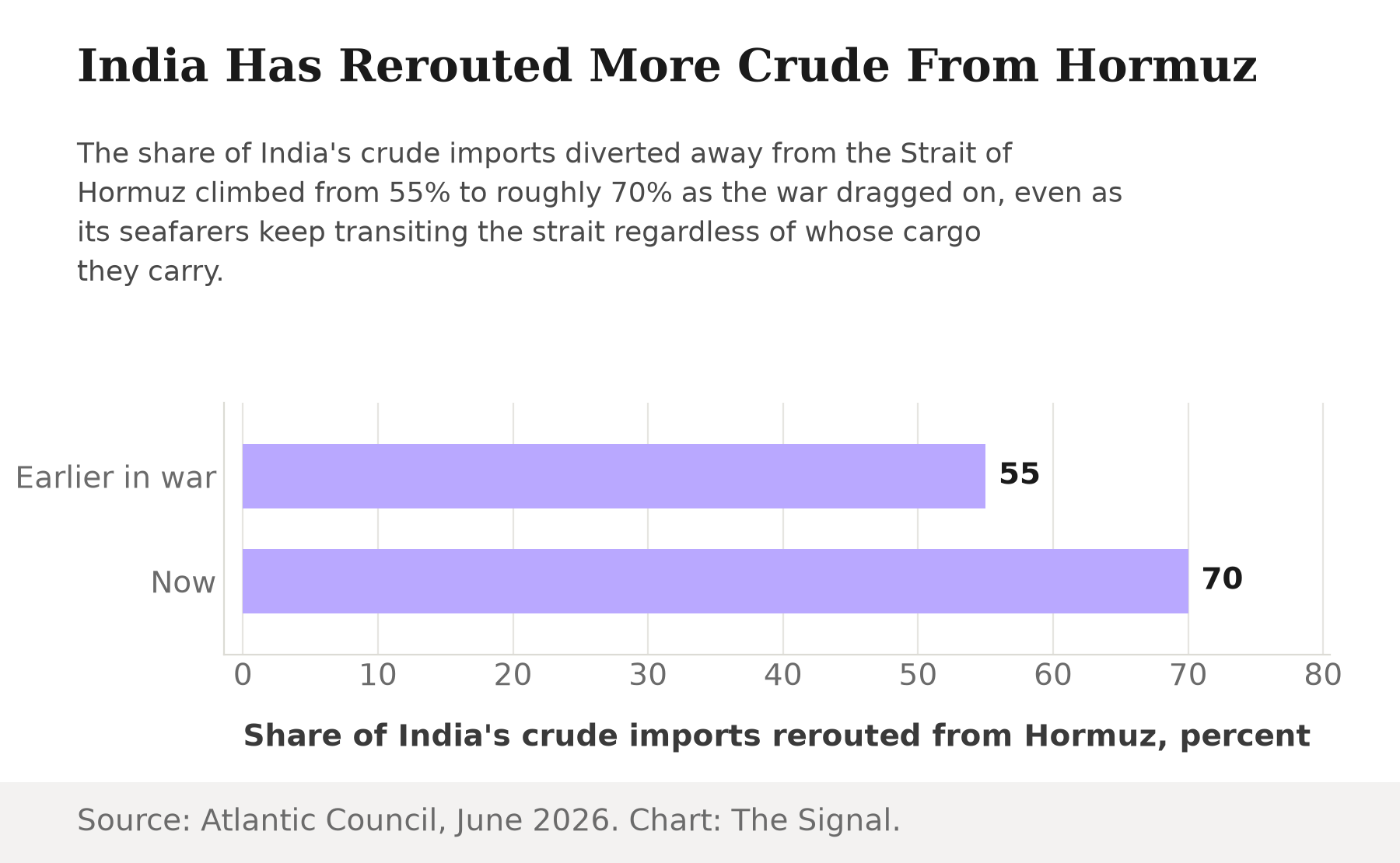
It is worth slowing down on that. As of early June 2026, India had rerouted roughly 70% of its crude imports away from the Strait of Hormuz, up from 55% earlier in the war, leaving roughly 30% still crossing it. Before the war, about 45% of India's crude oil imports, half its LNG imports and 90% of its LPG imports passed through the strait; most of that crude no longer does. New Delhi has done roughly what a country facing a war in its main energy corridor should do. It has moved its own trade away from the danger.
Rerouting a nation's trade does not reroute its labor.
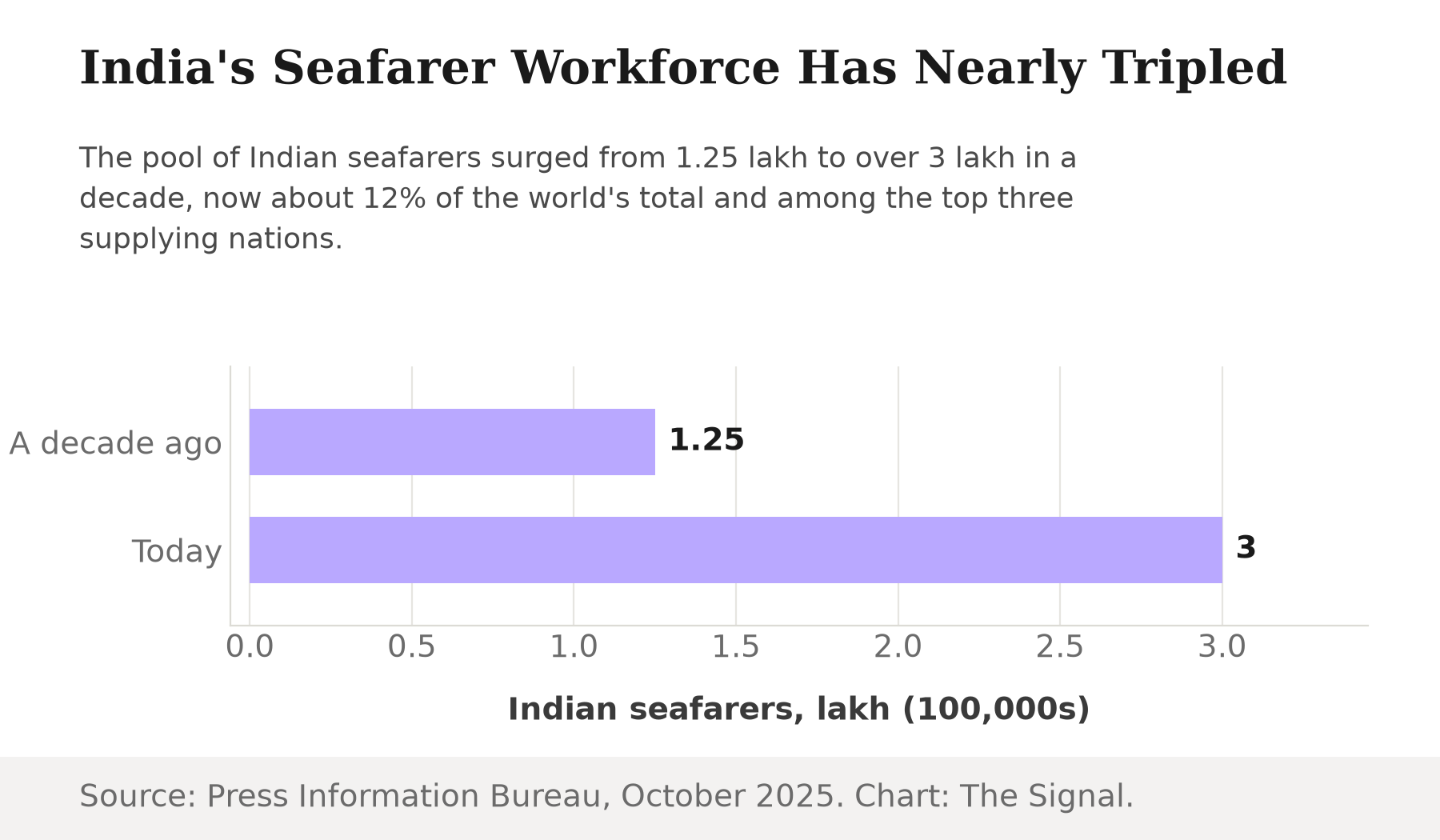
The number that has not moved is the workforce. India's seafarer count has surged from 1.25 lakh to over 3 lakh in a decade, now about 12% of the world's seafaring workforce and one of its top three supplying nations, as of October 2025. Roughly one in eight of the sailors crewing the world's commercial fleet is Indian, and that fleet keeps transiting Hormuz on its own schedule, regardless of how much Indian cargo still rides in its tanks. GFS Galaxy was Cyprus-flagged, not Indian-flagged. It carried 11 Indian nationals anyway. The war India has largely routed its own oil around is a war its labor force cannot route around, because Indian seafarers crew ships on the basis of who needs a crew, not whose oil, or whose flag, is on board. India's own shipping ministry put a number on that exposure on 19 June: nearly 18,000 Indian sailors remained stranded in and around the strait, and only 662 of them were aboard the 13 Indian-flagged vessels there. The rest, the overwhelming majority, were crewing ships that fly someone else's flag.
The workforce nobody reroutes
India did not become one of the world's largest seafarer-supplying nations because of any single strait or any single war. It happened the way most labor-export scale happens: shipping companies needed trained crew, Indian maritime academies and recruitment agencies supplied it at scale, and the number compounded across a decade into a workforce large enough to be counted among the world's top three supplying nations. That scale is now structurally exposed to every chokepoint conflict the global fleet sails through, Hormuz included, independent of anything India's own refiners and import planners decide about their own supply routes. A war can make an Indian company's crude imports safer within months, simply by rerouting tankers. An Indian sailor's job on a foreign-flagged, foreign-owned ship is no safer for it, because that sailor's exposure was never a function of India's trade routing in the first place.
A ship does not check whose oil it carries
The attacks themselves back this up. Kpler's ship-tracking data counted 22 vessels attacked in the Strait of Hormuz between the war's start on 28 February and 14 April, and the toll kept climbing after a ceasefire briefly suggested otherwise: at least five more vessels were hit in and around the strait in the three weeks after the 17 June US-Iran ceasefire, as of 9 July. Today's strike on GFS Galaxy fits the same pattern: a Cyprus-flagged ship, hit regardless of a ceasefire, with an Indian crew that had no more say in its cargo or its flag than in the missile that found it. None of these ships needed to be carrying Indian trade for Indian nationals to be aboard when they were attacked. A large, mobile, globally distributed workforce guarantees that a meaningful share of any incident in any strait will involve an Indian national, on nobody's schedule but the shipowner's.
| Commodity | Share of India's imports transiting the Strait of Hormuz before the war |
|---|---|
| Crude oil | 45% |
| LNG | 50% |
| LPG | 90% |
Source: Atlantic Council energy-security analysis. Crude's share has since fallen sharply as India rerouted; the analysis does not report a comparable current figure for LNG or LPG.
The bill that lands on the crew, not the customs form
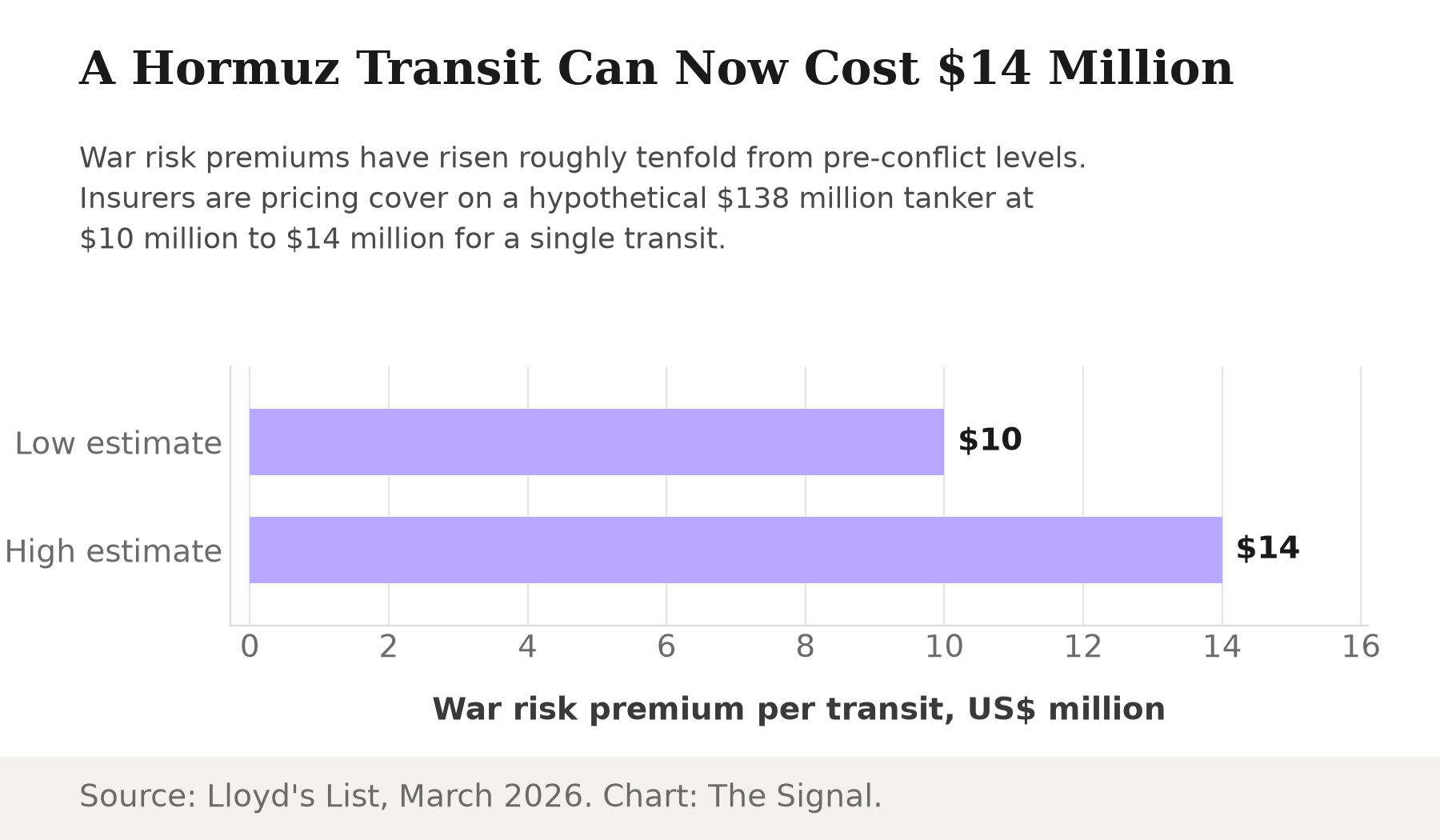
The war's cost has not disappeared. It has simply moved to a different ledger. War risk insurance premiums have risen roughly tenfold from pre-conflict levels, with insurers pricing cover on a hypothetical $138 million tanker at $10 million to $14 million for a single transit. That premium is charged whether or not the cargo in the hold is bound for an Indian refinery. The "roughly tenfold" jump also shows up as two concrete price tags: insurers reported a $300 million tanker's own war-risk premium rising from under $400,000 before the conflict to between $6 million and $15 million at the peak of the crisis. Separately, the Strait of Hormuz, the Gulf of Oman and the Persian Gulf are designated a Warlike Operations Area under the seafarers' industry agreement, entitling crew to a bonus equal to 100% of basic wage for a minimum of five days and more for each extra day in the zone, doubled death and disability compensation, and the right to refuse the voyage with paid repatriation plus two months' basic wage. Those entitlements attach to the sailor, not the shipment. A vessel carrying zero Indian cargo still owes its Indian crew members the same hazard bonus as one carrying an Indian refiner's full order.
The honest objection
The strongest case against dramatizing this is proportion. Twenty-two attacked vessels since late February and five more since mid-June are a small fraction of the ships that cross Hormuz in any given month; the odds that a specific Indian seafarer on a specific voyage is hit remain low, and calling the strait a blanket danger zone for Indian labor risks overstating an individual sailor's actual exposure on any one transit.
That case holds for any single voyage, but it misses how the risk is actually priced and compensated. The Warlike Operations Area entitlement and the roughly tenfold jump in war risk premiums do not wait for an individual sailor's odds to clear some threshold. They apply to the entire class of vessels and crew in the zone, because insurers and unions are pricing the tail risk across the whole fleet, not any one ship's chances. For the one Indian national still missing from GFS Galaxy tonight, the low base rate is beside the point. Low average risk and a real, ongoing casualty count are not in tension: they are the same war, measured two different ways.
The Signal
India has done the defensible thing with its own energy security: it rerouted most of its crude away from the strait a war put in play. But a country's trade routes and its labor supply are not the same asset, and only one of them can be rerouted by a government decision. The seafarer workforce that makes India one of the world's top three crew-supplying nations sails on contracts written by companies in Athens, Hamburg and Singapore, under flags of convenience, into whatever strait the cargo demands. Watch two numbers together, not one: the war risk premium on a Hormuz transit, and the count of attacked vessels with Indian nationals aboard. If the premium keeps climbing even as India's own tanker traffic through the strait keeps falling, the decoupling is complete: the war becomes something India's economy has left behind, and something its workforce has not. A rerouted tanker protects a balance sheet. It does not protect the man on watch on someone else's ship.
Reporting basis: the seafarer workforce figures are from a Press Information Bureau review citing the Ministry of Ports, Shipping and Waterways, dated October 2025. The 18,000-sailor and 662-sailor Gulf headcounts are per Business Today, citing the same ministry, dated 19 June 2026. The $300 million tanker's before/after war-risk premium is per Insurance Business's trade reporting, dated 25 June 2026, and describes a separate illustrative vessel from the $138 million tanker cited by Lloyd's List. The Strait of Hormuz's oil-flow share is from the US Energy Information Administration. India's crude rerouting figures and pre-war import shares are from a single Atlantic Council energy-security analysis synthesizing tanker-tracking data, dated June 2026, without independent corroboration in the matrix for those particular percentages. The GFS Galaxy attack and casualty details are per Gulf News, citing India's Ministry of External Affairs. War risk insurance premiums are per Lloyd's List's shipping-insurance reporting. The Warlike Operations Area designation and seafarer entitlements are per the International Transport Workers' Federation. Vessel-attack counts are per two separate Al Jazeera reports, one citing Kpler ship-tracking data for the period through 14 April and one for the three weeks following the 17 June ceasefire; the two counts cover different, non-overlapping windows and are not additive. The remaining roughly 30% of India's crude still transiting Hormuz is The Signal's calculation from the Atlantic Council's rerouting figure.