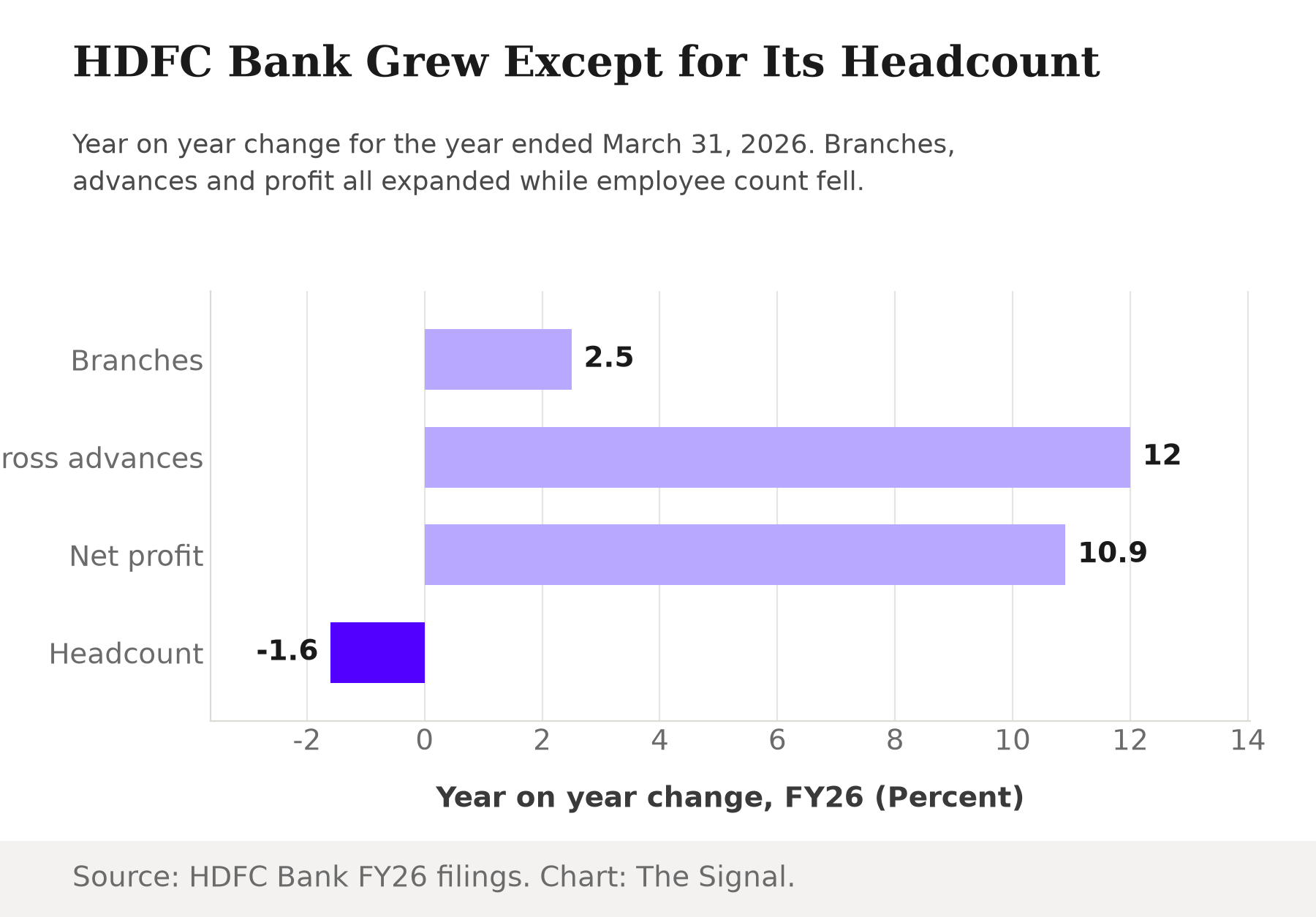
HDFC Bank has told one hiring story since 2022: absorb, integrate, grow. The bank's own Form 20-F filing with the US Securities and Exchange Commission states that its headcount rose from 1,41,579 employees as of March 2022 to 1,73,222 as of March 2023 to 2,13,527 as of March 2024, as it onboarded staff acquired when parent HDFC Limited merged into it. Extend that line and the year to March 2026 should look like more of the same: a bigger loan book, more branches, more people to run them.
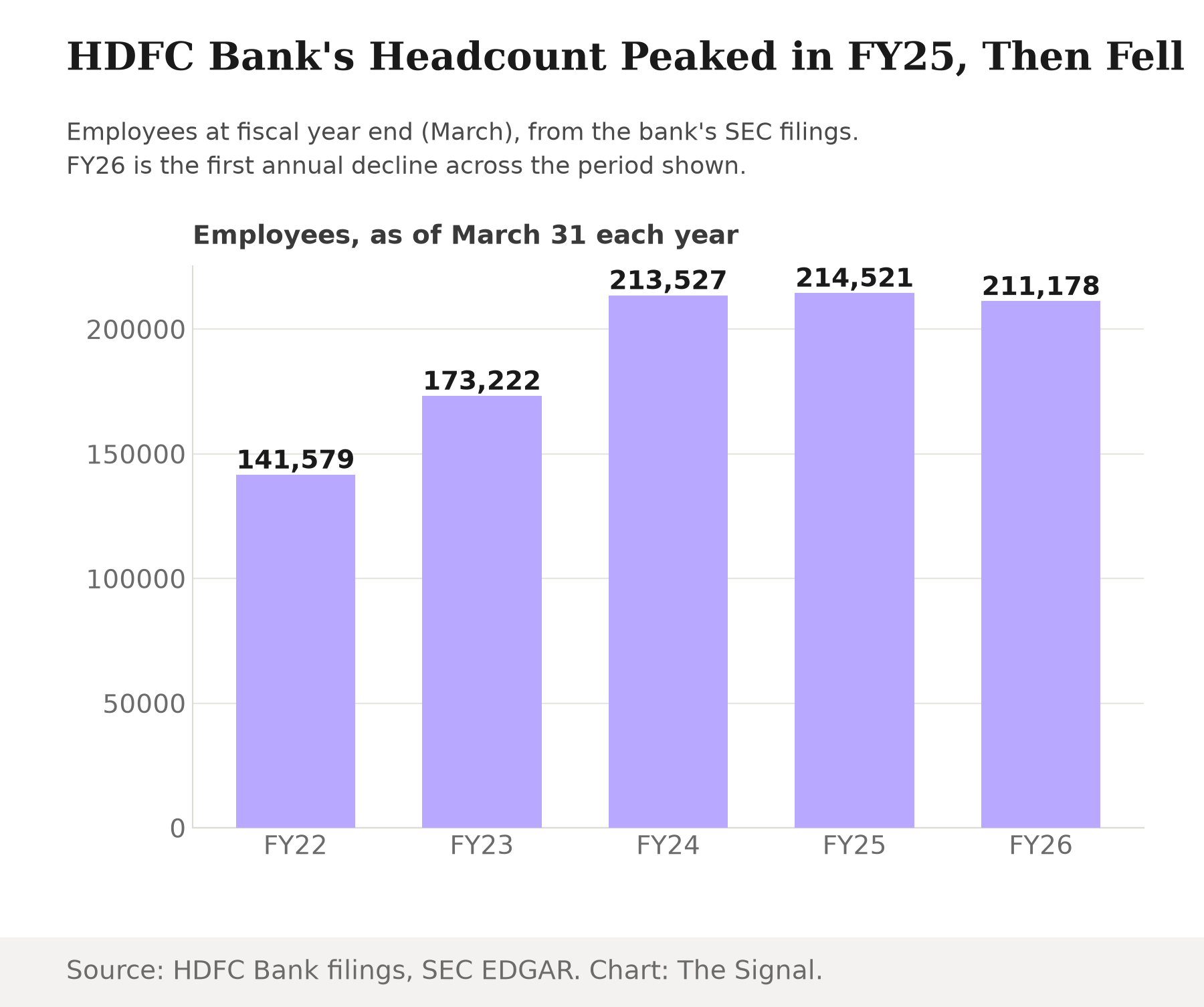
It does not. HDFC Bank's own FY26 results release, furnished to the US SEC on Form 6-K, puts headcount at 2,11,178 as of March 31, 2026, down from 2,14,521 a year earlier, a decline of 3,343 employees, the first annual drop across the five years of filings cited here. The bank itself did not shrink. Gross advances grew 12.0 percent year on year on an end-of-period basis in the year to March 2026, standalone net profit for the year ended March 31, 2026 rose to Rs 74,671.29 crore, from Rs 67,347.36 crore a year earlier, a rise of about 10.9 percent, and the branch network grew from 9,455 outlets to 9,689. Every measure of the bank's size grew in the year to March 2026 except the number of people on its payroll.
The five-year swing
The scale of the earlier hiring wave matters here. Headcount grew 22.4 percent in the year to March 2023 and 23.3 percent in the year to March 2024, adding roughly 72,000 people in two years, as HDFC Limited's staff were folded into the bank. Middle management grew 26 percent to 7,993 employees, from 6,326, and junior management grew 19 percent to 30,715, from 25,837, in that same year to March 2024. As of March 2023, just before that absorption, non-supervisory staff, including sales officers, already made up 81 percent of the combined workforce, 1,40,888 of 1,73,222 employees. The headcount HDFC Bank added during the merger was concentrated in front-line and sales-facing roles, the segment of any bank's workforce with the highest ordinary turnover.
Growth after the merger nearly stopped before it reversed. Headcount rose just 0.5 percent, to 2,14,521, in the year to March 2025, after two years of double-digit increases that took it from 1,41,579 to 2,13,527. The year to March 2026 is the first one in this run where the number moved backward.
Everything else got bigger
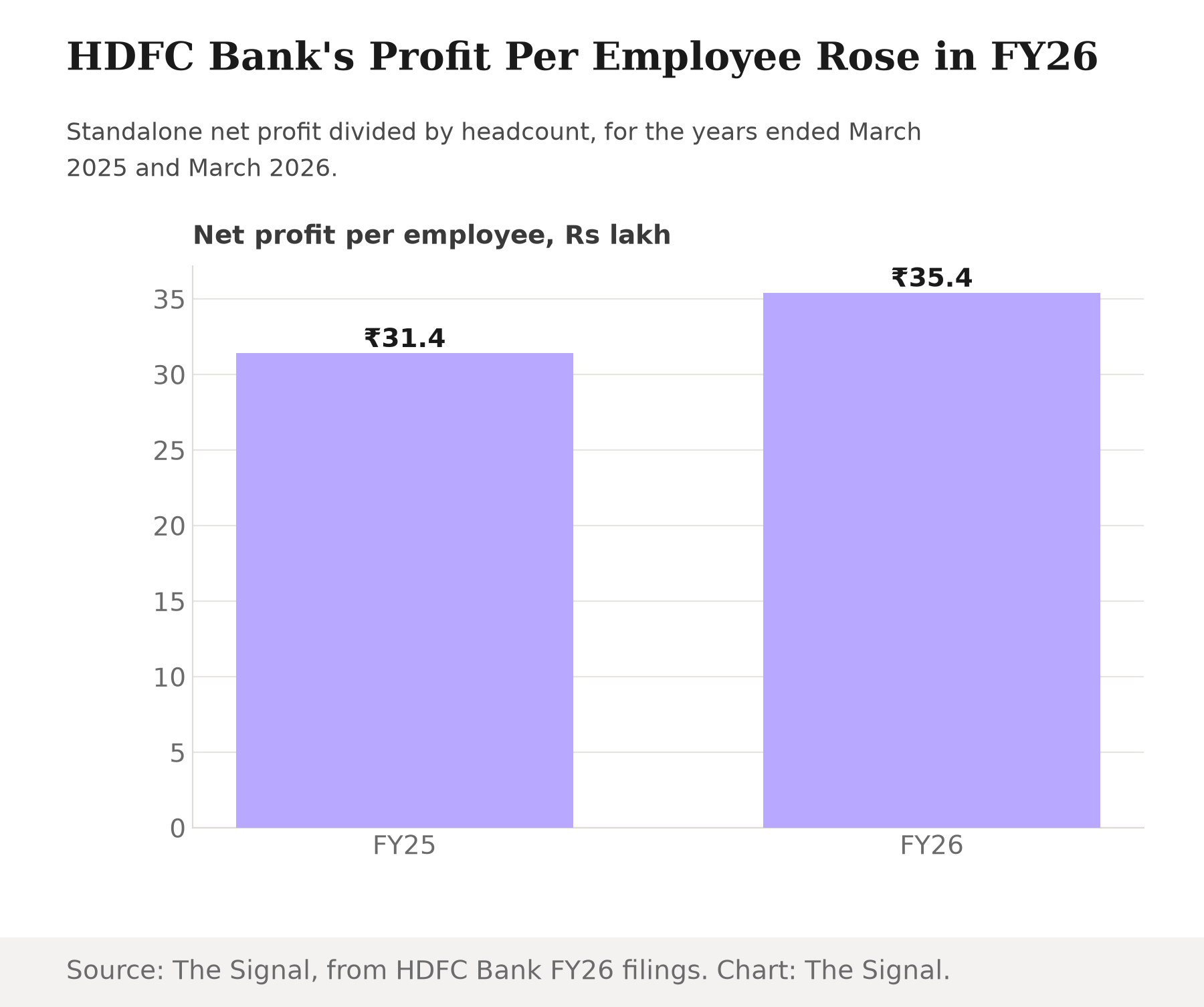
Gross advances grew 12.0 percent year on year on an end-of-period basis in the year to March 2026, an increase of about Rs 3.17 trillion. Standalone net profit for the year ended March 31, 2026 was Rs 74,671.29 crore, up from Rs 67,347.36 crore a year earlier, a rise of about 10.9 percent. Divide profit by headcount and the swing sharpens further: profit per employee rose from about Rs 31.4 lakh in the year to March 2025 to about Rs 35.4 lakh in the year to March 2026, a jump of roughly 12.6 percent, our calculation from the bank's profit disclosure and its headcount disclosure read together. A bank paying out more profit per employee while employing fewer of them is the textbook signature of a productivity gain, whatever produced it.
A pattern beyond one bank
HDFC Bank is not the only large private bank posting this shape. Axis Bank's own Q4 FY26 earnings call transcript states that it added 400 branches during the year even as its total workforce declined 3 percent year on year, which the bank attributes directly to "technology-led efficiency gains at both employee and branch levels." Axis had no merger to digest. A second large private bank, starting from a different base, posting the identical direction, more branches and fewer people, with a cause named in its own transcript, is meaningful context for reading HDFC Bank's year.
Two of India's largest private banks, HDFC Bank and Axis Bank, grew their branch networks while shrinking their workforce in the year to March 2026.
| Bank | Branches, FY26 | Workforce change, FY26 | Stated driver |
|---|---|---|---|
| HDFC Bank | 9,689, up from 9,455 | Down 1.6 percent (3,343 employees) | Not stated in the bank's own release |
| Axis Bank | Added 400 during the year | Down 3 percent year on year | "Technology-led efficiency gains at both employee and branch levels" |
Source: HDFC Bank's FY26 results release; Axis Bank's Q4 FY26 earnings call transcript.
The honest objection
The strongest case against reading the year to March 2026 as an automation story is arithmetic. HDFC Bank's headcount grew 22.4 percent in the year to March 2023 and 23.3 percent in the year to March 2024 as it absorbed HDFC Limited's staff, adding roughly 72,000 people in two years. Non-supervisory staff, including sales officers, already made up 81 percent of the workforce as of March 2023, before that absorption, and middle and junior management, the categories that took in much of the merger's headcount, grew 26 percent and 19 percent respectively in the year to March 2024. A workforce built that quickly around commission-driven, high-turnover roles sheds people through ordinary attrition once integration settles, with no automation initiative required. HDFC Bank's own disclosed staff turnover rate supports that reading directionally: it fell from 34.2 percent in the year to March 2023 to 26.9 percent in the year to March 2024 and 22.6 percent in the year to March 2025, and within that most recent year ran far higher among non-supervisory staff, 25.8 percent, than among middle management, 5.3 percent, the merger-swelled, high-turnover segment of the workforce. On that reading, the 1.6 percent decline in the year to March 2026 is not a productivity story. It is the same workforce that grew 23.3 percent in a single year settling back toward a size the bank can sustain.
That case would be stronger if HDFC Bank stood alone. It does not: Axis Bank, with no merger to digest, posted the same direction in the same year, more branches and fewer people, attributing it directly to technology-led efficiency. And the decline itself is still modest: 1.6 percent against a headcount that had grown from 1,41,579 to 2,13,527, a rise of more than 50 percent, in the two years to March 2024. This reads as an early data point, the first year of a possible new direction, not proof of a multi-year trend.
The Signal
One year of filings cannot settle whether HDFC Bank has begun a genuine efficiency shift or is simply absorbing the tail end of its merger's oversized hiring. What the filings do settle is that the year to March 2026 broke a five-year pattern: headcount fell while the branch network, the loan book and profit all grew, and a second large private bank posted the identical shape with a cause it was willing to name. Watch the year to March 2027. If headcount keeps falling as advances and branches keep growing, the case for a durable efficiency shift gets stronger. If it stabilizes or resumes rising with the loan book, the year to March 2026 was the last correction after absorbing HDFC Limited, not the first year of something new. A bank that spent three years measuring its scale by employee count has, for one year at least, grown everything but its headcount.
Reporting basis: HDFC Bank's headcount, branch count and prior-year comparatives for the year to March 2026 are from its FY26 results release, furnished to the US SEC on Form 6-K. Gross advances growth is from the bank's own Q4 FY26 earnings presentation, and standalone net profit figures are from its audited financial results for the year ended March 31, 2026, filed with the stock exchanges. The March 2022 through March 2024 headcount figures are from the bank's Form 20-F, and the merger-period management-category breakdowns are from its Integrated Annual Reports for 2022-23 and 2023-24, all furnished to the SEC. Axis Bank's branch and workforce figures, and its stated cause, are from its own Q4 FY26 earnings call transcript, and that comparison rests on that single source. The profit-per-employee figures are The Signal's calculations from the bank's profit and headcount disclosures read together.