On April 6, 2026, India's National Statistics Office announced the first ever Annual Survey of Incorporated Services Sector Enterprises, using the GSTN database as its sampling frame to survey more than 1.21 lakh incorporated enterprises across trade and other formal services, for reference year FY2024-25. The coverage read it the obvious way: India, finally, would get a direct measure of what its shops and traders sell, the kind of number the United States and the European Union have published every month for decades. The US Census Bureau has run its retail trade survey monthly since 1951, refreshing its sample roughly every five years. Eurostat compiles a monthly EU retail trade index as one of the bloc's Principal European Economic Indicators. Against that backdrop, MoSPI's launch looked like India closing a decades-old gap in one stroke.
It is worth slowing down on that. The survey, called ASISSE, is not a sales index and it does not price what shoppers bought. It counts enterprises: more than 1.21 lakh of them, sampled once from GST filers, for a single reference year. That is a real dataset and a genuine first. It is also a different instrument from the one the framing borrows its credibility from.
A one-time enterprise count against a monthly sales index is not the same instrument.
The US Census Bureau's monthly release puts a dollar figure on the American consumer within weeks of the month closing. US retail and food services sales reached $763.7 billion in May 2026, up 6.9 percent from a year earlier, with retail trade sales alone up 7.5 percent. The EU's retail trade volume rose 1.6 percent in October 2025 compared with a year earlier. Both numbers are live, sales-based, and monthly. ASISSE is annual, enterprise-based, and was built to catalogue a sector, not to price a month of shopping.
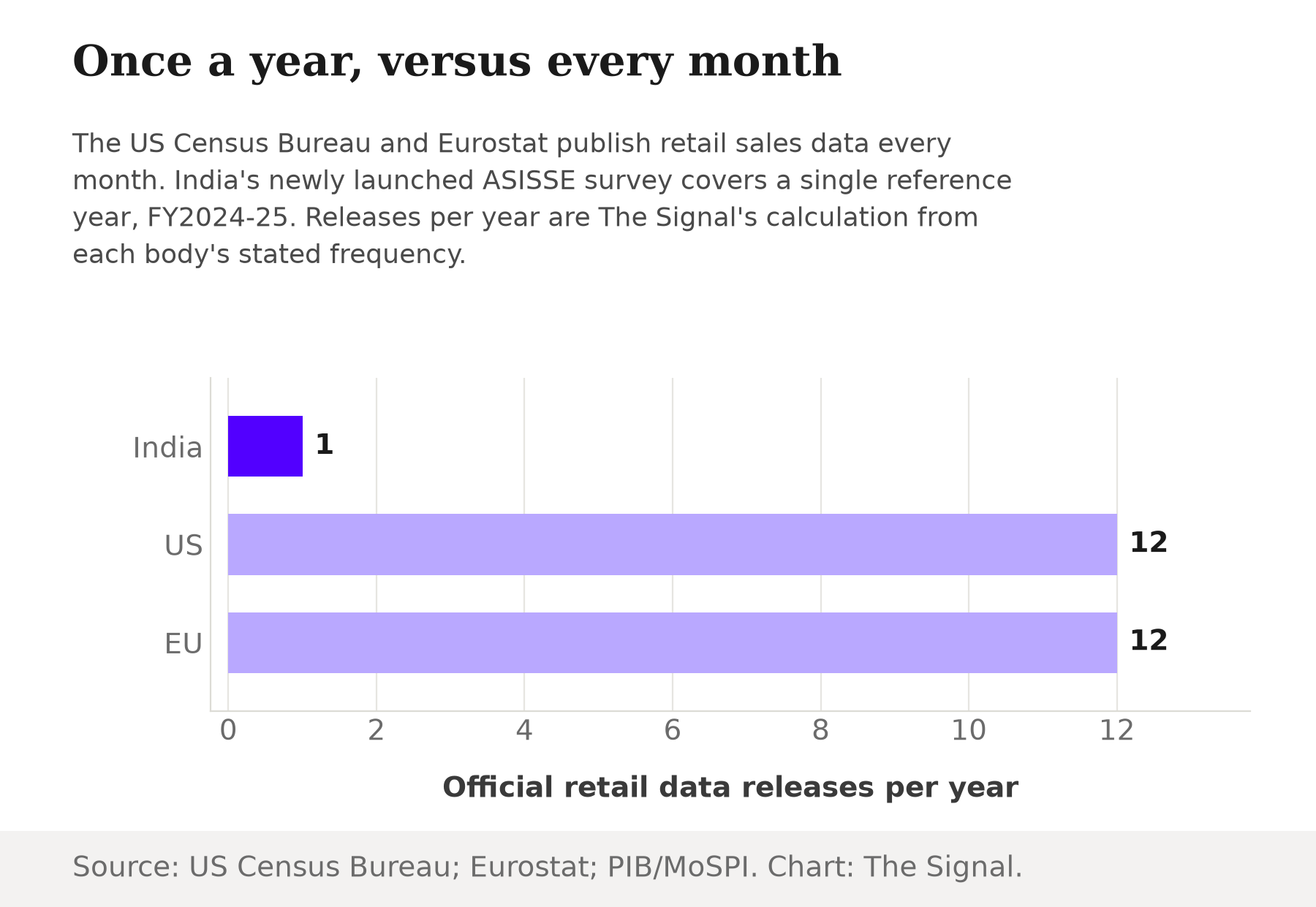
Source: PIB, ASISSE launch; US Census Bureau; Eurostat. Releases-per-year conversion is The Signal's calculation. Chart: The Signal.
What has stood in for the number until now
The absence of a direct retail read never stopped India's GDP prints, RBI rate calls, and consumption narratives from moving. It just meant the numbers moving behind them were proxies for the number nobody had. MoSPI's GDP compilation methodology lists GST data and vehicle registration and sales data from the e-Vahan portal among the administrative indicators used to estimate output and expenditure. Each is a genuine data source. None of them was built to measure retail sales.
The clearest example is tax revenue standing in for a sales number. India's gross GST revenue collected in October 2025 was Rs 1,95,936 crore, a 4.6 percent year-on-year rise the government read as a sign of sustained consumer demand during the festive season. That is a real, timely, monthly figure, and it is the closest thing to a live nationwide read India has. But it moves with tax revenue, not units sold, and it says nothing about which categories or which formats, big retail chains or the corner shop, are driving it.
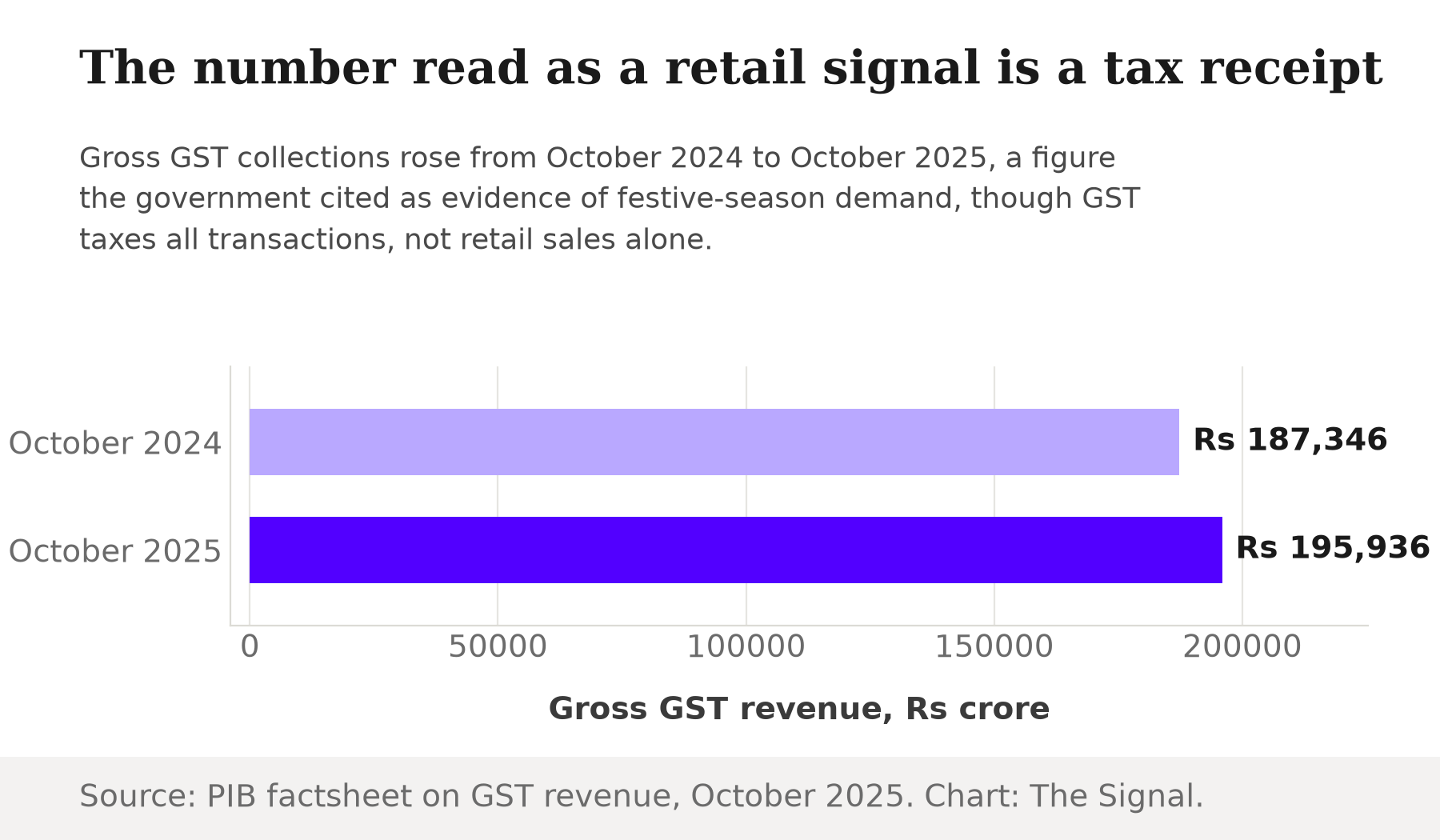
Source: PIB factsheet, GST revenue, October 2025. Chart: The Signal.
On the household side, the Household Consumption Expenditure Survey (HCES) 2023-24 measures spending directly from sampled households rather than from retailers, putting average Monthly Per Capita Consumption Expenditure at Rs 4,122 in rural India and Rs 6,996 in urban India. It is India's principal consumption benchmark and the newest round available. But it asks households what they bought, for one reference year, not what retailers sold, every month.
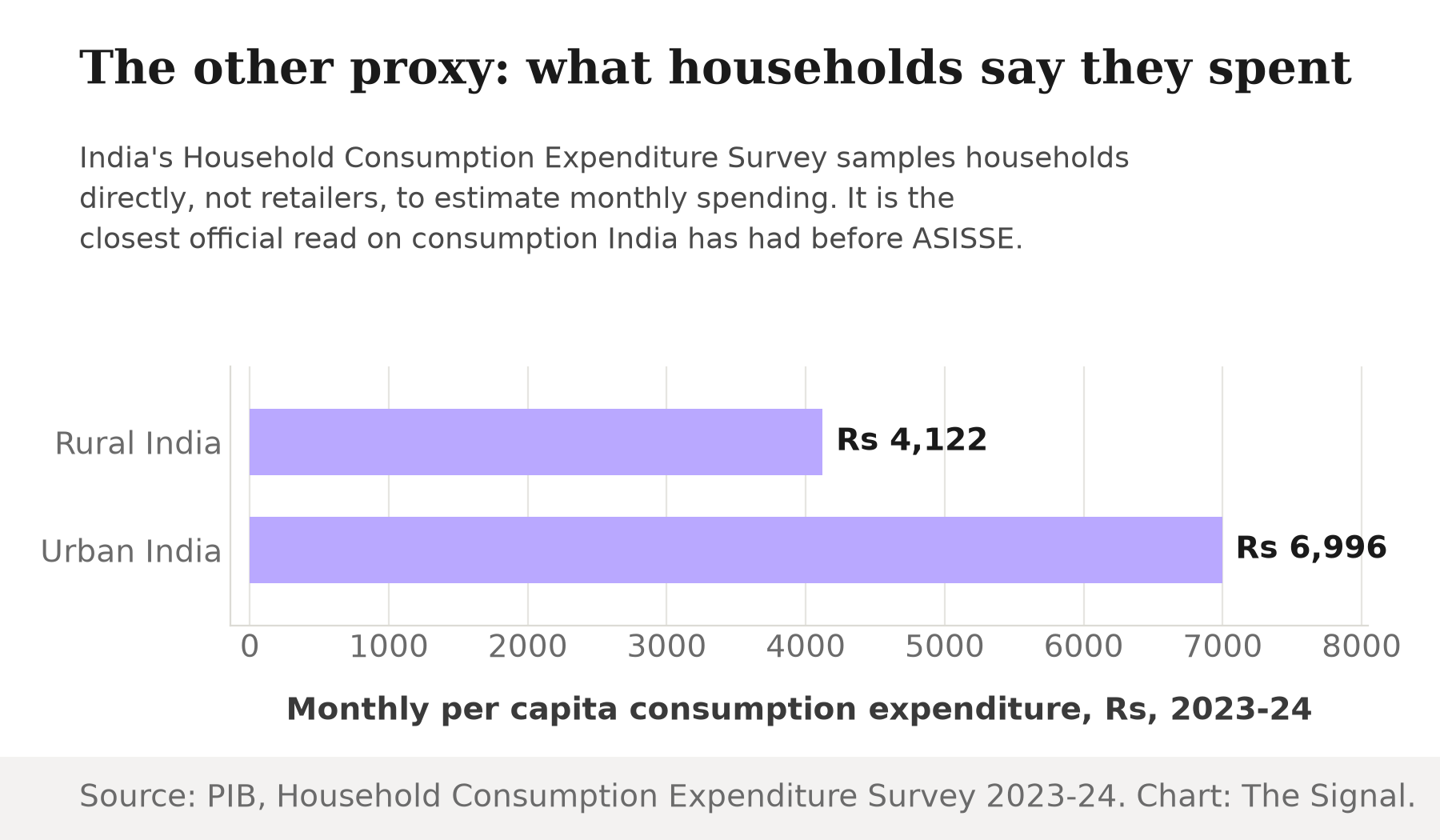
Source: PIB, Household Consumption Expenditure Survey 2023-24. Chart: The Signal.
Four proxies fill the gap ASISSE was built to close, and none of them is a retail sales number.
| Proxy | What it actually measures | Why it is not retail sales |
|---|---|---|
| GST collections | Total tax revenue nationwide, Rs 1,95,936 crore in October 2025 | Tracks tax paid on all transactions, not units or rupees of retail sold |
| e-Vahan vehicle registrations | Vehicle registrations and sales by category, used as one administrative indicator in GDP compilation | Covers a single category, motor vehicles, not shops or retail broadly |
| Household Consumption Expenditure Survey | Household-reported spending, Rs 4,122 rural and Rs 6,996 urban a month in 2023-24 | Asks households what they spent, not retailers what they sold, and runs on a multi-year cycle |
| RBI Urban Consumer Confidence Survey | Qualitative sentiment on spending and income across 19 cities | Carries no rupee or volume figure, sentiment only |
Source: PIB, GST revenue; MoSPI GDP methodology note; PIB, HCES 2023-24; RBI, Urban Consumer Confidence Survey.
The RBI's own instrument makes the last gap explicit. The RBI's Urban Consumer Confidence Survey, whose July 2026 round it launched on 9 July 2026, gathers only qualitative sentiment on spending and income across 19 cities, not a measured volume of retail sales. It tells the central bank whether households feel better or worse about spending. It does not say by how much, or on what.
The bundle survives the fix
Even once ASISSE data starts flowing, it will not necessarily stand alone in the number that matters most. MoSPI's national accounts still group retail and wholesale trade together with hotels, transport and communication into one bundled "Tertiary Sector", rather than reporting retail activity on its own. A retail figure can exist in a survey and still be invisible in the headline GDP release, folded into a category built for a different purpose. The methodology note that lists GST and e-Vahan data as inputs is the same note that keeps trade bundled: the ingredients changed before the recipe did.
That bundle is not a rounding error. The "Trade, Hotels, Transport, Communication & Services related to Broadcasting, Storage" category, the group ASISSE's retail data feeds into, accounted for 14% of India's entire nominal Gross Value Added in FY2025-26, ₹44.92 lakh crore out of a ₹314.87 lakh crore total. Retail sits somewhere inside that 14 percentage points, next to hotels, transport and telecoms, with no line splitting out how much is trade alone.
The honest objection
The strongest case for patience is that no country's retail survey arrived finished. The US Census Bureau itself only removed nonemployer businesses from its retail estimates in April 2025, 74 years after the survey began in 1951, redrawing its own definition as the economy changed under it. A first-year census sampling 1.21 lakh incorporated firms from the GSTN database is real statistical infrastructure, not a finished product, and turning it into a monthly sales read is exactly the kind of multi-year process the US itself went through.
That case is real. It explains why ASISSE started where it did, with a count of firms rather than a count of rupees. And the government's own paper trail suggests this was never meant as a one-off: a MoSPI press release on the pilot study, issued a full year before ASISSE actually launched, said the pilot gave "a strong foundation for launching the full-scale annual survey", design language for a recurring exercise, even though MoSPI has not yet announced a date for a second round. It does not change what fills the gap in the meantime. Every GDP print and RBI rate decision made through the rest of 2026 will still run on GST receipts, vehicle registrations, a household survey last fielded for 2023-24, and a sentiment poll that never mentions a rupee, not on the incorporated-enterprise census that only began three months ago.
The Signal
Treat 2026 as the year India started building the plumbing for a retail number, not the year it got one. ASISSE will eventually generate a database that a genuine sales index could be built on top of, the way the US Census Bureau's decades of monthly reporting rest on infrastructure built long before any single release. That is a multi-year project, not a press release. Until it matures, every rate call, GDP print and consumption headline in India runs on the same stand-ins it always has: a tax number, a vehicle count, a household survey years old, and a sentiment poll with no rupee attached. Watch what ASISSE's first data release actually contains, not just its sample size. If it comes out as enterprise counts with no sales values attached, the gap it was built to close is still open.
Reporting basis: the ASISSE launch and its methodology, the GDP compilation methodology, and the GST revenue figure are each from separate PIB press releases citing MoSPI's National Statistics Office and the Ministry of Finance/GST Network. The trade sector's share of gross value added is from that same MoSPI provisional GDP release, accessed directly rather than via PIB. The RBI survey launch is from an RBI press release. The household expenditure figures are from a MoSPI press release on the HCES 2023-24 round. The US retail survey's history and its 2025 methodology change are from the US Census Bureau, as are the May 2026 US retail sales figures; the EU figures are from Eurostat. The chart comparing releases per year converts each body's stated reporting frequency (monthly or annual) into a per-year count; that conversion is The Signal's calculation.