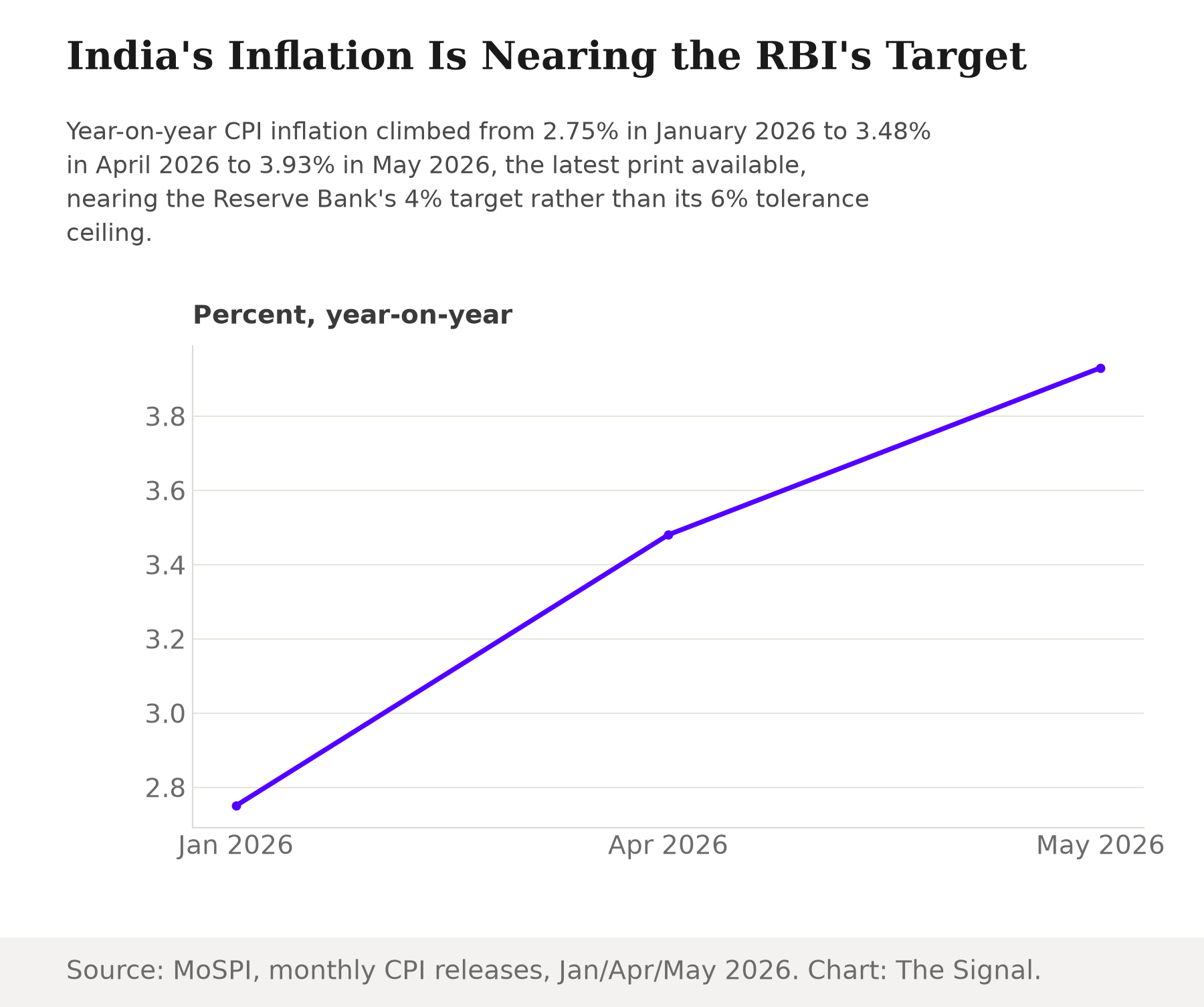
India's May 2026 inflation numbers landed, at first glance, inside the Reserve Bank of India's comfort zone. Headline consumer price inflation came in at 3.93% year-on-year in May 2026, safely under the 6% upper limit of the RBI's tolerance band. Days earlier, the Monetary Policy Committee held the repo rate steady at 5.25% and kept a neutral stance at its June 3 to 5, 2026 meeting, signalling no urgency to move. Read against the ceiling, inflation looks tame and the central bank looks unbothered.
Food prices, not the headline ceiling, are the number worth watching.
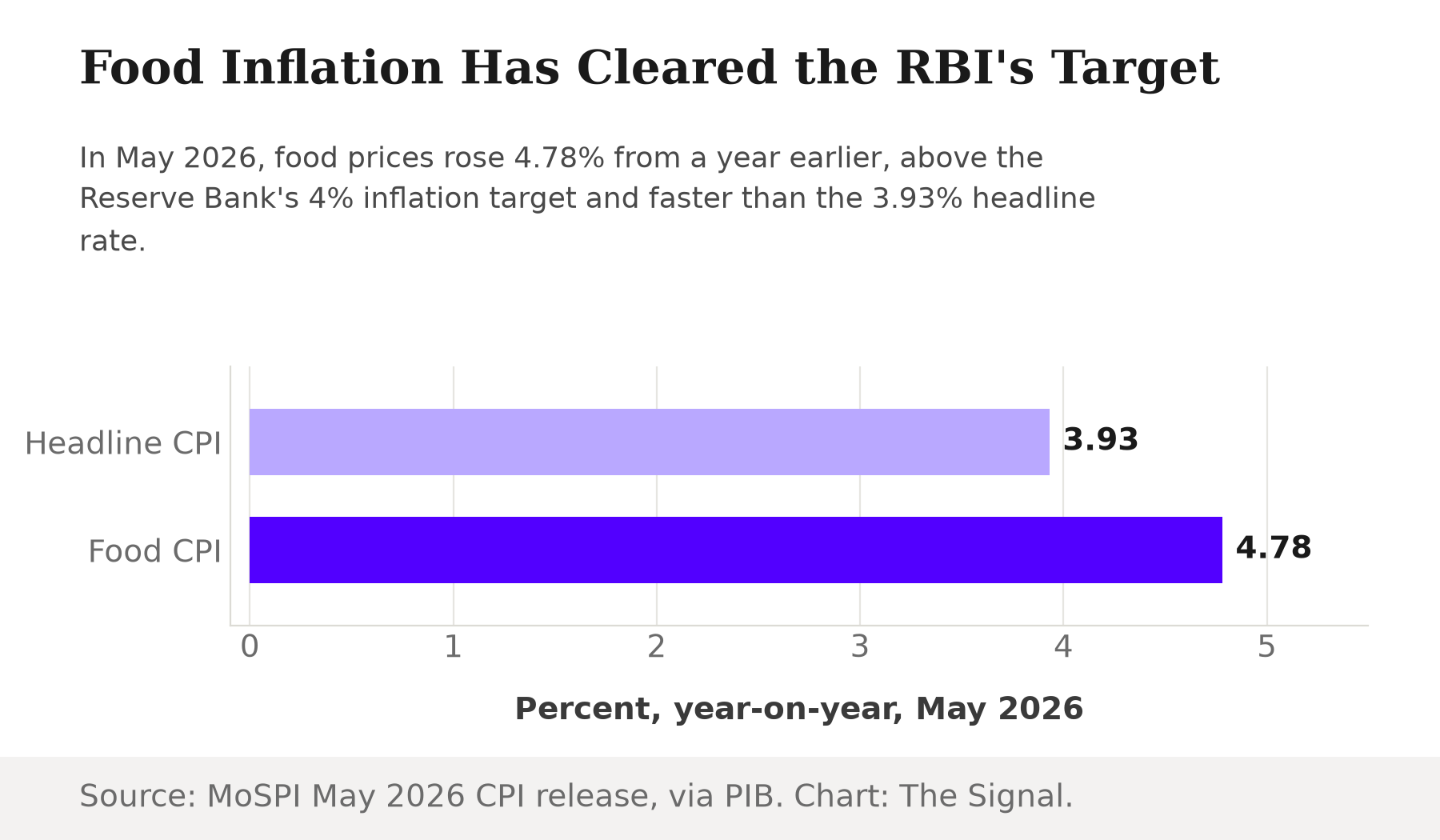
It is worth slowing down on that framing. The RBI's actual target is 4% CPI inflation, not the 6% figure that marks the top of its band. Measured against that target, headline inflation has climbed all year, from 2.75% in January 2026 to 3.48% in April 2026 to 3.93% in May 2026. That line has already been crossed: food prices, measured by the Consumer Food Price Index, rose 4.78% in the year to May 2026, above the RBI's target and well ahead of the headline rate.
The forecast that is already being tested
The RBI does not need an outside critic to flag this risk. In its own April 2026 policy, the Monetary Policy Committee projected CPI inflation for fiscal year 2026-27 at 4.6%, with the April to June quarter forecast at exactly 4.0%. May falls inside that quarter, and May's actual print already sits within a hair of the RBI's own full-quarter estimate, with June still to report. If June holds anywhere near May's pace, the quarter closes at or above the number the RBI itself pencilled in, before food inflation had shown its hand.
A monsoon risk still resolving
Food is running hot for a reason still playing out in real time. The India Meteorological Department's long-range forecast, issued May 29, 2026, put the 2026 southwest monsoon at 90% of the Long Period Average, with a margin of error of plus or minus 4%, and flagged below-normal rainfall as most likely nationwide for the June to September season. That forecast predates the monsoon season itself, and the risk behind it has hardened since. NOAA's Climate Prediction Center, in an update dated July 9, 2026, puts the odds of a very strong El Nino developing by October to December 2026 at 81%, an event that would rank among the largest in the historical record going back to 1950. The below-normal monsoon IMD flagged in May is unfolding under an El Nino signal that, per NOAA's own read, just got stronger.
Not an imported price shock
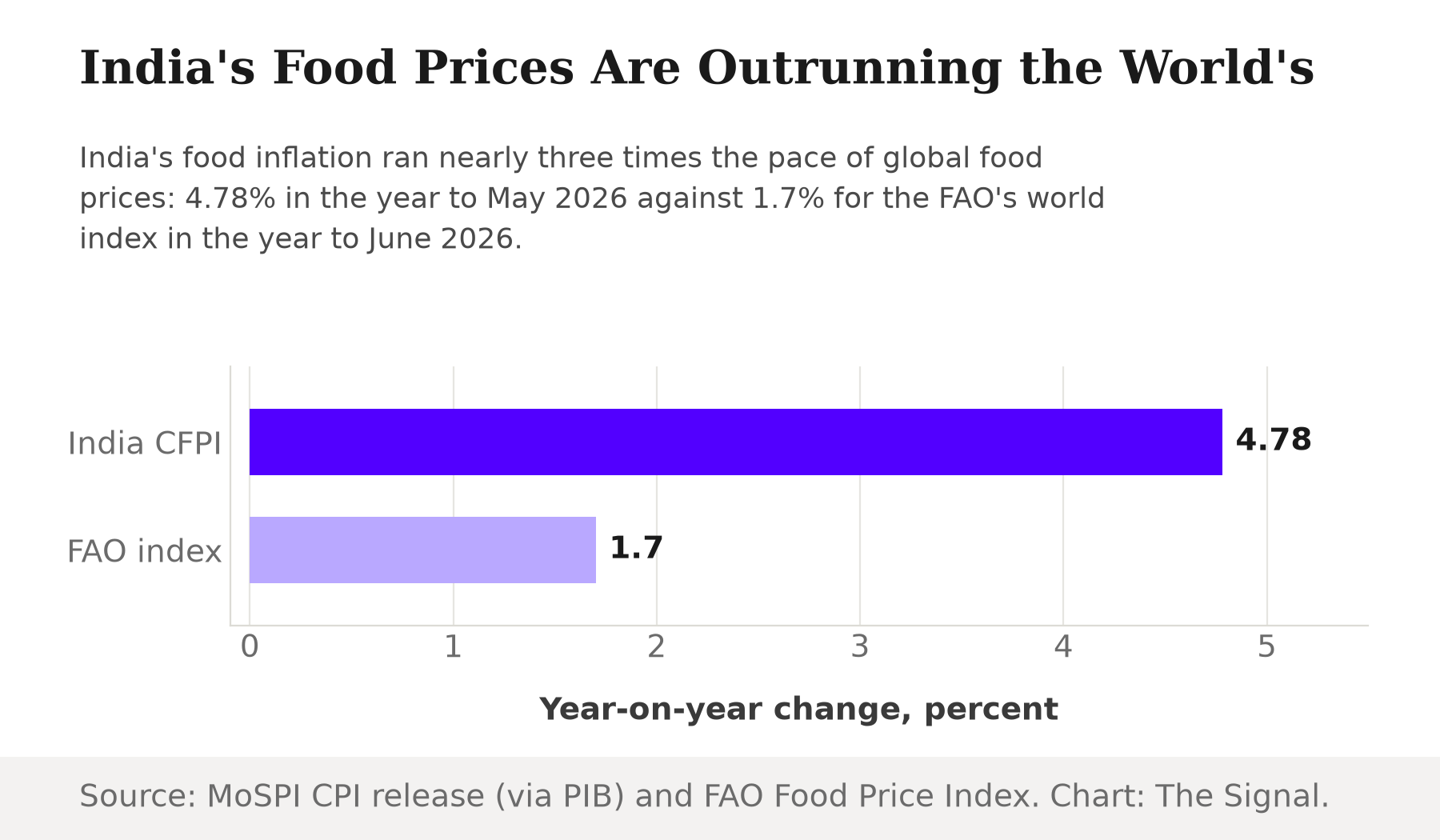
One read of hot food inflation is that it is a global story landing on India's plate. The data says otherwise. The FAO's Food Price Index averaged 130.3 points in June 2026, just 1.7% higher than a year earlier, against India's food inflation of 4.78% in the year to May 2026, nearly three times the pace. Global grain, oil and sugar markets are not what is pushing Indian food prices higher this year. Whatever is driving the gap sits inside the country.
The honest objection
The strongest case for staying calm is that none of this is a crisis yet. A 90% of Long Period Average rainfall forecast, with a margin of error of plus or minus 4%, is a modest shortfall, not a drought, and the outcome could still land close to normal. The RBI's mandate itself runs on a 2% to 6% band, renewed through March 2031, built for exactly this kind of year-to-year wobble. On this view, a central bank that just held rates and kept a neutral stance is doing precisely what a calm, credible inflation targeter should do: wait for data, not react to a forecast.
That case would be stronger if food inflation were still comfortably under target while the monsoon risk built. It is not. Food prices had already cleared the RBI's target in May, before the monsoon season's own risk could show up in a single harvest, and before NOAA's freshest read pushed the odds of a top-tier El Nino to 81%. The buffer the RBI's band is meant to provide is being spent ahead of the risk it exists to absorb, not after.
The Signal
Nothing here forces the RBI's hand today. But the numbers worth tracking from here are the RBI's own: whether the June and July CPI prints hold near its own quarterly forecast, and whether the monsoon's actual rainfall this season comes in near IMD's below-normal call once the season closes in September. If food inflation cools as the season plays out closer to normal, the neutral stance ages well and the central bank's patience is vindicated. A strengthening El Nino that pushes the monsoon toward the shortfall end of the range would leave the RBI defending a rate pause with its own buffer already spent, the room between food inflation and its target that it was counting on. A neutral stance is a bet with no position taken. The monsoon is about to place it for them.
Reporting basis: monthly headline inflation figures for January, April and May 2026 are from the National Statistics Office's CPI press releases; the May food inflation figure is from the same underlying release, via the Press Information Bureau. The Reserve Bank of India's June 2026 policy decision, its inflation target and tolerance band, and its April 2026 inflation forecast are all from Reserve Bank of India Monetary Policy Committee press releases and the RBI's own statement of its mandate. The monsoon outlook is from the India Meteorological Department's long-range forecast, issued via the Press Information Bureau, and the El Nino probability is from NOAA's Climate Prediction Center's ENSO Diagnostic Discussion. The global food price comparison is from the FAO's Food Price Index. The comparison between May's CPI print and the RBI's own quarterly forecast, and the multiple by which India's food inflation exceeds the FAO's global index, are The Signal's calculations from those figures.